



Remnants of the past can be subtle or intrusive, welcome touches that add an unexpected complement to a contemporary design scheme or annoying defects that send one’s up-to-date intentions off the rails. They can offer time-revealing testimony or hover beyond comprehension, uncertain specters from another era. For some homeowners, they are to be exorcised, while others live with them, happily.
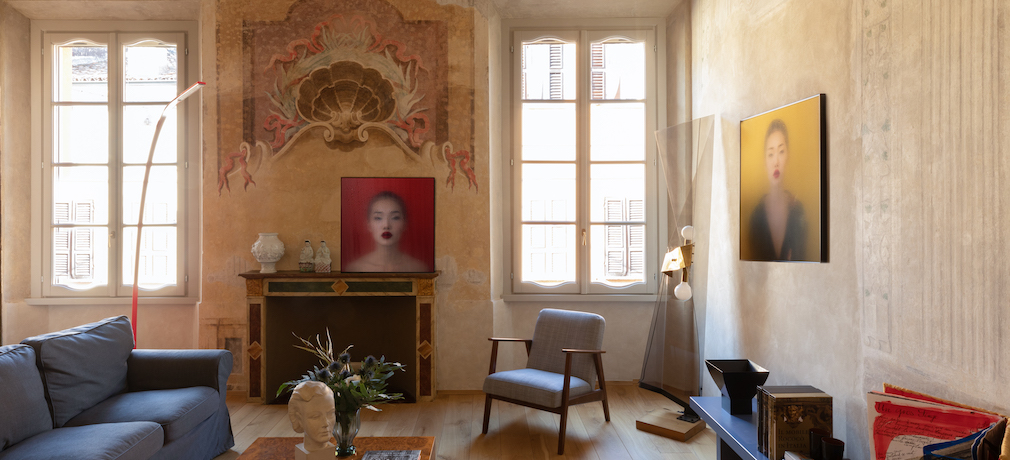
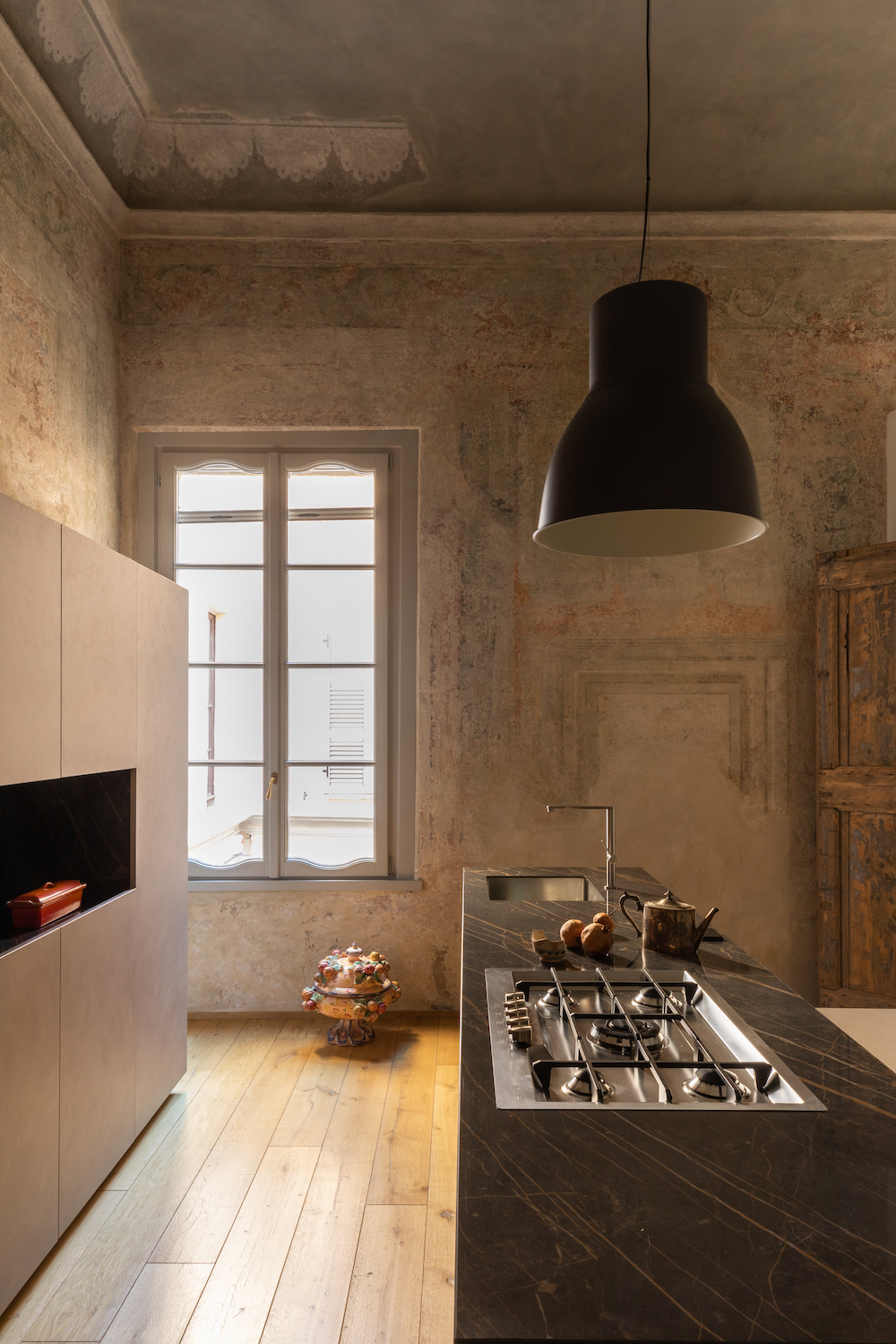
When Francesca and Luigi Piatti acquired this grand apartment in Mantua, steps from the Roman Forum and the Campidoglio, they sensed there was more to it than met the eye. The interiors were all covered in white plaster, but as the residence was situated in an aristocratic, 17th-century building, they suspected there might be something of interest beneath the surface. They honored that intuition and engaged a team of restoration experts to investigate. Slowly removing layers of plaster, the crew discovered frescoes dating to the 17th, 18th and 19th centuries. A cartouche came to light above a fireplace. A bathroom ceiling revealed an image depicting the Greek myth of Phaethon. A previous owner’s coat of arms emerged on the walls of one room, like the repeating pattern of a wallpaper.
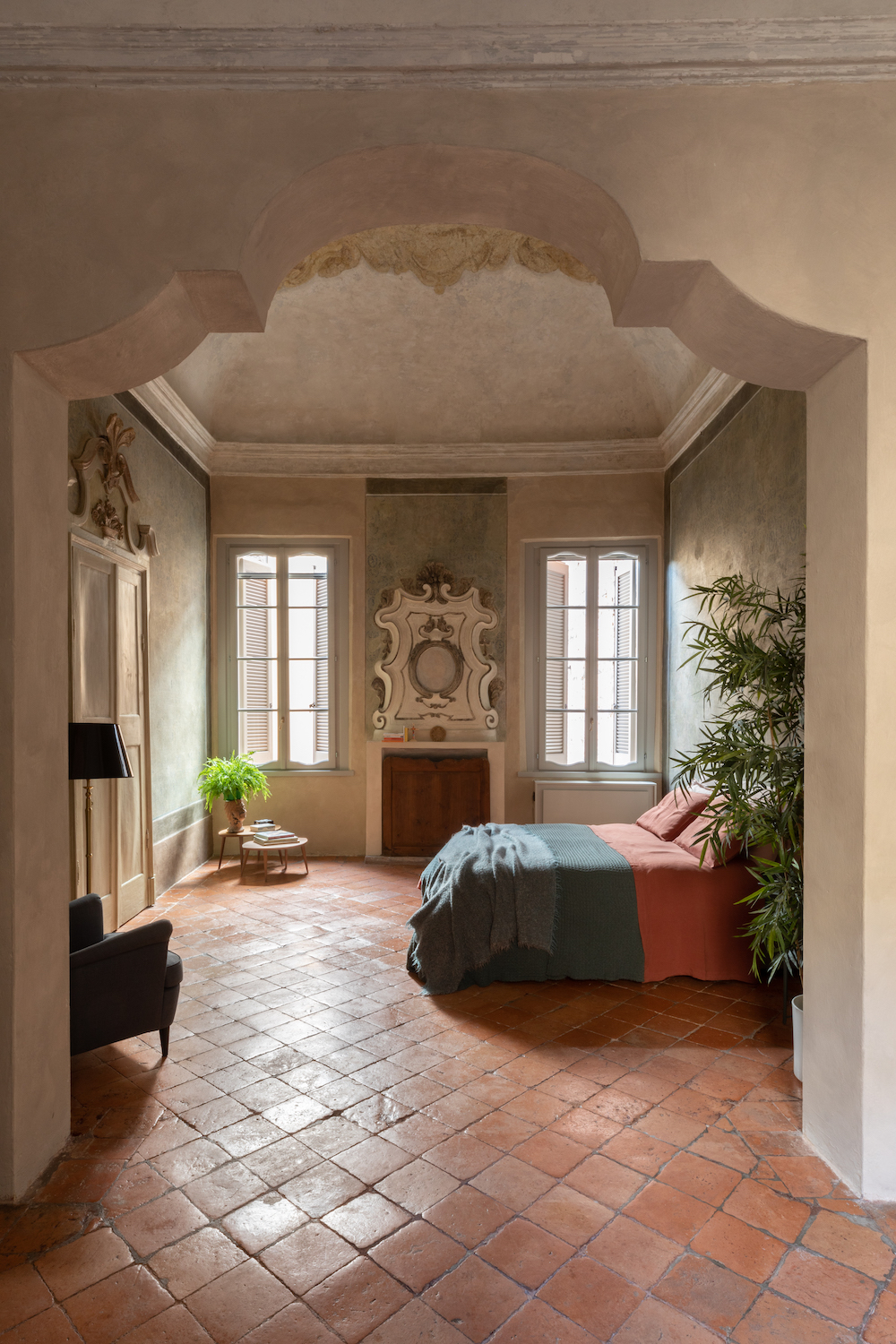
Incomplete in places, barely emergent in others, the paintwork lends an archeological air to these spaces. Almost diaphanous, the muted hues form an atmospheric envelope that partners perfectly with the couple’s taste for a select gathering of furniture and objets d’art arranged with minimalist restraint. In the living room, a Yumi lamp by Shigeru Ban arcs over a plump custom sofa. In a bedroom, a humble Ikea side table supports Andreas Engesvik’s Blom lamp. “We have a passion for contemporary lamps, in particular those by Flos and FontanaArte,” says Luigi. “We believe that they go well with the details of an ancient house. Furthermore, the right light is everything when creating the atmosphere of a room.”
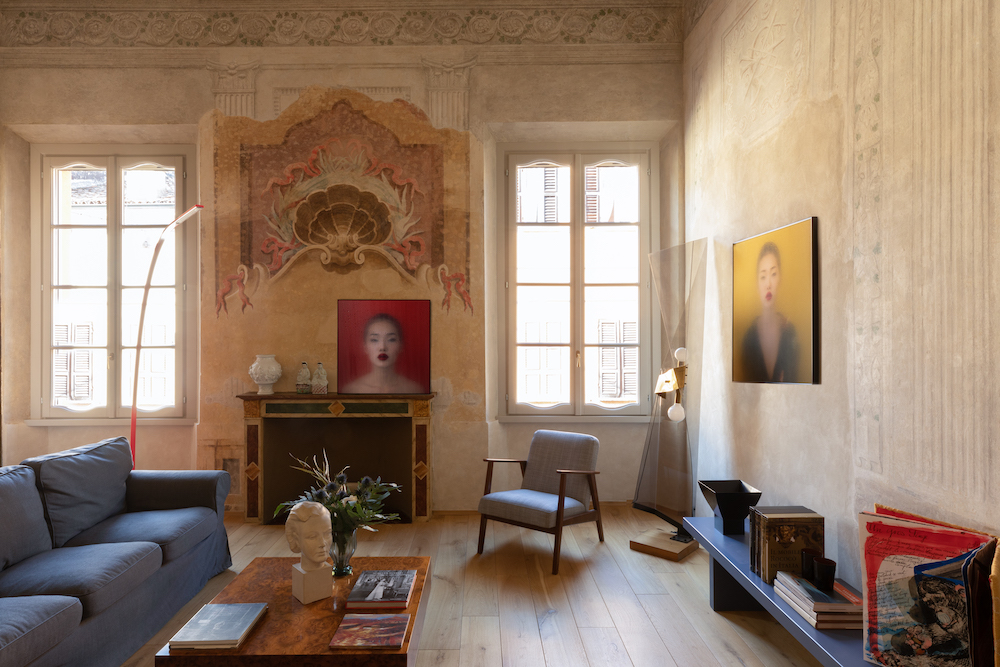

Art and treasures from their travels play a big yet understated role in the home’s decorative appeal. A large-format portrait by Mantuan photographer Giuseppe Gradella and 19th-century Chinese votive figures share space atop a mantelpiece. Tibetan fabrics, Burmese lacquer vessels, Aztec statuettes and Roman antiquities all have a home here. Although clearly no haphazard affair, the décor – defined as much by empty space as by tableau-like constellations – strikes an especially authentic note. As artful as it appears, this is clearly a home. “We believe a house should not follow a style, but rather be furnished and decorated following the inspiration of the moment,” shares Luigi. “It’s like when you prepare a pasta dish in Italy: Each time, the recipe changes depending on the inspiration of the moment, the imagination and the mood of the cook. It is not necessary to follow a recipe, and sometimes, the riskiest combinations create an unexpected novelty.”
Photography by Monica Spezia.
Production and styling by Laura Taccari.
For more like this Mantua apartment, be sure to check out these designers at the forefront of the 19th-century Italian apartment revival.
Like what you see? Get it first with a subscription to aspire design and home magazine.