
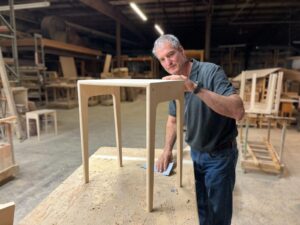
 Tom Belletete, a third-generation woodworker, is the CEO of Heywood-Wakefield, founded in 1826 and restarted in 1992. Tom has been head of production since 2012 and co-owner of Heywood-Wakefield since 2022. He runs Heywood-Wakefield out of his Winchendon, Massachusetts, factory, which his father and uncle built to start their furniture business in 1958. Tom began learning how to build furniture as a child, helping his father on nights and weekends. He studied Electrical Engineering at Rensselaer Polytechnic Institute, moved to Germany to design infrared detection systems for the aeronautical industry, then returned home to work with his father. Heywood-Wakefield has built many different products in many styles over its 200 year history (including wicker furniture, baby carriages and seats for opera houses and trolley cars), but today Tom makes the classic American modern furniture from the company’s 1940’s and 50’s catalog and designs new pieces in the same midcentury modern streamlined aesthetic. Tom’s approach to design is holistic; his work is informed by the constraints of his material, how it will be assembled and shipped, the work of past Heywood-Wakefield designers and the requirement that it stands up to decades of use. Learn more about Tom and his woodworking in today’s Maker Monday.
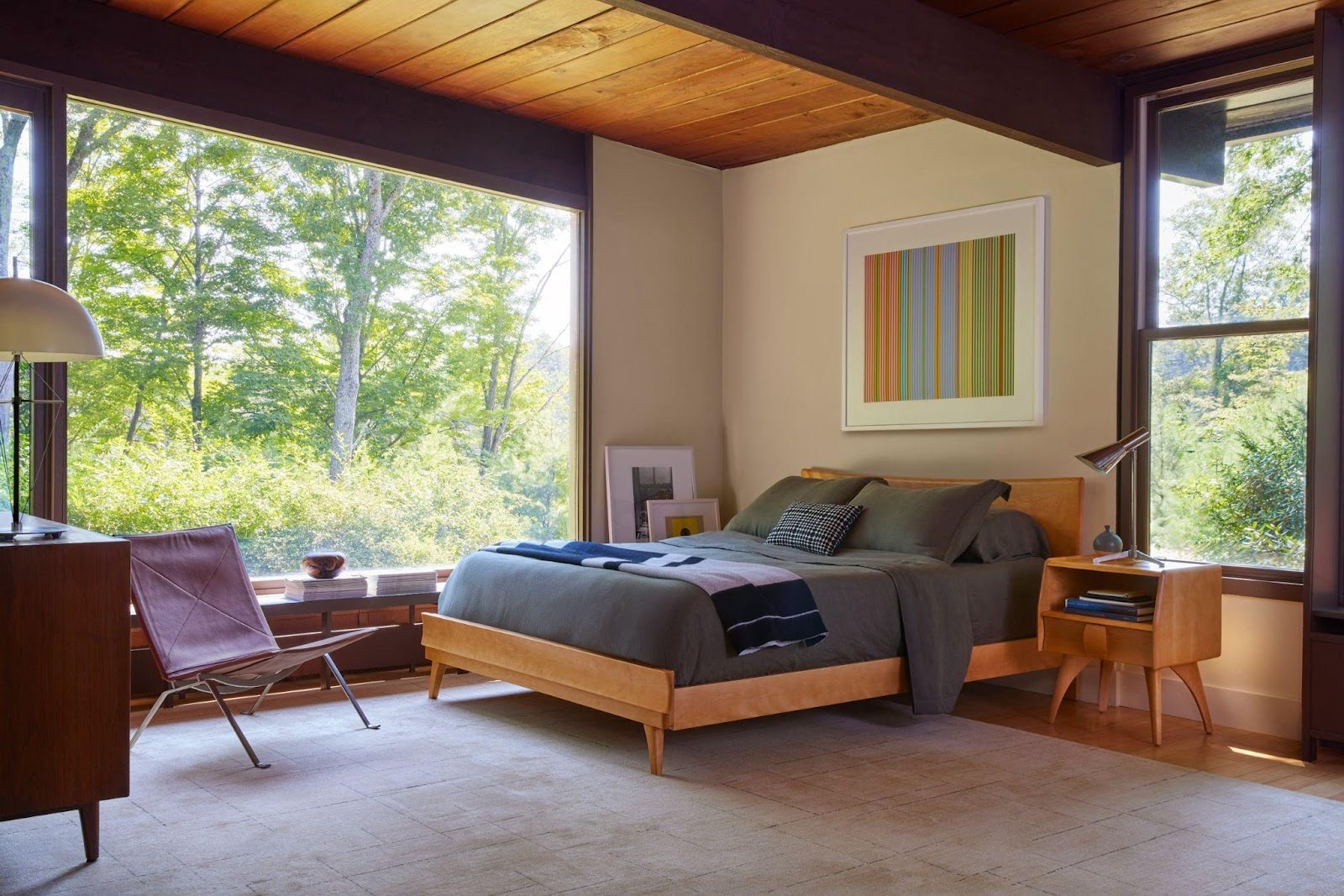
With its subtle inward curve, the M140E Kohinoor Elite Bed headboard creates a natural sense of comfort and welcome.
Andrew Joseph: What inspired you to become a designer?
Tom Belletete: Necessity. In a small family business, you wear many hats. Sometimes you wear hats that nobody else wants to wear, and that inspires creativity. I started designing in the mid-90’s, when I joined my father and uncle’s furniture business, Bellecraft. They were mostly subcontractors to other wholesale companies, but I made the decision to develop more of our own pieces and sell directly to retailers. Because of my engineering background, I’ve always been fascinated by how things go together. Designing furniture allows me to explore and apply that interest. It has been essential over the past 13 years while re-engineering the old and designing all of the new Heywood-Wakefield products available today. The bonus: it’s fun.
AJ: Can you describe your design philosophy in three words?
TB: Aesthetics, functionality, manufacturability. It’s a balancing act. I can create a great looking design with Heywood-Wakefield DNA that fulfills a customer need, but if I can’t manufacture it efficiently, it won’t work. Sometimes things that look simple can be very difficult to assemble, sand and finish. My upbringing has definitely influenced my design philosophy. From a young age, I worked closely with my dad in our factory and learned firsthand all the steps needed to build a piece of furniture. I use that knowledge when I create a new design, so that it can be produced at scale. I’m not just designing the piece, but also building it, shipping it and running a business around it. The midcentury period of Heywood-Wakefield exemplifies the same design philosophy, so it is a good fit.
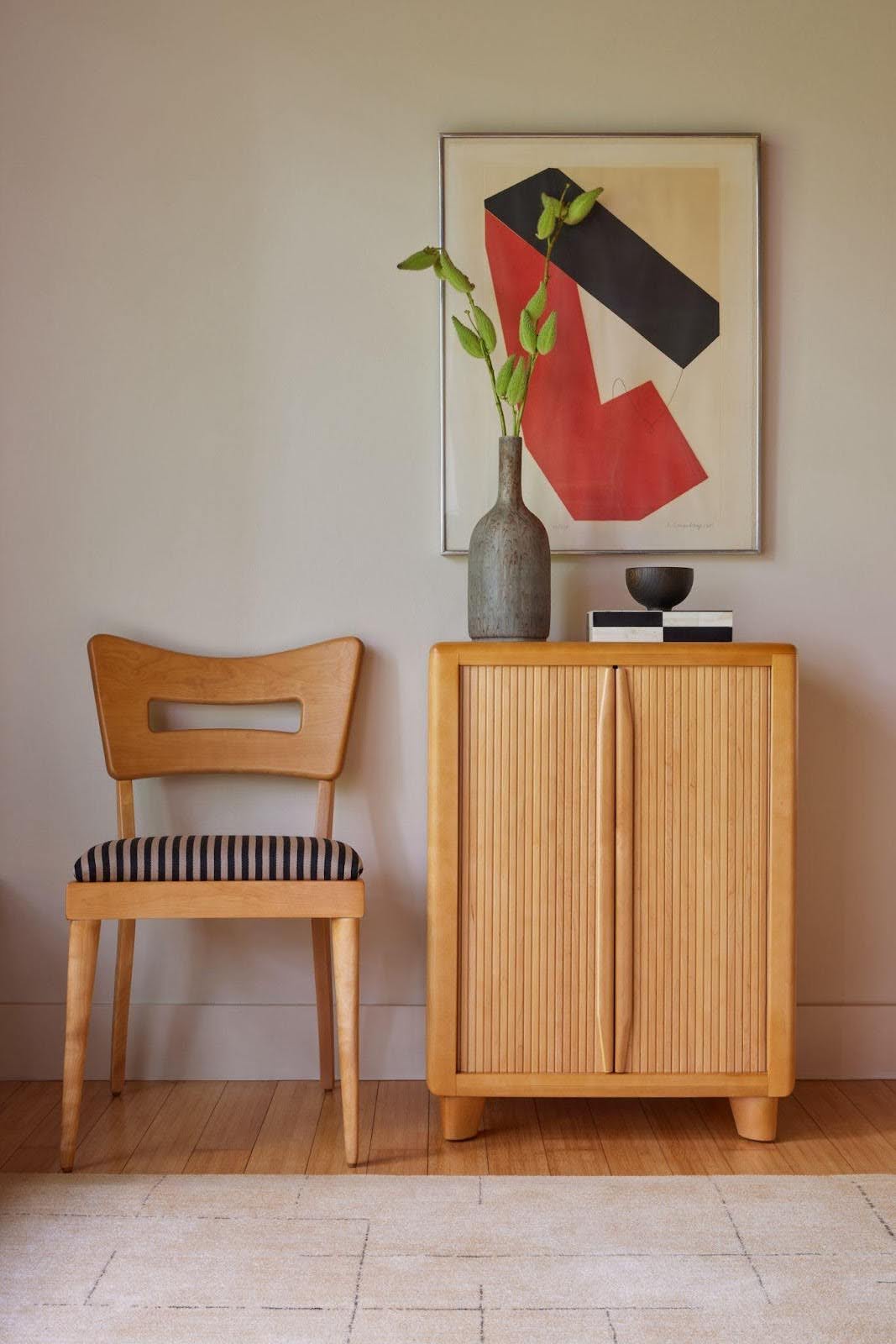
The M 154 A Dining Chair and M 179 Tambour Utility Case balance sculpted lines and practical storage.
AJ: What is your favorite design tool?
TB: The glass door in my shower. I’d like to say that I use a high-tech program in my studio loft, but to be totally honest, I start most of my designs by drawing them on the fogged-up shower glass. If it doesn’t look right, I just wipe it off and start again.
AJ: What is your favorite aspect of your job?
TB: Walking into my factory and knowing that what I do there is a continuation of my family’s legacy of New England furniture manufacturing, as well as my contribution to preserving and growing the Heywood-Wakefield brand and aesthetic. 2026 will be the 200th year since Heywood-Wakefield was founded, just 10 miles away from my factory. As a bonus, I love that I get to work with my family. My son Joe has been working with me since 2012, and my wife Deb started working with me full time in 2022. Even my 89-year-old mother, Rita, helps out from time to time.
AJ: What’s your favorite cocktail?
TB: A Jaeger Old Fashioned. Some excellent Rye, Jaegermeister, simple syrup, bitters and an orange twist. Delicious!
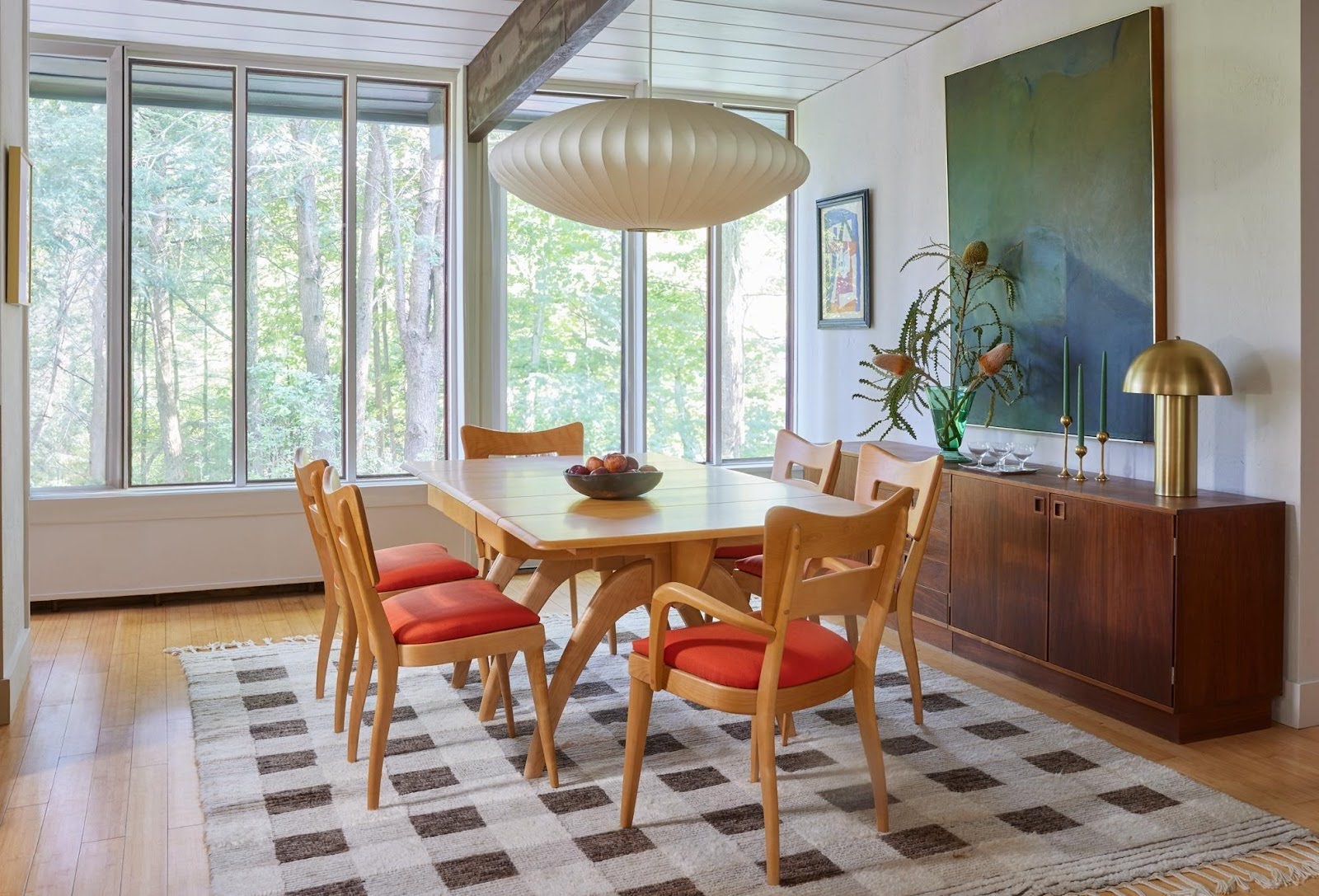
Flexible forms in the M 154 A and C Dining Chairs and M 197 G Butterfly Drop-leaf Dining Table soften the room and invite movement.
AJ: How do you incorporate sustainability into your designs?
TB: We do this in several ways. The most important one is that Heywood-Wakefield builds furniture that lasts for generations. It’s not “fast furniture” that falls apart after a few years. Customers often tell us that they still use the Heywood-Wakefield pieces their parents bought in the 50s, and I’ve improved some of the manufacturing details to make the new ones even sturdier. The other ways are in our material and processes. The wood we use, Northern Yellow Birch, is a non-threatened species and we get it from sustainably-managed forests in New England. I buy the best grade of lumber available, which reduces the waste, time and energy of cutting out the knots and other unusable parts of the boards. We manufacture all of our wooden small parts in-house using off-cuts, so very little of our lumber goes to waste. Finally, any unusable scraps are offered to the community as free kindling and we donate our sawdust to local farms for their livestock.
AJ: What’s the weirdest thing a client has ever asked you?
TB: To design a Heywood-Wakefield-style bed for their dog. It looked awesome.
AJ: What is your favorite thing about being a designer?
TB: Collaboration. I may come up with the seeds of a good design, but as part of the process, I like to get opinions and insight from my wife, who is an artist. Once we move on to prototyping, I work closely with my son, who does all the CNC programming. With their input, the final design is always better than the initial concept. It’s tremendously satisfying when we bring a project to life.
Photography by Alexandra Rowley.
Like what you see? Get it first with a subscription to aspire design and home magazine.