
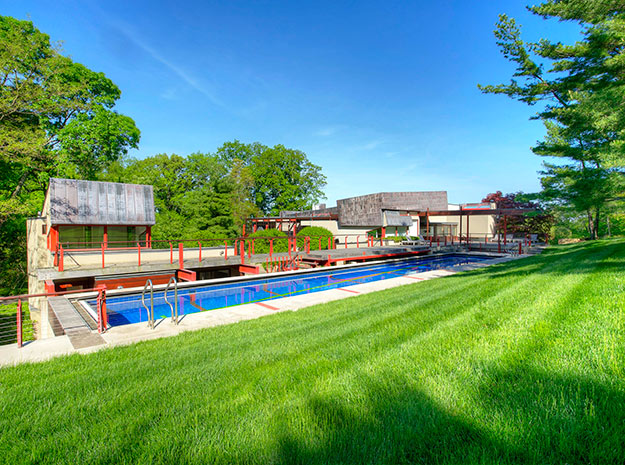
“Can we design a house that feels traditional but looks
contemporary?”
Such was the query posed to California-based RoTo Architects in 1989 by David Teiger, who was looking to build a “country house with a difference” in Bernardsville, NJ.
Teiger, now deceased, was a successful management consultant, which allowed him to pursue his passion for developing a collection of modern, American folk and contemporary artworks – much of which he wanted to display in his new country house. These artworks may have heavily inspired his vision for his home, especially in the choice of materials.
RoTo Architects’ principal, Michael Rotondi, and the executive architects of Brandes Maselli Architects worked with Teiger through a seven-year design and build process. Their goal was to let the landscape inform the home’s structure by considering how the views and light could move through the house unobstructed.
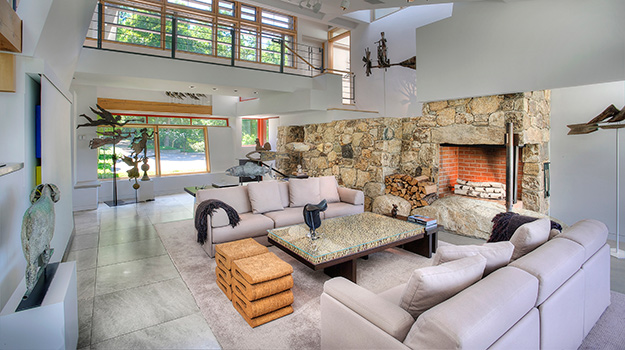
While Teiger wanted flowing, contiguous rooms without walls, he still wished for clear distinctions between separately purposed spaces. Thus, the design became for the main living space to occupy the intersection between the two wings meeting in an L-shape. Furthermore, they decided to identify the separate spaces by incorporating ceilings that would shape the space of the room. The lack of interior walls makes it feel as if one is always outside. This same design is repeated in the master bathroom, where the limestone shower also lacks walls.
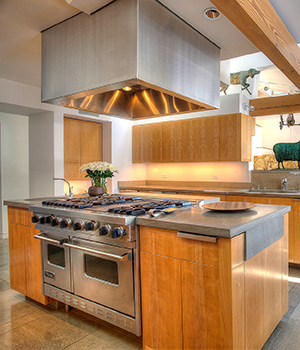 A year after the project was completed (although a house of an art collector is never truly finished), Rotondi described the home as such in “Southern California Institute of Architecture” in April 1997: “The Teiger Residence project began as an experiment to see if it could be designed without a primary section or elevation, and explored the concept that a building can enhance the experience and understanding of a site.”
The relationship of the home to the site is clear. Perched atop a grassy knoll and nestled into the apex of the slope, the home has views of fields and forests that extend for 30 miles. There is also easy access from the main living areas to the outdoor spaces, which include a patio, porch, garden, pool and decks.
The bright, white walls of the house are enhanced by the natural elements brought inside – some directly from the property itself. For instance, local fieldstone was incorporated into the central hearth and exterior retaining walls, while fractured bedrock harvested onsite was used for the entry steps and the lower exterior facade. Elsewhere, the floors are made from Indiana Yukon Silver Limestone or light beech wood. The double sinks in the master bathroom were also carved from solid limestone, and the Douglas fir beams were exposed as much as possible.
The abundance of natural light pouring in through the windows proved to be ideal for displaying Teiger’s vast art collection. Even during the design and build process, certain rooms were repurposed to display more art, especially Teiger’s collection of weathervanes and American folk art sculptures.
While the fate of most of Teiger’s art is unknown, one can hope that the striking sculpture featured on the rear lawn may remain a permanent installation. The cast aluminum gnarled tree, which stands out with a brilliant coat of white enamel, is the work of mixed media artist Ugo Rondinone and was completed in 2009. His works range from mysterious to monolithic, from psychedelic to whimsical, blurring the boundary between fiction and reality through a contemporary conceptualism. By casting this piece in aluminum, he permanently freezes this particular semblance of a tree at a single moment, both emphasizing and negating its perishability, and so it is aptly titled “A Day Like This, Made of Nothing and Nothing Else.”
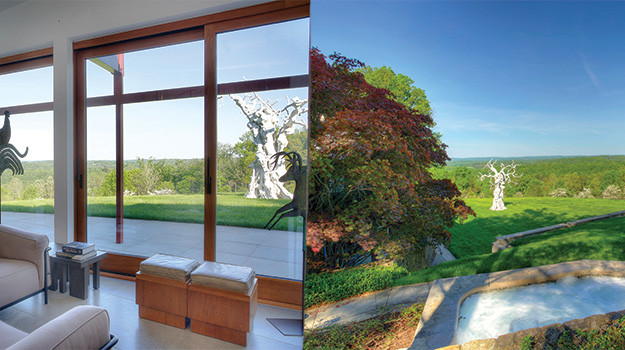
The artist(work may be seen in the photo above), Ugo Rondinone, has also been featured in Architectural Digest for a recent collaboration with the Nevada Museum of Art.
For more information about this home on the market, visit the official listing.
Like what you see? Get it first with a subscription to ASPIRE Metro Magazine
Photography by David Gruol