
California-based interior designer and architect, Gustave Carlson has had a long and fruitful career. After starting out as an architect, Carlson set up his design firm Gustave Carlson Design in Berkeley, California in 1999. Since then, he has designed for home renovations, as well as new construction projects for more than 50 private homes. A member of the American Institute of Architects, The National Trust of Historic Preservation, and Build It Green as well as a Certified Green Building Professional, Carlson’s work is sophisticated, clean and super modern. Find out more about Gustave Carlson in this week’s Designer Friday.

Large bright windows with dark wood frames flood this kitchen with natural light. The wooden panel ceiling and vent play against the white marble surrounding the room and are grounded in the yellow tones of the cabinetry. Photography by Paul Dyer.
Andrew Joseph: What is something you hope to see trending in design in the future?
Gustave Carlson: Ownership of one’s space—and what I mean by that is making the space utterly unique to the inhabitant that I am designing for. So many people are afraid of making a mistake in design—and what I find inspirational is when a client has a particular furniture piece or color preference or personal inspiration that I can build upon. I prefer to guide people toward their unique design—the answers are inside them—and I like to improve on their design ideas so that the outcome resonates with them. Furthermore, a well-designed place is restful.
AJ: If you weren’t a designer, you’d be a ….?
GC: I would be a painter, and I am currently painting large-scale acrylic on wood panel pieces. I like to paint agrarian architectural themes—old barns and weathered dwellings—and document them in various scales. I also weave themes of wallpaper, chairs, color and interiors into my pieces. I am fascinated by found objects at yard sales and what creative new ways something can be recycled—these personal objects always tell something of their history.
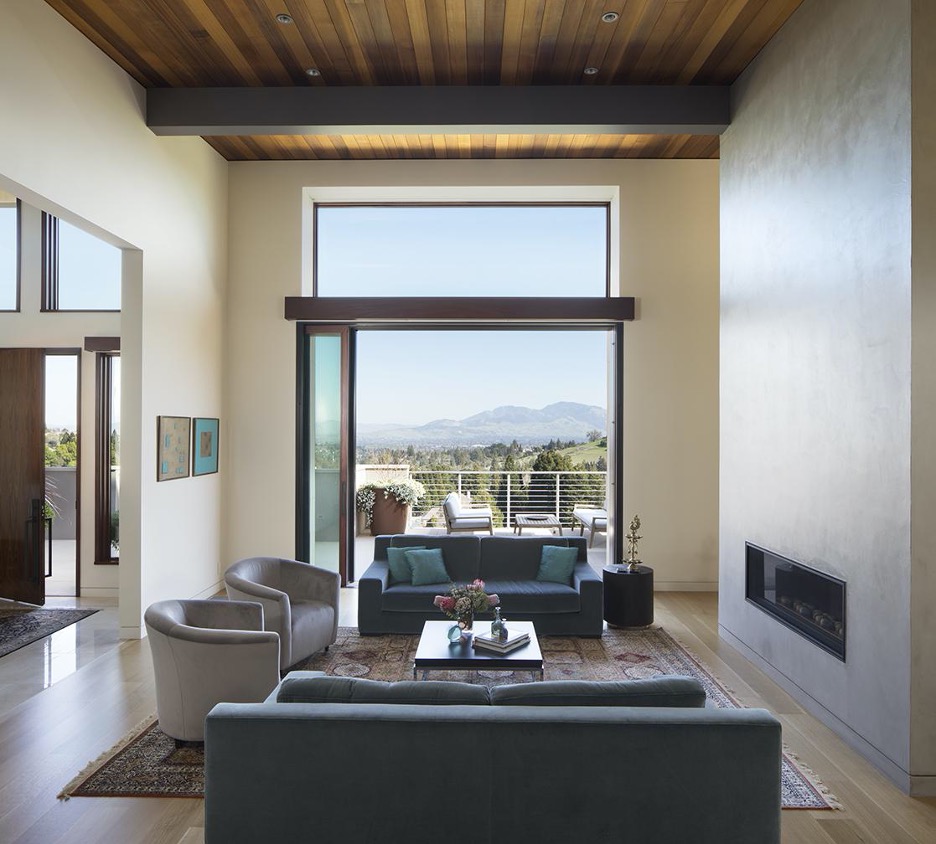
In this inviting minimalist sitting room a sleek fireplace sits within a floor-to-ceiling slab, competing for attention with the stunning mountain views.
AJ: Style (or design) icon?
GC: I have a reverence for the Bay Area Tradition, and a fascination with the Case Study houses. I appreciate Joseph Eichler and, in fact, I recently completed a remodel of one of his projects sited on a unique lot, and even in the land of Eichlers (Palo Alto, California), it is a standout.
AJ: What’s inspiring you in life (in the industry) right now?
GC: “Now is the time” is my mantra for life and work. Opening myself up to new ideas and jumping deeply into an unknown design opportunity, instead of thinking about it too much is refreshing, inspiring, and meditative for me.
AJ: How do you define beauty?
GC: Beauty is defined internally, and it starts within the self. As a designer, I see each house I design as uniquely different. I create beauty out of the meaningful ways materials can be brought together and detailed to tell a story. For example, wood can be artfully detailed in so many ways—and the beauty of each project design comes from careful listening to my clients in order to create an inspirational environment uniquely tailored to them.
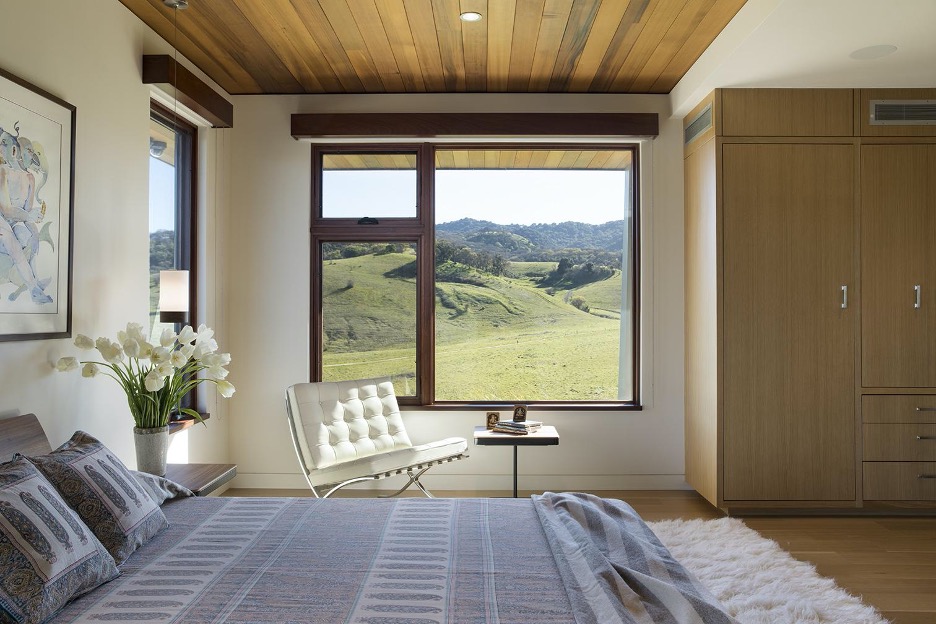
A white Knoll Barcelona Chair acts as a centerpiece for this bedroom; the perfect place to relax and watch the world go by in this countryside home.
AJ: What new skills have you taught yourself this quarantine? (baking, bread making, or a craft etc)
GC: My wife is a mixed-media artist, and she taught me, inspired me really, to go back to my roots as an artist (painter). Post-pandemic, I am embarking on another inspirational journey — a 200-hour course of yoga teacher training with Colleen Saidman Yee and Rodney Yee of Yoga Shanti.
AJ: What about your design style has shifted this quarantine?
GC: My design style has shifted to be more flexible. Certain products may not be available, or lead times can be significant. I have become more curious about different applications of products, and what possibilities exist in new ways and new forms.
AJ: Which room in the house do you find yourself working from the most? Why? How does this inform your thoughts about architecture?
GC: I am most inspired by the dining room, and my own dining room is a creative laboratory of sorts for me. I am using themes and concepts of furniture, lighting, flexibility and multiple use functionality in my own dining room, and finding ways for the open plan concept and the need for privacy when working to co-exist.
 About the Designer | Gustave Carlson, AIA, founded his namesake architecture studio in 1999 following a decade of working in New York, Los Angeles, and San Francisco. Since then, he has designed renovations, interiors, and new construction projects for more than 50 private homes, ranging in style from craftsman to contemporary. His book, Pacific Modern: Houses of Northern California (ORO Editions, 2018), explores Carlson’s conceptual practices of design across architectural vernaculars.
Like what you see? Get it first with a subscription to aspire design and home magazine.