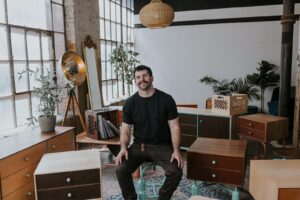
 Sam Acuff is a furniture maker & designer based in Baltimore, Maryland. Sam’s formal education was in painting; however, he pursued work in a bronze foundry after college and later started his own custom fabrication shop, Two Bolts Studios. Sam’s latest project, KOBA, explores playful modern design and other visual concepts that explore the blending of “fun” lo-fi elements with heirloom quality furniture and the tension between graphic artificial forms and more conventional natural materials. Sam’s work with KOBA can be seen in publications like Dwell, Dezeen & Wanted’s 2025 lookbook, as well as physically in the DUDD HAUS in Philadelphia. Learn more about Sam’s unique style in today’s Maker Monday.
Andrew Joseph: What was the last book you read and how did it inspire you?
Sam Acuff: “Designing Japan” by Kenya Hara. It was a great book to find while working on the first pieces for KOBA. Hara explores the importance of simplicity and gives historical context of when design in Japan shifted from complex to conscious. He stresses the importance of minimalism and simplicity in good design, that there should be something left open-ended. He calls it an “emptiness”. That emptiness leaves room for the user to fill in the blanks and leads to a more personal relationship with whatever the object is, a hairdryer, a cabinet, a car, etc. I found it fascinating, and I find myself considering that philosophy when designing now pretty frequently.
AJ: What is your favorite place to find inspiration?
SA: Concerts, particularly hardcore or punk shows. Lately, it’s where I have my best ideas. It’s not an environment I expected would be good for it, but over the last year, I’ve gotten a lot of drive from the hardcore scene, especially here in Baltimore. Starting KOBA felt very risky and was almost in defiance of making more conventional career choices. So it gets the juices flowing to watch musicians who have more or less chosen to be perpetual underdogs pour themselves into their craft solely for the love of the game. I have no interest in making a pop equivalent of furniture, so it’s also become a convenient well to draw from for reminders of what awesome work can come from experimentation & not always worrying about “who this is for”.
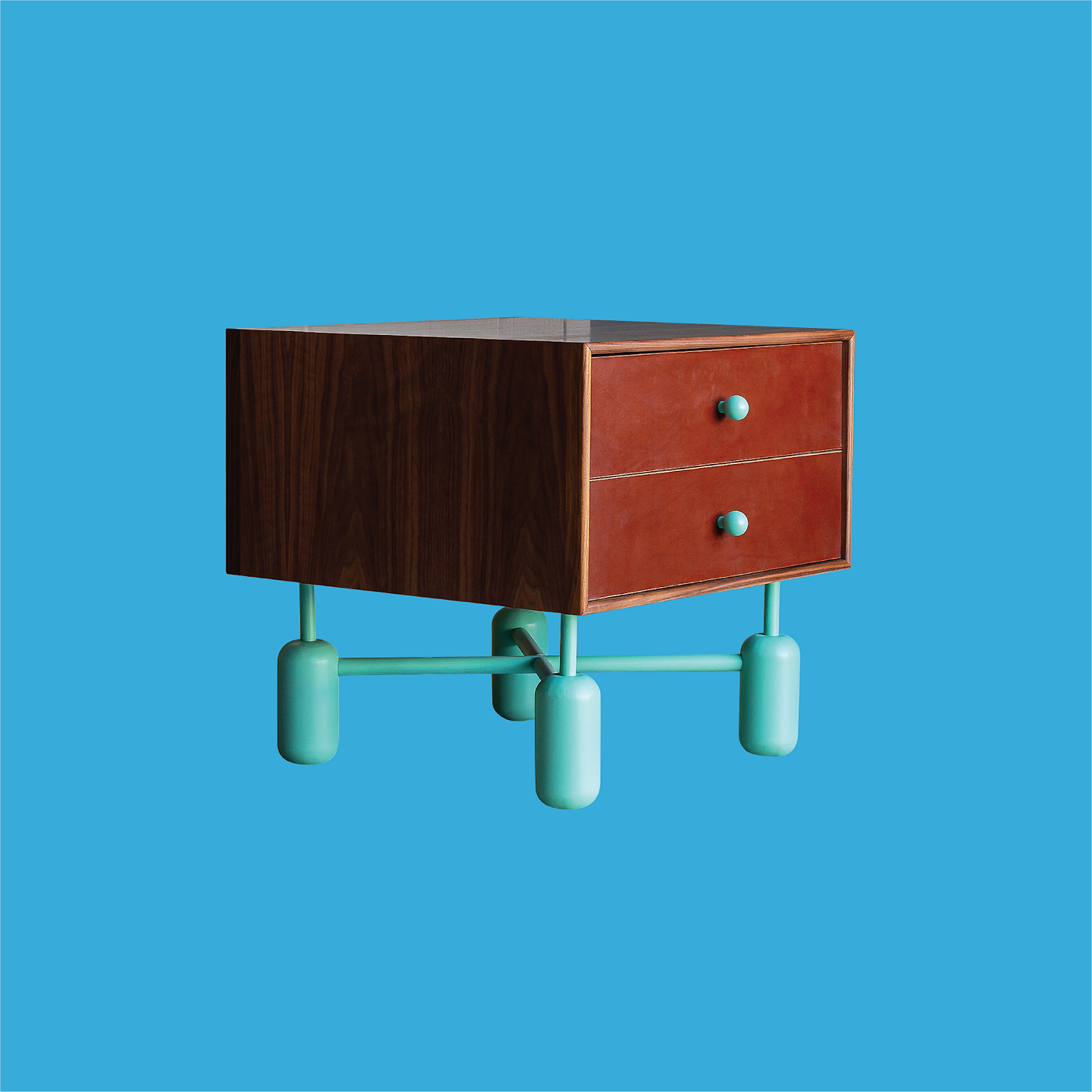
Model 02 is a cheeky little sidekick, mixing bold legs and bright details to bring a splash of personality into any space.
AJ: What is your favorite design element to incorporate into your projects?
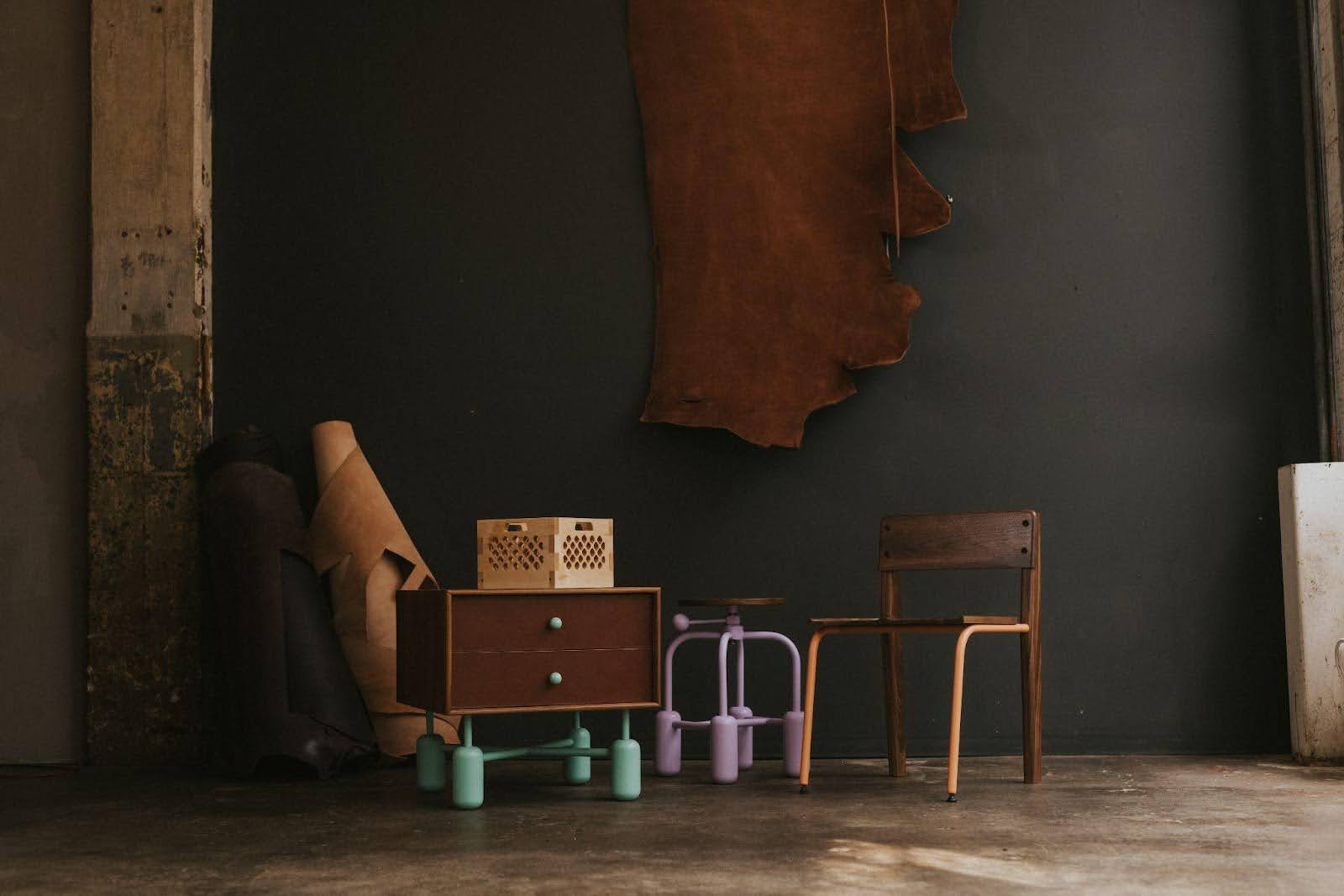
SA: Color. My formal education is in painting, and it’s been pointed out to me that this furniture is very “painterly”. I don’t disagree with that, but I also did not go into the designs with that perspective. However, it does make sense. When I was fleshing out the initial designs, I was really drawn towards Finn Juhl’s cabinetry from the 50’s and 60’s with the colorful drawer fronts. I think there are certainly a lot of people making colorful work, but I feel what you see right now is either all color or all wood tones, and I don’t see a lot of work that plays with the contrast of the two like Juhl was doing. So that got me excited, and I wanted to take that tension and see what it looks like if you transferred it to more three-dimensional elements. This led to making them more artificial and cartoonish, to boil them down into an almost 2D element, making it more about color and shape and not about materiality. Color has become as much of a tool for me in design as raw materials or hardware.
AJ: What’s your favorite cocktail?
SA: You know, I’ve never really thought about a “favorite cocktail”. I’m also struggling to answer whether it is “what is the best single cocktail I’ve ever had”, or just what is my favorite recipe. I’m going to have to go with the latter, and I think my answer is going to be a simple highball with lemon. I became a fan in Japan and it’s become my go-to in most situations.
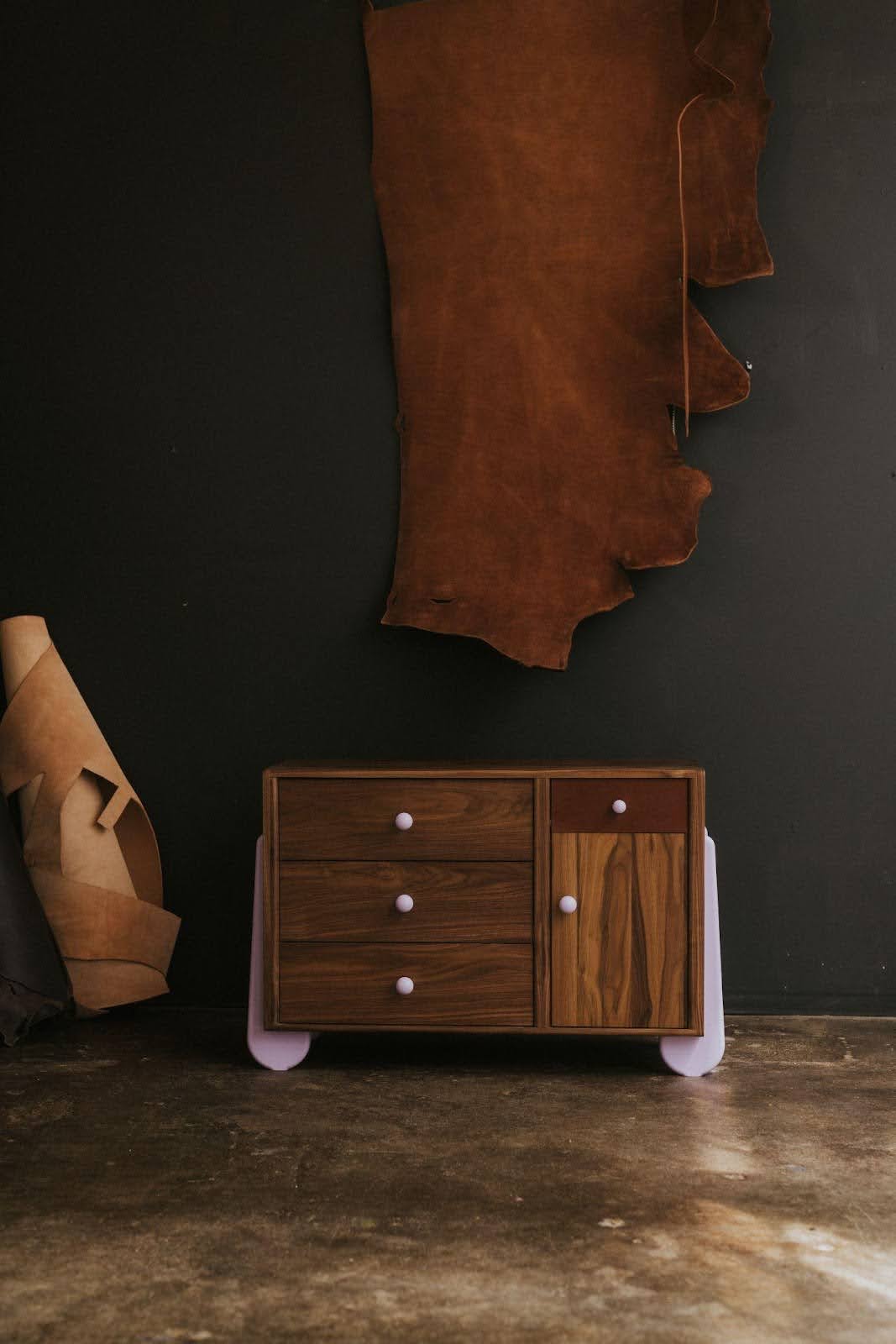
Model 03 is the life of the storage party, with pops of color and a mix of drawers that keep your treasures tucked away in style.
AJ: What is your favorite design-related quote?
SA: “If only you could design just one good chair in your life. But you simply cannot” – Hans J. Wegner. I recently read this inside the design museum in Copenhagen, and think this quote is really doing a lot in so few words. It really sums up why I find making furniture so wonderful. It conveys the transparency and lack of gatekeeping in the community that I’ve really come to appreciate. It’s a reminder that no one really knows what they’re doing, and that even people with decades more experience than you can still find themselves in the shit. Plus, the idea of a chair inspiring nihilism is hilarious and relatable.
AJ: What’s the weirdest thing a client has ever asked you?
SA: I once fabricated a canopy bed for a client as a part of a bedroom set, and they asked me while we installed it if it would be sturdy enough that you could hang from it during sex (and then proceeded to hang from it). Not necessarily that weird, but certainly the most memorable thing a client has asked me.
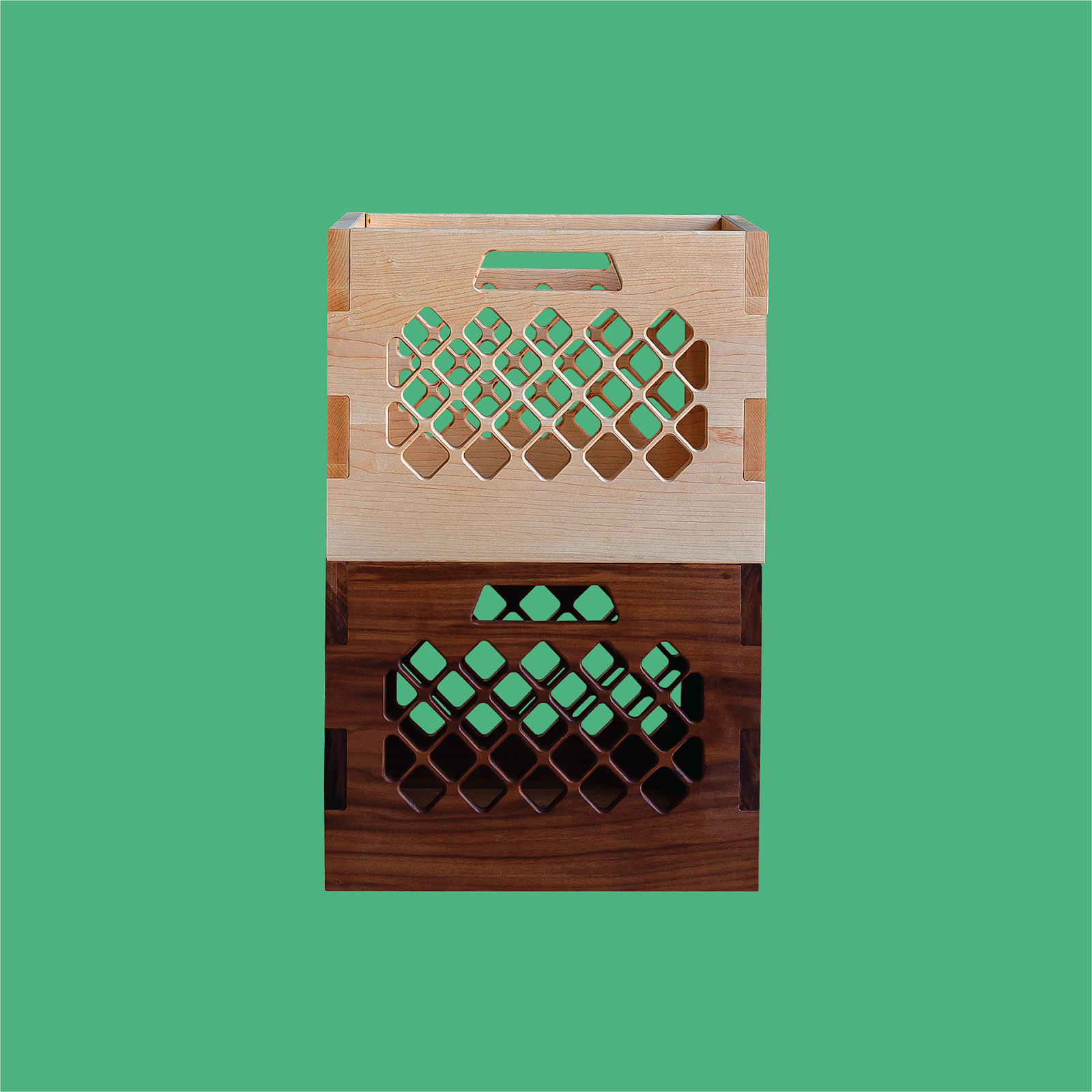
Model 05 is a playful yet refined accent piece, blending natural materials with understated design to bring unexpected beauty into any room.
AJ: Can you describe a project that you’re particularly proud of?
SA: I’m pretty proud of our Milk Crate aka Model 05. I think the struggle of coming up with ideas that are new and unique and appeal to you, but also appeal to an audience or fill a role, is particularly daunting. Somewhere along the way, the Milk Crate became a passion project that sort of broke things up a little. When I set out to make the first one, all I knew was that I wanted to make something for myself and didn’t care if anyone else thought it was interesting. The design also forced me to places outside my comfort zone: utilizing more digital fabrication and a more production-aligned mindset to get the best results. Once I put them out there, they got a much larger response than I was expecting.
Like what you see? Get it first with a subscription to aspire design and home magazine.