Since joining rug manufacturer Merida Studio in 2017 as Artistic Director, Sylvie Johnson has expanded the concept of weaving textiles as art. Studying the effects of hue, relief and shadow, her work experiments with the mixing of textural yarn palettes to layer experience and memory into impressionistic pieces. In this, Sylvie works with a curated team of talented designers and master craftsmen to create Merida’s annual Atelier collection, a fusion of individual brilliance and collective creativity. Now in its seventh edition, we caught up with Sylvie to discuss the latest additions to the Atelier collection, and where the series is headed before it comes to an end this October.
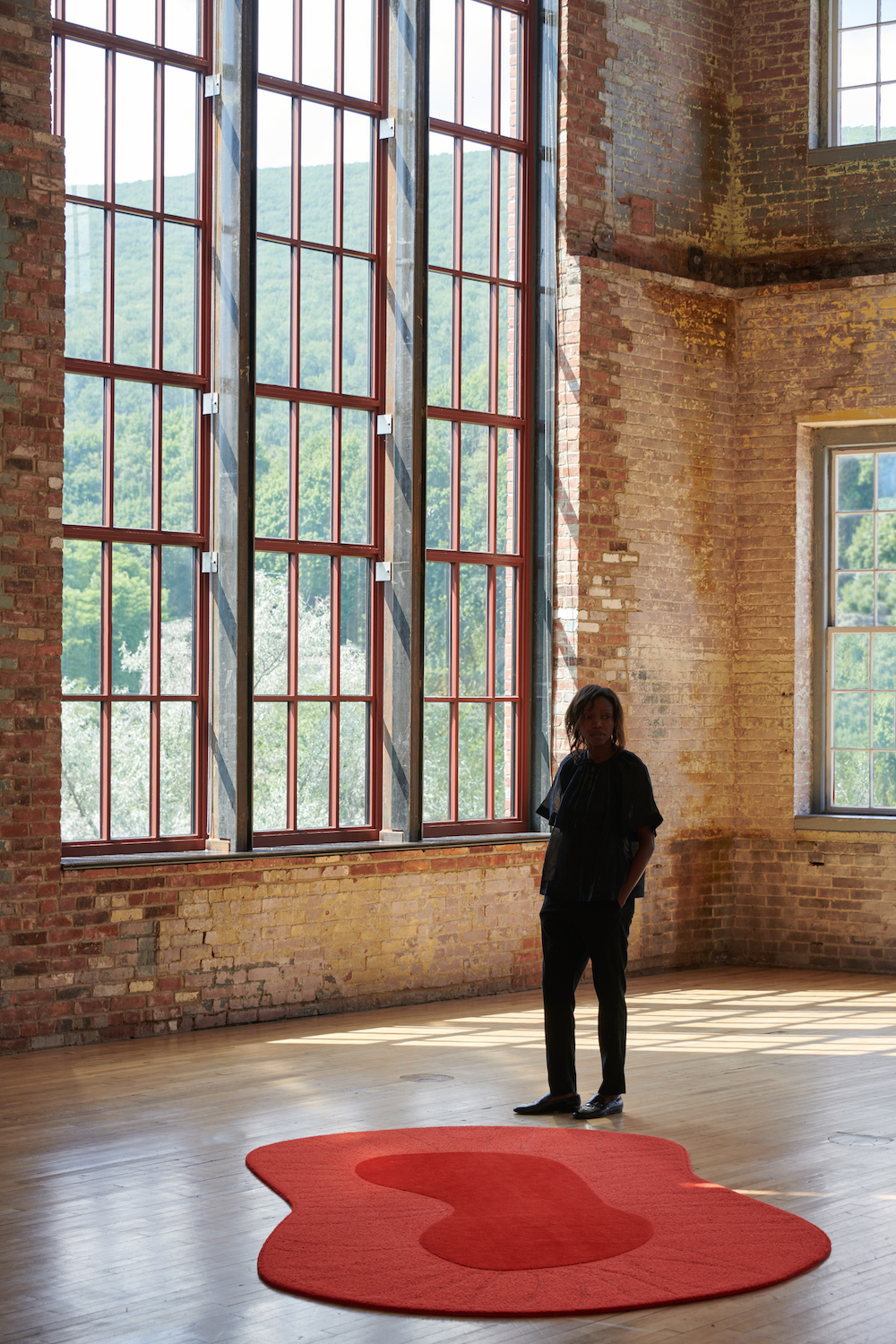
Sylvie Johnson with Reef at MASS MoCA. Photography by Richard Powers.
Raymond Paul Schneider: When did you first start to develop this new collection?
Sylvie Johnson: It may seem strange, but I began developing this series five years ago when I originally conceived of the 7-year arc of Atelier. The way you work and create is the same as how you see the world—it cannot be conceived of in an hour or a day or a week or a month. It’s a lifelong assembly. Even when you have the idea, it all starts as this broad concept and slowly gets more and more narrow as you think about it day after day. It’s like the idea for a story that, over time, is distilled into chapters, then to words, then to paragraphs. So the idea, and thus the development, of the series began five years ago.
In this process, I nurture the idea in my mind for years before making a sketch. After the sketch, we spend a minimum of two years developing it in the workshop, bringing the idea to life with yarns and weaves and watching it transform through the live process of working with the materials.
RPS: What was your initial inspiration, and where did the idea(s) come from?
SJ: Though I am constantly pulling from all of the thoughts and experiences I have had throughout my life—drawing on all of the art I have ever loved and all of the music I have ever heard—what I was meditating on so much with this series was Land Art. My deep love for nature runs through everything that I do, and this particular series became a conversation between me and nature and all of the artists before me that have had their own unique relationship with nature. My use of yarn as a natural material connects me and my work to nature in the same way that those artist’s use of stone, dirt, and wood did in their own practice.
I am so grateful for what nature offers, and for all of the diverse beauty that it shows. The biggest art to me is the translation of a feeling that all humans experience but that they don’t fully know until they see a particular piece. The biggest art to me is the revealing of something hidden, but shared; that intangible beauty of the world.
This series, to me, was an ode to the grandeur of nature and the constant performance of time, movement, and feeling that we all get to witness and be a part of.

Drift and Tephra at MASS MoCA. Photography by Richard Powers.
RPS: Please describe your overall creative and design process.
SJ: In general, I would say that every piece is a work in progress. It is a constant leaving and coming back. Everything is in service of trying to capture a feeling. And capture is the right word because it is hard to grasp.
When I’m thinking about the pieces, I’m already thinking about the layout of the exhibition for them: what will work with the pieces, who needs to be near who, what the feeling of the space needs to be. But I always wait until after the photoshoot to do this because I always see them differently afterward. There are constant reintroductions to each of the pieces: as they evolve from my mind to the paper, from the paper to the loom, from the loom to the setting. Every moment they change; not only as we shift weaves and change yarns, but as the time itself revolves around the object. From moment to moment, the pieces change in the light, in their surroundings, in your own internal landscape. So what is the most important, both in the process of making and in the process of experiencing these pieces, is pause. Time is an essential ingredient. Without it, we do not have time to leave the piece, think about it, think about other things, come back to it with fresh eyes, and continue the conversation. Without a breath and a pause, you’re not able to experience the shifting impressions of the piece. You’re unable to notice the subtle changes it is making in you.
One of the reasons I have always been interested in the Bauhaus and Renaissance workshops and the like is that there is something unique about making things not just by yourself but with others. I’m so interested in the idea of creating pieces of art that carry your intention, but are made collaboratively as an orchestra. Every piece becomes a performance—how your intention builds as you add the spiritual, physical, and mental material of others. My intention is centered around the way yarns form an alphabet, and like a poet, you are able to have your own voice and capture otherwise incommunicable ideas. And the subject of my gaze in this poetry is shadow.
The challenge in this is that when you are creating a piece, the yarn you thought would say one thing decides it will say another; but the mystery of this is what makes it so interesting. My job is to find the right yarn and the right combination to make my intention seen and felt. It’s like being the director of a play: the lighting, the placements, the acting are all important; but I need to find a way to direct them so that each of those actors are in the spotlight in the best way possible, and so the entire moment of the play makes you feel the way that I’m after. This is why I am in the workshop and talking with the team so much. I have written the script, and the team and I have to find the best way to choreograph the lights and music so that the actors on stage—the yarns—shine.
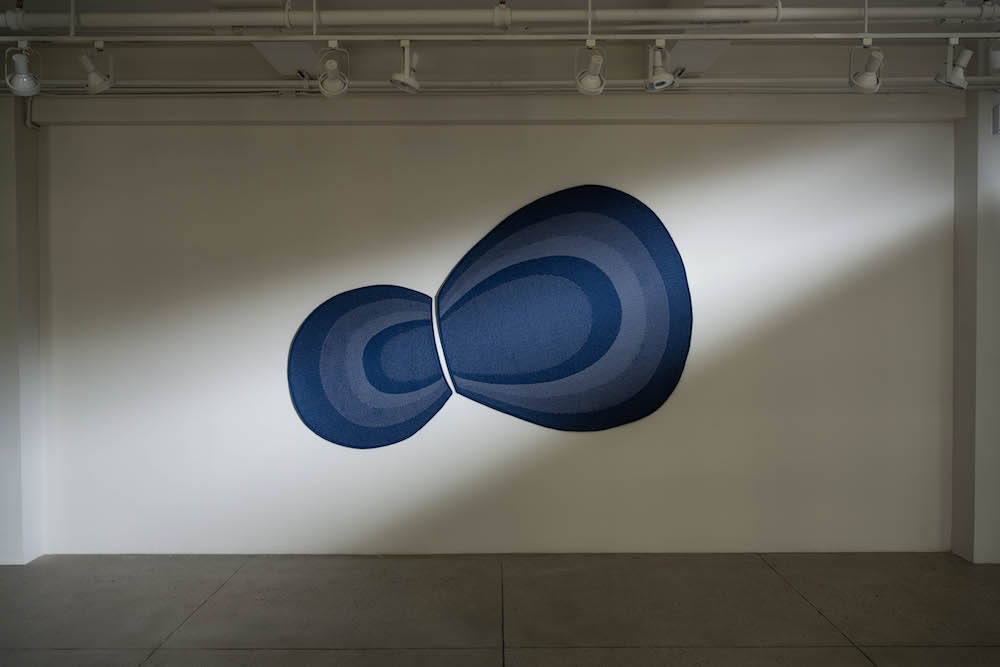
Duo in Elements: Outside Within exhibition at Merida Studio’s New York Gallery. Photography by Patrick Kolts.
RPS: Did you utilize a new technique or technology to conceptualize or create this product? If yes, please share the details.
SJ: In this series, I wanted to push the boundaries with the dobby-woven rugs so we experimented with a splicing technique to combine multiple textiles into one rug using leather piping—something that had not been done before. With this technique, we were able to break the mold of dobby-woven textiles and create organic motifs while using traditional looms, where previously we had only been able to create these flowing shapes using the Jacquard loom or a tufter.
The leather upholstery piping that we brought in to splice these textiles together was also a completely new material for us. In contrast to the yarn fibers, the presence of leather brings an almost lacquer-like effect to the fine details as the soft sheen of the material attracts the light, but almost swallows it.
The other concept we were experimenting with for the first time was a dual piece—a rug that came in multiple pieces but acted as one. The negative space created by this separation in Duo emphasizes the reflective quality of the design: it’s like an echo that you can never quite touch. What began as an hourglass form took on a new life with this space between the pieces; almost touching but never quite.
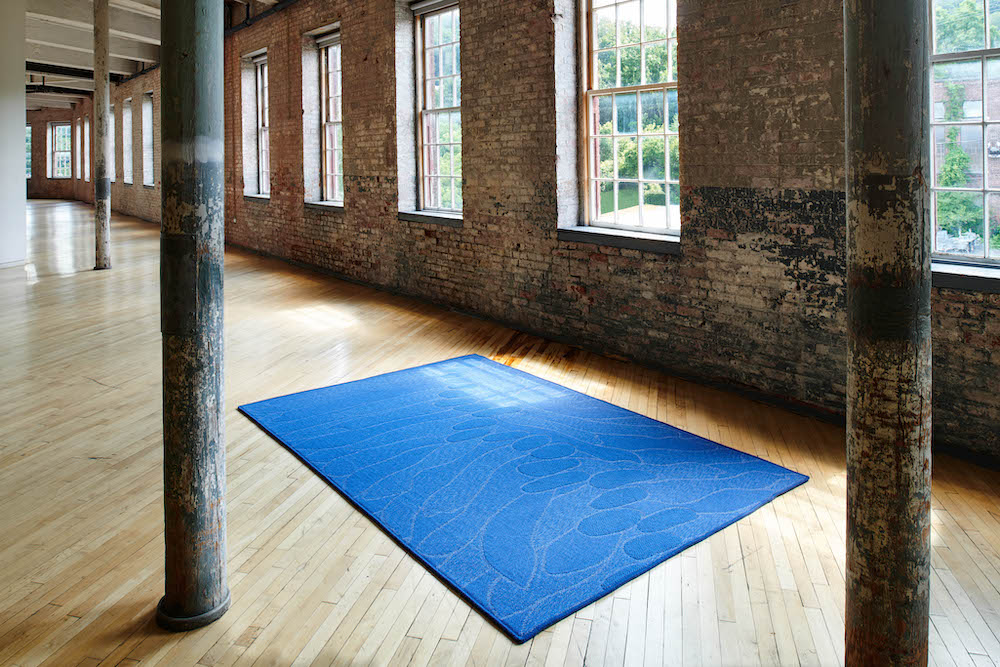
Calm at MASS MoCA. Photography by Richard Powers.
RPS: Please describe any challenges that affected the design and perhaps steered you to an entirely new final design?
SJ: There are always many challenges and changes throughout the development of a series, but Calm in this series was a particularly interesting one to see transform because such a subtle change had such a large effect. When we began developing Calm, the fluidity of the design wasn’t coming through, and we needed to find what shift of yarn or weave was going to help tell the story better. The problem was that everything was the same level, there was no differentiation between the motifs, and so the nature of the movement was muddy. As we experimented, we found that the weave used in the negative spaces of the design needed to be tighter—for a few different reasons. With the tighter weave in between the flowing motifs, the negative spaces recede into the ground, lifting the motifs up as if they were water rushing up over a stone. The dimension gained from the tighter weave made the textile come alive. The wonderful complexity that comes from this is the light colored warp lines being more prevalent in the recesses, simultaneously communicating depth and also height.
RPS: Describe your overall brand DNA and ethos.
SJ: What is at the center of everything we do is, as I mentioned before, time. Taking the time to think, to experiment, to talk, to feel—to question, more than anything. That is why we have the relationship that we do, Merida Studio and I. We both understand the need for time and the beauty of time.
Click here to see more of our “Anatomy of a Design” series.
Like what you see? Get it first with a subscription to aspire design and home magazine.