


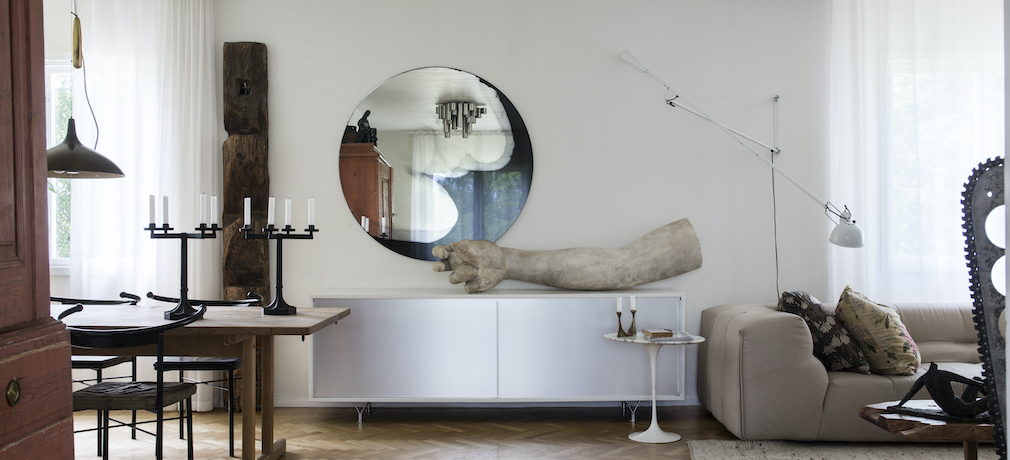
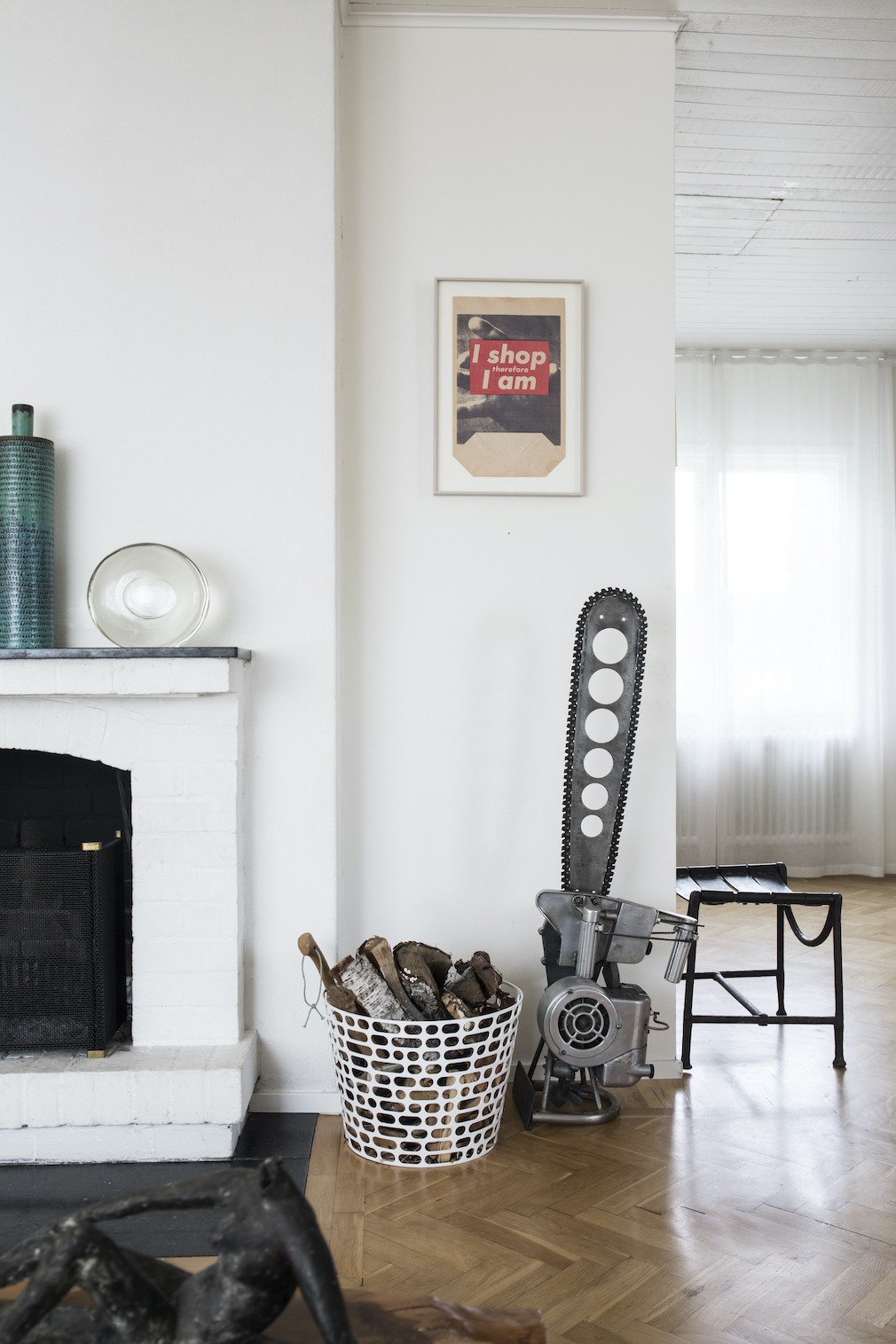

Next to the fireplace in Johan Sjöström’s living room in Stockholm, just above a 1930s chainsaw-turned-sculpture, is a framed giveaway bag by Barbara Kruger that reads, “I shop therefore I am.” “It’s a bit sad, but that’s me,” jokes Sjöström.
Lest you surmise he is just another vapid consumer, however, note that this burly bearded man is the proprietor of Sjöström Antik, a pair of exquisitely curated antique shops in Sweden’s capital. What he’s after is not the latest iPhone or chic white Nike Air Force 1 sneakers. He covets everything from 18th-century decorative objects to French, Italian and Scandinavian furniture and lighting from the 1920s through the 70s.
About two decades ago, Sjöström purchased this 2200-square-foot, c. 1947 house for his wife at the time and their three children. (Today, the kids, ranging in age from 14 to 20, live here with their father.) Sjöström was 19 when he started collecting, and 21 or 22 when he opened his first shop. He was deeply into Scandinavian midcentury back then and planned to outfit the five-bedroom residence accordingly. “But I felt it was not personal and didn’t reflect me,” he recalls. “I like everything that’s nice. It doesn’t have to be Scandinavian. I like the mix.”
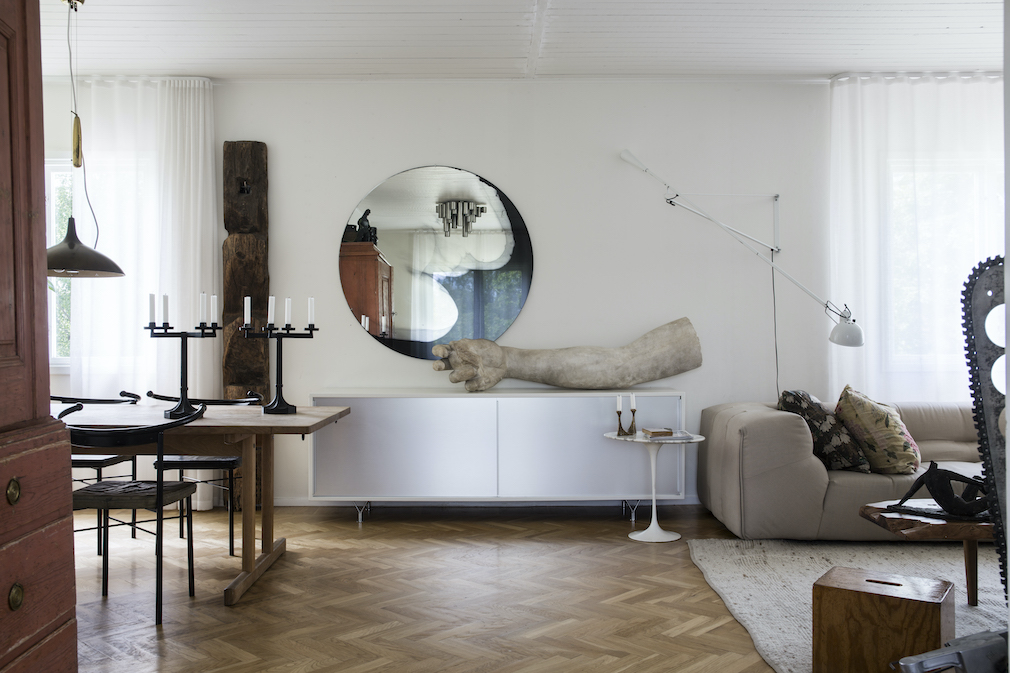

That is, ultimately, how a plaster sculpture of an arm cast from Michelangelo’s David came to rest upon a modern, aluminum-fronted credenza by Swedish cabinetmaker Bruno Mathsson. Or why an enormous paper decal of a deer (deployed by a contemporary street artist to adorn building walls) ended up glued to a plywood backing and propped in a window overlooking a 1960s oak dining table designed by Danish modernist Børge Mogensen. The same reason explicates the 1960s Angelo Mangiarotti crystal links chandelier suspended above a natural-edge coffee table that in a former life served as a sauna bench.
Mixing and matching is hardly novel – old with new, sleek with primitive, refined sophistication with pop irreverence. But Sjöström has an intriguing eye for scale. The plaster arm, deer decal and chandelier are all quite large for the low-ceilinged open plan that embraces the living and dining rooms. What these supersize objects accomplish is twofold: First, their enormous proportions make the room feel more spacious and taller, distracting the eye from the modest height of the ceiling.
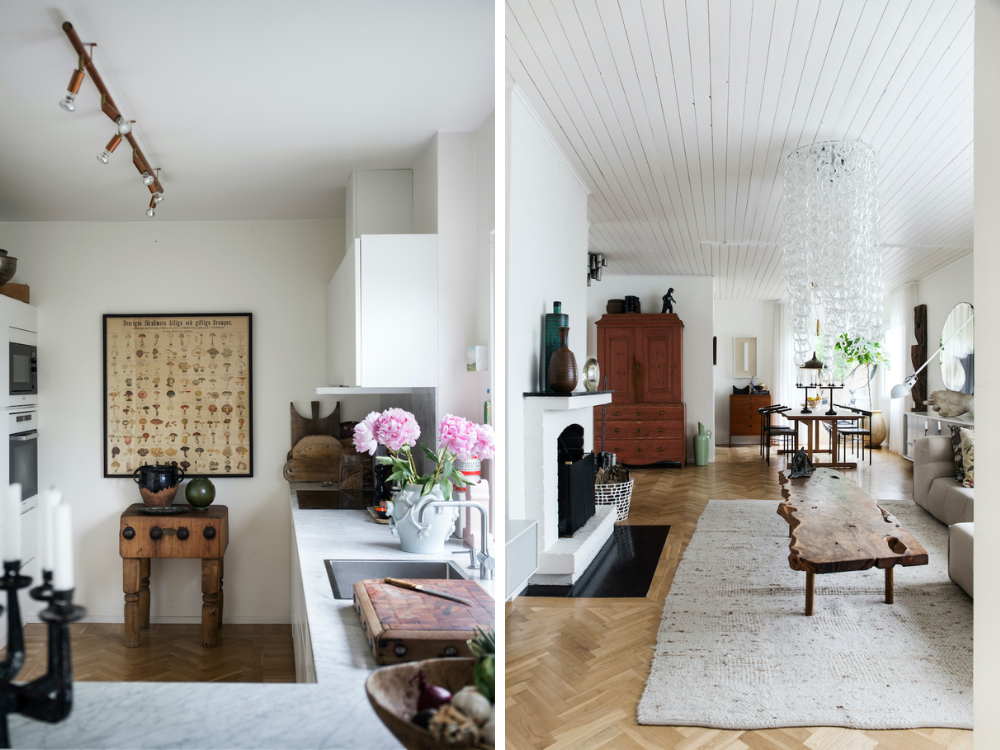

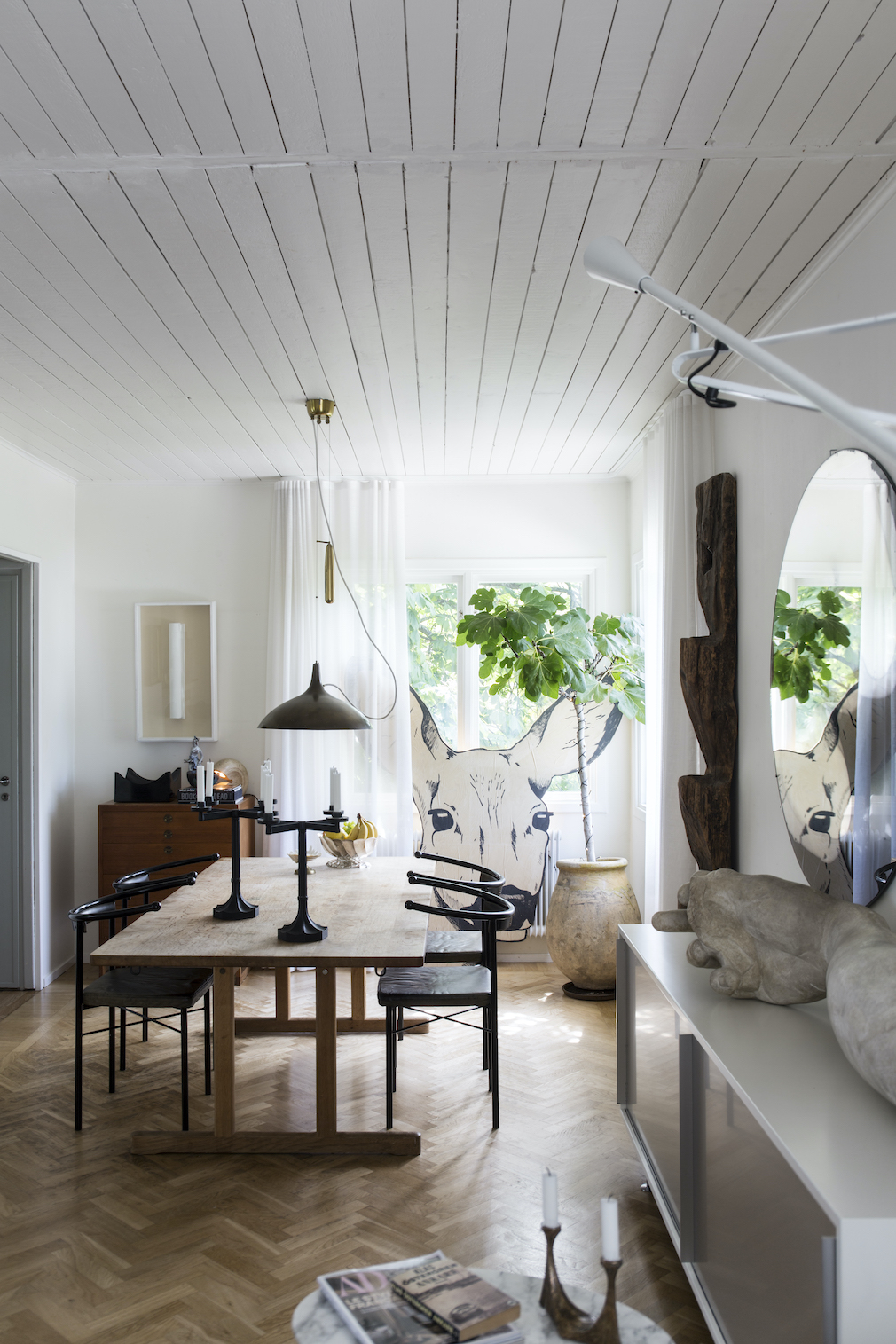
Second? Formerly, the living room boasted a parquet floor, the dining room was tiled in linoleum, and they were divided from each other by walls. When Sjöström demolished these partitions – and extended the parquet into the dining area – the resulting longitudinal room might have felt rangy and unfocused. Each of these objects anchors the space over which it presides… deer (dining room), chandelier (living room), arm (the transitional space between them). This helps convey the sense that each area is distinguishable from the other, with its own function and presence.
“It’s fun to see the unexpected,” believes Sjöström, and it’s clear he enjoys creating those moments of surprise. Arguably the most cohesively contemporary room is the kitchen, which Sjöström rebuilt with lacquered wood cabinets and Carrara marble countertops. Yet he couldn’t help inserting a whimsical painting of a chef by a 1930s Swedish artist or bringing in a suggestion of age with an authentic antique butcher block and his own collection of antique cutting boards.
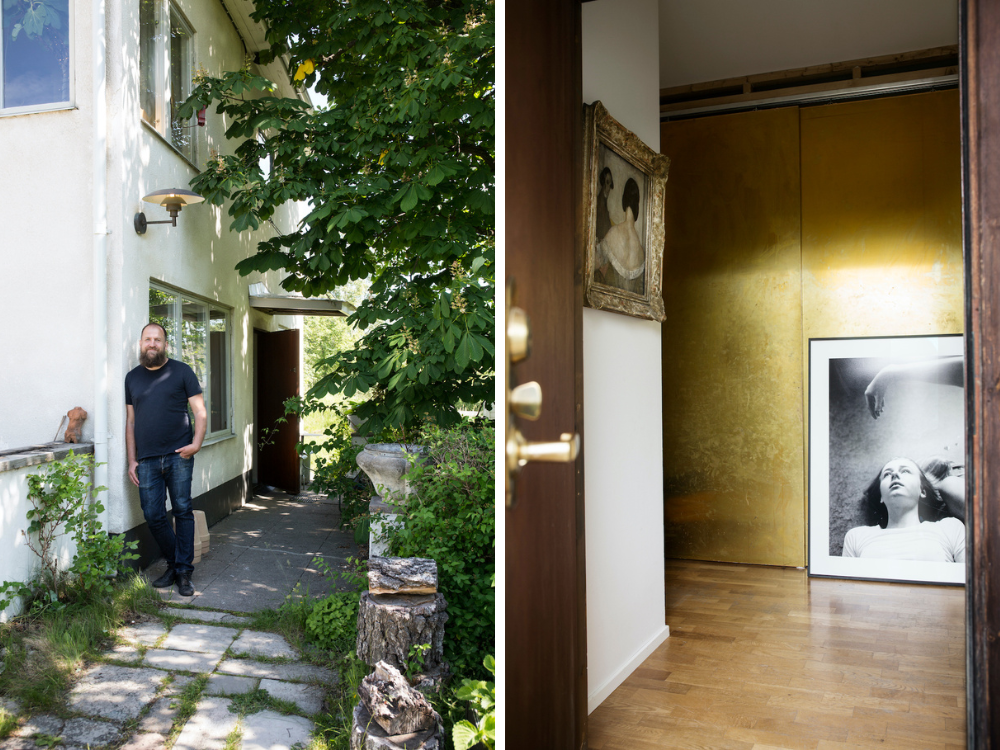
Sjöström’s delight is infectious. When a writer finally pinned down a time for a remote video interview, Sjöström was traveling for what he loves most: shopping. “Shall I send you a Zoom link?” asked the writer. “Yes! Please!” he responded, then attached a picture of two gold, leather-covered cabinets from the 1920s or 1930s. “Look what I bought today in Italy,” he enthused. “Love them!”
Photography by Johan Sellén.
Styling by Gill Renlund.
Like what you see? Get it first with a subscription to aspire design and home magazine.