

“Why are we making art in the first place?” asks sculptor Jonathan Prince. His answer: “It’s never been about making money; it’s been about the passion of creation.” For Prince and his partner in life and business, curator Stephanie Manasseh, that passion is central in their holistic approach to how they exist in the world.
The couple are founders of Berkshire House in Western Massachusetts, the 23,000-square-foot property where they live, Prince creates his art and they host conferences and other events that focus on the interrelationship of art, digital technology, architecture and gastronomy. It is also a nexus for collaboration with artists, architects and designers on a variety of projects that arise out of a respect for science and spirituality.
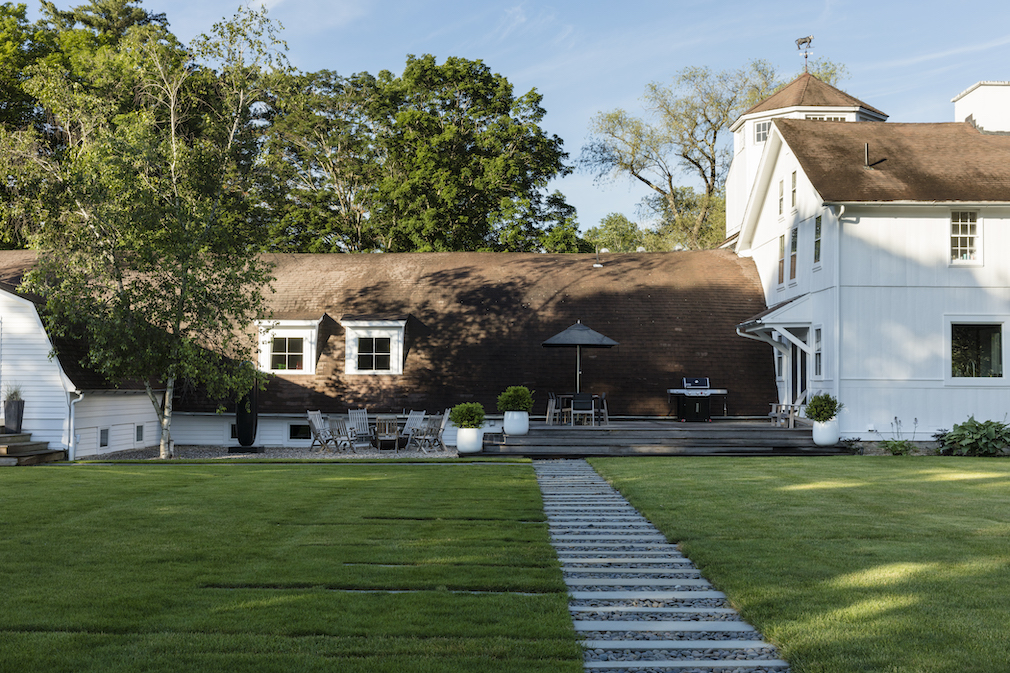
Prince has a lengthy and prestigious résumé in the fields of science, technology and medicine. But 20 years ago, he began creating sculpture from stone and steel that explores more ambiguous mysteries of the universe and reality.
“Really, my art is about the relationship between the aims of science and the wisdom of spirituality – how they elucidate, inform and complete one another,” he explains. “They’re not mutually exclusive. Science is in its infancy, and spirituality is a way of asking questions that science hasn’t answered yet. All my work asks more questions than it answers – about how it’s made, what the material actually is, where perfection meets imperfection or chaos, whether it’s ancient or futuristic.”

Jonathan Prince (left) and Stephanie Manasseh (right). Photo by dearedithandlily.
Take Transcendent, a wall piece that hangs over a fireplace in the couple’s great room. It is made of ceremonial buffalo hide normally stretched over drums for Lakota rituals, so the material itself carries both physical property and spiritual resonance. Its natural tendency in this dried state is to bunch up and contract. Yet Prince pulls it tight within a steel frame, thus conveying the sense of the material resisting being conformed and confined into a state of perfection, completely flat and without wrinkles.
Or his Shatter sculptures, whose exterior presents perfect Euclidean geometric forms (in this case, Cor-Ten steel cylinders), but inside seem to be fracturing and crumbling. Amazingly, these pieces are neither digitally modeled nor molded using 3D printing. In the faceted fracturing, he describes, “each plate’s position is informed by the one that came before.” Prince does innovate machinery and methods for grinding and polishing, but these pieces can take some 500 labor hours to construct.
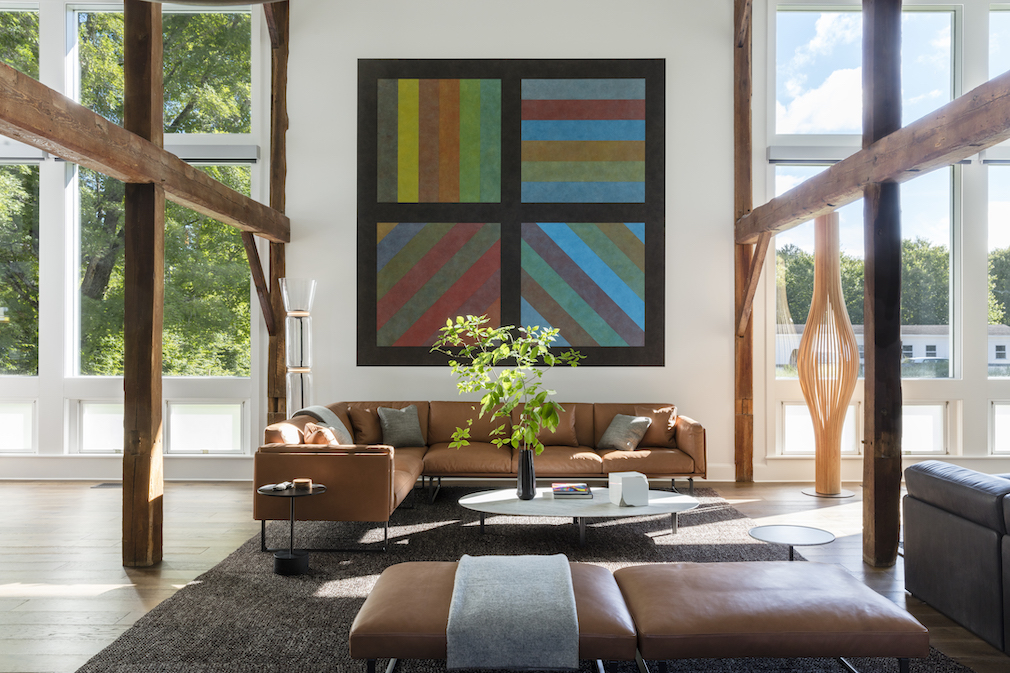
Prince and Manasseh live with these and other artworks at Berkshire House, namely a Sol LeWitt fresco in the great room that is on permanent loan from his estate. (It came to reside here as Manasseh was assembling works for a LeWitt show at the Jewish Museum of Belgium in Brussels, during which she developed a relationship with the artist’s widow, Carol). The fresco lives alongside a Piero Lissoni sectional sofa and coffee table.
There is no separation between art and design (or anything else, for that matter), according to the couple. In many cases design is, in fact, a direct outgrowth of art, which is, of course, an expression of the artist’s soul. To wit: the enormous light fixture over the dining room table. Its creator, John Procario, was an admirer of Prince’s work, and it arises out of a collaboration of ideas between the two men. A coffee table and end table near the fireplace are sculptural riffs on Prince’s Torn Steel works, for which he developed a technique to emulate cracked stone using metal. The latter pieces combine art, technology and science, with the more spiritual concepts of imperfection and surrender of control.
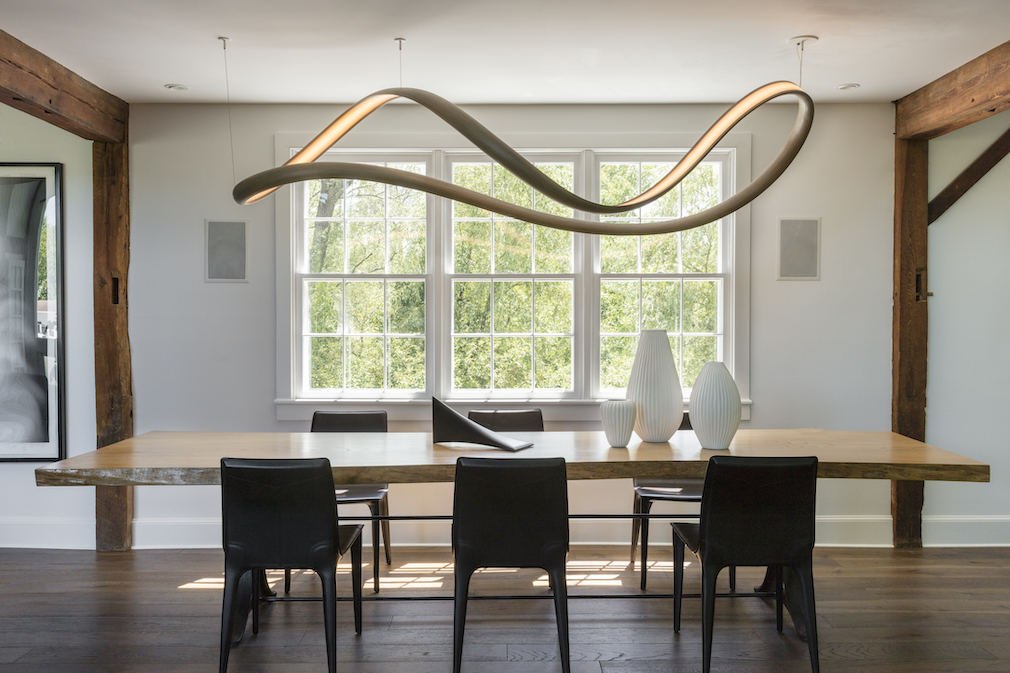
All of it ultimately stems from that “passion of creation.” In that passion, we sense the human desire to reconcile what is rational or knowable with that which is abstract and impossible to quantify with the human brain and its necessarily limited capacities.
These are the sorts of interchanges that take place during events, dinners and conferences at Berkshire House. Ultimately the couple wants, states Manasseh, “to create a sense of community by invitation. We have to know something about what you’re interested in – the Sol LeWitt, Jonathan’s art, our lifestyle.” It is at the intersection of many ideas that something new is created and deeper understanding is possible.
Photography by Antoine Bootz.
Like what you see? Get it first with a subscription to aspire design and home magazine.