


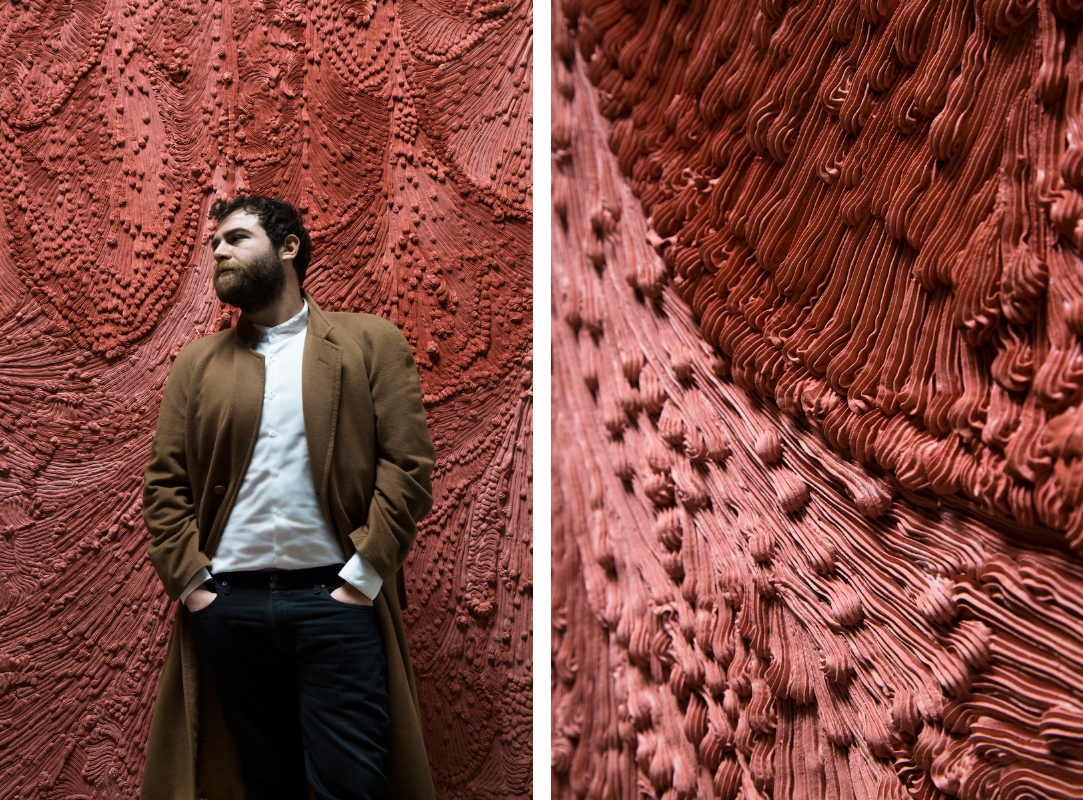
Edoardo Piermattei standing before a painting in his studio, for which he claims he was thinking of theater curtains: “An imaginary scenery for an act in a play yet to be performed.”
“Art is my language,” states Turin-based artist Edoardo Piermattei. “The history of art is like Italian for me.” Piermattei’s vision, in fact, is fluent in hundreds of years of diverse artmaking. He is influenced by, not necessarily in this order, medieval artists (particulary Giotto and Piero della Francesca), Byzantine icons, the Baroque incrustations of the Trinity monument (erected in Vienna to commemorate the plague of 1679), the Polish-French modernist painter Balthus, Dan Flavin’s light installation in Milan’s Chiesa Rossa church and the art of Sol LeWitt.
“A friend of mine once told me that my art is like the meeting of Clyfford Still and Bernini,” he jokes. What might sound like a bipolar combination, however, fits Piermattei’s work like a glove. His blotchy forms and colors, particularly the way he applies the latter, have an affinity with Still, while his compositions tend to recall the Baroque sense of movement and high drama of Gian Lorenzo Bernini’s sculptures (think “The Ecstasy of Saint Theresa”).

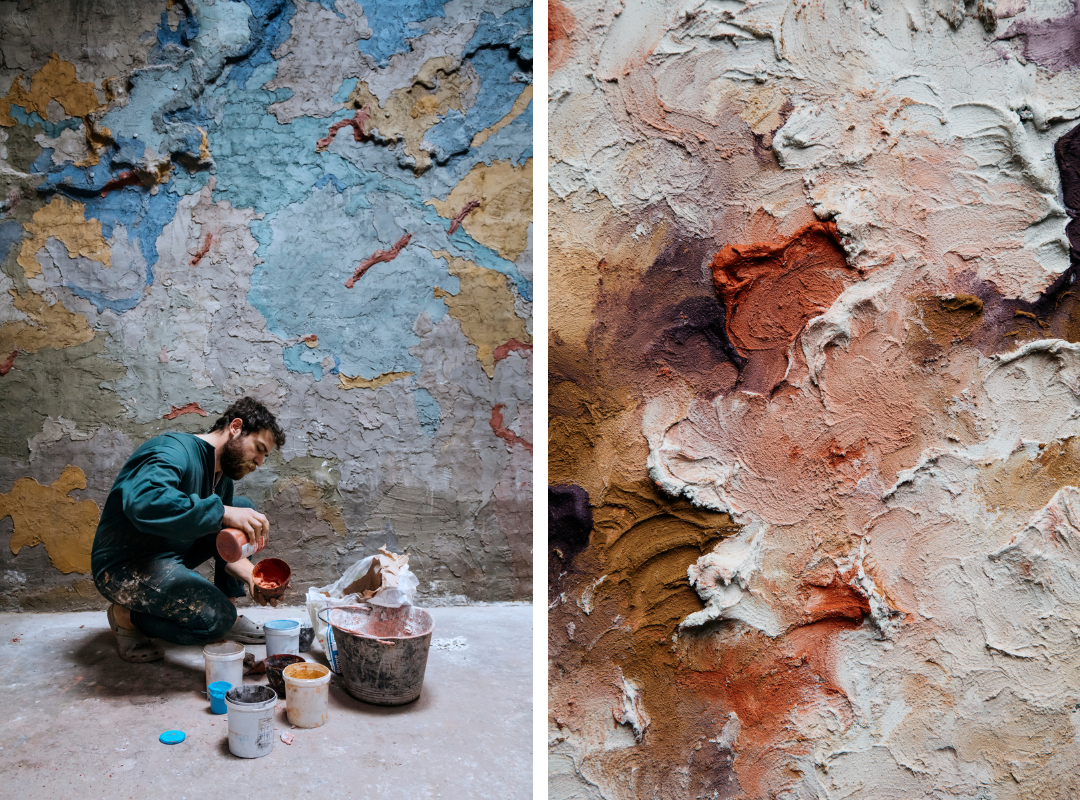
(Left): Piermattei at work, coloring his wet concrete with pigments. (Right): An alternative detail of the thickly applied pigmented concrete.
Piermattei says that as a youth, he used to go on walking pilgrimages to the lower Basilica of San Francesco in Assisi — 75 miles from his hometown of Offagna — “not for the church, but for Giotto.” In old churches, he became mesmerized by deteriorating frescoes that were flaking. “All my work is about absence,” he explains. Of these patches of exposed plaster, he observes, “From this absence comes something spiritual and mystical.”
So he began replicating the shapes of those empty patches, building them up with pigmented concrete, as if that mysticism were emerging through the voids and emanating outward. In a grotto on the property of one of his collectors, he kept encrusting them until they formed stalactites. Appropriate for a grotto, of course, but in actuality, what was driving this was the depiction of “St. Bartholomew and his flayed skin,” in the Sistene Chapel.
“I’m very connected to religion,” he notes unsurprisingly. Sometimes the absence can represent something else, such as a wound or an opening in the dress of a pregnant Virgin Mary, as painted by Piero della Francesca. “It is very violent, but very soft, too,” he describes. These juxtapositions of pain and tenderness can be intense. But, “I don’t want my paintings to be bourgeois.” Rather, he wants his work to radiate deep spiritual meaning. And they do.

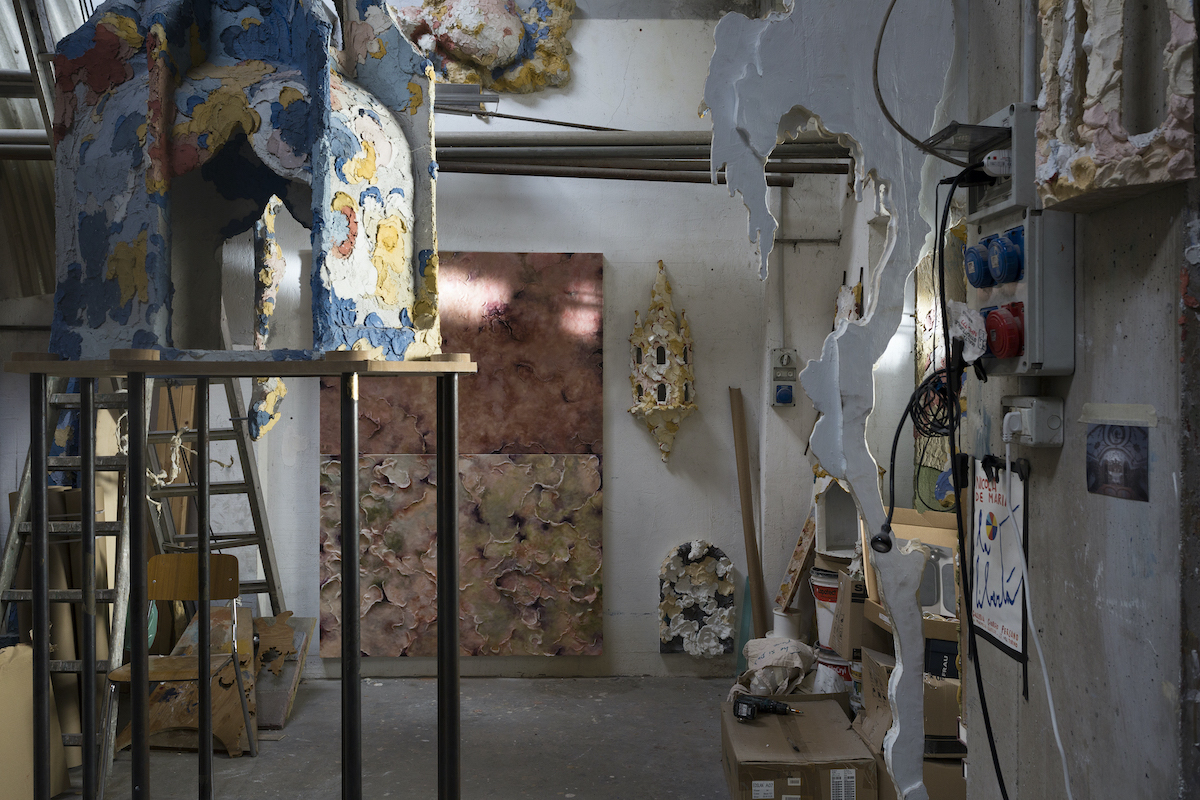
Piermattei’s studio.
Whether we comprehend that meaning intellectually or not is beside the point. What Piermattei is reaching for is a way of articulating the profound ecstasy of union with the Divine.
Photography by Lea Anouchinsky.
Like what you see? Get it first with a subscription to aspire design and home magazine.