

Can art help you see the invisible? I recently had an extraordinary experience which proved to me that it can. You can see it, too, at Manhattan’s Ippodo Gallery through December 29, 2022.
The exhibition is called Susumu Shingu: Sculpting with Wind. Early in his career, the Japanese artist had hung a painting outside, intending to film it. But the way it danced in the wind fascinated him, and he began to explore three-dimensional movement in his work. Soon, kinetic sculpture became his calling card. Shingu went on to create large-scale public works all over the world. There’s even a Susumu Shingu Wind Museum in Sanda, Japan. And after seeing the artist and his work in person, I’m eager to visit.
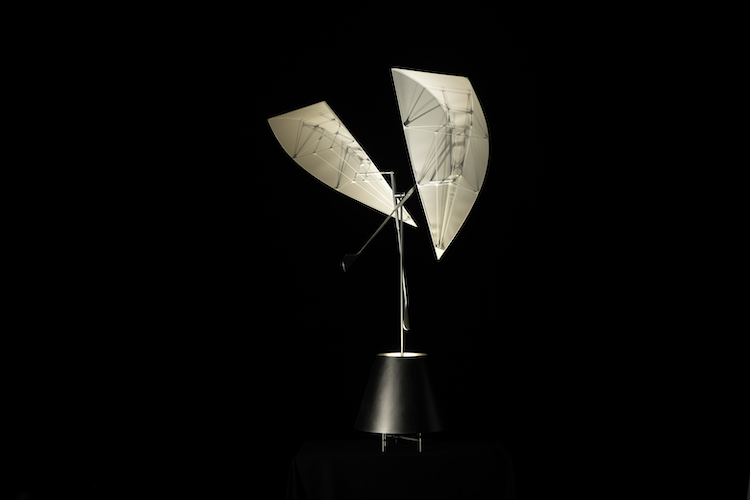
Floating Upward
On the day I visit, I breeze into the gallery and up the circular stairs into the exhibition space. The rooms have an air of darkness. Bright, focused beams illuminate the artwork. And work, they do. All around, the pieces are moving—tracing seemingly ever-changing patterns in the air with the grace of figure skaters on fresh ice. My eye is drawn to “Moon Boat” (pictured above). The piece seems perpetually on the edge of flight. Yet as its wings catch the air, their motion is also like that of a climber ascending. It’s a remarkable juxtaposition.

Speeding the Invisible
Others admire the art around me. They make occasional oohs and aahs, but the general air is one of awed hush. And then a man enters the room. You might guess he was a person of some importance as people approach him, nodding reverently. But when he walks over to one of the pieces and gives it a shove, it’s clear that this could only be Susumu Shingu. The piece is “Little Flower” (pictured above). Its shape is a series of cones topped by an inverted umbrella. Each part has been swinging in its own languid circle like waltzers on a ballroom floor. But with some added oomph from a Shingu shove, the piece takes on new energy. It’s as though Mary Poppins had opened her umbrella and taken to the sky only to be suddenly spun by a rogue breeze.

The Ineffable Nature of Memory
I introduce myself to Shingu, beginning with the four or five words of Japanese vocabulary I have carefully rehearsed. Continuing in English, I tell him that I am honored to meet him and experience his beautiful work. He smiles and gestures toward a piece called “Ladder to the Moon” (pictured above) It is reaching for a memory of childhood, he explains. Does he mean that he was reaching for a memory of childhood when creating the piece? Or does its unending upward crawl represent the ineffable nature of memory itself? I tell Shingu that it reminds me of a game I played as a child called Jacob’s Ladder. He nods sagely.
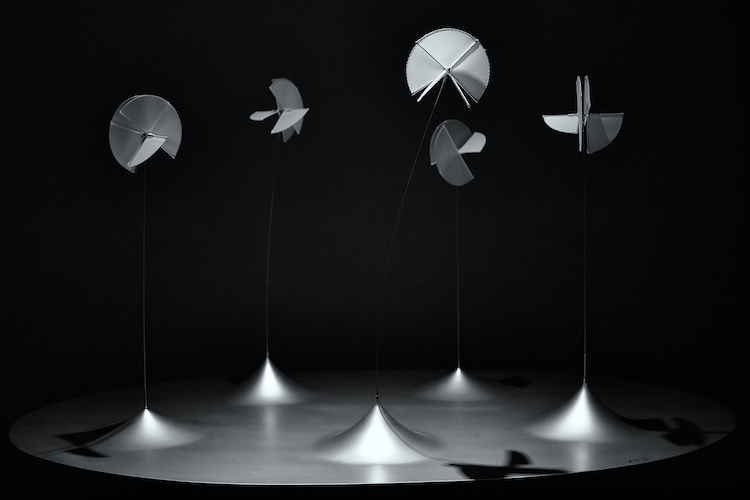
Vessels for Invisible Energy
“I trust something that moves,” says Shingu, motioning to his creations dancing all around him. “Each works independently, but they all work together. I try to make the space askew, to change something,” he says. And he wants them to offer “fresh sight.” Shingu wanders over to his “Astral Forest,” (pictured above). He says invisible energy—the flow of air, water, energy—inspires him. The art, he explains, becomes a vessel for this energy. And he waves his arm over the forest, sending its delicate stems swaying, each thrumming with its own exuberant energy.
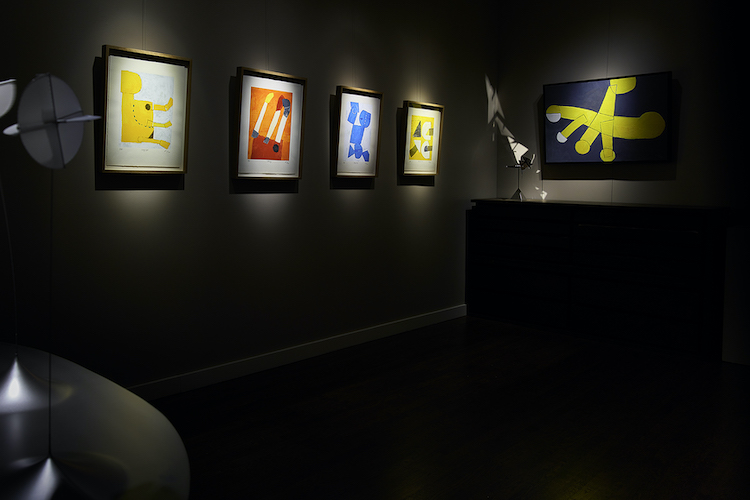
Capturing the Invisible for Kids
We wander into the next room and Shingu beckons me to sit with him. Before us are a collection of exquisite children’s books. He introduces me through them—some written in multiple languages, others without words at all. We follow the evening with a spider, chuckling at the invisible action between each illustration. I gasp audibly when he reveals what surely must be the most intricate pop-up book I have ever seen. More of Shingu’s two-dimensional work is hanging on the wall around us. Images of Shingu’s stories-tall outdoor pieces flash in another corner. And the artist sits beside me, turning meticulously crafted page after page. It is marvelous.
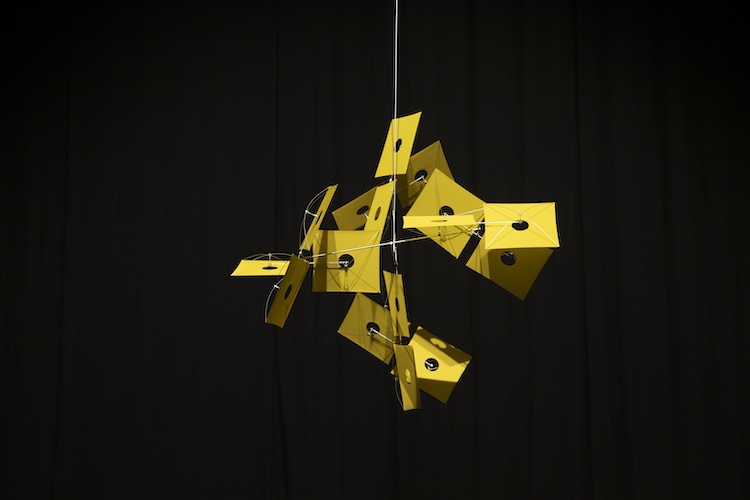
Taking the Invisible with Me
After sitting with Shingu a little longer, I say my farewells and descend the staircase toward the exit. Behind me, visitors continue to mill about in hushed silence. And Shingu circulates among them, lending his creations surprising bursts of energy now and then. It is here that I realize I had actually missed the first of Shingu’s pieces on display in the entry room. This kinetic sculpture is called Moonlight (pictured above). Like the other works, it calls to mind a variety of happy things. Its vibrant yellow squares could be vinyl album covers or oversize slices of cheese. And their movement is absolutely mesmerizing. I feel as though I could spend hours watching them spin on their axes.
But when I finally convince myself to leave, I walk toward nearby Central Park. And what’s amazing is: I’m still seeing the invisible. Pedestrians seem to walk in hypnotic patterns and I thrill at the susurrus of the wind through the trees. This is a feeling that will stay with me for some time, and I am grateful.
Visit Susumu Shingu: Sculpting with Wind through December 29, 2022.
See Susumu Shingu’s work in motion on YouTube.
Want more art? Check out what’s happening at Art Basel.
Photography by Douglas Duber 3.
Like what you see? Get it first with a subscription to aspire design and home magazine.