
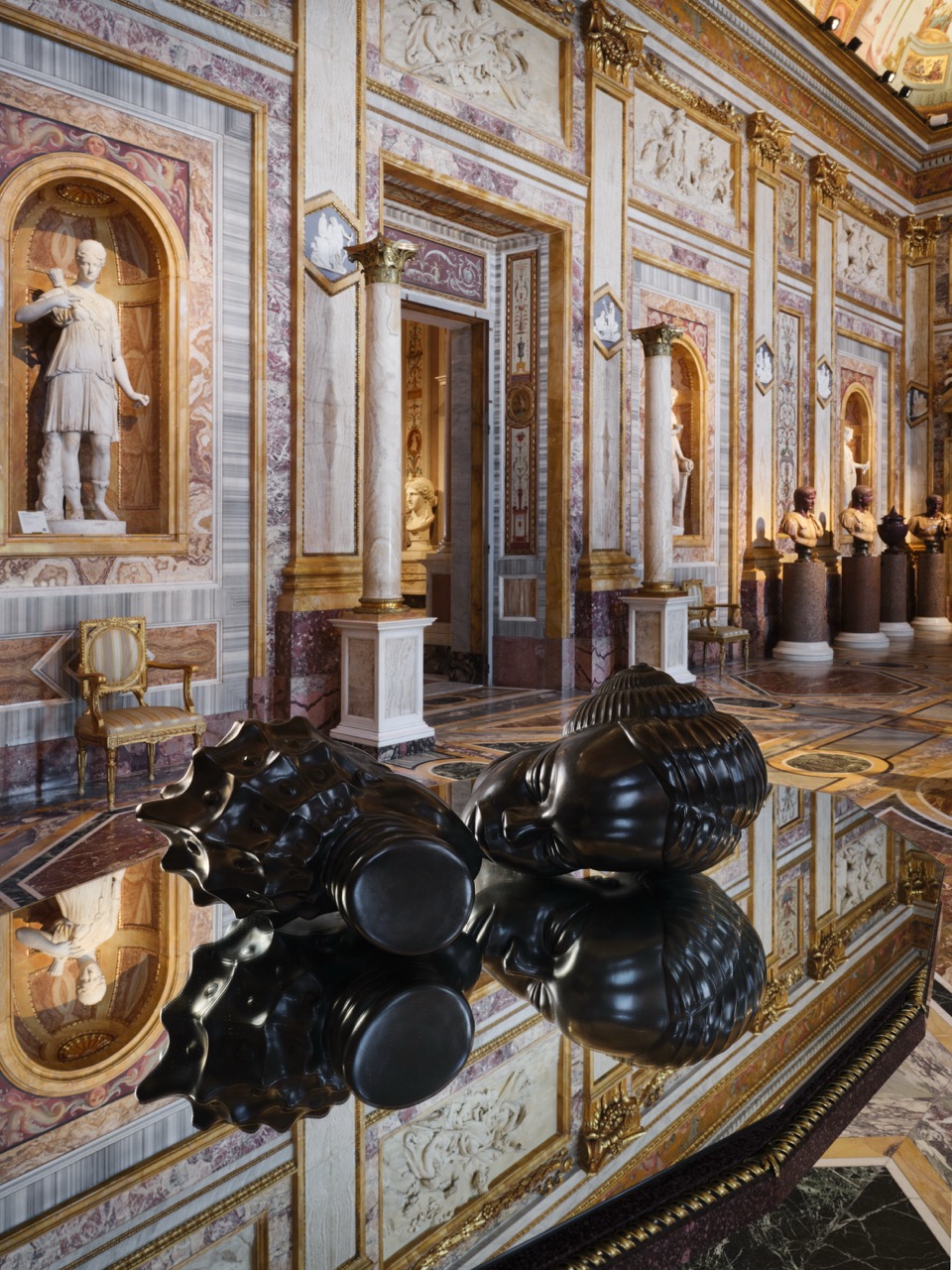
On view now through 14 September 2025, Galleria Borghese presents the first solo exhibition dedicated to Kenyan-American artist Wangechi Mutu in Italy. Titled Black Soil Poems and curated by Cloé Perrone, the show unfolds throughout the entirety of Cardinal Scipione’s residence, from the galleries, façade, to the Secret Gardens. Conceived as a site-specific intervention, it challenges classical tradition through suspensions, fragmented forms, and newly imagined mythologies, establishing a multilayered dialogue between the artist’s contemporary language and the museum’s symbolic institutional authority.
The title evokes the dual nature of Mutu’s practice: poetic and mythological yet deeply connected to the social and material contexts of our time. “Black soil” — rich and malleable under the rain, almost like clay — appears across multiple geographies, including the Galleria Borghese’s Secret Gardens, which resonates with the artist’s imagination. From this soil, the sculptures seem to emerge, as if moulded by a primordial force, giving shape to stories, myths, memories, and poems. This metaphor underscores the generative and transformative power of her work; it is simultaneously rooted in materiality and open to multiple future interpretations.
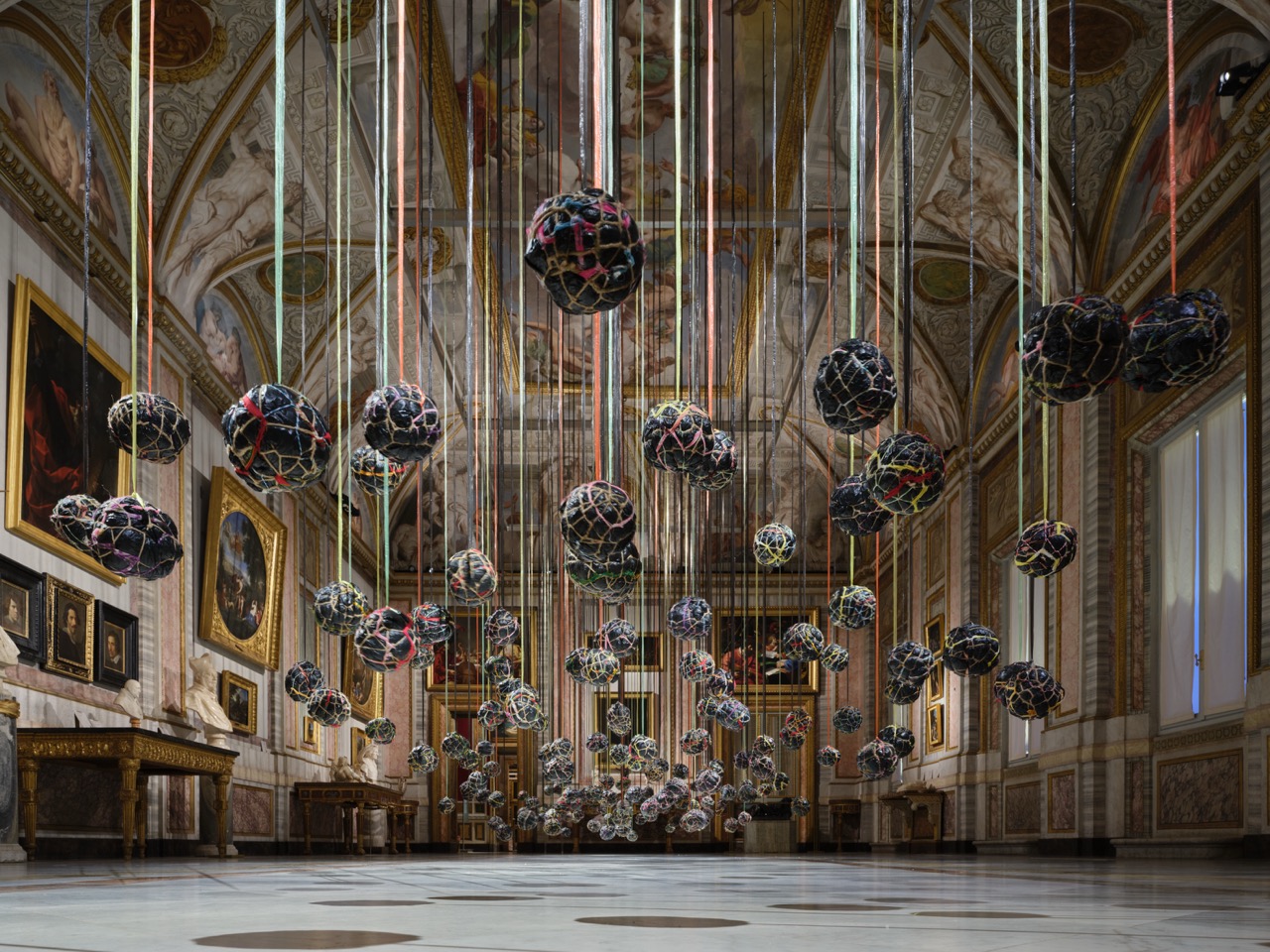
The exhibition is structured into two complementary sections. Inside the museum, Mutu radically reconsiders spatial orientation: her sculptures never obscure the collection; rather, they appear as subtle additions — ethereal presences that hover in mid-air, float lightly, or rest on horizontal surfaces. Works such as Ndege, Suspended Playtime, First Weeping Head and Second Weeping Head defy gravitational logic, delicately hanging from the ceilings and framing new lines of sight. This act of suspension is not merely formal: it introduces a shift in historical narratives and material hierarchies. The museum’s visual field is redrawn, opening new modes of perception as a result.
The materials — bronze, wood, feathers, soil, paper, water and wax — are central to the exhibition’s ethos. Bronze is stripped of its traditional connotations to become a vessel of ancestral memory, recovery, and multiplicity. By inserting organic, fluid, and mutable substances into a context traditionally dominated by marble, stucco, and gilded surfaces, the artist reaffirms a poetics of transformation and becoming — thus anticipating a theme that will be central to the museum’s 2026 exhibition program: metamorphosis.
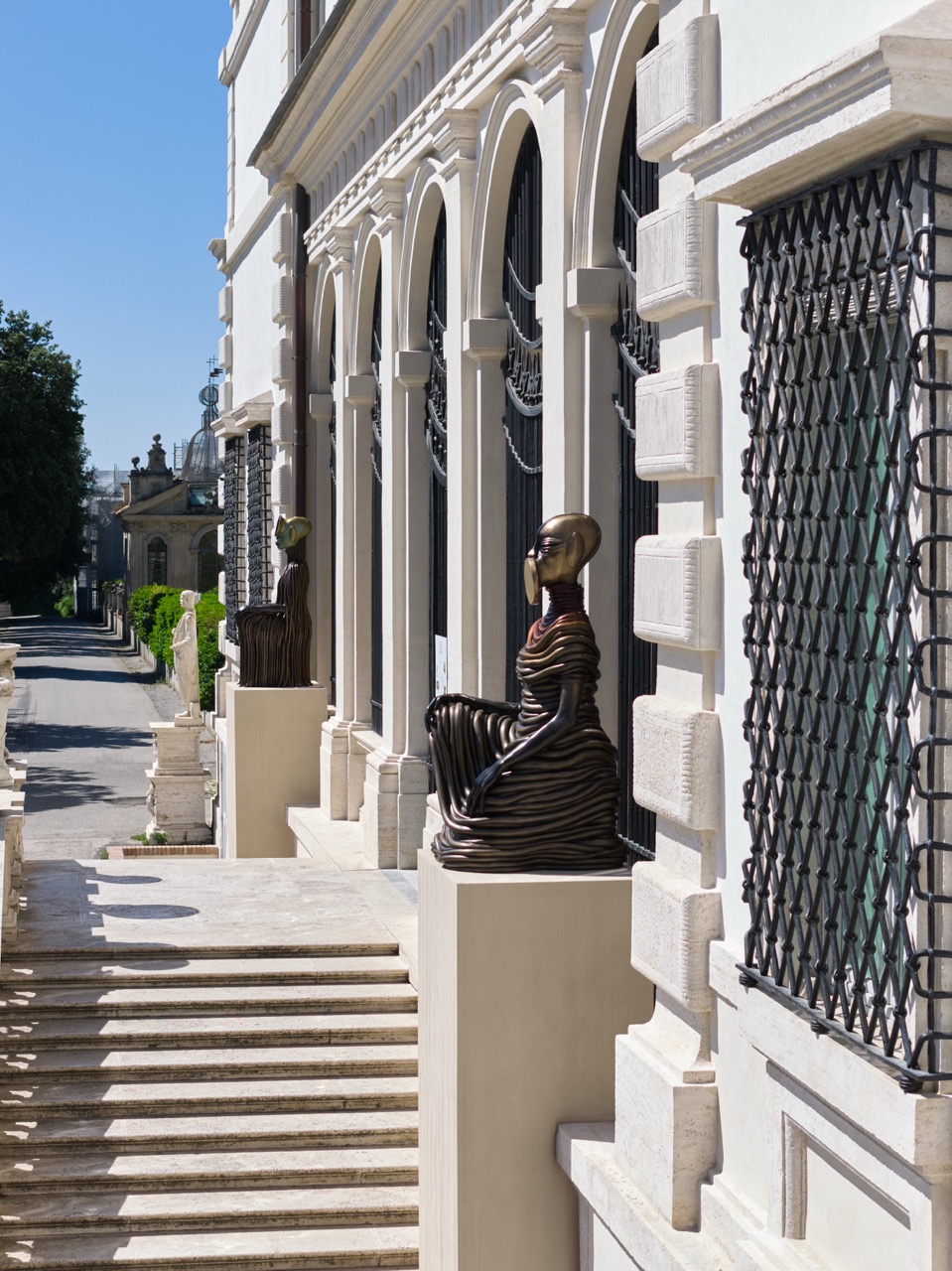
Outdoors, a series of bronze sculptures populate the museum’s façade and Secret Gardens: The Seated I and The Seated IV — two contemporary caryatids originally created for the Metropolitan Museum of Art in New York in 2019 that kickstarted The Façade Commission series — mark a significant moment of engagement between the artist and a major public institution. Also present are Nyoka, Heads in a Basket, Musa and Water Woman bronzes that reinterpret archetypal vessels as sites of transformation.
These works introduce new hybrid forms, part human, part mythological, part symbolic vessel, drawing on the traditions of East Africa and global cosmologies, as if emerging from a symbolic ground. In their quiet occupation of the gardens and architectural thresholds, they offer a counterbalance to the site’s classical order, challenging idealized form and linear narrative in favour of ambiguity, otherness, and spiritual presence. Sound, whether audible or implied, plays a subtle but pervasive role in the exhibition: from the suspended rhythm of Poems by my great Grandmother I, to the lyrics resting in Grains of War, drawn from Bob Marley’s song WAR. The song references Haile Selassie, the last emperor of Ethiopia (1930–1974) and a key figure in anti-colonial movements, whose 1963 speech at the United Nations called for an end to racial injustice. Language becomes sculptural, and sound becomes a form of memory.
Like what you see? Get it first with a subscription to aspire design and home magazine.