




aspire design and home: Let’s start at the very beginning of your process when a client first enlists you to help organize them. What’s your first step?
Keith Johnson: So there are two different appointments that we do now during COVID and the pandemic. We do virtual appointments and then we do an in-person. So virtuals, it’s a little bit more about getting in touch with the customer beforehand and making sure that they can provide us with all the measurements, any photographs of the spaces, anything unique that we should be aware of, like any access panels, obstructions on the walls that we would have to work around. They send us all the measurements that they take and I put it into my software ahead of our conversation. I model out the space in 3D, and then this way, when we get on the call together, we just jump right into it, and then there’s no time wasted. Then I say to them, talk to me about how you want this space to be laid out. Are you thinking that you want some drawers in the closet? Are you going to have a dresser in the bedroom? What’s your hanging situation? So more asking them the questions.


Adh: It sounds like there’s a lot more early groundwork with a virtual appointment.
KJ: It’s a matter of getting their wishlist. I take a very detailed inventory of what they want and then showing them that, well, your space is only so big, so let’s start figuring out what the priorities are in the closet. Then I lay everything out, designing in front of them through the 3D software, but making sure that we have all the information upfront is very important because if we don’t receive the measurements, we get on the call and we have nothing to go off.

adh: Do clients typically have a sense of what aesthetic they’re looking for or do they lean more on your expertise?
KJ: Not necessarily. Sometimes I have them show me around their bedroom so I get a sense of what hardware their doors have that lead into the space and then get a sense of what their style is. And then I pull up a PowerPoint presentation and I run through it with them to get a sense of what their aesthetic is. On that PowerPoint, it illustrates, for example, a flat drawer face, which is more contemporary, and here’s more of a shaker style profile. So the PowerPoint is a really good guide to steer the aesthetic conversation, but it really depends on the person because sometimes I can tell right off the bat, this is a traditional Upper East Side client who wants crystal handles and the traditional drawer fronts, so you also get a sense of who they are.
adh: Do you have a favorite collection or style?
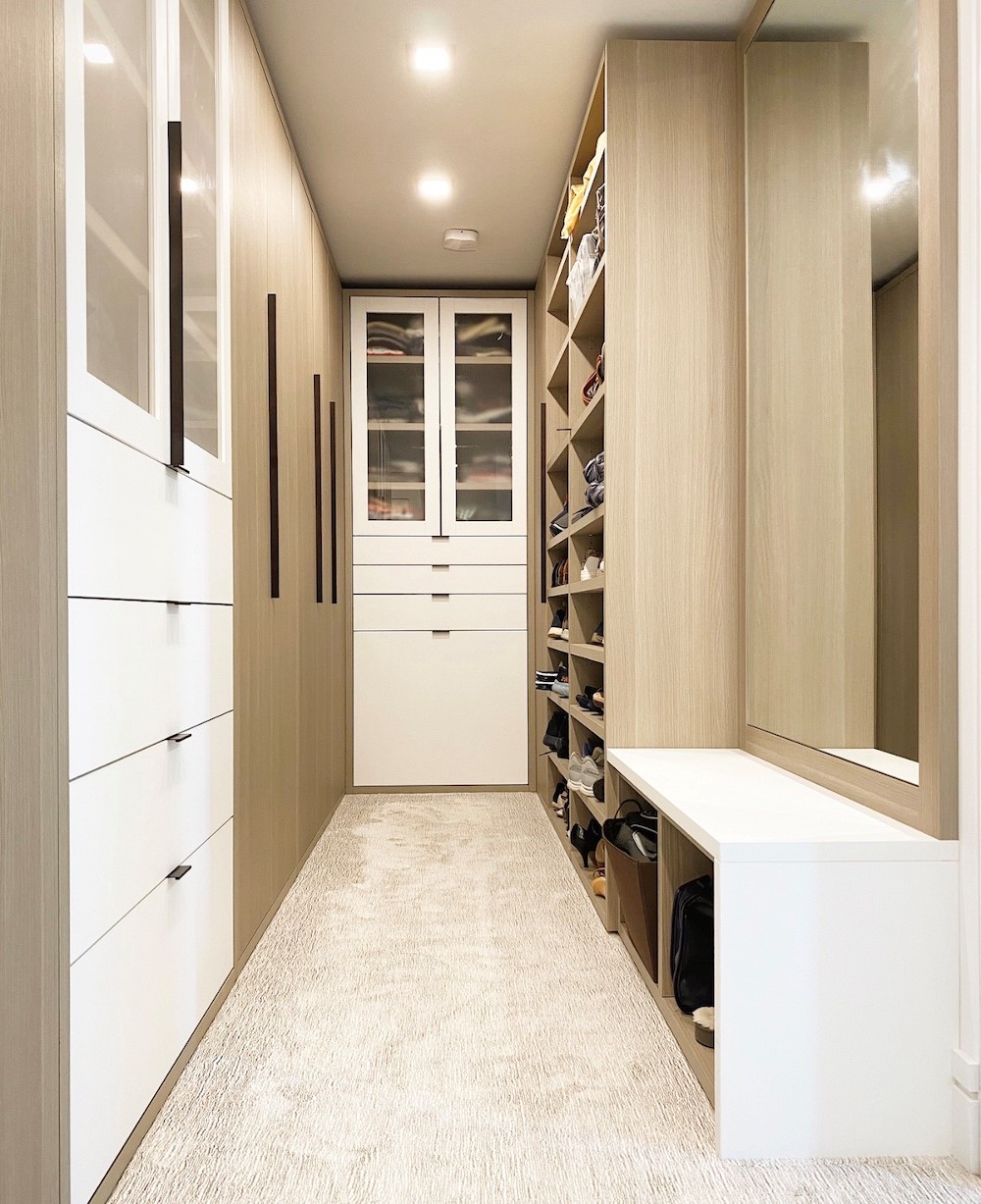
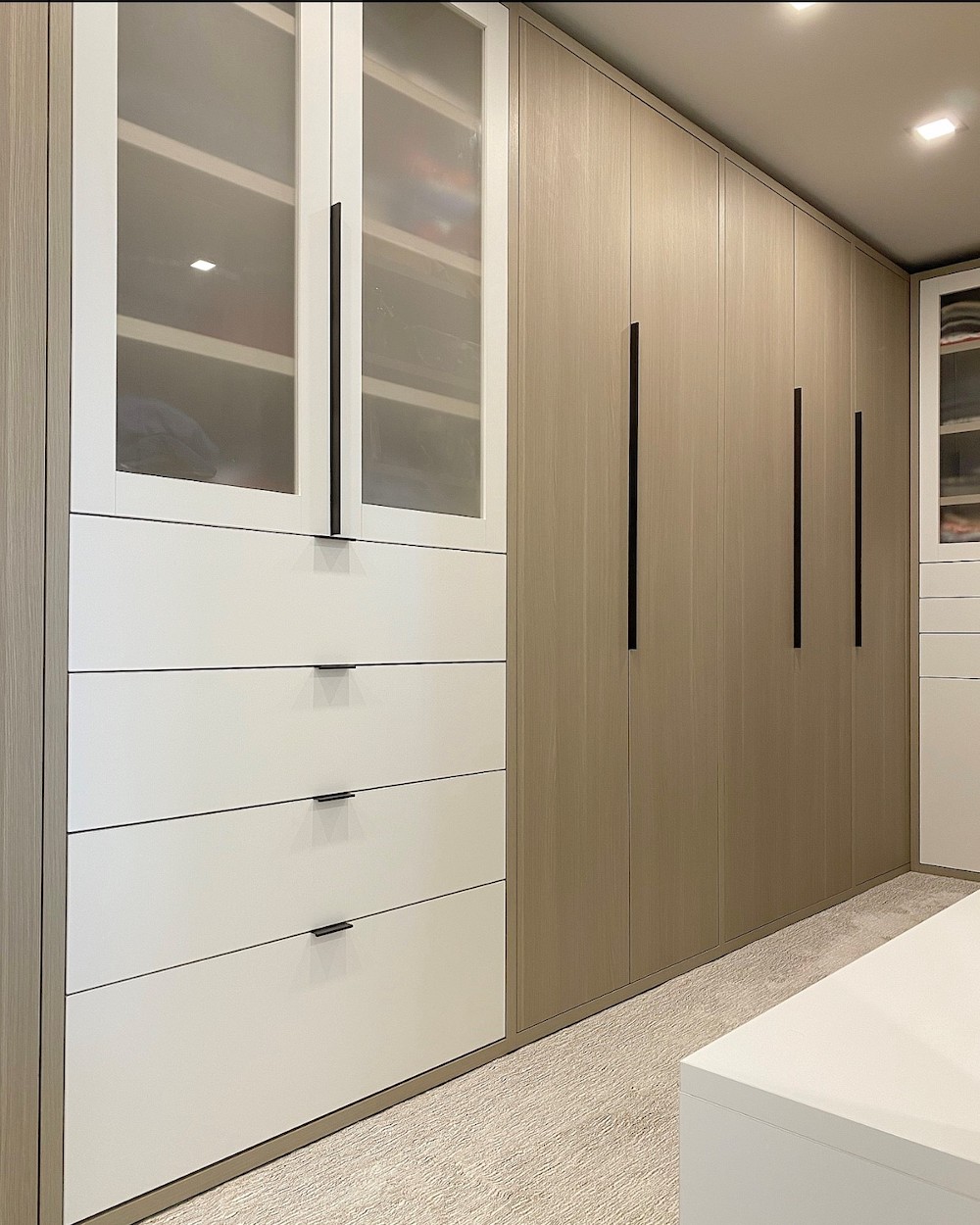
KJ: I love a good inset drawer. Inset is a drawer style that is flush between two partitions. Essentially, the partitions come down the sides and they’re visible. And then the drawer faces are set between them, which is a lot more contemporary and modern in aesthetic, than let’s say, a traditional overlay drawer face, where the drawer face itself or a door overlaps the front of the partition by three quarters. And you don’t have this kind of flush modern aesthetic. It looks more traditional in profile.


adh: Your style sounds like it veers more contemporary than classic.
KJ: Definitely more contemporary.
adh: What does contemporary mean to you and how do you explain it to clients?
KJ: Definitely neutral colors, which are always a topic of conversation with clients. I lay out all my finishes and we look at it with the floor color to get a sense if they want to go with a darker wood tone or if they want a more white aesthetic or somewhere in the middle. A lot of times they want our input. They’ll say to me, well, what do you think works best? And I try not to answer that because I don’t want to alter their decision on color and then have them regret it in the end. So a lot of times, I’ll put a couple colors on the floor that I think work well. And I’ll say, this color profile complements the floor tone and it’s bringing out some of the softer tones of your wood floor versus this one that’s completely contrasting. So do you like more of the contrast or do you like more complimenting?
And then the other big thing when it comes to finishes, I always say that you don’t necessarily want to try to match the wood floor because it’s never going to quite match. You’re using two different wood grains, two different woods. It might be in the same color range, but one’s going to be in a vertical orientation cause it’s up against a wall and one you’re seeing more from a different angle, from above, so it’s never going to look exactly the same. So I always try to steer people away from matching their floors, but either contrasting them or complimenting them.
adh: Color can be challenging because it sets the tone for the entire room; it’s a big design choice.
KJ: One hundred percent, someone can walk into a space and think, ‘oh my gosh, this brown is way too dark, I hate it.’ Another thing to bring up when it comes to color tones is resale value. A lot of times in New York City, clients will ask what other people gravitate towards most and I always say it’s the lighter, more neutral tones than the darker tones. When you get into the darker wood colors, people either love it or hate it. When you get more into the neutral tones, they sell a lot more. For example, our grigio color is a light gray, a neutral gray tone, which is our most popular color outside of white before we start going into the darker tones. And that’s something that we just find people gravitate towards because you can’t argue with a neutral color.
adh: You work in the New York City market where every inch counts. How do you maximize a space’s potential?
KJ: That’s where my background comes in handy. I come from an architecture background. I was in that industry for over 10 years outside of Philadelphia. And then I even went abroad to Australia and did architecture over there for a bit. So that background helps me astronomically. I mean, I can walk into a space and already have it mapped out in my head, like the hanging must go over here. Drawers must go here. You know, shelves must go there, and it’s already planned out when I walk into a space. So just visually, I can walk into a space and understand the best way to maximize it. A lot of times, it’s a matter of taking advantage of the ceiling height. If you have 11 foot high ceilings, I don’t want to give you an eight-foot-high unit, I want to make sure that we go all the way up to the ceiling.
adh: What’s one of the trickier elements to designing a picture perfect closet?
KJ: Shelf widths and drawer widths, I think it’s very important to get right. Because so often people will say something along the lines of, a 30-inch drawer will be much better than a 24-inch wide drawer. And I always say, well, not necessarily because if you’re an adult and you’re a stacker, as in, you fold your clothes and you stack them on a shelf, every stack takes up about 12 inches of width. So I don’t want to give you a 30-inch wide shelf if you’re going to stack two items, cause now there are six inches of wasted space that then could have gone into hanging or gone elsewhere, like shoe storage, bag storage. That’s valuable space.

adh: What made you want to jump from architecture to closet design?
KJ: I was literally about five hours away from completing everything and going for my license when I had a talk with myself and I thought, is this where I want to go with my life? And the biggest thing for me is that I’m not a cubicle person. I cannot sit in a cubicle day in and day out, and work on a computer. I have to be face to face with customers. In the world of architecture, so often our project managers or the partners of the firm, were going out to present the ideas and having the face to face interactions with clients while I was in the cubicle and that just isn’t what I wanted. So I quit and traveled around the world for a year and a half.
adh: What do you love most about your job?
KJ: California Closets is the perfect mix of clients, especially in New York City. I meet people from all walks of life. I do the small studio apartments to the largest penthouses. My whole territory is Manhattan and most of Brooklyn. So I literally see everything. People have come from all over the world and I always find that I can relate to them because you know, a lot of times at our first appointment, the client will say, I’m from India. And I’m like, oh, I’ve actually been to India, where are you from? And we bond on that level, which I think leads to a little bit more trust in that aspect, like oh, this designer gets me and is listening to what I want, so I’m going to trust this person to reorganize my life and make my life more simple. It’s a matter of listening to what they want and then achieving that goal, so at the end of the day, they’re happy. That’s what it’s all about.
Like what you see? Get it first with a subscription to aspire design and home magazine.