

What do you create for a client who wants to celebrate nature without disturbing it? For architect Alexander Gorlin and designer Judy Dunne, the answer was this extraordinary home. It’s designed to practically disappear from the outside, while still offering both modern luxury and a grand connection with nature from within. But how did they and their clients embark on this balancing act?
Celebrate Nature by Fitting In and Being Eco-Friendly
The clients were a family that wanted to be in a private community close to NYC where they could enjoy mountains and lakes. Their sights landed on the picturesque Hudson Valley village of Tuxedo Park. “This is an hour north of the city,” explains Gorlin. “It used to be the place for society to go from New York in the 1880s.” But could this community—replete with late 19th century homes by the likes of McKim, Mead and White—welcome something more modern?
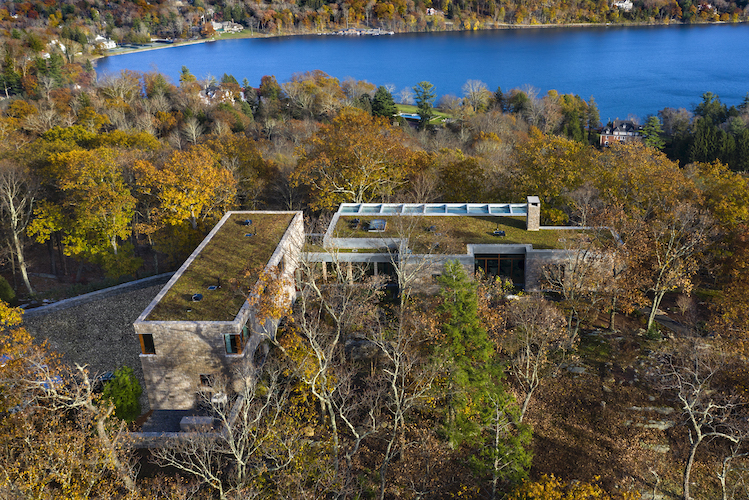
“We had to read the code very carefully,” recalls Gorlin. “Basically, they just didn’t want to see it from the other side of the lake.” Gorlin achieved this by building with native granite and using non-reflective glass. Gorlin notes that this type of glass has only been perfected in recent decades. It’s the same kind one might see protecting priceless paintings in a museum.
Happily, these visual necessities overlapped with eco-friendliness. “It was a fortuitous intersection of desires and requirements,” Gorlin says. The home’s green roof replaced ground cover removed during building. It also helps absorb water and regulate temperature. The windows do wonders when it comes to insulation, and their special glass offers an added benefit. “From the inside, for the client, it gives a sense that there’s literally no barrier between you and the outside,” says Gorlin.
When one thinks of building in harmony with nature, a certain iconic architect tends to come to mind. But is he the right reference for Gorlin? “Frank Lloyd Wright is always appropriate to quote,” Gorlin assures. “He was the beginning. He actually coined organic architecture long before kale and granola.”
It’s Like Frank Lloyd, Right?
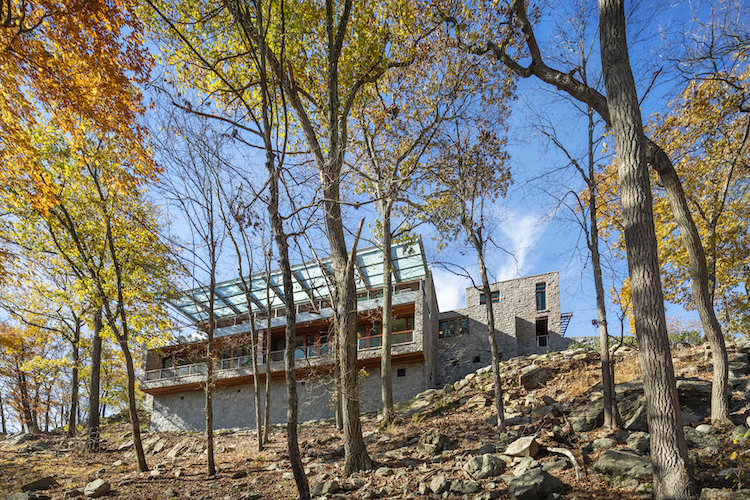
This Wrightian incorporation with the home’s surroundings was in part a request from the owner. “The client wanted to enter at the upper level, have the house set into the hillside, and have the bedrooms below,” Gorlin explains. “So we cut into the rock. And it’s like the house is sitting on a rock shelf that’s partly natural, partly excavated, and then suspended out into space through the cantilevered terrace.” Gorlin notes that, though it may blend in from a distance, the house can also seem grandly imposing when viewed from below its stone retaining wall. “It does have this fascinating duality.”
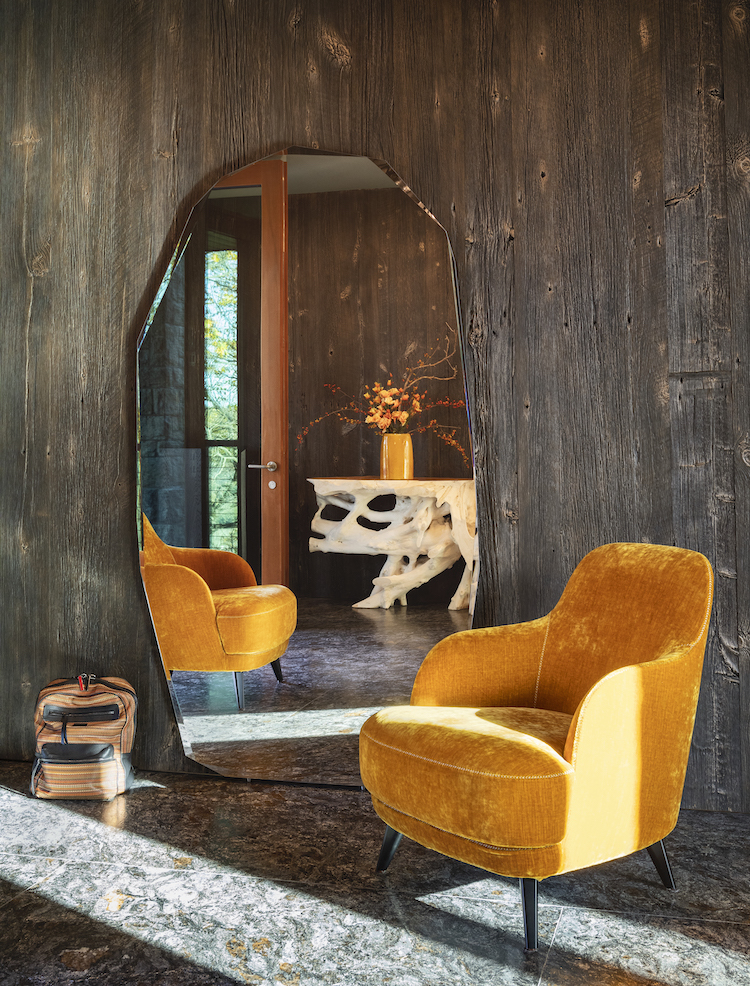
“As you enter the house, you’re really entering almost into this kind of cave,” says Gorlin, referencing an entryway of reclaimed barn wood and stone. “But then, when you’re in it, the house seems to become the background to the view.” After entering, one proceeds down a hall, past a rock garden, and toward a view that makes one seem perched in the canopy. “You feel like you’re in a tree house,” says Gorlin. “Many houses built on the hills just look above, but here you’re actually in the tree canopy looking through to the lake. You really feel like you’re a bird in a nest.”
Gorlin also sought to improve upon Wright’s juxtapositions with nature in certain regards. “Wright often exposed the natural rock to the interior, but that creates complications in terms of runoff and water,” Gorling explains. “We were more practical in creating waterproofing between the rock wall and the inside of the house.”
Celebrate Nature Through Design
“Alex was onboard right away,” recalls Dunne of the project’s timeline. “I came into the picture a bit later.” By that point, the house’s exterior was fairly fully formed. And they’d already gone through extensive approvals with local authorities. Yet red tape had not dimmed the family’s enthusiasm for the location. “They came to me having the utmost love and respect for where the house was being sited,” she remembers. This influenced many of Dunne’s ideas.
The result was a design in which Dunne layered materials, seeking ways to bring the outside in. “You have a local stone on the floor and on the fireplace,” she says. “But then you have this beautiful barn wood—that’s rustic feeling—and then it has this state of the art finish on it. So you create this wonderful play between rustic and modern.”
Other entryway materials include a chandelier of natural crystals, which are meant to promote good health. Beneath it, a chair cuts a modern silhouette even as its vibrant color connects back to nature’s brilliant foliage. “There were so many layers of materiality that make this even more luxurious and delicious,” Dunne recalls.
Dunne also reveals that the client had an early notion about incorporating even more stone—cladding the adjoining hallway wall in onyx. Cost and sourcing issues led them to, instead, use 10-foot panels by the artist Alex Turco. “They’re a wonderful, poetic gesture that moves down the hall,” she says. “They’re magnificent at sunset when they sparkle.”
Celebrate Nature Designing On Its Own
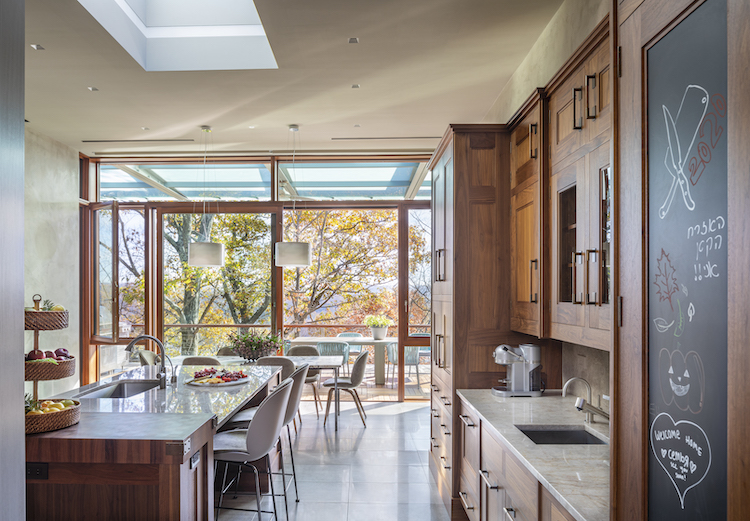
Wood and stone were also keywords when it came to the kitchen—along with functionality. “There seem to constantly be people around the house,” Dunne remembers. “So first and foremost, function was important. But the aesthetic is also warm and beautiful.” She attributes some of this warmth to pieces from Christopher Peacock. Meanwhile, for the countertop, they chose quartzite for durability.
Another goal was to create a comfortable, eat-in kitchen area. Completing this involved discovering another remarkable slab of quartzite. They fell in love with it and decided to turn it into a custom table for this area. “Being able to keep layering in more natural materials,”she said. “It was a ton of design by nature.
Another testament to the clients’ love of stone is the beautiful rock garden by landscape designer Janice Parker. Both Gorlin and Dunne sing her praises. “I feel comfortable in interior spaces. I wish I had the same acumen outside,” says Dunne. “Janice is a genius.” Dunne specifies that Parker’s creation both celebrated the existing landscape and amplified it. “And so, again, nature did us right,” Dunne notes.
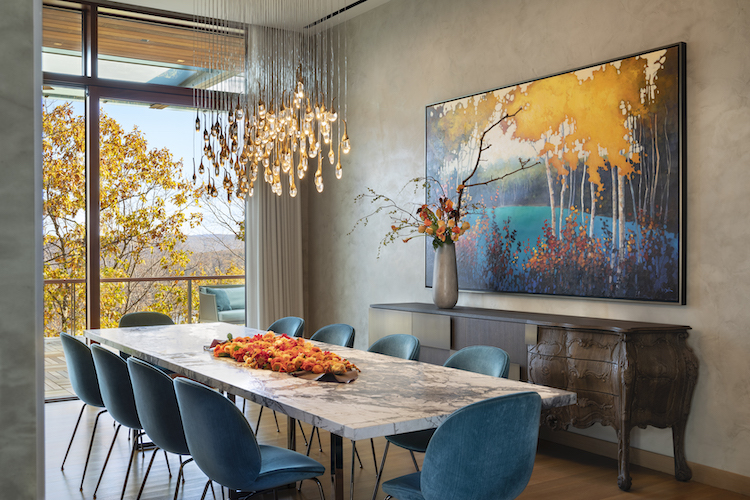
A chandelier from Ochre and chairs via Gubi–Suite NY participate in the extraordinary match with art by Linda Wilder.
Discovering an Artist that Speaks to the Palette
Another of the home’s many choices that celebrate nature was serendipitous. Looking at the dining room, one might assume Dunne found the landscape that hangs on the wall and shaped the space to match it. In fact, the process happened in reverse.
“On one side of the dining room, we have this wonderful credenza that’s half Baroque, half very modern. And on the other side of the dining room is this wonderful, 17-foot long bespoke buffet by Wood Furniture,” Dunne says. “Then, in between, is an 11-foot custom-made stone table—back to our love of stone,” she adds. “Over that are these little seedling light fixtures from Ochre.” All of that existed before the art.
“Then the owner saw a painting she liked,” Dunne recalls. “The artist is named Linda Wilder. And she does all of these remarkable, pastoral, nature scenes.” Dunne and the client explored Wilder’s website until they came across a piece that was an amazing match for the space. “It was as though she had created it based on our palette,” says Dunne. “We commissioned something similar—an original piece of art but based on something she had done.”
Regarding the photo, Dunne nods toward yet another touch of design by nature. “The tree outside was very agreeable in giving us exactly the same fall color,” she says with a laugh.
Celebrate Nature from Every Angle
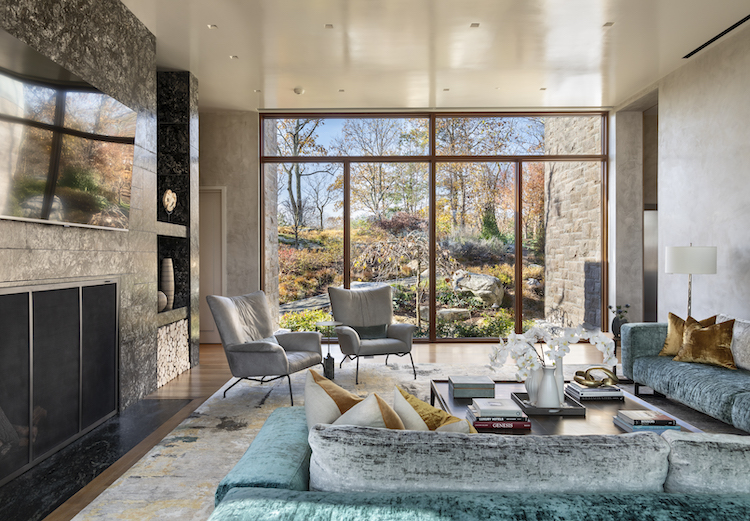
But once a home faces some beautiful aspect of nature from every angle, where does one focus the living room? For Dunne, it was a matter of providing enough expansive sofas and additional seating for to accommodate every view. “So you have one vantage point facing out to the rock garden. You have another one facing the fireplace and the TV. And you have chairs that face out toward the terrace,” she explains. “I think we tried to capture all angles, being mindful that some of the experience of being in the room is about being together.”
Dunne’s discovery of what would become the rug for this space was happily akin to finding the art for the dining room. “I went into one of the showrooms we work with frequently, and some version of it existed as a very small piece.” It was in the right palette, and Dunne knew that—at the right size—it would pull together the room. And it did. “A lot of those kismet moments happened,” says Dunne of the project as a whole.
Shaping Ample Outdoor Space
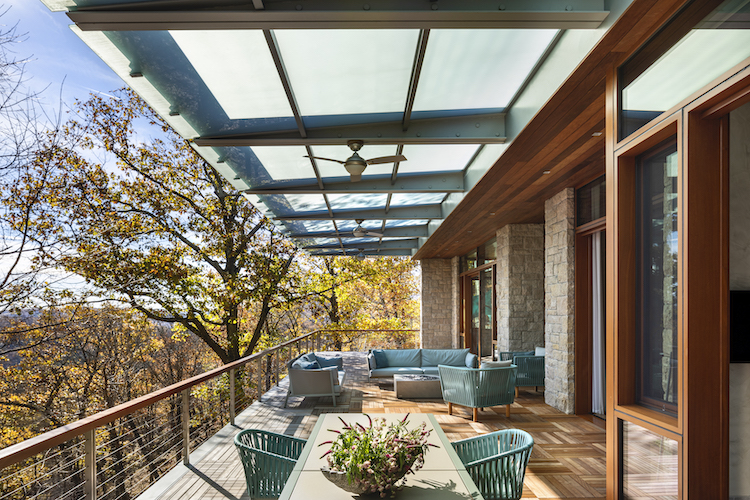
How does one begin to organize a terrace so large that one can see it from every room of the house’s main floor? Dunne started with the palette. “Those soft blues and teals,” she says. “Those were something that we knew was coming out to the terrace.”
Dunne also did her best to match what would be happening inside. “We coordinated functions,” she explains. “So if you’re dining, we like the idea that you can walk straight out and continue dining.” Thus, the living room lounging area leads to similarly lounge-worthy space on the terrace. “It becomes a very flow-through space,” she says. “You want to be able to have somebody easily roll right out.”
One of Dunne’s fondest memories of the project was the first big reveal of the house for the family with the furniture in place. “Within maybe 15 minutes, all the kids were out on the terrace, fully laying around on the sofas, super happy,” she remembers. “Nobody was moving them anytime soon.” Dunne loved seeing everyone gravitate toward the careful balance with nature they achieved on the terrace. “You can be completely outdoors but not stuck in the elements,” she says.
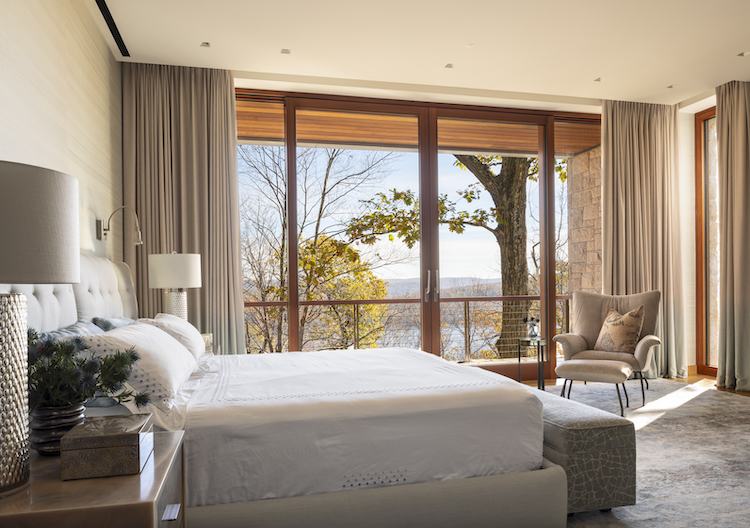
Secreted away on the home’s lower level, the bedrooms offer plenty of privacy, their own terrace space, and beds by Flou.
Creating Private Space That Still Celebrates Nature
That’s not to say the entire building is beckoning visitors to the main terrace. There are places for private retreat, as well. “The house is sort of upside down,” says Dunne. “You come in the entrance, and all the public spaces are on grade. And then the bedrooms are on the lower floor, really nestled into the hillside. But even these spaces get smaller terraces of their own.”
Whether shaping space for the massive terrace above or moments of retreat below, Dunne loved working with the homeowners. “This is a client who was really excited to go on the journey,” she says. Dunne says that she loves this collaboration, interaction and dialogue with the client—contrary to conventional designer wisdom. “Everybody loves a client who’s like, ‘Here! Here’s a blank check, and here’s the keys to my apartment! Go!'” observes Dunne. “That’s less how I work.”
Dunne also appreciated Gorlin. “Alex and I have known each other for 20 years and have worked together, but this was a big project,” she says. “He’s a remarkable architect with unbelievable skills,” she adds. “I was lucky enough to come in and continue what he had already started—with great appreciation.”
Gorlin is also happy with his decision to recommend Dunne to the client. “We worked more closely than usual with an interior designer,” he recalls of his experiences with Dunne. “Rather than simply running off with the client, she reviewed everything with myself also.”
Moreover, Gorlin genuinely enjoys working with Dunne. “When it’s a good experience with an interior designer, it’s wonderful. And when it’s not, it’s horrible,” he says. “With Judy, I’m always guaranteed of a happy ending.” Together, they created one for their clients, as well.
Paul Hagen is a writer and editor for aspire design and home magazine.
Photography by Peter Aaron.
Want another disappearing home? See an architect and designer use their magic touch.
Like what you see? Get it first with a subscription to aspire design and home magazine.