




If one were to encounter Christopher Florentino (a.k.a. the artist Flore) shirtless on a beach, it would be easy to guess his profession. The 38-year-old’s body swarms with tattoos. By his collarbone is a Keith Haring radiant baby; on his left shoulder, a pair of Kaws “Companion” figures. Elsewhere on his clavicle is a Jeff Koons balloon dog. There’s a Warhol on his back and, over his heart, two paintbrushes. By his right thumb are the words “Wet Paint.” “Art is the way I live, what I live,” Says Florentino. “I put it all over my body to celebrate it.”
But though he is an artist with a capital “A,” Florentino is just as passionate a proponent of midcentury modern furniture and aesthetics. His path to this loft condo in a Chad Oppenheim-designed building in Miami’s North Bay Village was paved as a teenager. While in sixth grade, he worked for an antique restorer who showed at a local flea market near Florentino’s childhood suburban New Jersey home. On his lunch break, the artist-to-be strolled the aisles, which is how he came upon a beat-up 1956 Eames plywood-and-leather lounge chair sans ottoman.
“The guy agreed to hold it for me while I saved enough money to buy it,” recalls Florentino. “He ended up selling it to me for $300.” An aunt reupholstered it for him and took her nephew to the Museum of Modern Art in New York to see a more pristine version, while Florentino’s parents gave him a book on Charles and Ray Eames that he devoured. The chair followed him to his first Brooklyn apartment at age 19. Soon he was buying midcentury modern ashtrays, lamps, a credenza. “Then, you know,” he says, “you go down the rabbit hole.”


Almost before he knew it, Florentino had purchased a 1963 Miami home designed by Gene Leedy. Up until then, Flore was mainly known for his “Urban Cubist” paintings. These jumbled, brightly colored graffiti-like compositions of signs, Takashi Murakami-esque flowers (minus the smiley faces) and cartoonish eyes, mouths and hands, he admits, owe some thematic inspiration to artists such as George Condo and Kenny Scharf (an “awesome dude” that the artist considers a mentor). But the Leedy home inspired a new “Modernist” series of paintings. They had the same Pop Art-colored palette but manifested as gestural abstractions that resemble mashups of Willem de Kooning, Cy Twombly and, most apparently, Joan Mitchell. (Art Angels in Los Angeles just showed various juxtapositions of Urban Cubist and Modernist paintings, and this summer Florentino will have a solo show, ‘Numbers and Colors,’ in South Hampton, New York at Chase Edwards Gallery, opening July 4th.)


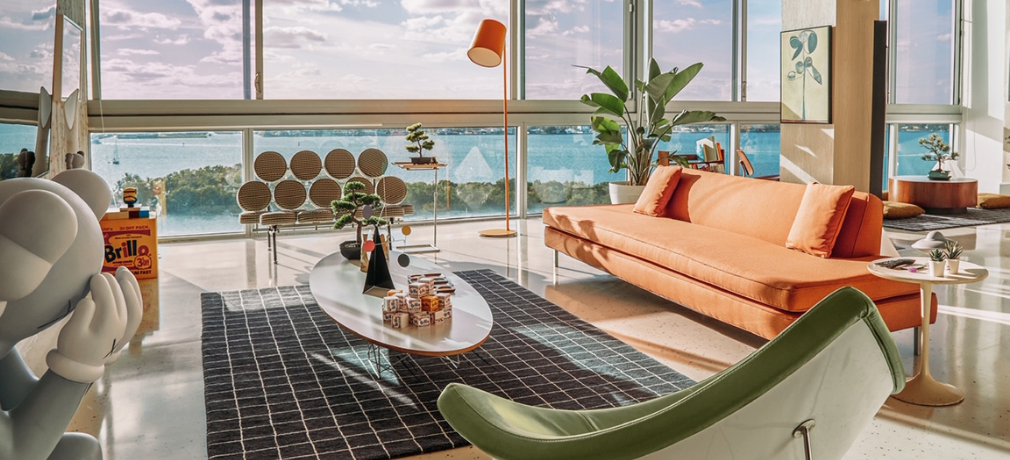
After six months he sold the house and moved here. Certain pieces made the journey: a 1955 George Nelson Coconut chair, an Eero Saarinen 1970s Tulip side table, a 1951 “Surfboard” table and a 1946 LCW molded plywood side chair (both by the Eameses). But the inspiration for the space was actually the late Japanese designer Shiro Kuramata. Florentino, in fact, calls the apartment his “Ghost” loft after Kuramata’s Oba-Q lamp, which shares a corner seating area with the LCW chair, a circa 1962 round teak coffee table, and a framed Roy Lichtenstein poster above a plant stand that accommodates bonsai trees (“I’ve been obsessed with bonsais since the movie ‘The Karate Kid,’” explains Florentino, “because they’re living artworks you sculpt”).


Florentino further pushed the ghost metaphor with a Pac-Man ghost lamp commissioned from a neon website. Kuramata’s furniture and interiors often employed a modern version of terrazzo (also a feature of the Leedy house), but the actual material was too expensive for Florentino, who instead poured flecked white epoxy onto the concrete floors. He also could not afford rose quartz countertops in the kitchen (“rose quartz brings love,” he observes), so pink epoxy became that material’s stand-in.


A rare 102-inch-long George Nelson bench sits in the middle of the room “like benches in a museum,” Florentino says. It is a prime perch for viewing his many vintage gems, which also include Nelson’s Marshmallow seating and a coral pink Knoll sofa. The loft is also a working studio, as evidenced by the easel set up between the bonsai trees and the bed (art supplies are stored in a closet next to the bed). Conceptually then, Florentino’s paired passions – art and design – meld into one cohesive space.
Photography by Megan McCluer.
For more like this Miami loft, be sure to check out these 8 art-oriented spaces.
Like what you see? Get it first with a subscription to aspire design and home magazine.