


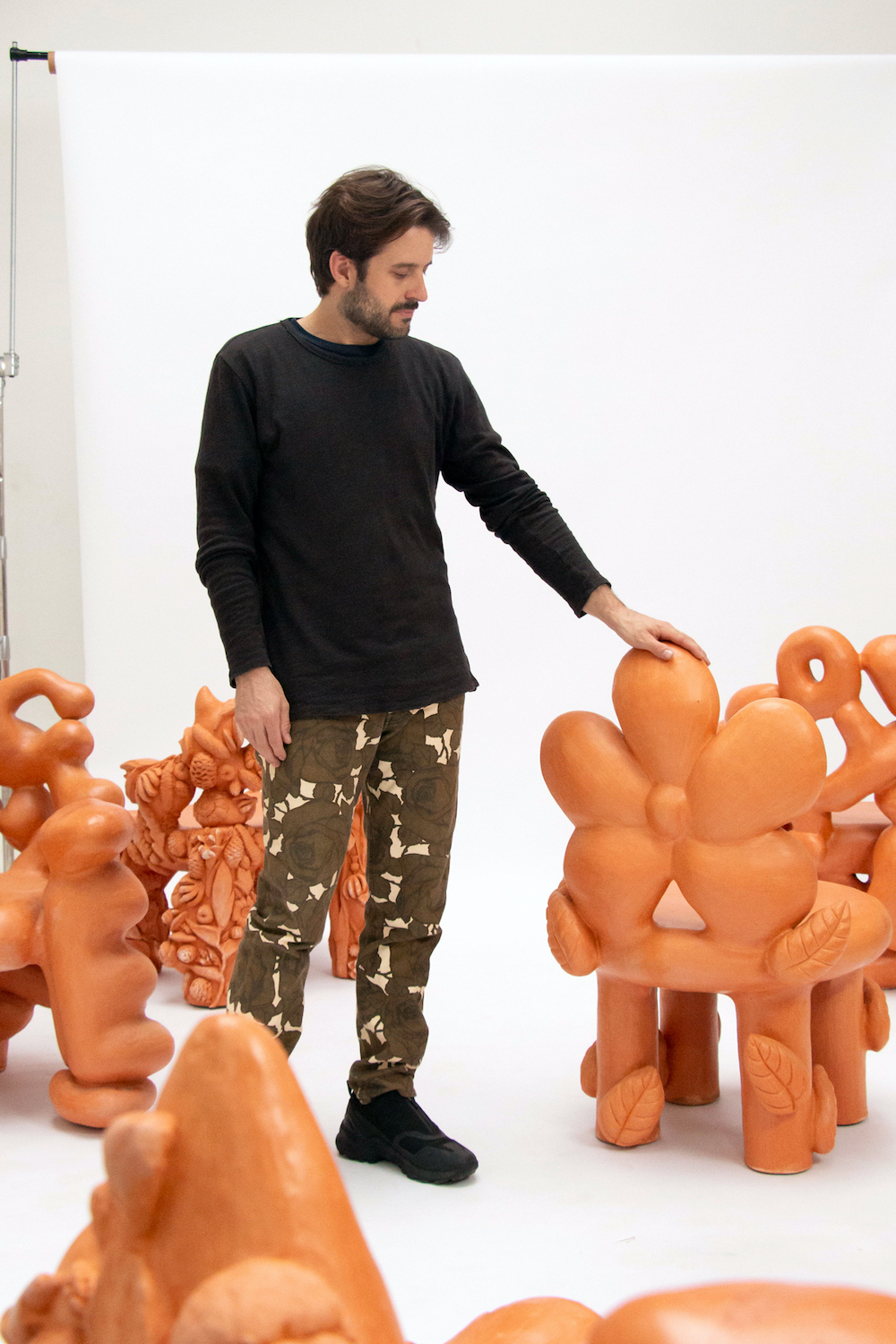
The Future Perfect presents “Flower Power” from Chris Wolston. Photo by David Sierra.
Sculptural furniture designer and artist, Chris Wolston is getting in the spirit of spring with his latest solo exhibition for The Future Perfect: Flower Power. On view from May 18th–June 30th at the gallery’s West Village townhouse, Flower Power marks a new direction for the artist’s ceramic practice with the debut of a series of terracotta furniture and lighting—the first ceramic collection he has made exclusively for The Future Perfect.
Drawing inspiration from the blossoming tropical flora found in the mountains and forests of Wolston’s adopted home of Medellin, Colombia, Flower Power probes and celebrates the cultural significance of the flower—from the practice of planting and cutting flowers to express joy, love, remembrance, and romance, and its various other symbolic meanings; to the role the flower industry plays in both the local and global economies; to its emblematic use in social and political movements. The exhibition’s title alludes to the phrase coined by beat poet and counterculture leader Allen Ginsberg in 1965 as a means to transform anti-war demonstrations into peaceful affirmative spectacles, through the use of love, unity, and imagination.
“The ‘flower power’ movement and its ideals—universal belonging, peace, love, unity, respect—are sentiments that I hope resonate throughout my work,” notes the artist. “We still see the offering of flowers as a gesture of peacemaking. Flowers are more than an olive branch—they stop you dead in your tracks, and force you to reconsider your relationship to the world around you.”
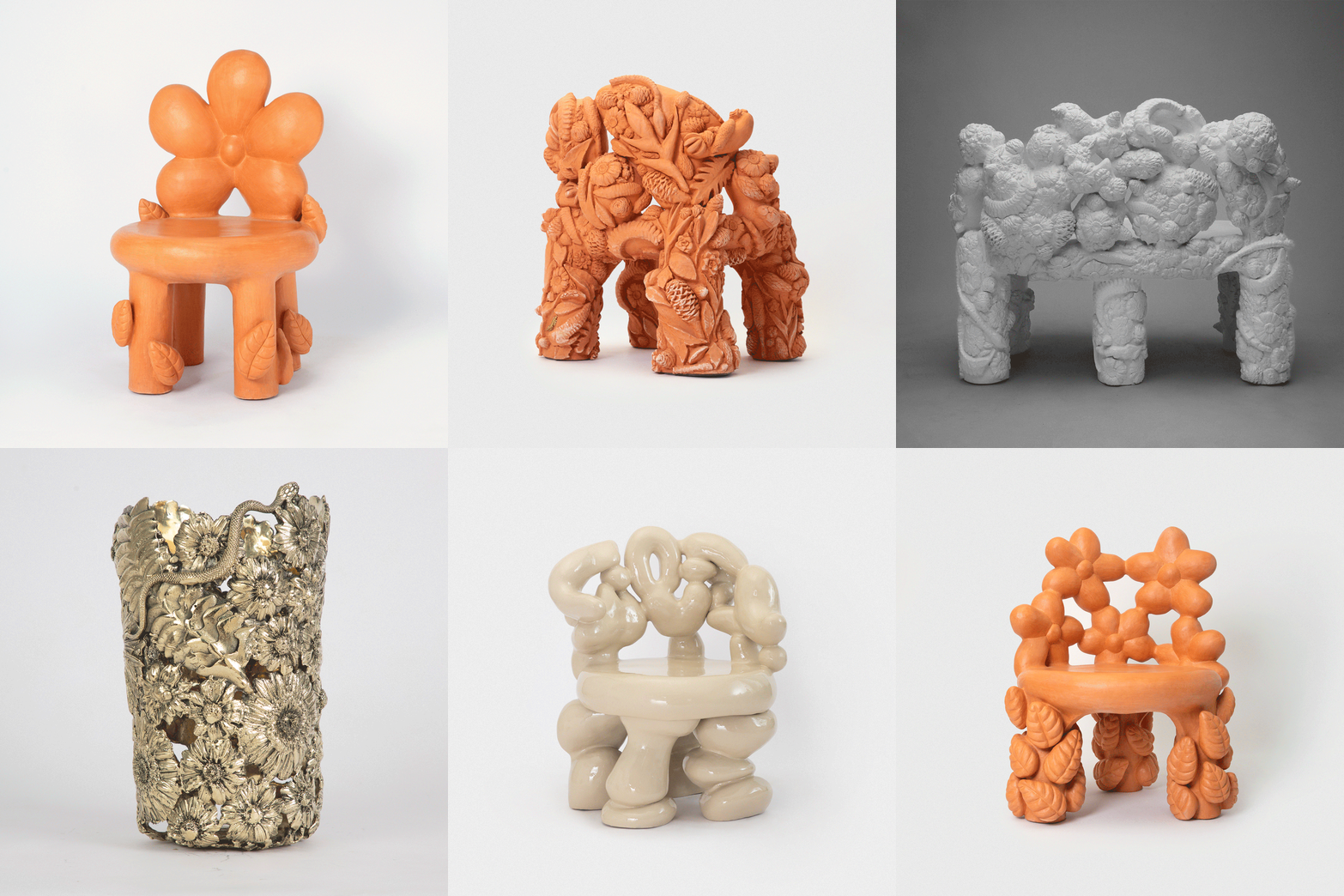

At the center of the exhibition is a series of thirteen throne-like botanical terracotta chairs and benches—some textured with detailed ceramic casts of plants, flowers and wild fruit from the artist’s own garden (heliconias, sunflowers, red ginger, birds of paradise, daisies, banana tree blossoms); some adorned with exaggerated and enlarged flowers and leaves, sculpted and molded by hand; while others are composed of abstract, gestural, amorphous growths reminiscent of vines and adventitious prop root structures. With the collection, Wolston will additionally unveil two light sculptures in the same styles—an amorphous table lamp reminiscent of a log devoured by insects and woodpeckers; as well as a chandelier comprising a bronze menagerie of abstracted blossoms and leaves reminiscent of a mango tree branch, complete with an opalescent glass orb blown in Murano, Veneto—the artist’s recollection of the wild vines that have overrun his chicken coop. Bronze casts of life-size rubber critters—ants, bees, centipedes, salamanders—accent various pieces in the collection, stealthily crawling on the backs of chairs. The bronze-casting is echoed again in the series of vessels that summarizes Wolston’s explorations of technique in Flower Power.
In addition to celebrating Colombia’s lush environment, the exhibition pays tribute to the nation’s status as the floral capital of the Americas, with Colombia now supplying roughly seventy-five percent of the cut flowers used in the United States, a fact which takes its roots in economic initiatives of the 1960s.
In one work titled Flower Chair, Wolston uses a curvaceous, retro depiction of a daisy as the chair’s backrest. In addition to the flower’s symbolic meaning within the ‘language of flowers’—rebirth, new beginnings, innocence, purity, love, hope—the period-stylized daisy brings to mind its symbolic use in the 1960s as an anti-war symbol following Lyndon B. Johnson’s infamous 1964 presidential campaign television advertisement, “Daisy Girl,” which sees a little girl’s counting of a daisy’s petals equated with the countdown of a nuclear missile launch, the ad ending with Johnson ominously stating, “We must either love each other, or we must die.”
Like what you see? Get it first with a subscription to aspire design and home magazine.