


Darrel Ellis, Self-Portrait after Photograph by Robert Mapplethorpe, 1989. Ink on paper, 23 x 30 in. Collection of the Whitney Museum of American Art. © Darrel Ellis Estate and Candice Madey, New York.
Currently on view through September 10, 2023 at The Bronx Museum of the Arts, Darrel Ellis: Regeneration is the first comprehensive museum exhibition on the profoundly moving and complex work of Darrel Ellis (1958-1992), who over the course of his brief career developed a distinct studio practice that merged the formal vocabularies of drawing, photography, painting, and printmaking to redefine Black male identity and family within the constructs of art history and mainstream culture. Organized in collaboration with the Baltimore Museum of Art, Regeneration triples in scale as it travels to the artist’s birthplace of the Bronx, and is curated by Antonio Sergio Bessa, Chief Curator Emeritus at The Bronx Museum, and Leslie Cozzi, Curator of Prints, Drawings & Photographs at the Baltimore Museum of Art. Additional research for this project was provided by Bronx Museum Curatorial Fellow Kyle Croft.
While Ellis was on the cusp of major recognition in his lifetime, his career was cut short by his untimely death at the age of 33 due to AIDS-related causes. Regeneration examines the full arc of Ellis’s career through over 160 works on paper, including an expansive group of portraits of family members that offer a record of Black domestic life and aided the artist in working through trauma and loss, as well as a body of work created within the last few years of the artist’s life as he struggled with living with the AIDS virus. In addition to featuring archival materials, including Ellis’s detailed notebooks, the exhibition and accompanying catalog reveal the results of a comprehensive technical study into Ellis’s process and unconventional use of materials that provide new insights into the artist’s life and work.

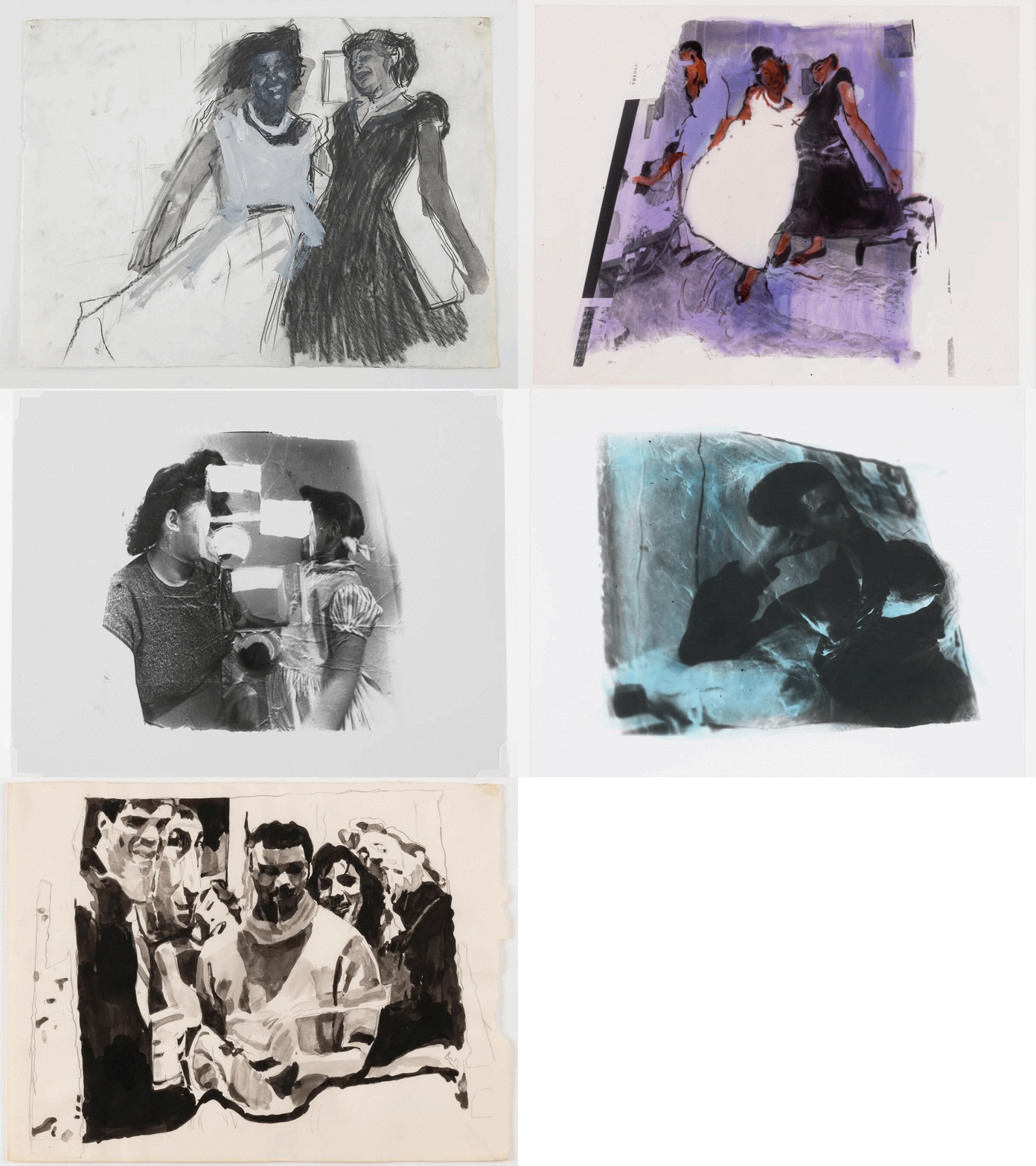
Image 1: Darrel Ellis, Untitled (Aunt Lena and Grandmother Lilian Ellis), ca. 1990. Collection of Frank Franca. Image 2: Darrel Ellis, Untitled (Aunt Lena and Grandmother Lilian Ellis), ca. 1983-1988. Image 3: Darrel Ellis, Untitled (Mother and Laure), 1990. Private collection. Image 4: Darrel Ellis, Untitled (Self-Portrait after Allen Frame Photograph), ca. 1990. Collection of Tim Garvey. Image 5: Darrel Ellis, Untitled (Friends), ca. 1990. All images © Darrel Ellis Estate and Candice Madey, New York.
To produce his work, Ellis employed a wide range of media, including painting, printmaking, drawing, sculpture, and collage, often generating variations on a single image. His raw source material was often drawn from negatives made by his father, Thomas Ellis––a gifted photographer and postal clerk who was killed during a confrontation with plainclothes police officers less than two months before Darrel’s birth. His wrongful death was never acknowledged in court and the tragic event shaped Ellis’s life and artistic path. Ellis’s highly inventive process entailed projecting his father’s negatives onto sculpted reliefs, obscuring areas, and re-photographing the results. In the resulting work, faces of his relatives are often obliterated through holes resulting from the projection of his father’s images onto irregular surfaces. As Ellis noted in a 1987 diary entry: “The hole is there instead of a normal whole image of family to signify the present condition of the family (fragmented). Not whole. It is impossible presently to try to show a whole—a ‘normal’ reality, since it does not exist.”
“Darrel Ellis developed a unique approach to image-making that can be seen as in dialogue with the cool, theory-laden approach embraced by artists of the Pictures Generation. But the stakes for Ellis were of a personal order, and ultimately his work became an investigation of his own subjectivity,” says Bessa. “Using his father’s archives, Ellis’s produced works that can truly be called ‘psychological images’; works that confront his father’s perpetual absence, and his own mortality resulting in a body of work in which the real intersects with the symbolic, the present with the past, and the photographer with the viewer.”


Darrel Ellis, Self-portrait based on Peter Hujar photograph, ca. 1989. The Baltimore Museum of Art: Purchase with exchange funds from the Pearlstone Family Fund and partial gift of The Andy Warhol Foundation for the Visual Arts, Inc. © Darrel Ellis Estate and Candice Madey, New York.
Ellis’s approach extended to his self-portraits and interpretations of portraits of himself modeling for artists such as Peter Hujar, Allen Frame, and Robert Mapplethorpe––photographers who, like Ellis, reflected their personal experiences in their work. Upon being invited to participate in Nan Goldin’s controversial 1989 exhibition at Artists Space about the AIDS crisis, Witnesses: Against Our Vanishing, Ellis decided to reinterpret the photographs that Mapplethorpe and Hujar had respectively made of him in 1980 and 1981––both of whom who had recently passed away from AIDS-related causes. It was also around this time that Ellis had learned that he was HIV-positive but kept it private. His notebooks from this time convey his concern with health issues and natural diets. Most strikingly, in a page of one of his notebooks, on the side of an I Ching hexagram Ellis jotted down: “Do I have AIDS?” Created at a time of highly personal questioning, this historical body of work conveys the artist’s own struggle with the social and physical costs of the AIDS virus. Of Ellis’s self-portraits, Allen Frame notes in his essay, “Stunning photographs, his mediation of them was poignant and confronting: the model talks back, pronounces his own truth.”
Like what you see? Get it first with a subscription to aspire design and home magazine.