


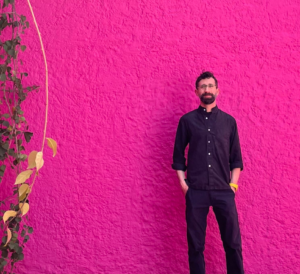

Andrew Joseph: How do you approach a new design project?
Daniel Ian Smith: At Village West Design, our approach to a new design project involves a unique method I have dubbed “Design Therapy.” First, our intake process focuses on understanding the individual homeowner’s personality, tastes, and goals, zeroing in on what’s currently lacking and how they want to feel when they come home. Our process emphasizes clear communication and trust, and I carefully uncover what makes the client genuinely comfortable, happy, and inspired—most of the time discovering things that they were not aware of or had not considered. By combining design knowledge with a deep understanding of the psychology of spaces, we continue along this path to create personalized, emotionally resonant environments that are satisfying functionally, aesthetically, and psychologically.

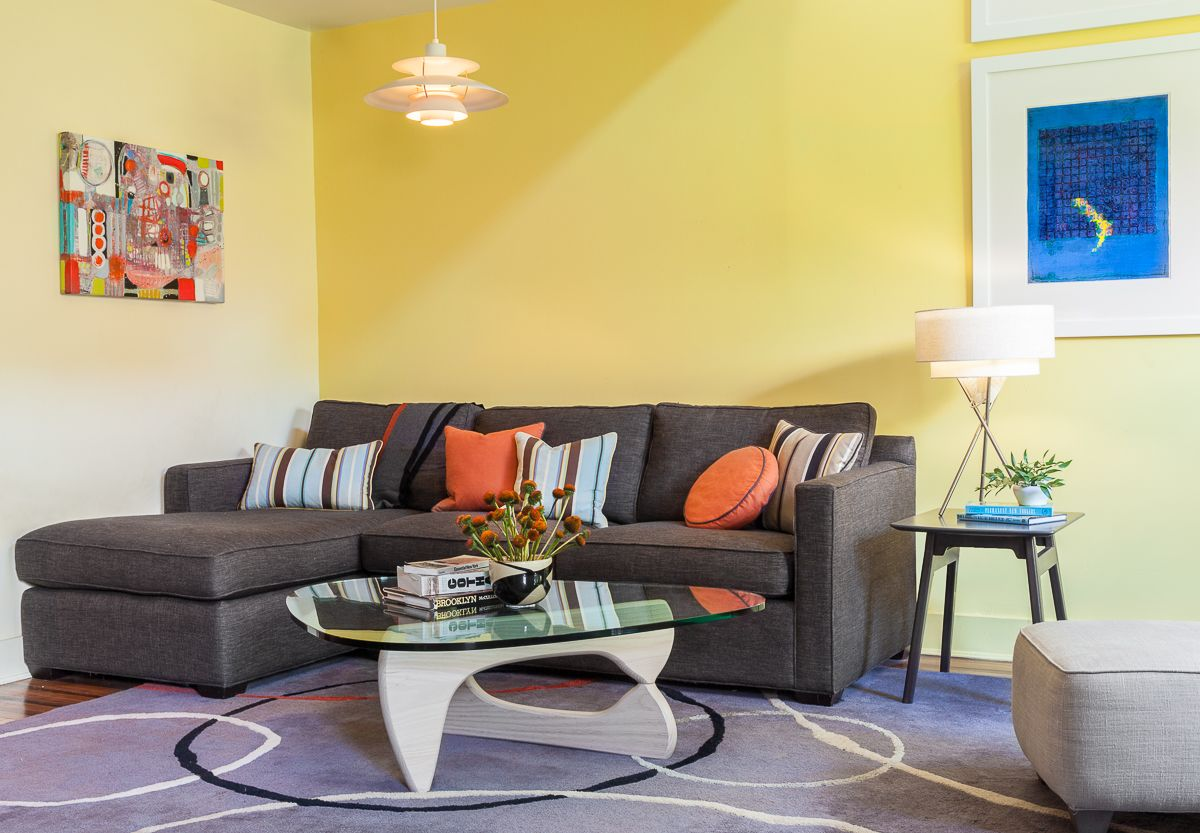
This living room seamlessly blends airy elements, featuring light yellow walls, a sleek glass table and minimalist art.
AJ: What is the most important element in a successful interior design?
DIS: Every successful project starts with having a solid rapport with your client. The more solid that connection is, the better the results.
AJ: Can you describe a project that you’re particularly proud of?
DIS: Recently we worked on a 17-room house from the 1880s, which had some lovely original details but just didn’t “pop.” To transform it into a truly “grand” home, we not only furnished it throughout, but also introduced focal points and built-ins; replicated and added all manner of trim; and embellished it with wallpaper, high-gloss paint, stone, and antique glass. The beauty of our intervention here has led to a minor but unexpected challenge: the new work is so well integrated into the 19th Century architecture that it’s hard for guests to really appreciate how much work we did! This invisibility makes me a little bit wistful, but is also part of what I’m so proud of. At the end of the day, though, clients as enthusiastic as these homeowners always make for a fulfilling project.
AJ: What is your favorite type of furniture to design?
DIS: Every time I get to design custom furniture, I find new appreciation for our genius furniture designer colleagues. Recently, I find that my initial inspiration comes from some incredible textile I’ve fallen in love with, and then I’m driven to design a piece that really showcases that particular pattern/texture/color.


In Smith’s projects, color plays a pivotal role, seamlessly woven into every element, from the rug and stool to the desk, lamp and artwork, creating a cohesive working space.
AJ: Can you describe a project where you had to work with a specific theme or motif?
DIS: We’ve had a bunch of industrial loft projects lately, and it’s fun to figure out how to convert these really unprocessed, almost primitive spaces into luxury living while maintaining their intrinsic character. Ironically, my first project was the opposite. It was on a high floor in an uptown skyscraper and had low ceilings and traditional details, but the client wanted it to feel like an industrial loft. He wanted exposed brick…but there wasn’t any brick to expose! I had to identify and harness all of the attributes of a downtown artist’s studio and simply convey the FEELING of light and air, spaciousness and raw materials—without resorting to a literal fake brick veneer.
AJ: How do you incorporate art into your designs?
DIS: My favorite thing to do besides devise a new floor plan is to hang artwork on the walls. It is probably the single easiest and best way to personalize any space. After all, that’s my goal for every space we design—speaking to the individual.

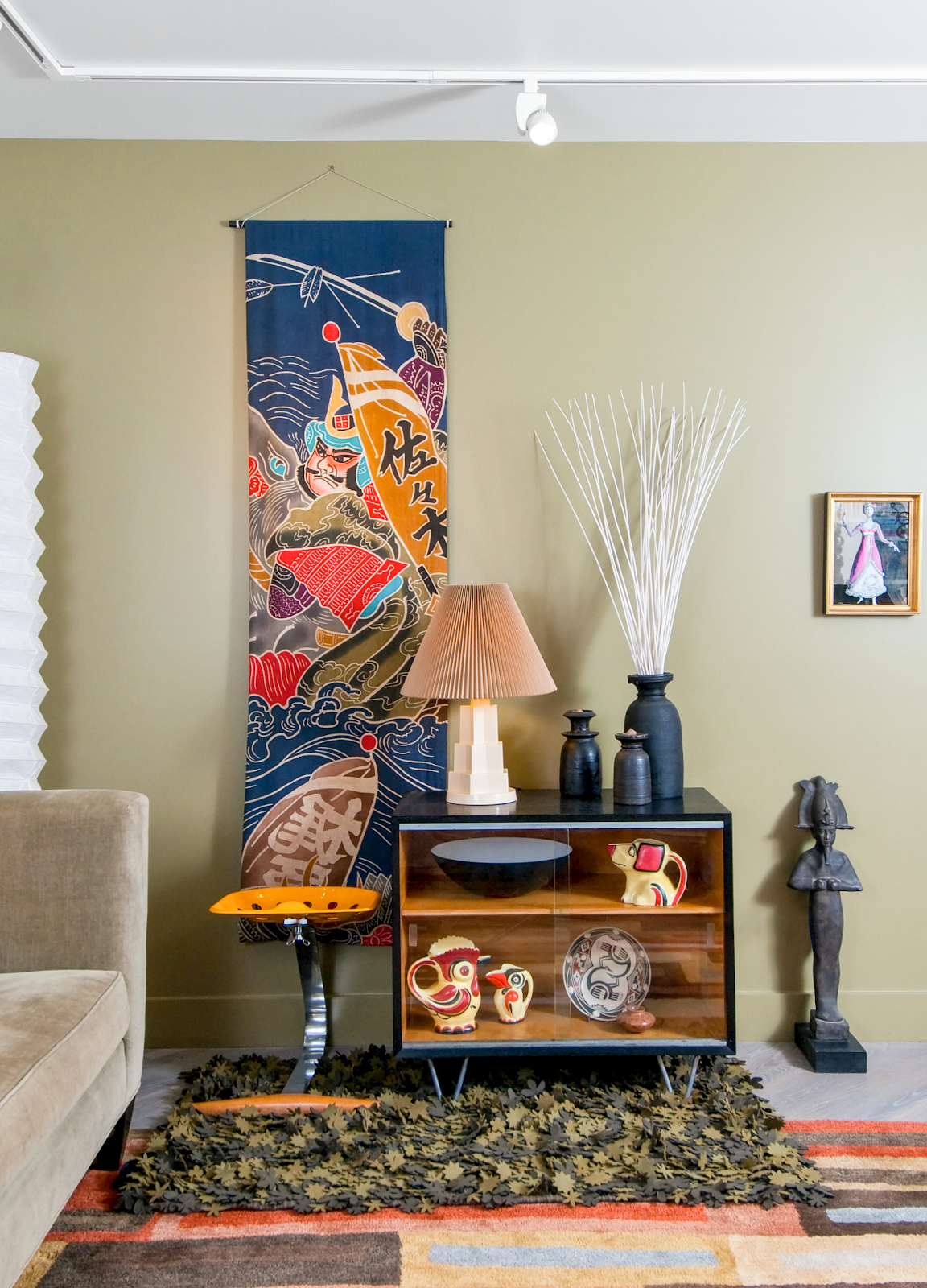
A curio cabinet presents Erphila pitchers, complemented by Casas Grandes pottery on top, and is finished with a classic 1950s Japanese batik banner draped above.
AJ: If you weren’t a designer, what would you be and why?
DIS: If I had completely different skills, I think that different “me” would do well as some kind of medical doctor, which of course would make my mother delighted beyond words (“kvelling” she would say). Helping people to lead happy, healthy lives sounds exceptionally gratifying, and since I’m not trained in medicine, I guess I try to achieve a similar goal with the skills I do have.
AJ: What’s the weirdest thing a client has ever asked you?
DIS: I’d venture to say that “weird requests” are at the heart of what it means to be a residential interior designer. At least for me, one of my favorite parts is rising to the newest creative challenge, and clients are always providing plenty of fodder for that. I’ve heard “no wood in the house” and also “no metal in the house.” I myself am partly to blame for weird requests, though, because our intake process includes an explicit request for inspiration that is not related to interior design. My favorite response to date is, “I want my home to make me as happy as this Looney Tunes poster!” I mean, it’s not every day that you’re asked to consider Daffy Duck as an interior design icon.
Like what you see? Get it first with a subscription to aspire design and home magazine.