

Hudson Valley-based interior designer and founder of his own eponymous design firm, Michael Gilbride has lived a colorful life. While he was born in the states, Gilbride spent much of his childhood in Latin America living in Brazil, Peru, El Salvador and Colombia. He credits this time spent in his formative years as one of the main inspirations for his work. After completing his education in Interior Architecture at Parsons, Gilbride became the Executive Director of Fashion and Luxury at the New York Times, a position he left at the start of the pandemic to start his design studio which now boasts growth even in its second year. Learn more about Michael Gilbride in this week’s Designer Friday.


Black and white contrast is the focal point of this modern living room. A light blue sofa and red patterned bench in front of the fireplace, as well as the mixed materials and textures throughout break up the stark coloration. Photography by Paul Maklary.
Andrew Joseph: Has your mindset changed since 2020? In what ways?
Michael Gilbride: The pandemic put a lot into perspective for me. I’d always had a passion for design, built my own furniture, designed and sold homes, but the pandemic showed me that my “career ladder” I was climbing, while successfully, was on the wrong wall. I left a career and team I adored, took an intensive two-year program in one at Parsons, and began my design business; I’ve never been happier.
AJ: Has there been a shift in what clients are requesting post-covid?
MG: I’m noticing two trends from both my clients and form conversations with other designers:
- Investing into homes by adding square footage: reclaiming basements, finishing attics, adding bathrooms, creating outdoor entertaining/cooking space, etc.
- Investing in yourself by taking rarely used formal spaces and guest bedrooms and putting that square footage to work to support an interest taken up during the pandemic.

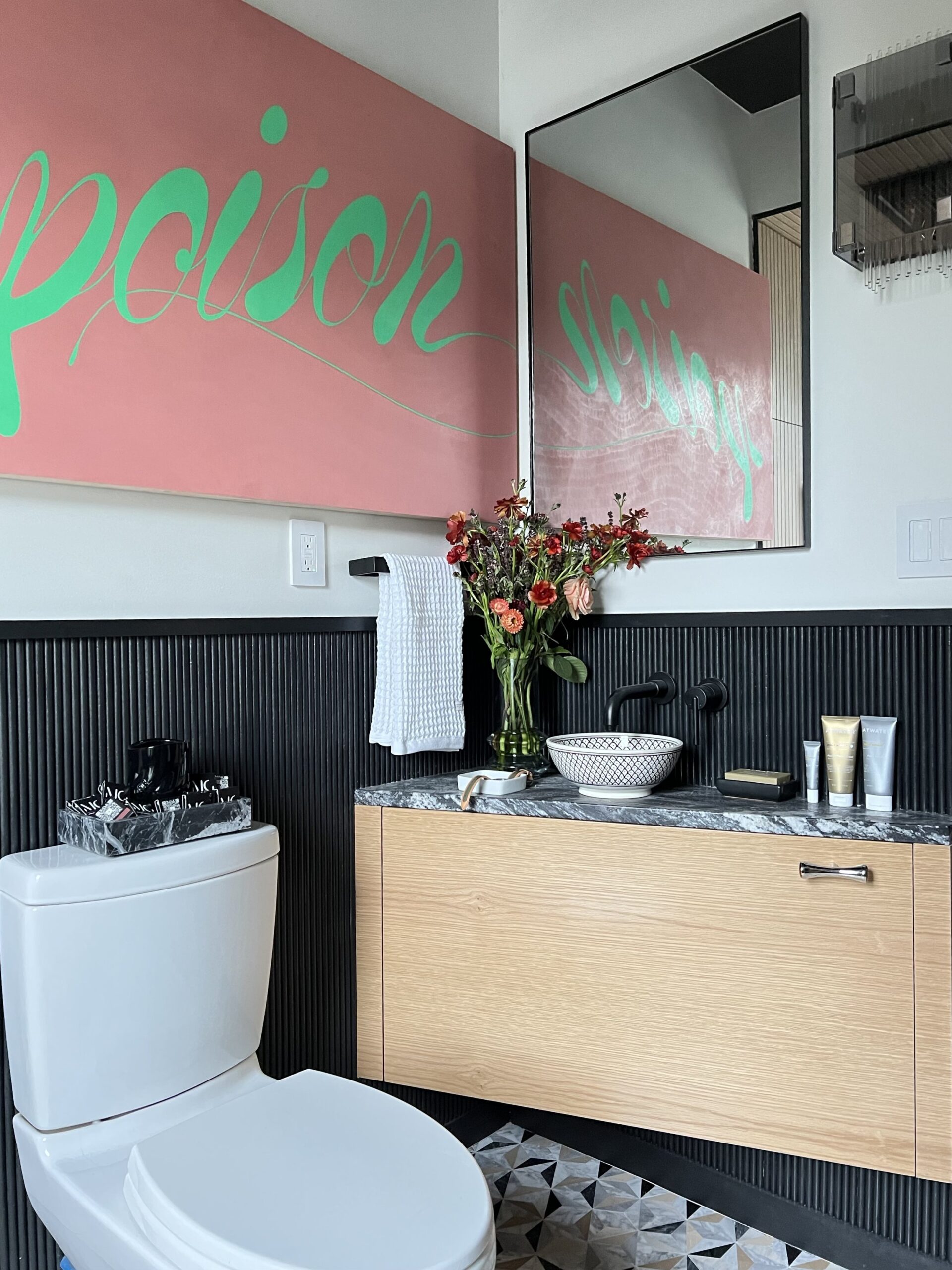
This bright bathroom is centered by the large peach and green artwork. The black marble counter and black fluted wall treatment are contrasted by the light wood finish of the attached cabinet.
AJ: Do you get your eight hours a night? – what is your schedule like?
MG: As I get older I find I have to stick to a pretty consistent routine, with a good 7-8 hours of sleep being key. When I get up, I make sure I’m up to speed on any news world, local, personal, or business that developed overnight. Once I get through the morning routine and urgent overnight emails, I’m off to the gym to get my heartbeat up.
That out of the way, I can dive into some deep focus work with short breaks to eat. Around 2 or 3, I’ll take an hour break with no screens to go for a walk or hop on my Peloton. That break is key to clear my head, step away from trees in the forest, and get reenergized.
Around 7 I try to step away again to cook for my partner or meet up with some friends. If I have any lingering ideas or inspirations rattling around in my brain before I go to sleep, I put them into a project management system I designed so I can get to it in the morning.
AJ: What might the design world look like in 10 years?
MG: Augmented reality is going to play a larger role in the design process with clients. Until recently, it’s been incredibly expensive to scan objects and spaces. With the arrival of true 5G connectivity and the familiarity, clients have with technologies like Matterport, it’s only a matter of time before we can scan and “design” spaces in real time. It’s not even that far away, iPhones will have the technology to scan spaces in the next year, the applications for our business will only begin from there.
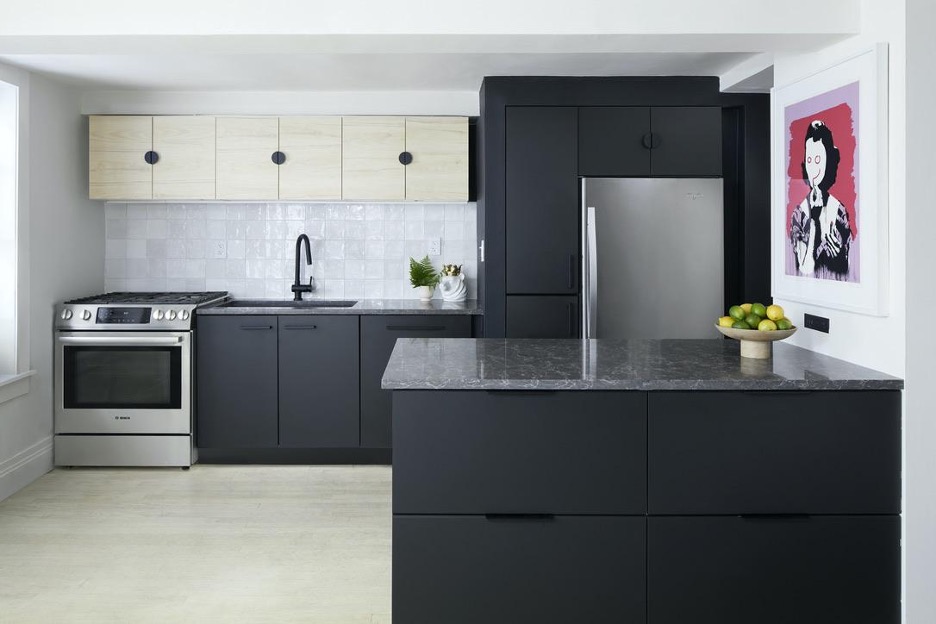
This sleek, modern apartment kitchen plays with dark and light tones throughout the room, with jet back, matte cabinetry and light wood finishes. Photography by Paul Maklary.
AJ: What would your dream project or dream client be right now?
MG: I’d love to design a hotel, restaurant, and resort in Costa Rica. It’s a breathtaking country abundant in incredible food. I may be biased since I grew up in Latin America, but go and prove me wrong.
AJ: What would you like to be remembered for?
MG: That slightly inappropriate joke I whispered to you at the dinner party.
AJ: What are some of the podcasts you listen to and why?
MG: I’ve been an early adopter of podcasts. In a previous life even launched a few. The most challenging podcasts to produce are interview podcasts. You need an insightful host and interesting people. My regular rotation includes: On with Kara Swisher, Fresh Air with Terry Gross, WTF with Marc Maron, and Milk Street with Chris Kimball.
AJ: What’s a new hobby/skill that you have learned recently?
MG: Quieting that inner gremlin and being an observer of my thoughts.


Michael likes to find potential in space. His passion to live well through design emphasizes elegance and comfort, pairing sophistication with function & simplicity. He explores new methods and technologies to relaxing, refined spaces.
Prior to running the studio, Michael was the Executive Director of Fashion and Luxury at the New York Times, overseeing the global cross-functional business. He honed his communication, project management, and problem solving skills at the Times, Conde Nast, New York Magazine, and a few agile technology firms. He is driven to help his clients design the life they want, starting where they live.
Like what you see? Get it first with a subscription to aspire design and home magazine.