




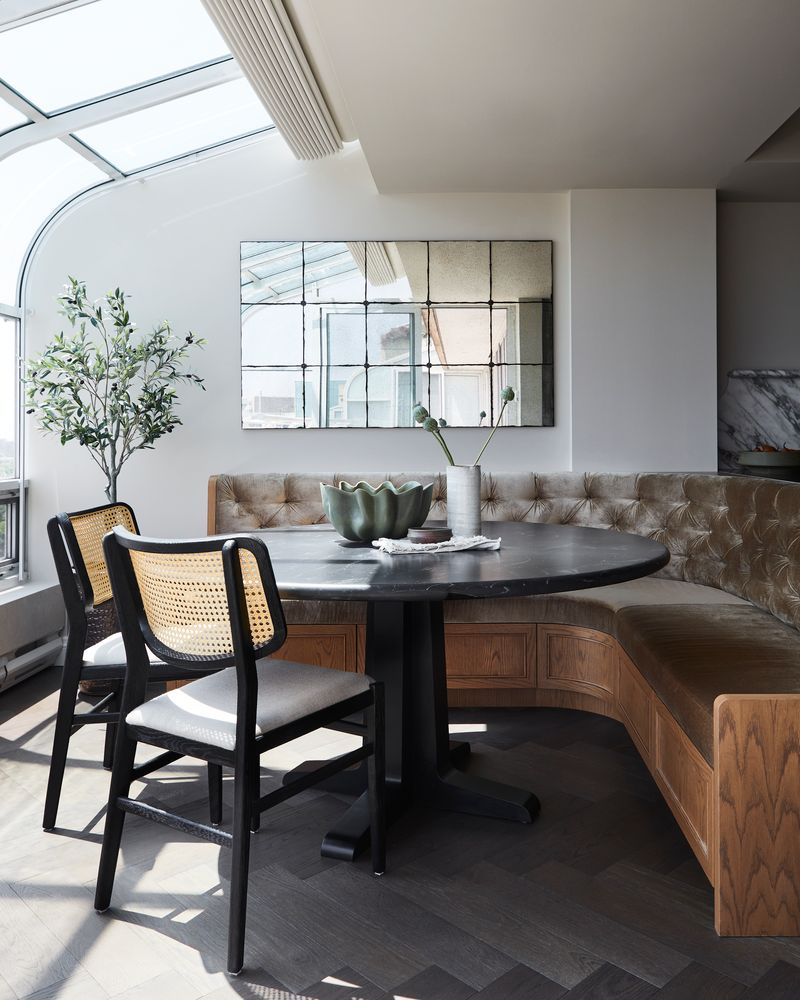
A tailored banquette wraps the corner with ease in this private dining room, grounded by a sculptural black pedestal table and softened with cane-back chairs.
Andrew Joseph: What inspired you to become a designer?
Olivia Botrie: My parents were always passionate about renovating. They had a knack for buying the worst houses on the best streets, so we moved every three to four years while I was growing up. I became comfortable with construction from a young age and was fascinated by the transformative nature of the process. As a kid, I would draw scaled floor plans of my bedroom on graph paper and make tiny paper furniture pieces to experiment with new layouts. That early interest stuck with me.
After completing my BA in history and political science, I began working in the design industry and quickly realized how much I loved it. I eventually enrolled in design school, and the rest is history.
AJ: Can you describe your design philosophy in three words?
OB: Thoughtful. Functional. Beautiful.
AJ: How do you approach a new design project?
OB: We always start with moodboards and space planning — function and form are the two most important elements. We love creating beautiful spaces, but they also need to work hard for our clients. At the end of the day, a well-designed space should not only look great, but genuinely make your life easier.
AJ: What’s your favorite cocktail?
OB: I love a good cocktail! In the summer, my go-to is a classic gin and tonic — lots of ice and extra lime. Refreshing, simple, and perfect for a warm evening.
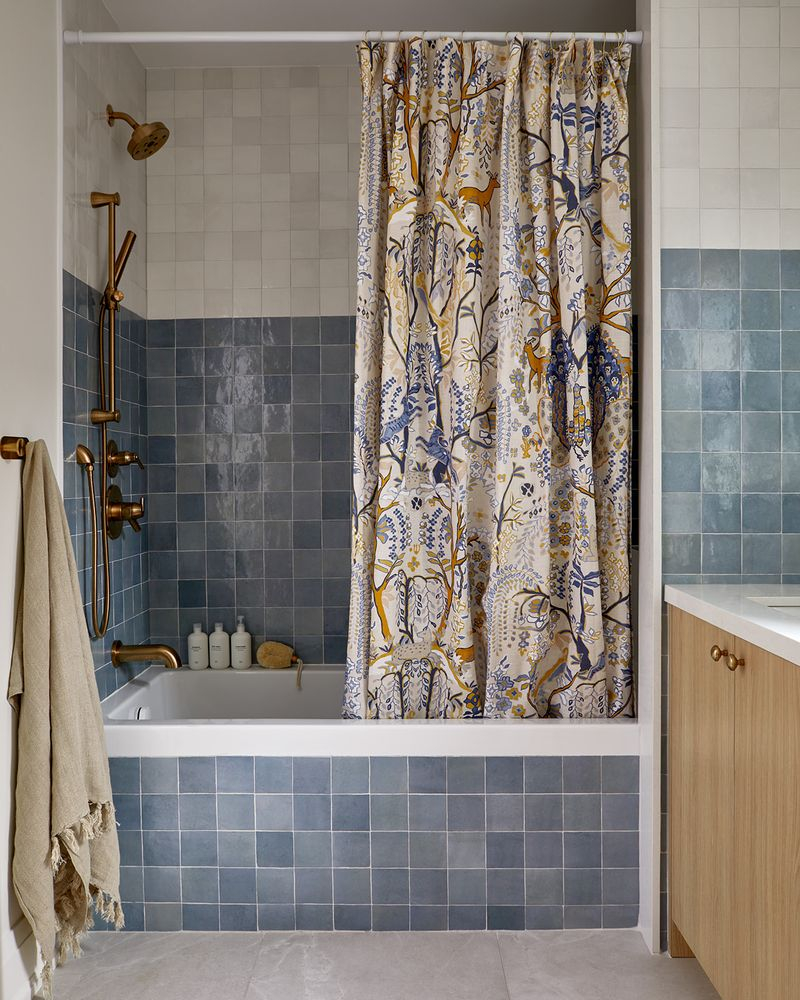
A simple tub surround becomes much more layered with handmade-looking blue tile, warm brass plumbing, and a curtain that reads like a full-scale mural.
AJ: Can you describe a project that you’re particularly proud of?
OB: We recently completed and photographed a landmark project for our studio — a new-build cottage that we’ve been working on for the past four years. We were brought in during the initial concept phase, which was an incredible opportunity and a major learning experience. Being involved from the very beginning allowed us to help shape both the layout and the exterior architecture in a meaningful way.
It’s been a true partnership with our client, who has since become a close friend. The collaboration was so successful that we’re now working on several more amazing projects together following the cottage’s completion.
AJ: How do you balance functionality and aesthetics in your designs?
OB: In residential design, functionality and aesthetics go hand in hand — one doesn’t work without the other. I always start by understanding how the client really lives in the space: their routines, habits, and non-negotiables. That insight drives the layout, flow, and practicality. Once the function is nailed down, I bring in aesthetic layers that reflect their personality and elevate the everyday. A home should feel beautiful, yes — but it should also support your life without friction. That’s the balance I strike every time.
AJ: How do you incorporate client feedback into your designs?
OB: Client feedback isn’t just welcomed — it’s essential. Design is a collaborative process, and the best outcomes happen when clients feel heard and involved. I listen carefully to what they say — and just as importantly, what they don’t say — to get to the root of their needs and preferences. From there, I filter their input through my professional lens to ensure the end result is both elevated and tailored. My job is to translate their vision into something more refined, functional, and cohesive than they even knew was possible.
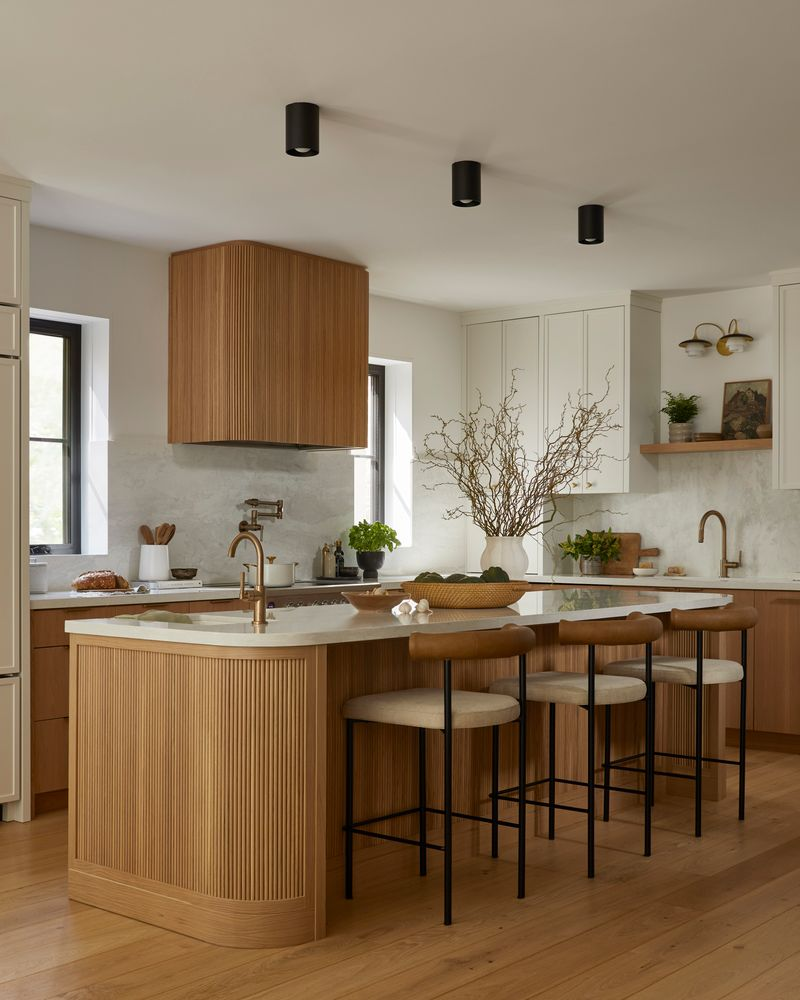
Built for gathering, lingering, and everyday ease, this kitchen turns thoughtful millwork into the main event with a fluted island, curved edges, and seating that feels more lounge-like than purely functional.
AJ: How do you stay organized while working on multiple projects?
OB: As a firm, we’re process-driven by design — structure is what allows creativity to thrive. We manage multiple residential projects by following a clear, repeatable framework that keeps things moving smoothly from concept to install. Basecamp is a key part of that system. It acts as our central command — tracking timelines, tasks, approvals, and all communication in one place. It keeps the team aligned and the clients informed, without the overwhelm. When you pair strong systems with a disciplined process, you create space to actually think, design, and deliver at a high level — every time.
AJ: How do you approach designing for a client with a specific style in mind?
OB: When a client comes in with a specific style in mind, I see that as a creative anchor — not a constraint. My first step is to unpack what they actually mean by that style, because ‘modern’ or ‘traditional’ means something different to everyone. I dig into the details: what they’re drawn to, what feels like home to them, and where we can push the boundaries. From there, I translate their vision into a cohesive, elevated design that works in real life — not just on a Pinterest board. It’s about honoring their taste, while guiding it with a trained eye.
AJ: Can you describe a project where you had to work in a limited space?
OB: Most of our projects are 100-year-old homes in Toronto, where space — and especially storage — is always limited. These homes often come with beautiful character but require creative solutions to make them function for modern living.
The key is designing multifunctional spaces and customizing every detail to the client’s needs. For example, we recently worked on a narrow semi where we integrated built-ins wherever possible — under stairs, around doorways, even in unused wall cavities. We also reimagined the layout to improve flow and carve out distinct zones for work, play, and downtime, all within a compact footprint.
It’s always a puzzle, but with the right design approach, you can make a small home feel incredibly functional and intentional.
AJ: What is your favorite design-related quote?
OB: Everyone wants their renovation cheap, fast, and good — but let’s be honest, you only get two. Pick cheap and fast? It’s going to look like it. Want it fast and good? Open your wallet. Good and cheap? Settle in, it’s going to take a while. This isn’t just a design myth — it’s project math. I don’t sugarcoat it because managing expectations upfront saves everyone time, money, and meltdowns later.
Like what you see? Get it first with a subscription to aspire design and home magazine.