

Step from the bustling Paris streets into architect Frederic Berthier’s apartment and you are immediately treated to a master class in contrast. The elegantly proportioned, calm-inducing spaces are a world away from the intense energy of Le Marais, instantly transporting one into a realm of luminous quiet, a place where one can recharge their batteries. Yet here, quietness is never boring – rather, it has a great deal to say.
Berthier and his partner, Emma Alves, had previously lived in the sixth arrondissement and were looking for a home in that area when he fortuitously discovered this one in Marais, a location that suits the couple and is “close to the Seine, which I love.” The apartment, on the other hand, was “a total ruin” – abandoned for some years and a warren of too-small rooms utterly lacking in charm.
Berthier’s vision for the apartment was clear to him from the outset. “My main idea,” he explains, “was that when it was complete, we would feel that the apartment had been this way for centuries – and that we arrived with just a few items of furniture and artwork, like the first owners did 300 years ago.” Of course, that classic appeal also needed to be matched by (largely invisible) modern comforts: underfloor heating, air conditioning, home automation, double-glazed windows and soundproofing.

Though Berthier has worked with a number of famous architects, he lists Philippe Starck as “my real mentor.” Like Starck, he prefers “shelter – we say cabane in French – to palaces.” Where he differs from Starck, however, is in the fact that “I like quiet design, because I design mostly houses.”
One of the key benefits of this “quietness” is that it “highlights the beauty of the elements of nature that I put into the spaces,” he describes. From the ebony plinth alongside the living room sofa to the bold cedar tree trunk that forms the base of the dining table and the items of furniture made from rosewood, Berthier’s love of exquisite woods is very evident.

Natural stone is another favorite material. “It’s absolutely amazing that in nature you can find a white marble as perfect as Thassos,” Berthier exclaims. In addition to the exquisite slab of black-veined white Panda marble used for the dining table, polished stone is used extensively in the bathroom as well as the kitchen.
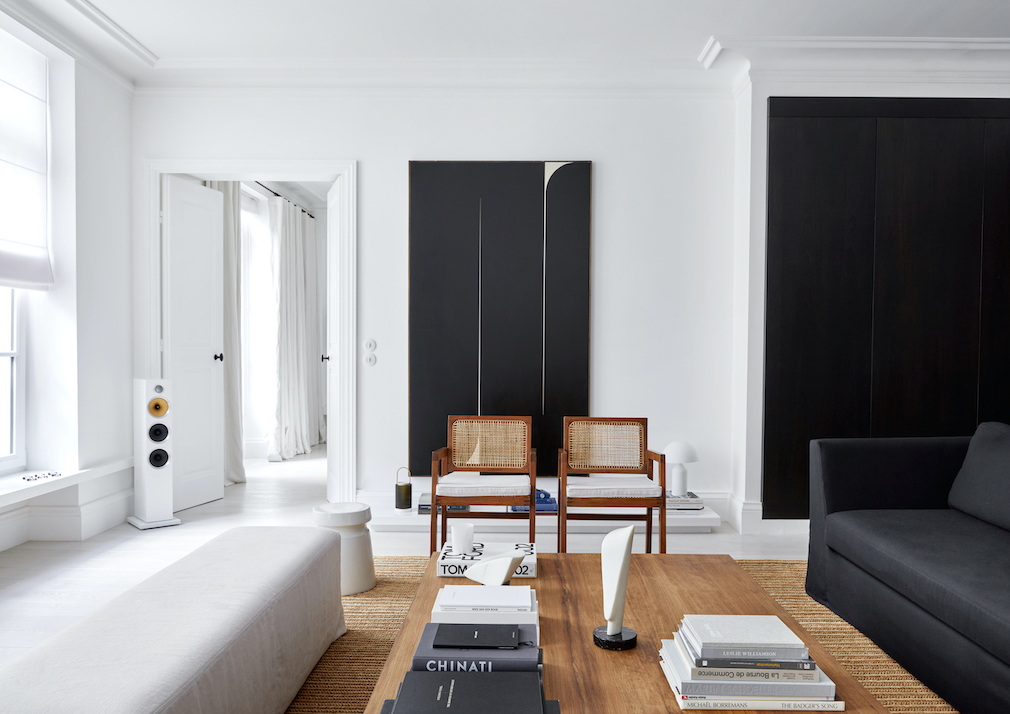
Other design influences include Berthier’s love of art and books, which come together beautifully in the living room. Here, a black, wall-spanning bookshelf – packed with art and architecture books – is enfolded on its two sides by panels in the same matte-black finish. Berthier’s inspiration for this came from the Rothko Chapel in Houston, Texas, where the abstract artist created a series of black-on-black panels that are mainly displayed in triptych.
Asked about his choice of artworks for the apartment, Berthier recognizes that his selections are based more on instinct than anything else: “Sometimes it’s because I feel the work of the artist is close to what I’m looking for in my own; sometimes it’s the exact opposite.” He lists Claude Monet, Rothko and minimalist artists such as the sculptor Donald Judd as among his favorites, but he also has a great fondness for “artists from the French figuration libre movement of the 1980s.”

In the end, the apparent contradiction here – between Berthier’s predilection toward minimalism and his great affection for its exuberant opposites – turns out not to be paradoxical at all. Because he is able to balance these elements, an overall quietness of design is perfectly complemented by the importance accorded to the spirit of the objects and artworks that animate and enliven every space.
Photography by Greg Cox.
For more like this Paris apartment, be sure to check out this light-infused, Haussmann-era residence.
Like what you see? Get it first with a subscription to aspire design and home magazine.