

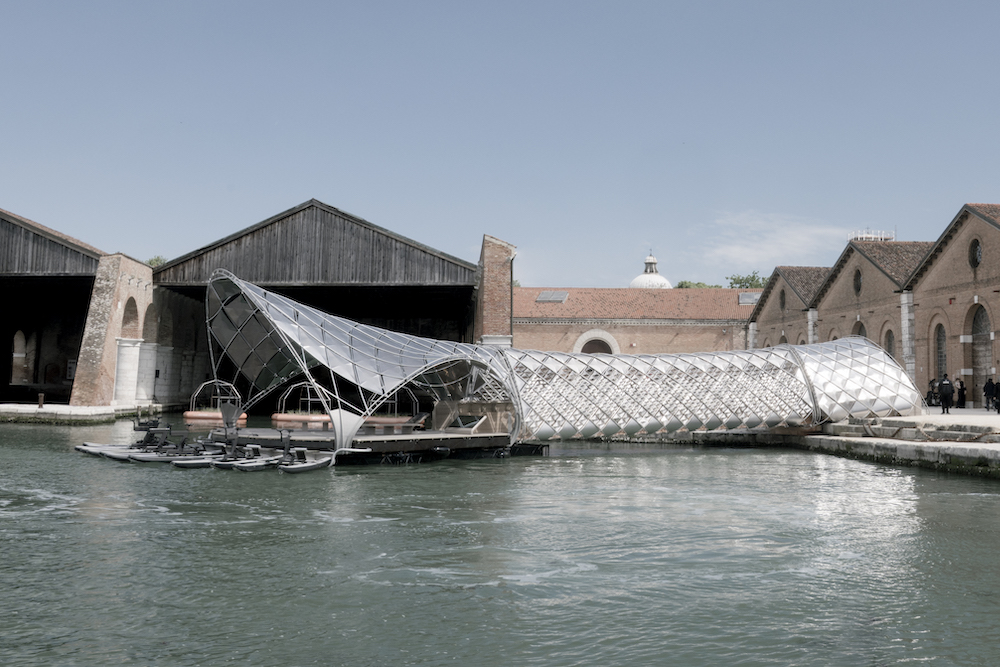

For the Norman Foster Foundation Team and Porsche, the Biennale Architettura 2025 marks the beginning of a new creative collaboration, in which product design and architecture collide to explore the future of mobility. The collaborative endeavor brings together architect Norman Foster and the Norman Foster Foundation Team alongside designers from Porsche to investigate every aspect of mobility — from individual vehicles to infrastructure expanding on the motif of dreams and the theme of the Biennale Architettura 2025 (Intelligens. Natural. Artificial. Collective).
The result is an architectural structure, titled Gateway to Venice’s Waterway — an innovative transportation hub that serves as an exploration into future mobility in Venice and beyond.
“Dreams were interpreted as aspirations brought to life through design,” says Norman Foster, President, Norman Foster Foundation. “In the context of the Biennale, dreams inspired the reimagining of Venice’s transportation infrastructure, bridging heritage and innovation. In architecture, it became a challenge to create a structure that not only functions as a transportation hub, but also resonates emotionally with its users. The biomorphic design reflects the dreamlike interplay of form, function and sustainability.”
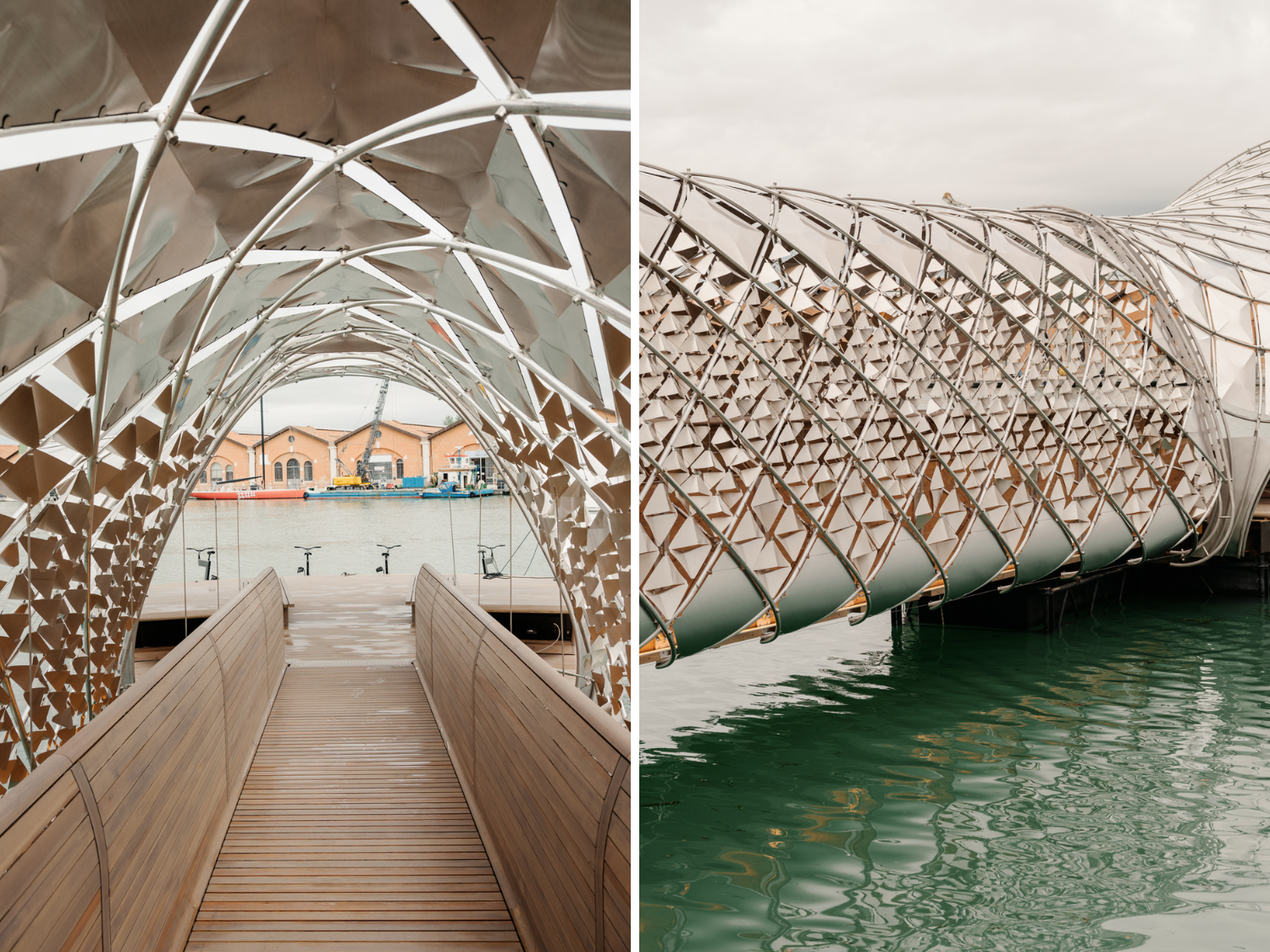

Gateway to Venice’s Waterway — a 121-foot-long, animal-like structure, evocative of Venice’s historic network of bridges — is a physical manifestation of the intersection between design and architecture. The design and construction of the outer structure are derived from lightweight technology found in racing cars such as the Porsche 917, which combines a solid aluminum structure (chassis) with a kinetic surface inspired by Porsche’s Kubus pattern. Both a functional gateway and bridge, the hub actively connects with new electric modes of transportation both on water and land.
‘”Porsche is and remains a brand that is characterized by a highly demanding field of tension between tradition and innovation,” says Michael Mauer, Vice President of Style at Porsche. “This means that we as a design team are constantly dealing with the question of how we can strategically shape the future of our brand in terms of identity and authenticity. The exchange with Lord Norman Foster and his team is a very valuable source of inspiration. This look beyond the confines of pure vehicle design provides us with important impulses for the consistent, but also future-oriented direction of our brand.”
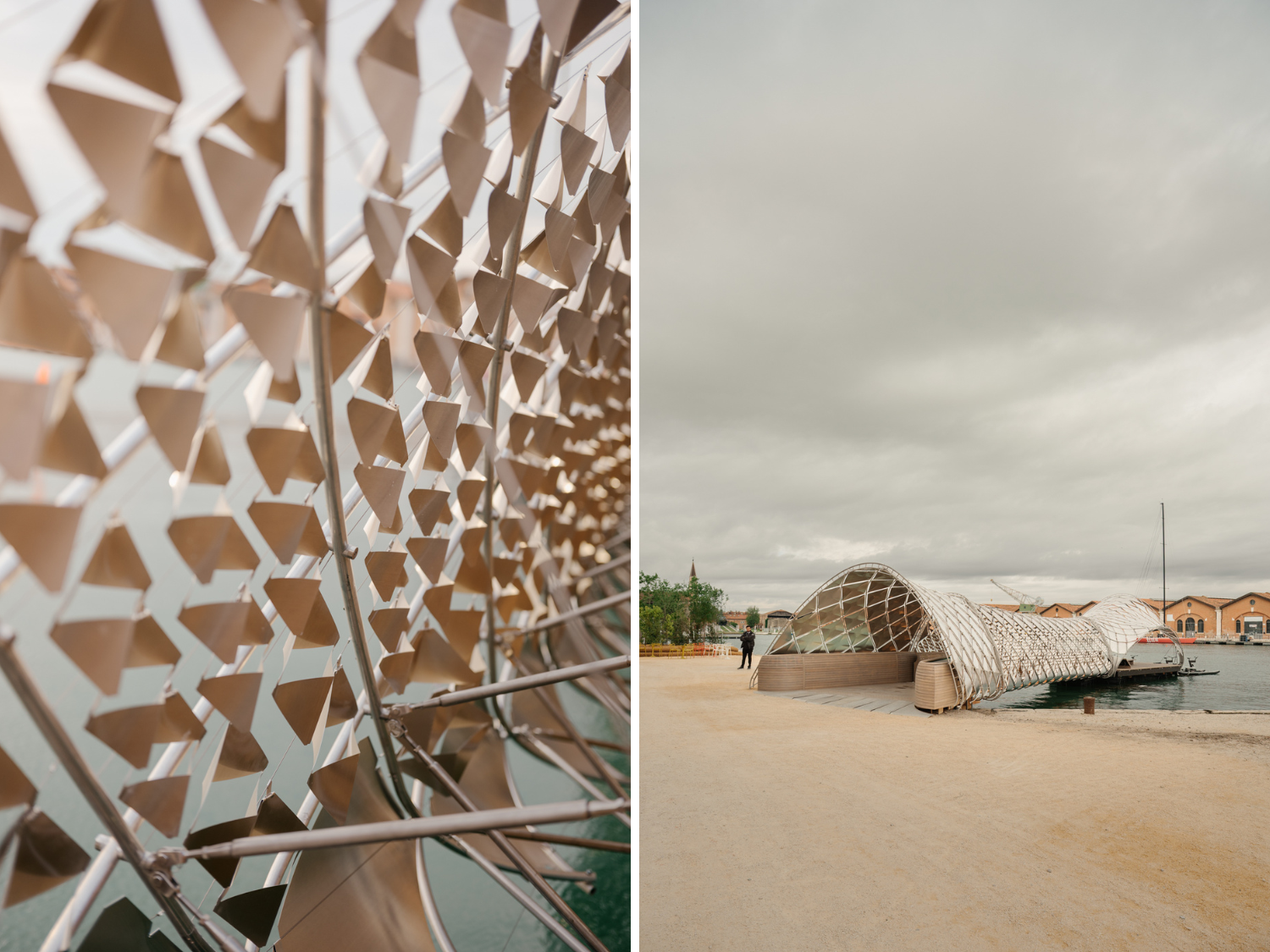
The first Venice Biennale to be entirely circular and no-waste, this sustainable precedent underscores the entirety of the collaboration where Gateway — from every element in design to implementation, has been carefully created to contemporary sustainability principles.
“This project encouraged a reimagining of the design philosophy to integrate circular economy principles and car manufacture know-how,” explains Foster. “Local materials were incorporated to honor the site’s heritage while reducing the environmental footprint. The collaboration with Porsche enabled us to push boundaries to design with practical, scalable solutions tailored to Venice’s challenges and opportunities.”


Gateway further responds to the immediate transportation challenges in Venice and beyond, designed to migrate and evolve to new locations, in anticipation of the changing demands of global urban mobility. A bridge between heritage and innovation, Gateway embodies the dream of lasting and scalable impact and function, ensuring inclusivity for individuals of all ages and abilities.
The 19th International Architecture Exhibition of La Biennale di Venezia titled Intelligens. Natural. Artificial. Collective, curated by Carlo Ratti, is open to the public now through 23 November 2025.
Photography by Pablo Gómez Ogando.
Like what you see? Get it first with a subscription to aspire design and home magazine.