


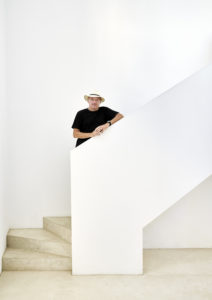

For fortunate homeowners Claus and Kirsten Bjarrum, the antidote to the ever-busy, everyday reality is a tranquil holiday home situated in one of the quietest parts of Mallorca, the small village of Alqueria Blanca on the eastern side of the island. Located in a predominantly agricultural area, the village is not far from the sea – though not at the coast – and its atmosphere is rural. Here, the pace of day-to-day life is still governed by old-fashioned rhythms and rituals.
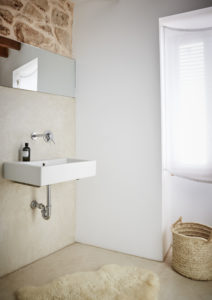
An architect who has worked on both private and public buildings in his native Denmark, Claus describes the renovation as a process of “opening, simplifying and finding a contemporary take on the vernacular.” When he talks about the process of overseeing the work, Claus emphasizes the high levels of skill – as well as the many insights and depth of traditional knowledge – that Mallorcan builders and craftspeople have.
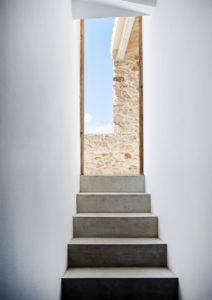
“The entrance hall in Mallorcan homes is always an open, welcoming space,” explains Claus, “and it always has a staircase in it.” Here, he has removed the ceiling that originally existed to make it double-volume, forcing visitors’ eyes immediately up to the old stone archway at the top of the building, and to the lofty, vaulted ceiling, which like the rest of the interior is painted white.

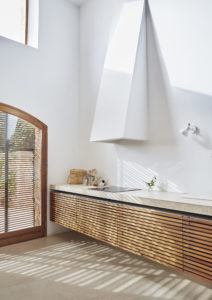
The ground floor – previously broken up into a series of small rooms – is now an equally uncluttered space in which the entrance hall and living area flow smoothly through into the kitchen/ dining room. The section of the building in which this room is situated was originally the stables. It’s now both simple and elegant. A long, fairly narrow room, it features a cast concrete countertop that runs all the way along one side of it. The extended countertop functions to elongate the space still further. The cupboards below the countertop are fronted by slatted wooden doors, which echo the exterior shutters in form. The slats eliminate the need for cupboard door handles, and make the unit appear to “float.”
Then there are the ceilings. The ground-floor rooms feature typical Mallorcan exposed wooden ceiling beams, placed parallel to one another in neat rows. On the first floor are several beautiful vaulted ceilings, created using a traditional Mallorcan technique that was demonstrated to Claus during the renovation. “You take concrete beams and lay them over the area to be covered with the ceiling,” he explains. “Then you place glazed ceramic vaulted pieces across the spaces and plaster them into place from above, using a plaster that expands slightly as it dries. This creates a perfect seal and results in a ceiling that is both very attractive and budget-friendly.”
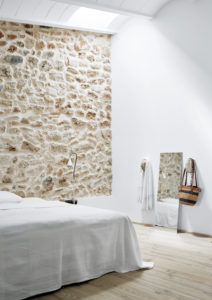
These ceilings – found in the two bedrooms and a bathroom – have been mostly painted white, with one section left with the original glazed ceramic finish to add visual interest and reveal the process of their making. The material needed to add height to the stone walls did not have to travel far; they used the sandstone excavated to create the swimming pool in the courtyard garden.
In the bedrooms, furnishings are kept to an absolute minimum. A plain white wardrobe in each room hides clutter, floating shelves on each side of the beds serve as bedside “pedestals,” and slender standing lamps provide illumination for reading. The bathrooms are even simpler. In each, a frosted glass panel encloses the shower area, and there is also a wall-mounted basin and concealed-cistern toilet. Plain mirror panels, stainless-steel mixer taps and a Mallorcan basket or two complete the minimalist picture.
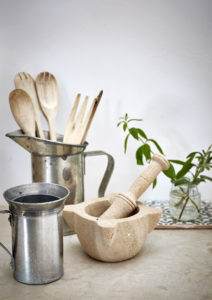
The main living space opens onto the garden behind the house via traditional wood and glass doors, with a built-in couch stretching along the length of the opposite wall of this space and a white String storage unit hugging another wall. The decor is a useful demonstration of how well traditional furniture and crafts work in conjunction with pared-back modern pieces. For example, the wood and metal desks designed by Claus perfectly complement the traditional wooden Mallorcan chairs.
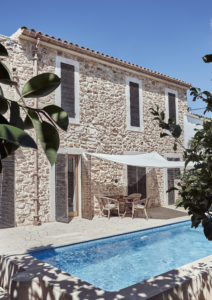
Outdoor living is centered on a rectangular salt-water swimming pool with a raised surrounding wall and a blue mosaic interior. The water-wise garden that surrounds it – which now includes the small adjoining plot of land that the Bjarrums purchased last year – features a veritable mini-forest of lavender, as well as the large lemon tree that gives this beautiful, peaceful house its equally lovely name, Ca’n Limon.
Photography Courtesy of Greg Cox.
Like what you see? Get it first with a subscription to ASPIRE DESIGN AND HOME magazine.