




When Jenny Kirschner first walked into her Brooklyn loft after an eight-month hunt for the perfect family home, she remembers thinking it was “not an attractive space.”
Originally part of a printing factory for the New York Daily News, the 1,400-square-foot Dean Street loft had been a rental, chopped up with temporary walls. But Kirschner saw the potential in the airy ground floor space, with soaring thirty-foot ceilings, an unusual layout and throwbacks to its industrial past.
“I had a vision of this bright space filled with art,” recalls Kirschner. “We bought it and tore everything down.” Hailing from a fine arts background, the designer envisioned a “gallery-like” home, with plenty of white to display her collections and “have fun with pops of color,” while keeping it relaxed and comfortable for her two young daughters.
Over the next several months, Kirschner composed a light, artsy sanctuary, adding an extra 600 square feet and a mezzanine in the process. The living area on the first floor comprises Kirschner’s glassed-in office, which doubles as a guest suite; and the children’s playroom (featuring its own loft, planned as a sleeping space later). Upstairs, the added mezzanine houses the bedrooms. A unique interior glass balcony off the master suite, the designer’s favorite part of the home, hosts a sitting area overlooking the downstairs. “I can be away but still hear what’s going on,” she comments. “It’s a calm, unusual space.”
Throughout the home, neutral tones lay down a canvas for the occasional burst of color, inspired by an art piece, the marbling of natural stone, or – as in hints of pale pink throughout the living room – a child’s vision.


“My daughter picked it out when she was really young, and I went with it, and ended up loving the color,” the designer recalls. “I love to play with color and pair things in unusual ways.” Case in point: the dining room, where vivid wall art by painter Tirtzah Bassel, created entirely from duct tape, inspires the brilliant cobalt of the reupholstered vintage dining set that Kirschner kept from her parents’ home.
“I’m very connected to my past and love having it around me,” adds the designer, referring to the numerous pieces passed down from her parents, including a vintage piano and art that belonged to her grandmother. “I was lucky to have a very happy childhood and love things that remind me of that.”
In continuing a legacy for her own children, Kirschner draws upon her talents to color the home with one-of-a-kind artwork.


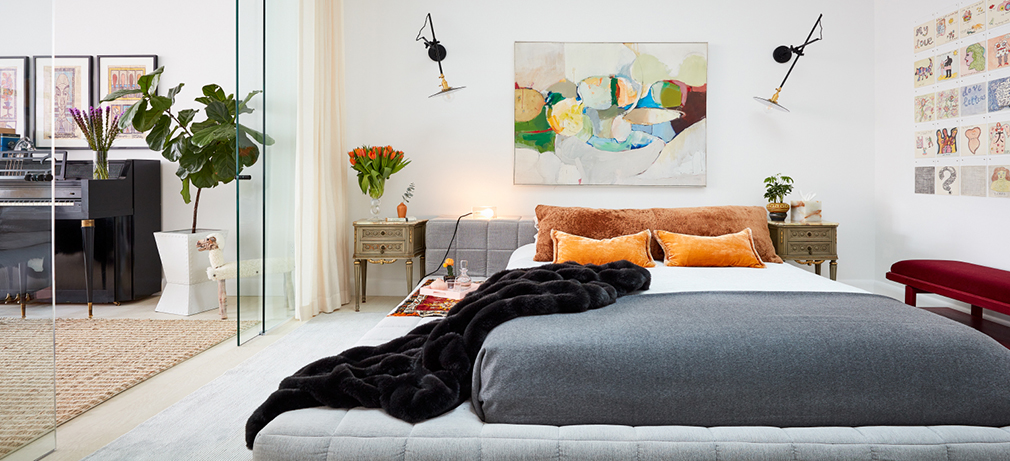
“My Barbie shoe piece is one of my favorites,” she describes, showing a whimsical framed arrangement of lined-up tiny shoes in a rainbow of hues. “I started collecting vintage Barbie shoes in 2008 and finally completed it eighteen months ago.” A bird mobile in the nursery was another of the designer’s projects, constructed from repurposed fabric samples and echoing the colorful Anthropologie wallpaper. In the master bedroom, a series of fifty miniature illustrations function as wall art, made from a book purchased by Kirschner’s parents at an artist’s exhibit in the 1970s – a “beautiful love story” that captured Kirschner so much, she ended up buying a second copy to cut up and display.

Another gem of a find, this one from the late 1960s, stars in the living room: a floaty light fixture, originally from an Amsterdam church that Kirschner stumbled upon at a vintage shop. “We had not even closed on the apartment yet, but I said, ‘I have to have it!’” she remembers. “It’s the anchor of the entire space.”
While her architectural aesthetic shows through in simple, clean lines warmed up with textures and rounded shapes, Kirschner’s connection with the past is what lends her home its true character.
Photography by Ryan Dausch.
Like what you see? Get it first with a subscription to ASPIRE DESIGN AND HOME magazine.