
“Crafted Potential”, an exhibition arranged by Olsson & Gerthel, pairs designer Kajsa Willner with furniture manufacturer Fogia to explore a sustainable production solution that makes use of residual materials and waste. We Zoomed with Willner in Sweden to talk about her resulting collection of objects and furnishings made from scrap materials left after commercial furniture design. The camera also revealed, through the window, a pure and simple classic in an overprocessed world: Her young family’s white picket fence in the yard outside.

Kajsa Willner with a pedestal table, vases, and fiber paper lamps she created from Fogia furniture factory scraps.
Alice Garbarini Hurley: Your yen to preserve our world, not overburden it—does that go back to childhood?
Kajsa Willner: Yes, I believe growing up in a small, small village by the sea in southwest Sweden had a great impact. It made me humble about what nature gives us humans that we often take for granted. My childhood was running around, jumping in sand dunes, swimming in the sea and walking in the forest. The village was our playground. As a single child, I spent a lot of time by myself, creating stories by drawing and dreaming of something bigger.
AGH: Is that what drew you to art?
KW: Again, yes. I was fascinated by that internal travel where another world opens up for you when consuming art in forms like theater, dance, movies, music, design and museums. My mother took me to what was available in the nearby small town and I often got a fever after seeing children’s theater because I was so moved.

An armchair made from stacked factory remnants has a Lego-like appearance.
AGH: So, what went into these pieces?
KW: They are all made from industrial residual discards from Fogia, a classic Scandinavian furniture design brand. The company trucked large pallets of leftovers from their factory in Poland to my studio in an old tobacco factory. The materials would otherwise be burned up for energy or go to landfill. This includes: Nature Loft textile padding; sawdust; wood scraps; and leather pieces left after upholstering. Olsson & Gerthel, the retailer, showed the collection for a month in their Malmö store.

(Left): A big vase made from wood scraps makes a big, bold statement. (Right): Fabric scraps the artist repurposed. Willner examined the potential of various approaches, such as material development, upcycling, craft techniques, collaboration and implementation.
AGH: When did sustainability become a theme in your work?
KW: As a student, I thought a lot about how to design furniture in a sustainable way-asking myself questions like “What is the designer’s role?” and “If I add something to this world that we really need, is it another sleek, stackable chair?” To constantly question my role is a bit draining, but also keeps me conscious about consumption. Asking the right questions is more important than having the right answers.
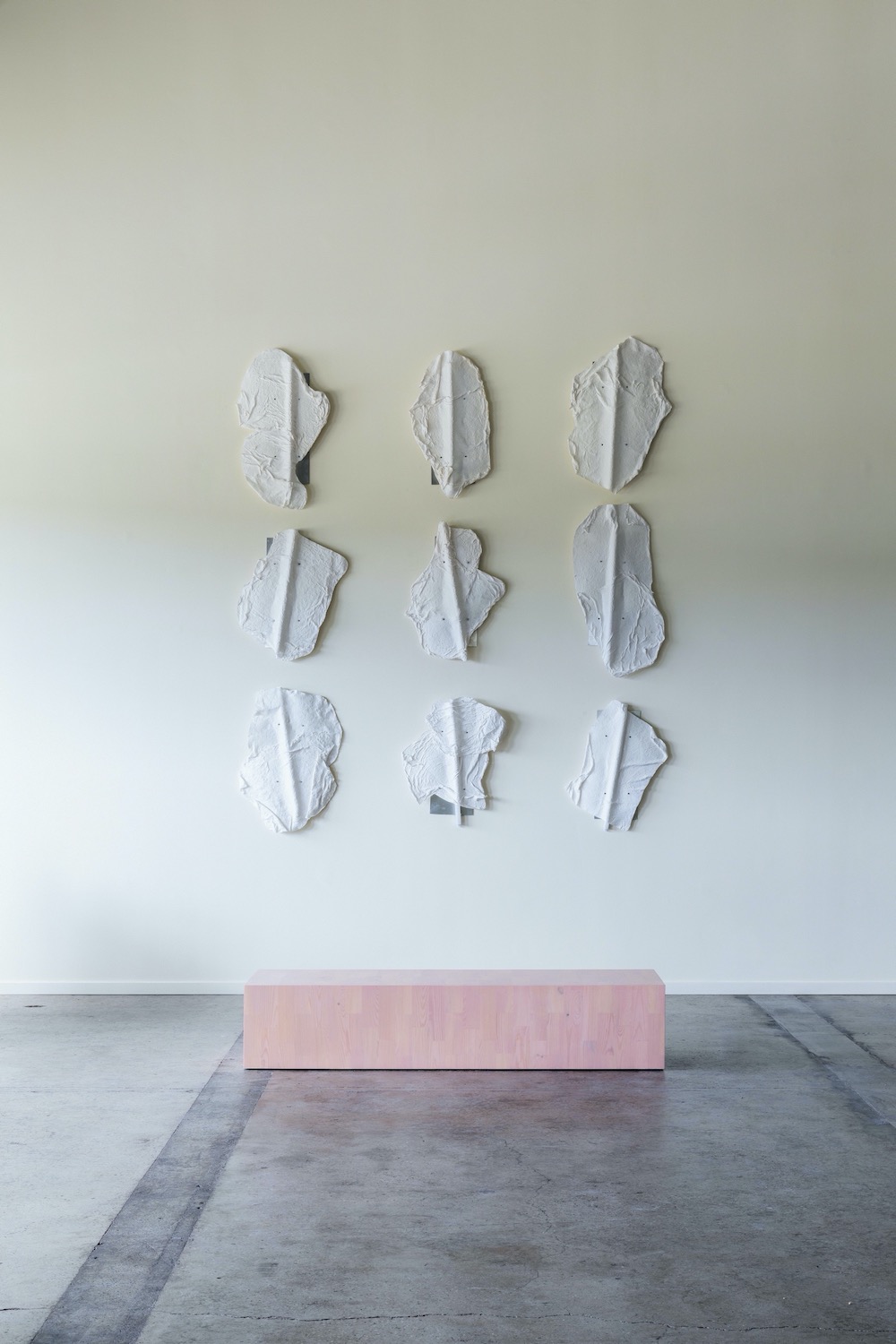
Low pink table and above it, wall-mounted lamps that Willner made using an old Japanese papermaking technique.
AGH: What do you hope people see when they see this project? And what’s next for you?
KW: I hope they see possibilities for having more scalable production in the future. It’s always harder to work with waste materials, and I had to push the factory, but we should walk these extra miles. I hope people think it’s fun. For the colors, I used linseed paints in a palette inspired by the crazy winter sunsets we saw in north Sweden. Next, I will be part of Stockholm Design Week in September. And I will continue to try not to buy things online and to shop local when possible, even for meat and fish.
To read more about “Crafted Potential” or to inquire about purchasing pieces, visit Willner’s website.
Photography by Robert Våhlström.
Like what you see? Get it first with a subscription to aspire design and home magazine.