

The City of Montreal, one of Canada’s urban gems, is known for its thriving cultural scene and its rich architectural heritage. What visitors often miss, however, is the gentle, yet radical transformation occurring in pedestrian-friendly neighborhoods away from downtown.
For the last twenty years, as urban designers were busy redefining street life, architects were building—or remodeling—numerous public amenities such as theaters, sports facilities, and libraries. One striking example of this transformative process is the Maisonneuve Library, housed since 1981 in what once was a small, but prestigious city hall for the short-lived City of Maisonneuve.
As the need to upgrade and expand the facility became more and more pressing, Montreal launched a multidisciplinary design competition in 2017. The winning team was a consortium of Montreal firms led by EVOQ Architecture and Dan Hanganu Architects (now part of EVOQ). Officially opened in summer 2023, the carefully restored 1912 building, with its glazed extensions, illustrates how the past can enrich the present, and vice versa.
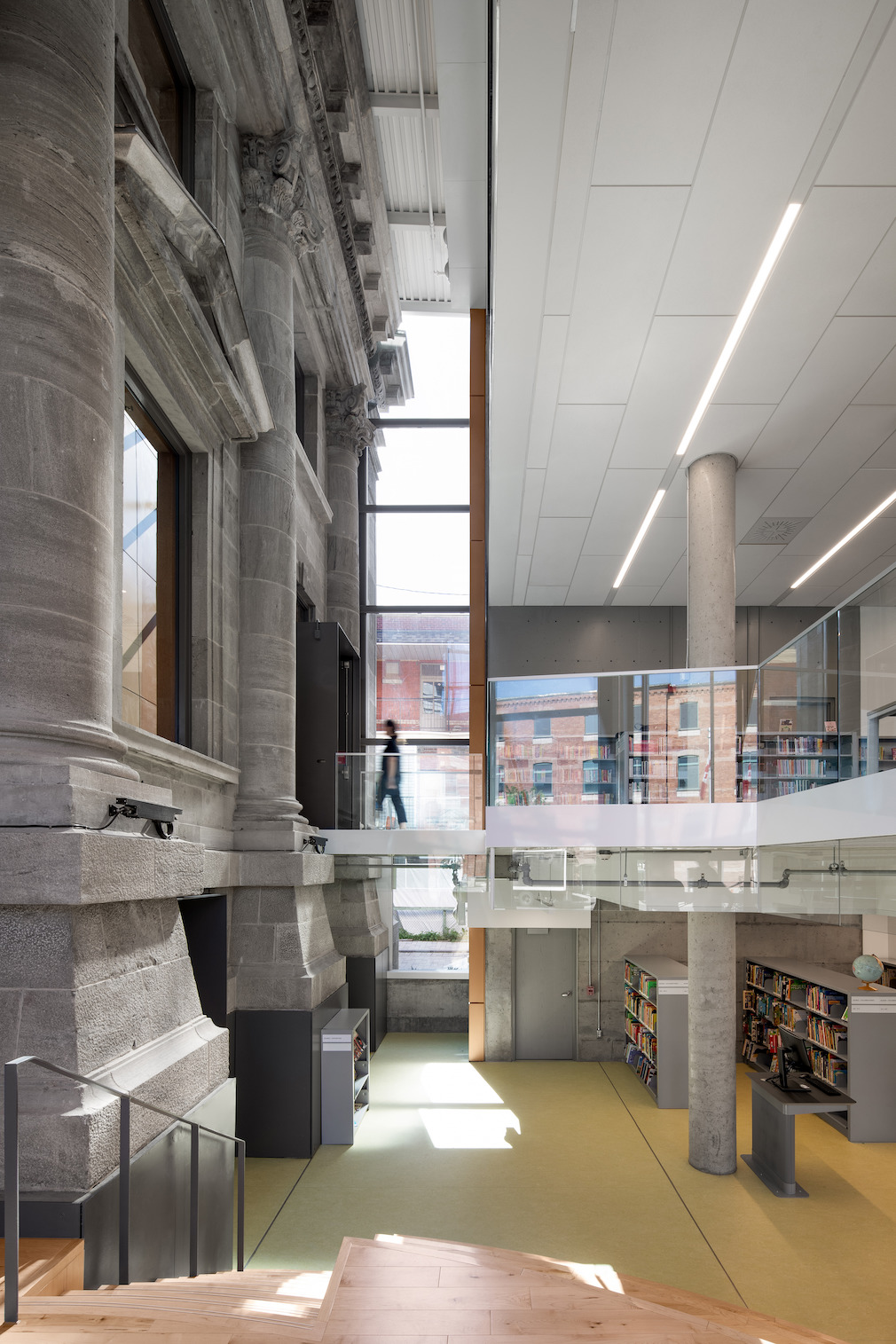
The book-centered archetype, which dictated the layout of libraries through most of the 20th century, no longer prevails, as recent libraries have taken on a new role and often act as social hubs in their respective communities. The Maisonneuve branch is no exception. Its transformation, which allowed it to expand from 1,240 to 3,594 square meters, provided it with an opportunity to reinvent itself and meet the needs of a more inclusive and constantly evolving society.
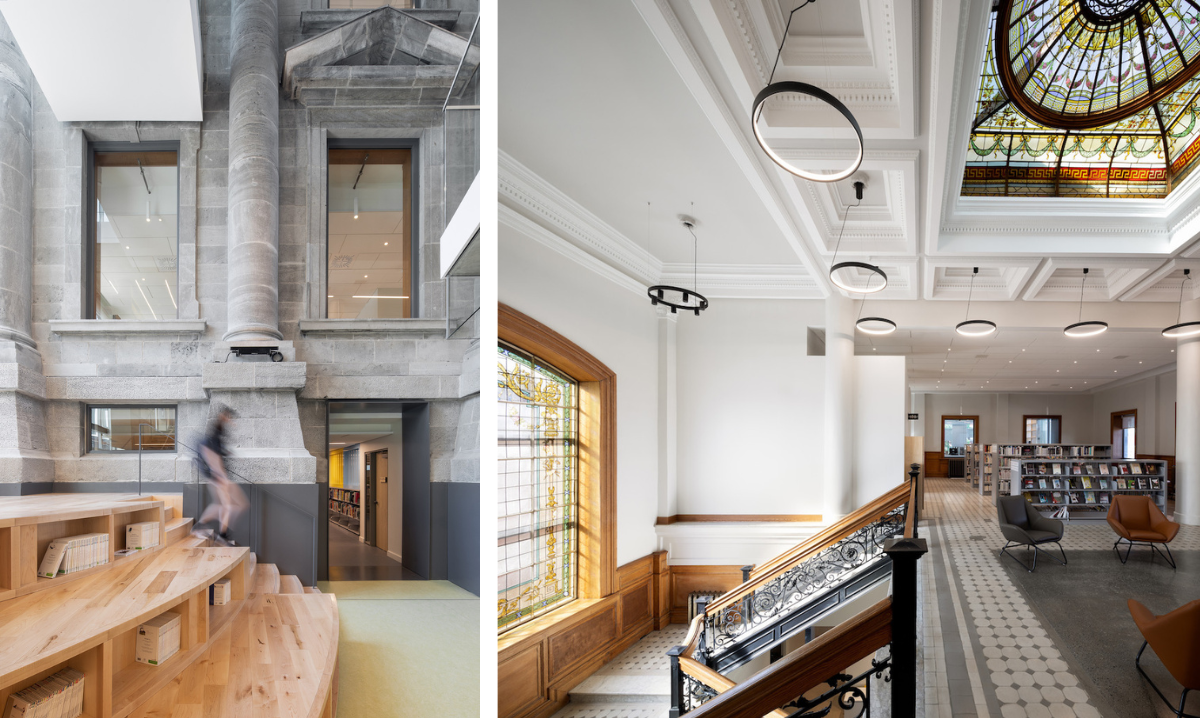
One of the most important decisions taken by the architectural team was to rehabilitate the historic building and bring it back to its original splendor. The stone façades and the monumental doors were carefully restored, as were the original plaster moldings, wood paneling, and mosaic floors. The piano nobile’s marble staircase, and its two imposing stained-glass features, were carefully repaired. The alignment of the new curtain wall and the rhythm of its brise-soleil were dictated by the historic building’s neo-classical colonnade.
Key to the design concept was the introduction of a “tower” element off the east wing. A clear statement of the library’s contemporary identity, it contains a new vertical circulation core and serves as the library’s main entrance. Users with reduced mobility can easily enter the premises and reach the elevator, giving them full access to each floor, as well as access to a small roof terrace.
Another move, which reflects the architects’ preoccupation with heritage issues, was to leave a full-height void on either side of the former city hall as a constant reminder to users of what was once there. Stunning views of the imposing columns are provided as users make their way through the building. Steel portals and spatial voids emphasize the transition from the light-filled contemporary wings to the more subdued ambiance of the original structure.


The reception area, directly accessible from the street, acts as an orientation device for the library’s different audiences. Young children are led down towards a succession of playful spaces, while teenagers head upwards to the second level, where a variety of creative amenities such as a medialab, an animation studio, and a small video games room await them. The upper two floors of the former city hall—as well as the west wing’s top level—serve a clientele looking for quiet reading and study areas. A partly cantilevered ‘silent room’, is aligned with nearby traditional balconies, overlooking Pie-IX Boulevard.
As one approaches the west wing from the outside, an intriguing set of open bookshelves attracts attention. This live-in modular environment was designed to respond to children’s desire for adventure.

A statement from the 2017 competition jury report perhaps best reflects the spirit of the new Maisonneuve Library, described as “a beautiful dance between eras, between exterior and interior, and between active and contemplative.”
Photography by Adrien Williams.
Like what you see? Get it first with a subscription to aspire design and home magazine.