


When it comes to abstract, Brecht Wright Gander is your guy. Born and raised in Rhode Island, the sculptor and designer has a philosophy background, and with a passion for all things thought-provoking opened Brecht Wright Gander Studio in 2018. Just under two years old, his mind-boggling lamps, tables, and installations caught the eye of gallerist Todd Merrill, who displays Wright’s pieces in his New York Studio. Big things are in the works for Brecht; a solo show is in the works, and his vision has already been noticed by major design publications. Meet Gander, take a look at his wonderfully weird creations, and read his thoughts on the future of design, in this week’s Maker Monday.
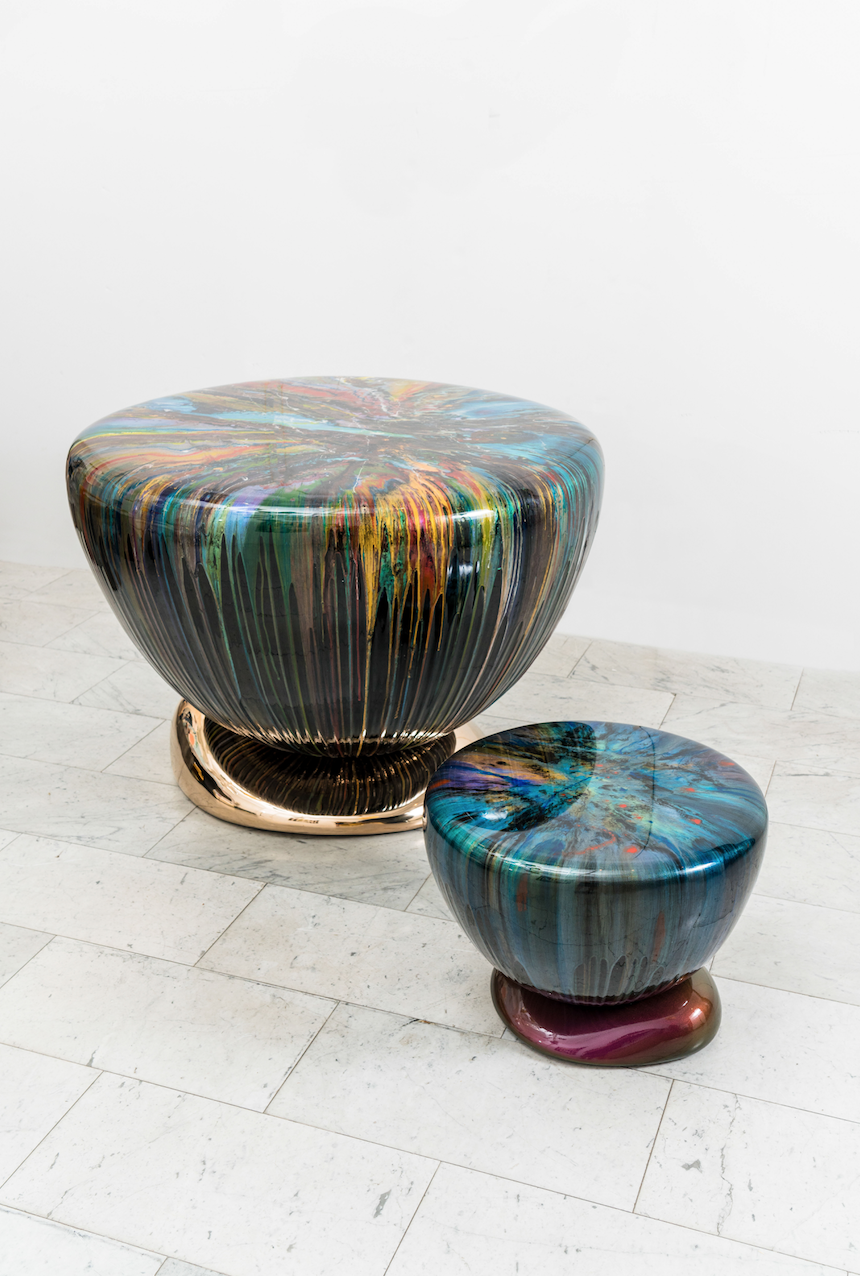
Gander’s “Flow Tables” appear to be melting with color.

Andrew Joseph: What might the design world look like in 10 years?
Brecht Wright Gander: Prophesy is usually better left to prophets. And I can see why, because I’m tempted to begin with a dreadful phrase like “kids these days…” But here we go: porosity along the border between the digital and material will continue to increase. People just a few years younger than me (“kids”) hardly distinguish between interactions they have with each other through screens and those they have in person. The porting out of our personalities and experiences from the so-called “real” to the “virtual” will continue to the degree that design will begin to fluently integrate elements which have no “real” existence. Consider, for instance, being able to “skin” your apartment in different wall colors, or apply different views to your windows, just as you can alter avatars in a video game. You’ll just need to wear the google glass, or whatever it is, to see it. Already it is possible to purchase virtual apartments, virtual real estate – and in so far as you are plugged into a VR experience, inhabit them. Reactions to this will continue to occupy well-used camps – those who cling ferociously to material experience – their very clinging being its own kind of estrangement – for instance, white-collar workers signing up in droves for woodworking classes – and those who embrace a non-hierarchical relation between the real and virtual and will be thrilled when Ikea furniture can be re-faced in virtual veneers and updated with a click. This will create radically new possibilities and offer a frightening limitlessness to designers. Design has so far been a kind of straggler behind more nimble fields – the sciences, arts, and philosophy. This is because it has been dragging all the friction of material existence behind it – it has been defined by encounters with what Turnovsky calls “the resistance of the world.” We’re near to reaching a technological precipice where this friction is lubricated by virtual supplementation.
Andrew: Best advice you’d give your teenage self?
Brecht: You’re absolutely right, those teachers are morons, but so are you.
Andrew: Who is your ideal client?
Brecht: Hmm. The term “client” presupposes a kind of service relationship that I don’t yearn to engage in. Bob Dylan says “you gotta serve somebody.” But I’d rather serve “something.” For me, the identity of the something is not always obvious. I suppose mostly what I’m working for as a designer are my own standards, which are themselves something of a work in progress.
Andrew: Song you can listen to on repeat?
Brecht: “I’m Done” by Frazey Ford. The music video is heart bursting. Her spirit! God, her spirit is rich.

A bubblegum pink floor lamp from Gander is both illuminating and intriguing.
Andrew: If you made a documentary, what would it be about?
Brecht: Hmm. One thing which it would be interesting to show is what commercially contextualized craft really tends to look like. What we’re often sold, by craftspeople themselves often as not, is a kind of idyll – the woodworker conscientiously hand-planing boards, blowing the shavings away, moving around with slow-motion gracefulness in a natural-light filled workshop. The truth is that craft, professionally practiced, which is to say outside the subsidies of universities and non-profit organizations, often takes place under near-hysterical levels of stress. Just buying steel from a steelyard requires a certain forcefulness. And there are woodshops on woodshops filled with highly skilled people, laboring ferociously to make things that are often barely considered at all at the design phase. There is a tragedy here, amid the vast human resources being directed by the mercuriality of financial markets. Consider the chaos of New York architecture, for instance, with its continually changing skyline – a kind of eruptive seismograph of capital, a spectacle of acquisitiveness and destruction both impressive and inane. There is a tremendous energy and dynamism to the forces of capital as they unspool at the level of the commercial cabinetmaker – and also a tremendous sadness. This more complicated, less idyllic view of professional craft is one I’d like for more people to see.
Andrew: What’s your go to bed ritual?
Brecht: My days vary a lot – at some point in the evening I usually try to plan out the next day. Usually, I just work until I’m too tired to keep working – and then I go to sleep. My girlfriend, thank god, has the same kind of drive, so we manage to forgive each other. If I can’t sleep, I put on an audiobook.
Andrew: Vintage or new?
Brecht: Vote for the living – buy new.
Andrew: What’s your current TV obsession?
Brecht: Blue Planet 2. Watching it is akin to a religious experience. The cinematography is divine. The sights are astonishing. The drama is as real as fang and bone.
Andrew: Style (or design) icon?
Brecht: Le Corbusier. His astonishing range. His astonishing fecundity. His astonishing ego.
Andrew: Favorite place to view art?
Brecht: The Noguchi Museum.
Andrew: What’s one thing that is always in your refrigerator?
Brecht: I’m made primarily of milk.


Andrew Joseph is a regular contributing editor for ASPIRE DESIGN AND HOME magazine. See more of his work here.
Like what you see? Get it first with a subscription to ASPIRE DESIGN AND HOME Magazine.