
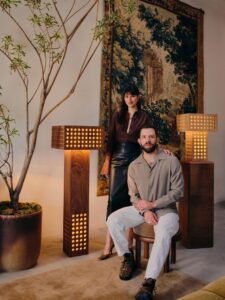
 Ceramicah is a Los Angeles-based lighting design studio founded by partners in work and life, Micah Blyckert and Alexandra Cadiz. Their ability to create pieces that expertly balance architectural precision with the warmth and character of human touch has made their work a staple among AD100 designers, used in bespoke homes and hotels around the world. Blyckert brings a maker’s curiosity to the studio, operating from a deep desire to understand how things work, while Cadiz shapes the emotional world around their pieces — the story, the mood and the experience of the brand. Together they take a holistic approach to design, considering every element from the quality of light, to the texture of a material, to the scale of how a piece sits within a space, always guided by the belief that surrounding yourself with beautiful, handcrafted objects has the ability to create more joy and inspiration in daily life. Meet Micah Blyckert and Alexandra Cadiz and their handcrafted approach to sculptural lighting in today’s Maker Monday.
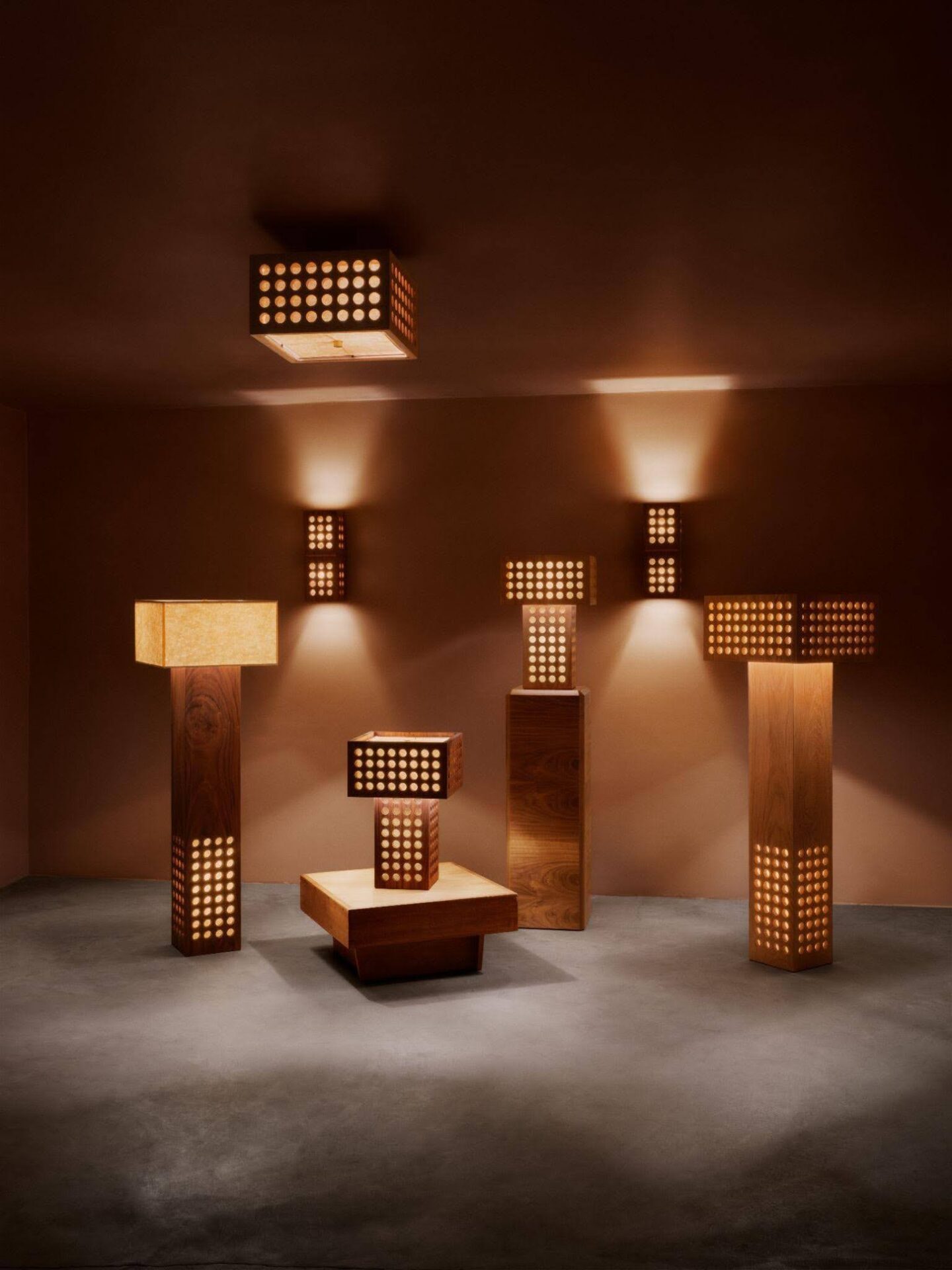
The Cuadra Collection turns a precise grid of perforations into a family of sculptural lighting, letting each fixture play with scale, shadow, and a beautifully warm glow.
Andrew Joseph: What inspired you to become a designer?
Alexandra Cadiz: Micah and I both had very different upbringings that inspired us to become designers. I grew up with design in my family; both my father and grandfather were architects, so I was surrounded by it my whole life. Although my family was the initial inspiration, when I went to architecture school, I fell in love with it on my own. I’ll never forget the day I learned in Arch History 101 that before humans even built shelter, they built structures to understand the cosmos — monuments to an invisible force or god. I think that says so much about human nature and how space shapes our understanding of the world.
Micah found ceramics in high school, where he took every ceramics class that was offered, started selling his pieces at farmers markets, and his parents even bought him a wheel and kiln from Craigslist so he could make things at home. He was the ceramics kid, but was also really good at math, so when someone suggested that architecture was a profession that bridged both sides, he decided to go for it. That’s where our paths crossed, and we met in architecture school at the University of Washington. After graduating and both practicing for several years, everything came full circle in 2020 when Micah started making ceramics again, and we designed the Tera Lamp.
AJ: What’s the best piece of advice you’ve received as a designer?
AC: The best designs come when you follow your curiosity.
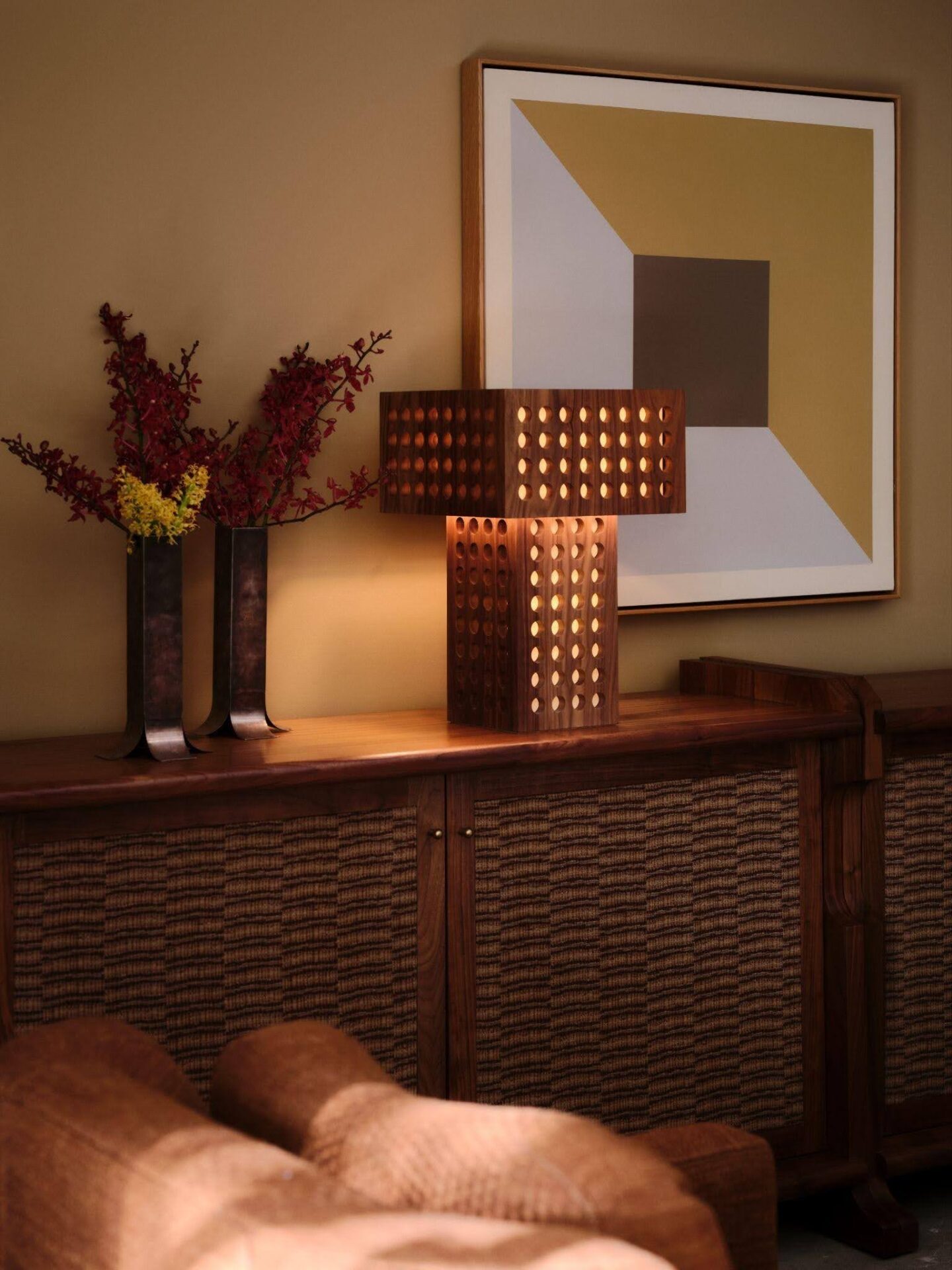
The Cuadra Table Lamp brings an architectural edge to any space, with its rich walnut form and perforated shade creating layers of warm, ambient light.
AJ: What is the most challenging project you’ve worked on and how did you overcome it?
AC: Before starting Ceramicah, we worked on a building renovation together in LA. Micah purchased it with another investor partner, and at the time I was running my design firm, Studio Cadiz, so they hired me to design it. We did a full gut renovation, which was a large undertaking as first-time design/developers with a very tight budget. We also did most of the general contracting ourselves, which was, in hindsight, a crazy idea. So many things went wrong during that project, but at the same time it served as the inspiration for our very first lights. After not being able to find any sconces that we liked for the bathrooms, we decided to make some ourselves. We also made over 250 tiles that we used for the front stairs. Then right when we finished the project and put it on the market, the pandemic hit. But thankfully everything turned out great and all the units sold within a few months.
AJ: How do you stay creative and inspired?
AC: We love to travel, and some of our biggest inspiration comes from places we’ve been. The Cuadra Collection was actually an idea sparked by a trip to Mexico City, where before we even left the airport we were struck by the poetic beauty of the airport itself. The entire terminal is clad in heavy concrete slabs that wrap around the walls and ceilings, punctured by tight circles that let natural light in. We thought this was amazing and would translate into a very cool lamp. Designing for our own home has also become a huge source of inspiration since recently buying our first house. We’re constantly thinking about pieces we would want to make and use for our space, whether it’s lighting, furniture, or beyond.
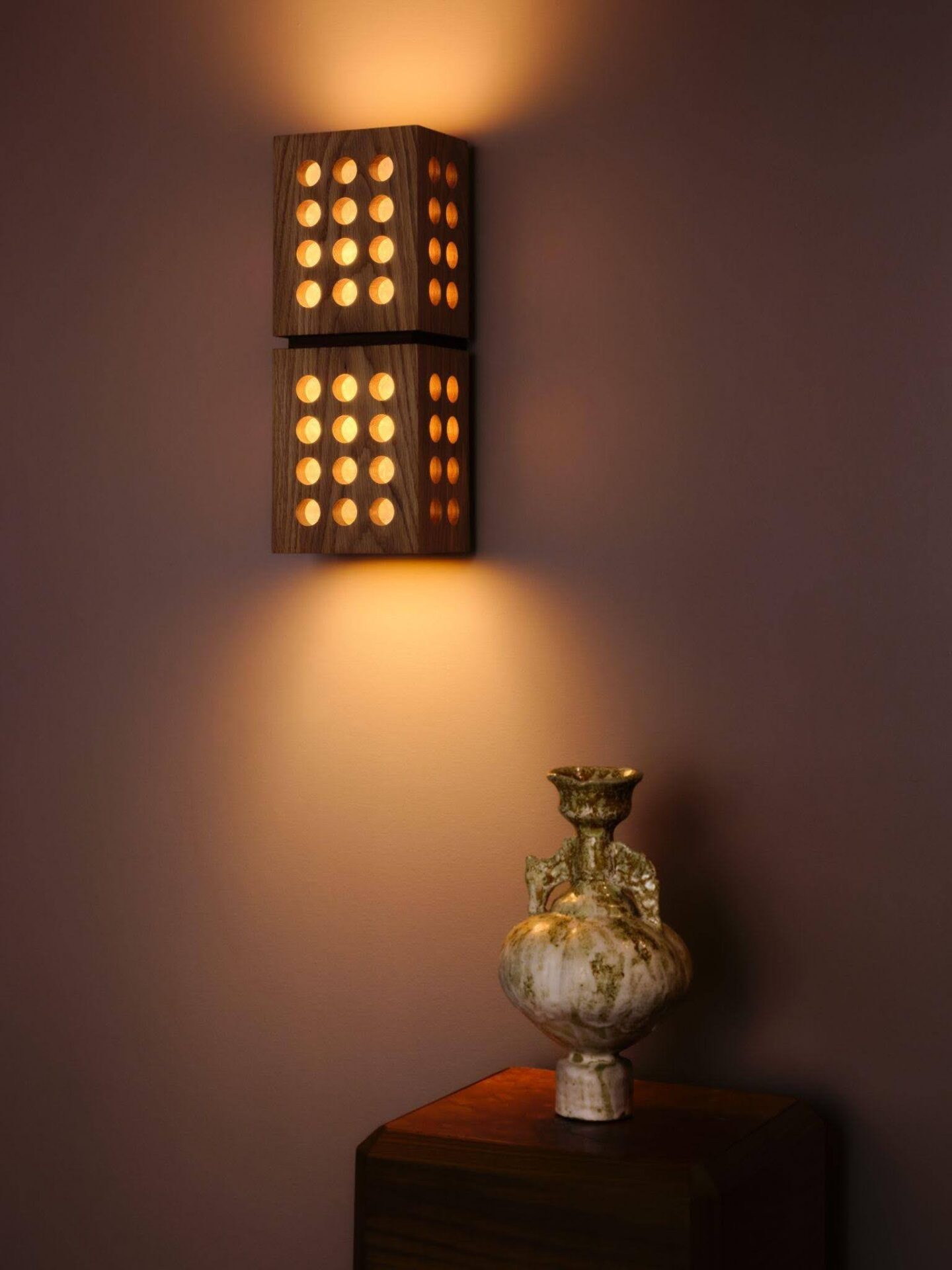
Compact but full of presence, the Cuadra Sconce uses its geometric walnut form to cast light through the perforations and across the wall.
AJ: How do you balance functionality and aesthetics in your designs?
AC: Function is deeply integrated into our design process. From the proportion and scale of a light fixture, down to the aesthetics of the bulb fittings inside the shade (that no one will ever see), it’s extremely important to us that every detail is refined. When developing our first product, the Tera Lamp, we didn’t want to just make a ceramic base and put a linen shade on it. Those lamps are beautiful, but we were more interested in making something that felt fully integrated, like a holistic sculptural piece. We wanted it to be a special experience for someone, from the smooth turn of a brass knob to the way a solid ceramic shade cast an intimate, moody glow. With our new Cuadra Collection, we applied the same principles — designed the fixtures to be as sculptural and interesting turned off as they are on. This was achieved by creating a monolithic form with a grid of holes that naturally plays with light whether it’s sunlight dancing on it, or illuminated from within.
AJ: Best advice you’d give your teenage self?
AC: Trust yourself. Most of us grow up being influenced by a lot of other people’s opinions and expectations, but learning how to understand how you think, what you’re curious about, what your own intuition sounds like, and what genuinely lights you up will lead you in the right direction every time.
Like what you see? Get it first with a subscription to aspire design and home magazine.