



Idyllia
Andrew Joseph: Can you describe your design philosophy in three words?
Christopher Grant Ward: Tell your story. Everyone has a story, a personal narrative of the things they strive for, where they come from, what they care for and what they’ve overcome. Like, I have this old side table I picked up on Joralemon Street one snowy night in Brooklyn, a reminder of a beautiful evening my partner and I spent during our time there. An old handmade violin in my foyer was made for my grandfather by a man named Andy. When my grandfather bought the land Andy lived on, he protected his home in the deed and gave him a free place to live for the rest of his life. It’s important to hold on to the beautiful stories imbued into the things we own. And these stories of our lives can be expressed in our interiors and our everyday things. We miss out on these opportunities for personal narrative when we purchase from big-box stores and retailers. This is one of the reasons my clients come to me for handmade one-of-a-kind pieces. My clients are looking to put a little soul back into their interiors.
AJ: Can you tell us about a design trend you are excited about?
CGW: Biophilic design. Bringing nature into the home. And I’m not talking about repeating wallpaper of monkeys and elephants. I’m talking about nature’s beautiful asymmetry, its serendipity. The lack of right angles and gridlines. With the onset of AI, my clients are seeking things that are not manufactured, but rather, handmade. I see people letting go of the “control” over their living spaces. Since COVID, I think we’re much more in touch with our homes as bastions and refuges, not galleries and showrooms. We also learned that nature and the outdoors provide one of the only places of sanctuary outside of the home during a pandemic.

Dragonfly
AJ: How do you incorporate sustainability into your designs?
CGW: My work honors what is found outdoors, and so does my practice. I have a responsibility to protect nature and the countries of origin with my work. It’s more important than ever to understand your supply chains in detail. My clients understand that the wood species I will work with must be FSC-certified sustainable. Most everything I use is domestic, such as Cherry, Walnut, Pine, Oak, Douglas Fir, and Alder. The only exotic wood I use is African Mahogany, and it comes exclusively from sustainable, FSC-certified lumber sources in Ghana. Ghana has some of the most progressive environmental policies in the world. Deforestation not only harms the ecology, but runoff and pollution can contaminate local communities. Revenues from the mahogany I purchase support local West African schools, hospitals and roads for the local communities. I also use organic oils & zero-VOC finishes, and I am a Rubio Monocoat pro partner. I reuse scrap material whenever possible for filler, mulch, demo projects and experiments and ensure proper green disposal of scrap lumber at all times.
AJ: What is your favorite design era and why?
CGW: The Art Nouveau movement of the early 1900s reimagined everything in your home, as a work of art to be appreciated, and a way to express your story, your humanity, and nature’s beauty in all things. This was a rejection and repudiation of the Industrial Revolution, and of assembly line products built for mass production. Art Nouveau embraced handcrafted artisans and one-of-a-kind creations. Asymmetry and organic form were prized, and furniture was seen as a thing to showcase, not meant to sit in the background of anything. They were there to be admired and adored. While I don’t love the fussiness of the execution sometimes, the philosophy of wonder and aesthetic value are an important part of my work. I embrace balance and natural harmony. These are the patterns I look for in my work.
AJ: If you weren’t a designer, what would you be and why?
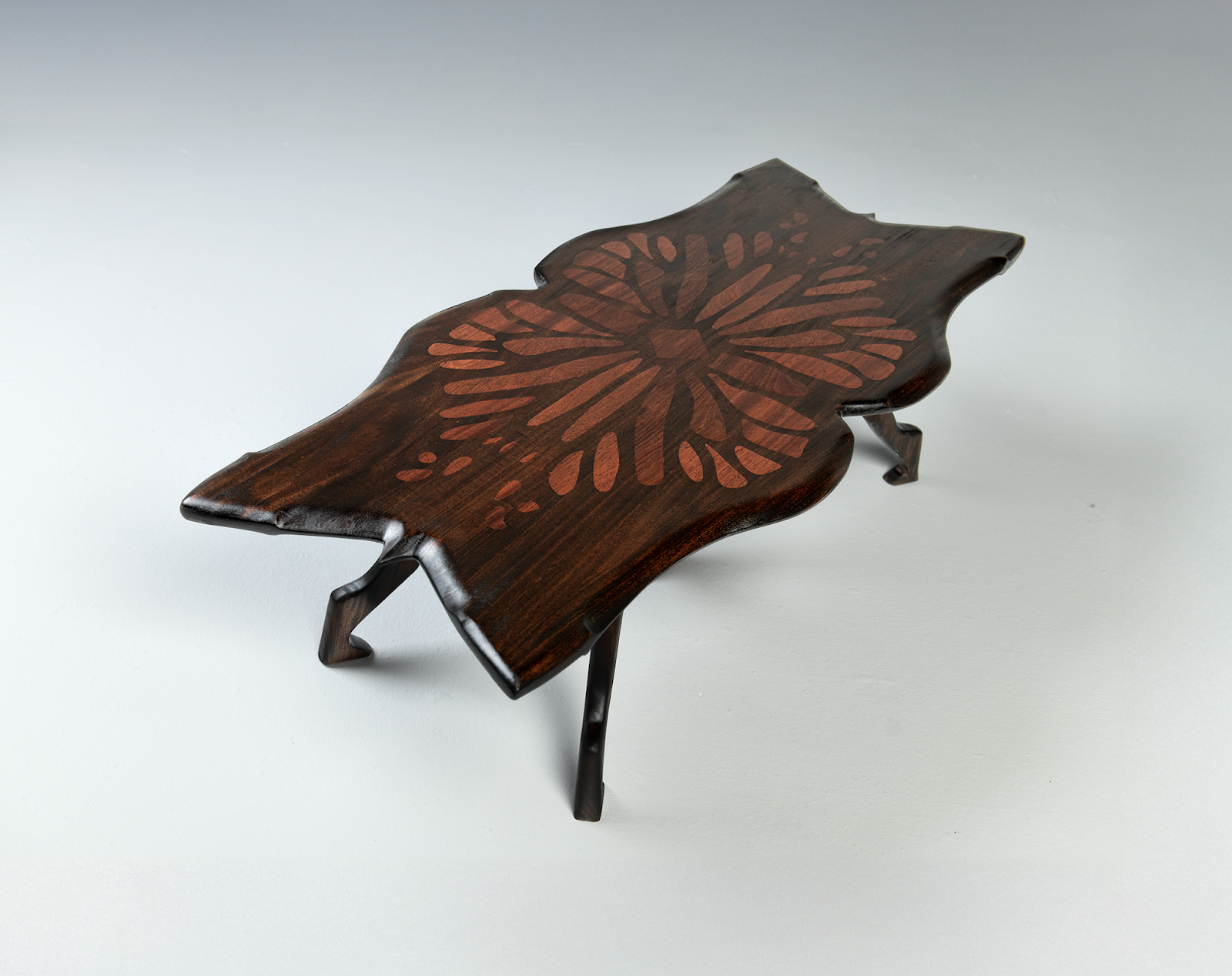
CGW: My life moves in phases and I have realized I am destined to experience a few lifetimes before I’m gone. Before COVID, I was a fairly successful rock musician, touring the US and Mexico between 2016-2019. We had a few hits, awesome fans and, I admit, I enjoyed the journey. Ultimately, I began looking for something with a little more calmness and consistency to it, and COVID made it impossible to tour. To be honest, the road life wasn’t really for me. Before music, I had lived in New York City and was Corporate VP for Shutterstock. I had an office in the Empire State Building, with a team of 80 selling millions of dollars daily to 46 countries. I absolutely hated it. As for furniture? Well, it came to me one night in a dream. I envisioned the Dragonfly table and set out to build it. Actually, my deep secret is that the Dragonfly table was actually the first table I’d ever made. I’ve only been doing furniture for two years now, and I am absolutely loving it. I have no idea what the future holds for me, I am sort of following my passions as I go, and focusing on the truest execution of work in everything I do.


Fauna Corvus
AJ: What’s your favorite cocktail?
CGW: Manhattan. Light on the vermouth. Rye whiskey. 2 dashes Angostura. I’d prefer it in a lowball, as I dislike the tipsy martini glass, but I’ll deal not to make a fuss, especially in NYC. The best Manhattan for me was at Armando’s on Montague St. The bar is closed permanently now, but it had first opened during the Great Depression in 1936 and became the regular dining spot for the Brooklyn Dodgers after games at Ebbets Field. See? Everything has a story.
AJ: What’s your design pet peeve?
CGW: Perfection. It’s simply not possible. It’s a recipe for disappointment. It’s anxiety in design. And for me, it’s not really even desirable. And I’m not talking about settling (ALWAYS DO YOUR F***ING BEST). But, keep moving and don’t let perfect get in the way of work. I do not live to be perfect, I live to express myself (and guess what, I’m certainly not perfect) The pursuit of vision is a nobler path, and the acceptance that our ideals, expressed in the lens of the world, take on the small errors and flaws that make the world beautiful, unique and inspiring.
AJ: What would your dream project or dream client be right now?
CGW: I’d love to do a commercial project, a hotel or museum lobby. Maybe the right kind of restaurant. Or a spa. Somewhere that my pieces are meant for the public, not the private, and can create a bridge to nature and create a sense of communal space. Also, to build pieces on a larger, grander scale could be fascinating.
AJ: What is your favorite aspect of your job?
CGW: I love working with clients. Sure, they can be frustrating, but 95% of the time, they have directional ideas that inspire me to do things I never have thought of before. Creating for a client is freeing in that the boundaries are set to work within. Also, I love learning about the ancestry, pursuits, the stories my clients have and want to tell in their pieces. My greatest joy is the successful execution of a piece created just for a specific place, a personal narrative, perhaps an heirloom for a family.
Like what you see? Get it first with a subscription to aspire design and home magazine.