
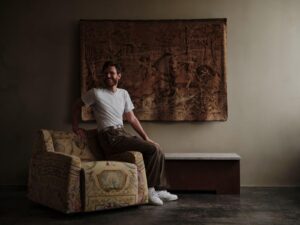
 Lance Trachier serves as creative director for American Leather, a Dallas-based manufacturer of made-to-order upholstered furniture, where he oversees the creative and marketing teams, as well as product design for the trade. With over a decade of experience in the premium branding, interior design, and B2B manufacturing sectors, he has been responsible for creating holistic brand approaches that span disciplines. A Texas native, Trachier studied communication design at the University of North Texas. He joined American Leather in January of 2025, where he is spearheading the brand’s continued evolution. Learn more about Lance and his creative journey in today’s Maker Monday.
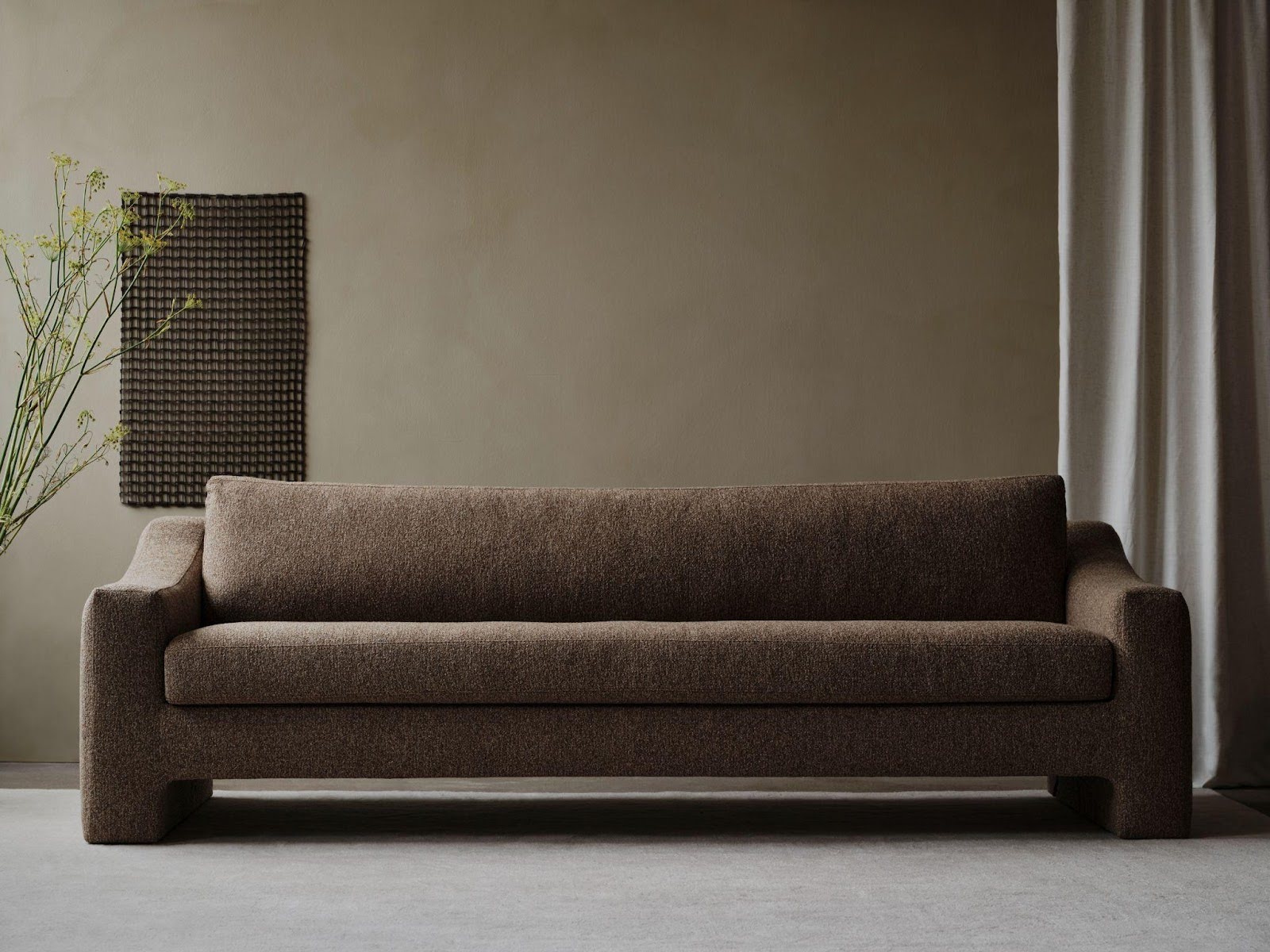
Effortlessly architectural, the Brooklyn Sofa gives a chic sense of metropolitan savoir-faire.
Andrew Joseph: What inspired you to become a designer?
Lance Trachier: A classic, Americana story, really — I was certain as a young adult I would be an illustrator and begged and pleaded for my parents to send me to a fine art school. My parents, who were both educators, gave me a wonderful ultimatum: go be a fine artist, or choose a career path that was equally as artistic, but more centralized on a business path.
My love for the arts was core to my being. I was always a creative child, making costumes from wayward scraps and unpaired socks, but through this choice, I decided to select the applied arts, and found a home in design. What started as an education in graphics led to a career at a multi-disciplinary design firm in Dallas that taught me in practice that design philosophy transcends disciplines. The same principles apply to any of the arts, and concept, scale, proportion, and color are all ingredients that span every design practice.
Through this upbringing, I’ve carved my own small corner of this industry, spanning creative direction over product, marketing, brand, and narrative.
AJ: Can you describe your design philosophy in three words?
LT: “Appropriate yet surprising.” I believe so many designers start from a place of their own desires and perspective, which is the definition of an artist’s approach. I was militantly trained to divorce my own preferences from the process, and to focus on “appropriateness” as a core pillar of my practice. Some products, some brands, some spaces don’t need to be pink. Others demand it. If I made a decision that negated pink from my toolkit, I’d be left unable to give appropriate solutions at times.
The side where I do get to put some self-expression in my project is through the lens of surprise. I find that all design becomes more meaningful, more attractive even, if there are layers to understanding. If you blur your eyes and feel that sense of “oh I get it” but when you look a little closer, you notice areas of interest — sometimes they’re witty and irreverent, other times they’re heartfelt and precious, either way, the element of surprise builds a sense of connection to the one experiencing the design, and makes way for my campy train of thought to feel utilized.
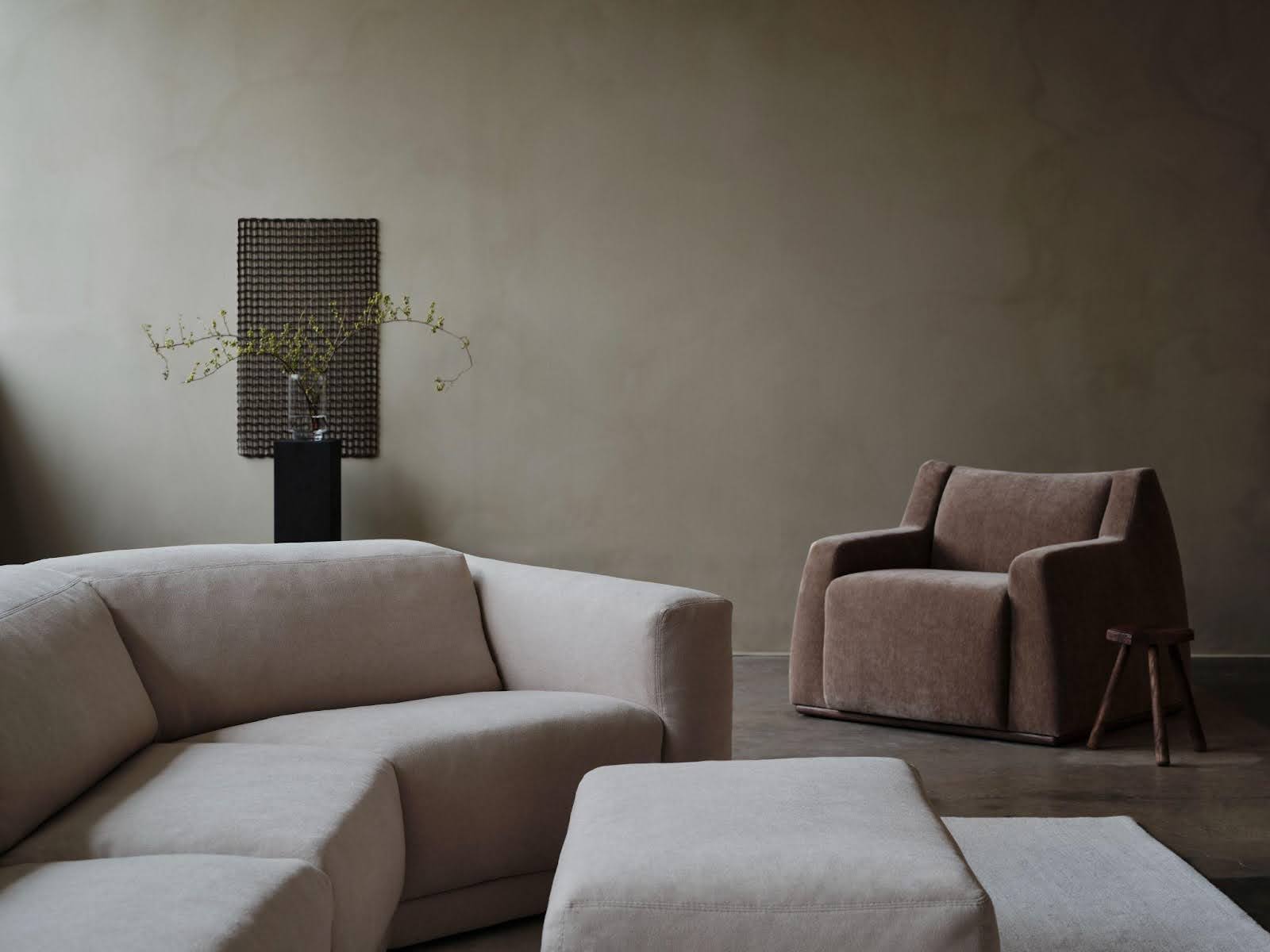
With its one-of-a-kind design, the Malibu Sofa transitions from a low-back sectional to a high-back seat to lounge in.
AJ: What is your favorite place to find inspiration?
LT: Anywhere and everywhere. I coach my young(er) creatives to find inspiration not in the big, baked ideas of the world, but to find it in the small details along the way. Finding inspiration in finished products leads to reductive thinking and regurgitated design. Finding inspiration in the curve of a driveway, or the texture of a building façade, leads to interesting germs of ideas that later can become fascinating narratives. I have been told before that my approach is rooted in curiosity — honestly, one of the kindest compliments I’ve received. I do find myself curious, archiving thousands of photos on my phone as I travel of interesting forms, surfaces, patina, and more.
Building this also creates a brand new destination: my own archive. I feel like pointing to someone and saying “have an idea” is akin to asking a comedian to tell you a joke during a cab ride. It’s hard to do what you’re best at on the spot, unprepared. Building your own rolodex of creative will leave you never without an idea, or a vision, or a resource to reference if needed.
AJ: How do you balance functionality and aesthetics in your designs?
LT: “Form and function” is one of those pocket phrases we all go back to time and time again, often citing it as function over form (though many of us candidly use the inverse). When it comes to special planning, yes, ergonomics should reign supreme, but quite controversially, I often find finished results more impactful if you do let form lead the charge. Figure out what “best-case” looks like if limitations were unreal (not just functional ones, financial, manufacturing, etc.), and then slowly chip away at that intention, finding where form rises to the occasion.
I find that trying to beautify form, rather, doing the opposite of the above, tends to lead to gilding a brick, rather than beautiful design. Aspiration is the important lodestar for function to be marching towards.
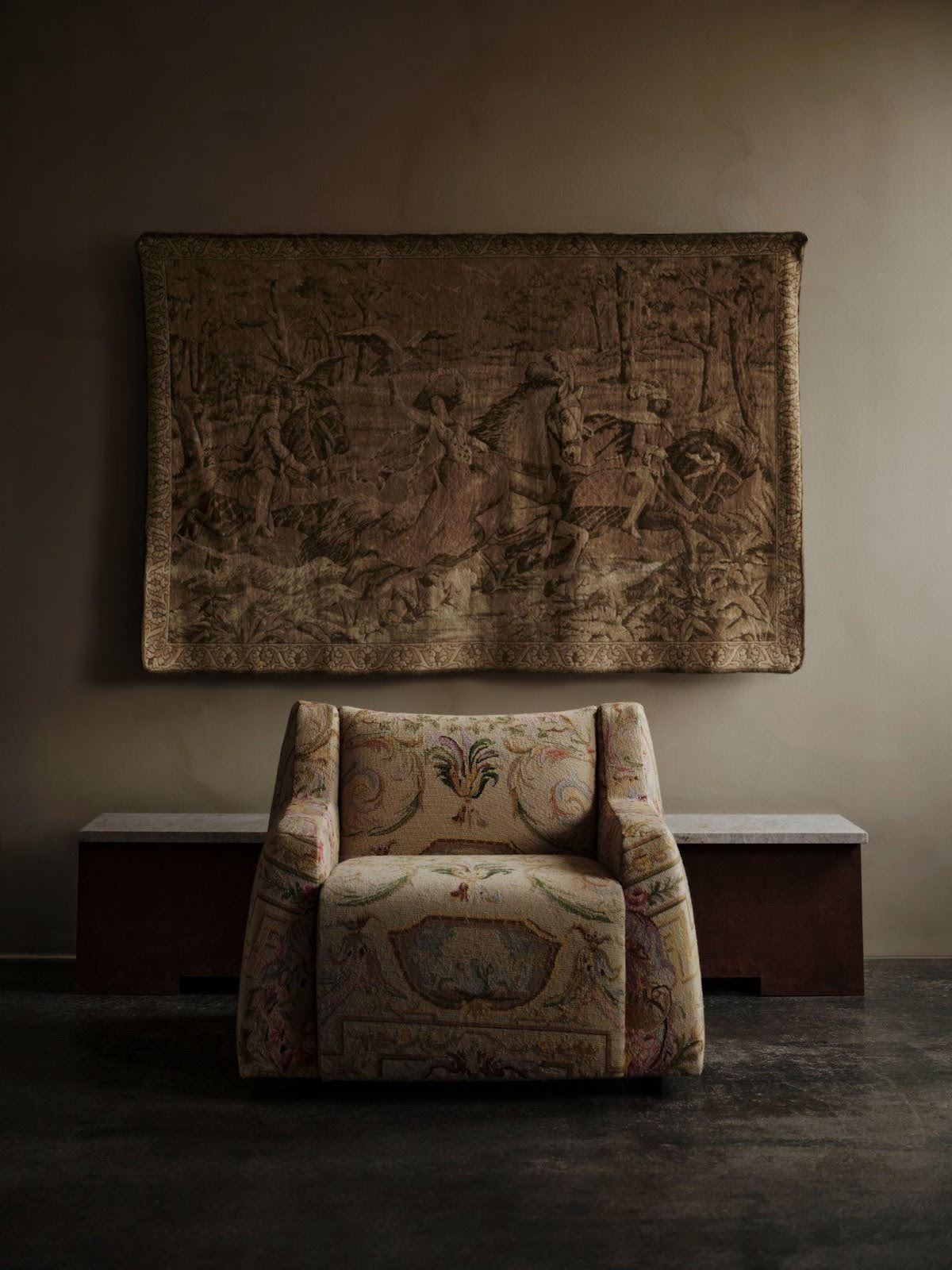
Rooted in the burgeoning Brazilian modernist movement, the Pira chair is softened for today’s customer through rounded, romantic, pillowy forms.
AJ: How do you approach designing for different demographics?
LT: Consider it a narrative, a beautiful story you’re trying to tell. Stories are universal if you focus on what is true rather than what people want to hear. I would say the broadest difference is expectations of function. Younger cohorts often have very different wants, needs, and expectations of how a space should function, how a website should operate, or how something photographs, whereas senior cohorts have much different checklists. I try to treat them just so, making sure the story we’re telling bends to those needs, but doesn’t stray from its core narrative.
AJ: How do you incorporate art into your designs?
LT: Art to me is the true window to personality. It’s so subjective, and while I genuinely feel like there is plenty of “bad” artwork around, it’s hard for me to claim any art is unusable. I find that it’s wonderful if the art blends into a space’s aesthetic, and sometimes even more wonderful if it feels like a non sequitur. There’s beauty in contrast, there’s beauty in homogenization. But art has the ability to add that “surprise” element to a space. A piece found by a street artist during travel, an auction item won, an heirloom that has been in the family for generations — each piece (barring mass-made art, yuck!) holds its own microcosm of a bigger story.
I do believe in originals only; I try to get others on board with this as well. I’d rather a simple, DIY scribble of charcoal on paper than a mass-made printed canvas any day. Even in the small spaces, nothing makes me sadder than being confronted face to face with some mass-made print while I’m peeing in a guest restroom.
The other overlooked item in this is framing. When I was young and broke and trying desperately to have a beautiful home of my own, my husband and I had our own little mantra, “Cheap art, expensive frame.” Framing adds the ability to give context to a piece. Framing something reverently can elevate it to a museum piece, and framing something with wit can add delicious subversion. It’s a super effective tool to own the narrative of an inherited piece.
Like what you see? Get it first with a subscription to aspire design and home magazine.