
 Maestro is a Spanish artist who divides his time between the eastern coast of Spain and the western coast of the United States. Born and raised in Spain, he studied and trained as an architect at the Polytechnic University of Valencia before joining the architecture honors program at the University of Pennsylvania. From there, Maestro spent several years developing a professional practice as an architect and designer, working as a creative for firms such as the Bjarke Ingels Group before beginning his artistic career. Maestro draws inspiration from both the simple elegance of European design and the dimensional complexity of the architectural process. As a recent immigrant to the United States, he is also fascinated by the contagious nature of American pop culture — especially those enduring icons that have spilled over into the global public consciousness. Maestro’s work explores the various ways in which highly recognizable icons are accessed and processed through contemporary media and technology. See how Maestro alters your perception on popular works of art in today’s Maker Monday.
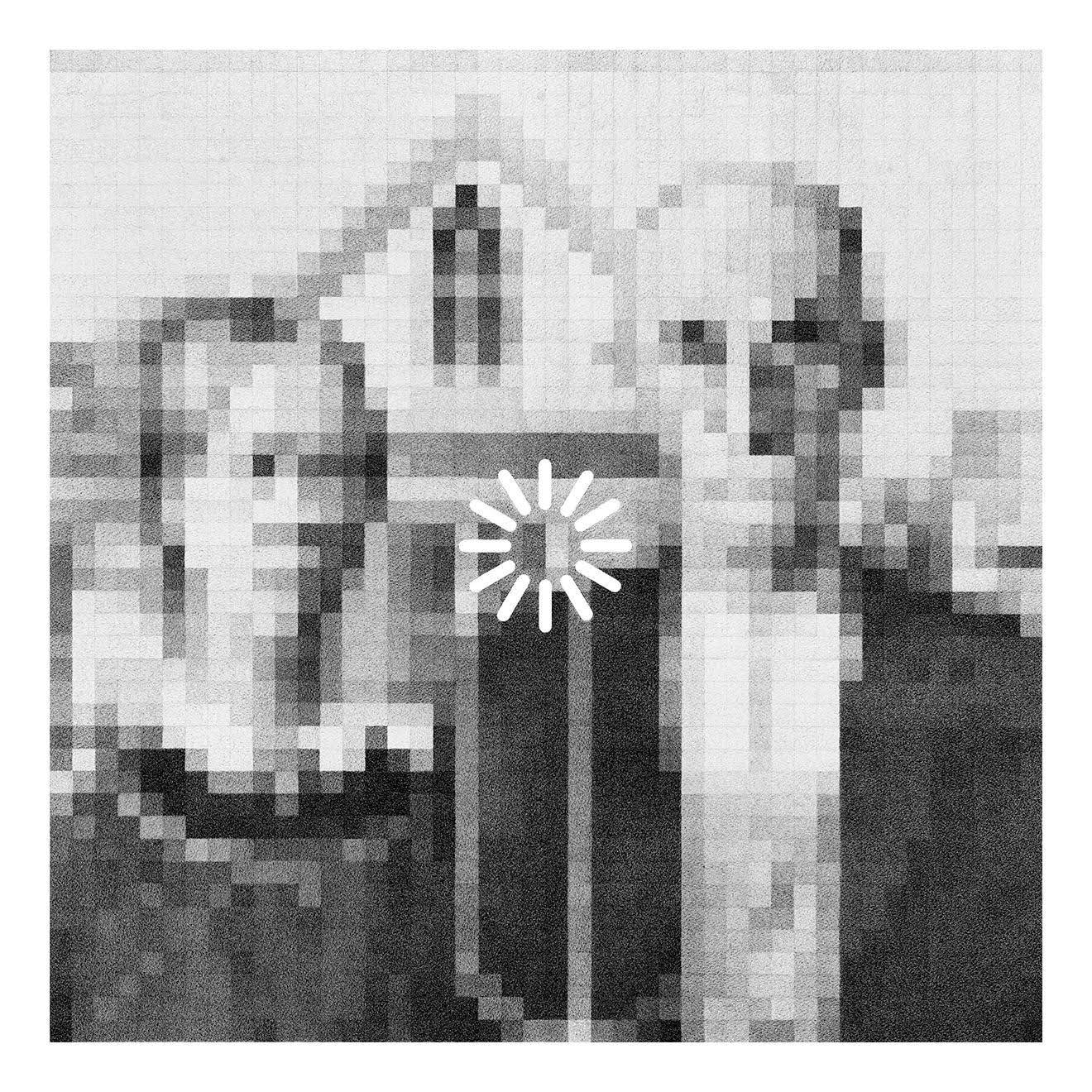
“Loading: American Gothic”; pen on paper
Andrew Joseph: What inspired you to become an artist?
Maestro: I think I developed an affinity for order and beauty early on in life, which has always stayed with me. I’ve always drawn — as long as I can remember. My father was an artist and painter (though not professionally) and he would sometimes have me work on a piece with him. Also, growing up in Europe, you’re surrounded by beautiful architecture. My mom is handicapped, so we would walk slowly and take it all in. I was always looking up.
Architecture remains a big part of my life, but being an artist frees me from the limitations imposed by municipal regulations and client preferences. Basically, there are fewer roadblocks, and that is really exciting for me. I enjoy the collaboration that comes with architecture, but I really value my creative freedom.
AJ: Can you describe your creative philosophy in three words?
Maestro: I would like my art to be thought of as timeless, elegant and playful. My artistic lens is tied to the digital, but that’s also what I am critiquing. I think sticking to black-and-white and pen-on-paper gives each piece a textured and nostalgic look that aims at being “timeless” and “elegant.” “Playful” I am less sure about. I am open to alternatives, but I think there is a cheekiness to my style and to my art — so “playful” is what I’ll say for now.
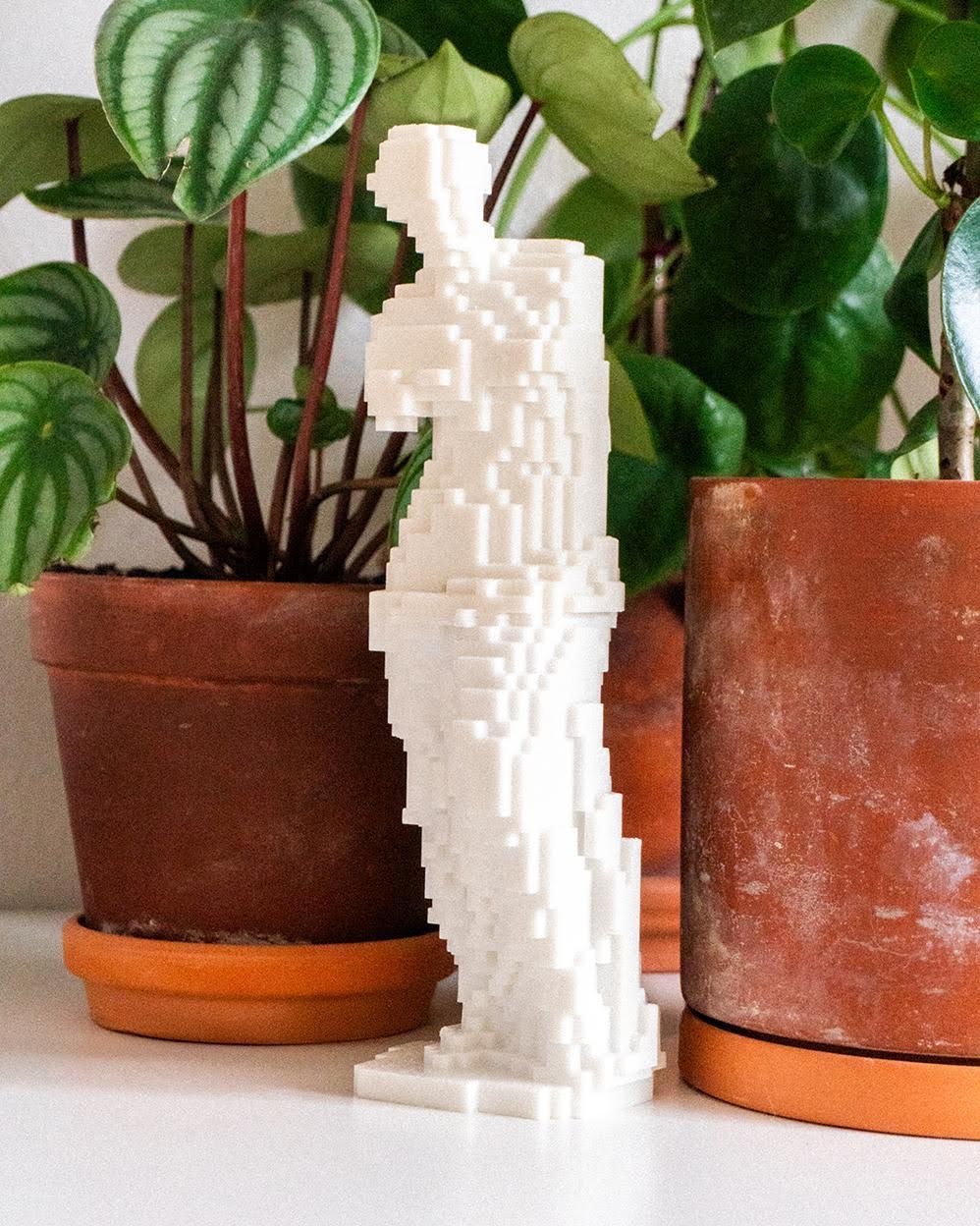
Glitching Venus
AJ: How do you approach new work/projects?
Maestro: Any new piece I consider making has to work within the constraints of my chosen medium and technique: for my drawings, I use only black pen and white paper, each pixel is 1.5 cm, and each loading sign is always the same size. If a particular figure or historical moment inspires me, I will try to find a reference image that, when put through these filters, remains compelling.
Given the labor-intensive nature of my pieces, if I don’t think the composition is striking enough, I won’t proceed. For some subjects, there are many possible images to choose from as a base inspiration; for others, there is only one, and sometimes that image just won’t work.
AJ: What is the most challenging work/project you’ve worked on and how did you overcome it?
Maestro: Making the pieces themselves has never been challenging for me — precision and detail have always been natural strengths. For me, the most difficult part was accepting that art could be a profession. I was always artistic, but I didn’t grow up feeling that a creative career was within reach.
I started drawing pixels during a moment of stress in my life. I felt compelled to create the pieces that I did, and making them made me fulfilled, but I didn’t necessarily imagine them going anywhere. The more I started believing in my practice, the more pieces I made. If my practice continues to grow as I hope it will, I’m sure I will encounter technical challenges — I’d love to push myself in the area of sculpture, for example — but for me, those kinds of challenges are entirely a joy. I don’t think of myself as having to overcome them in the same way I need to overcome mental limitations.
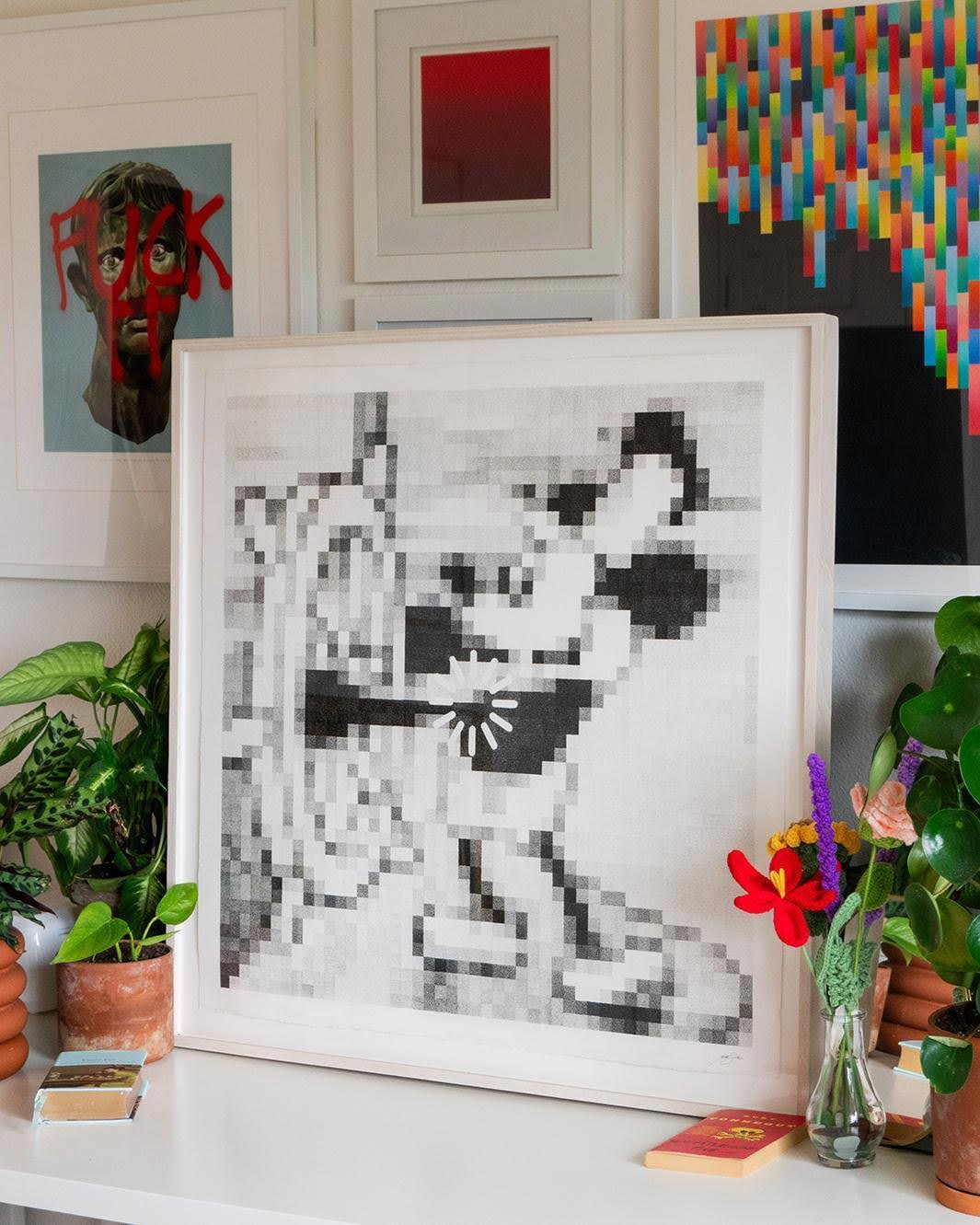
“Loading: Steamboat Willie”; pen on paper
AJ: Can you describe a work that you’re particularly proud of?
I am especially proud of the first pixelated piece I made: “Loading: Steamboat Willie,” which was sold to a couple in New York a few years ago. It was smaller than my pixelations are now — the pixel size and the loading sign were different — but it was the first time I looked at my own art and thought there was something there. The subject was a frame from 1928’s “Steamboat Willie,” which was Walt Disney’s debut for Mickey Mouse and a big moment in cartoon and art history. I’ve always loved the symmetry that a beginning for Walt was also a beginning for me.
AJ: What’s the best piece of advice you’ve received as an artist?
Maestro: Behave in a way that aligns with the identity you have — if you are going to be an artist, make art. Try to improve 1% every day. Don’t give up. Those are all from James Clear’s Atomic Habits, I think. I go back to that advice frequently.
AJ: How do you stay creative and inspired?
Maestro: My primary inspirations are history and culture, both of which are infinite sources. Human variety is the gift that never stops giving — I find there is endless beauty and potential within it. Also, my recent series features the gazes of iconic women, and the more I work on it, the more I realize that eyes are everywhere. We are all about attention and “looking” these days, and that means there is always someone staring back at you.
Like what you see? Get it first with a subscription to aspire design and home magazine.