
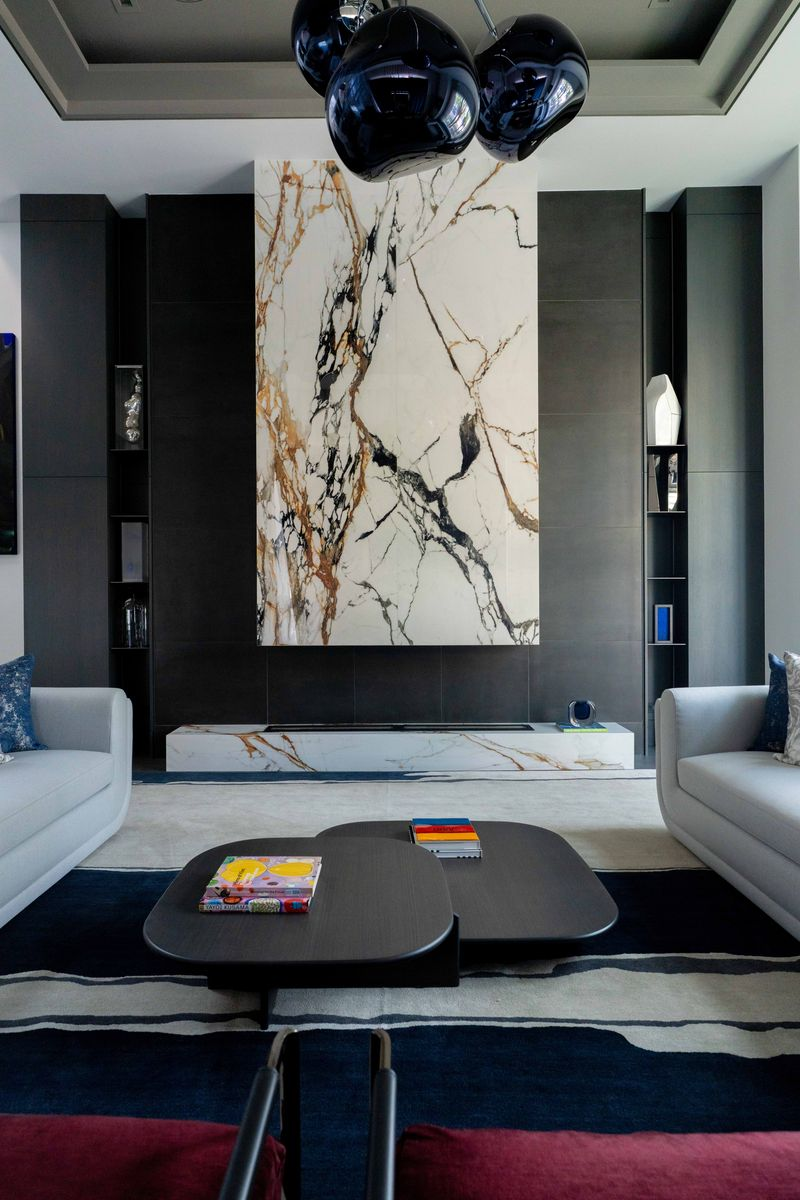
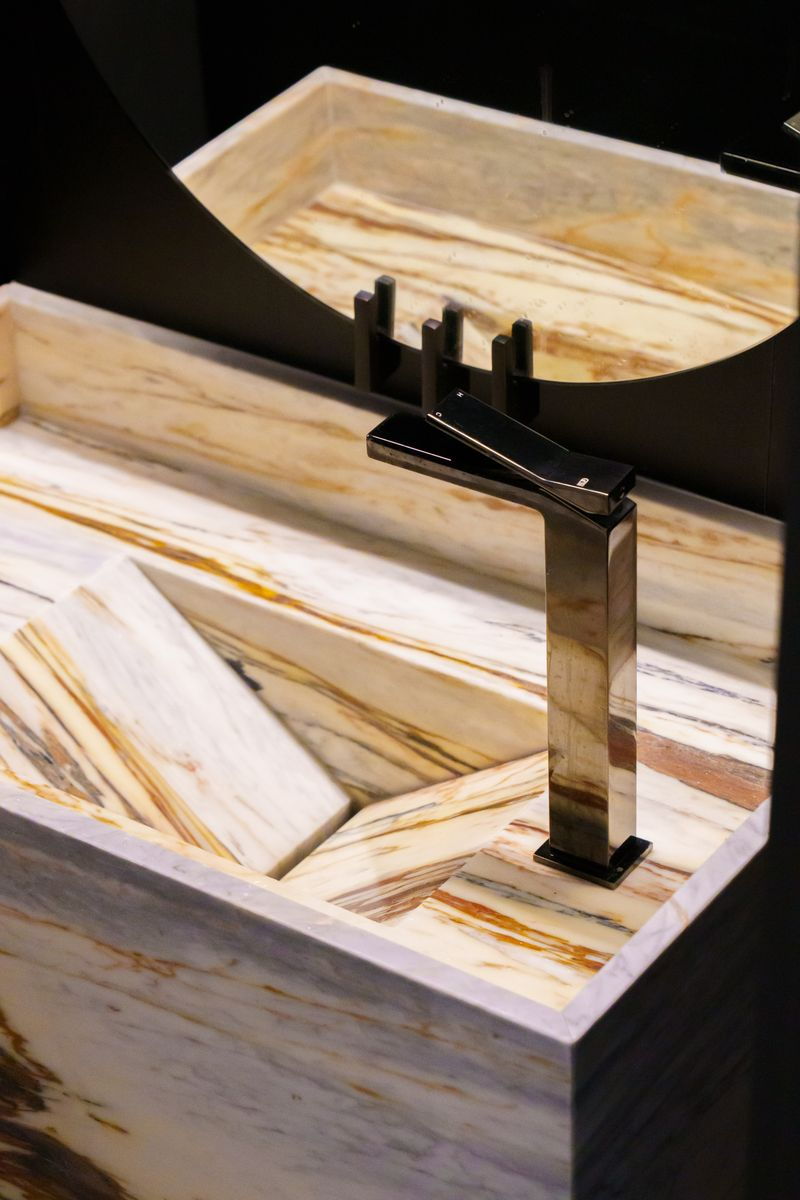
 While some artists rely on paint, clay, or fabric, Sandya Dandamudi works with stone, describing it as both medium and canvas. Design has long been central to Dandamudi’s work as president of GI Stone, a supplier, fabricator, designer, and installer of stonework for developers, interior designers, architects, and homeowners across the Midwest and Nashville. She describes her work as “a conversation between nature and space,” approaching each project with both precision and intuition. Her portfolio includes sculptural marble fireplaces, waterfall-edge kitchen islands, and illuminated onyx vanities, though her innate sense of proportion elevates even the most understated installations.
Recently, Dandamudi launched GI Stone’s Luxury Residential Division, marking a new chapter in the firm’s 30-year history. Known for her collaborative approach, she works closely with interior designers, architects, contractors, and homeowners, advising on everything from tonal palettes to spatial flow. She measures success not only in the reveal of a finished project, but in the harmony created between architecture, environment, and emotion. As she puts it, “Stone has soul. My job is to help it speak.” Learn more about Sandya Dandamudi in today’s Maker Monday.
Andrew Joseph: What inspired you to become a designer?
Sandya Dandamudi: I grew up around nature and design – my family is from India and from generations of farmers. Living in an Indian village, you are surrounded by both intricately embellished design and design created with natural elements. I did not grow up with an academic design background, but the appreciation of design is part of who I am.
AJ: Can you describe your design philosophy in three words?
SD: Aesthetic, structure and integrity.
AJ: How do you approach a new design project?
SD: Our projects all come to us with the framework of design already in place. As a professional who works in stone, it is my job to translate the design vision into practical reality.
AJ: What is the most challenging project you’ve worked on and how did you overcome it?
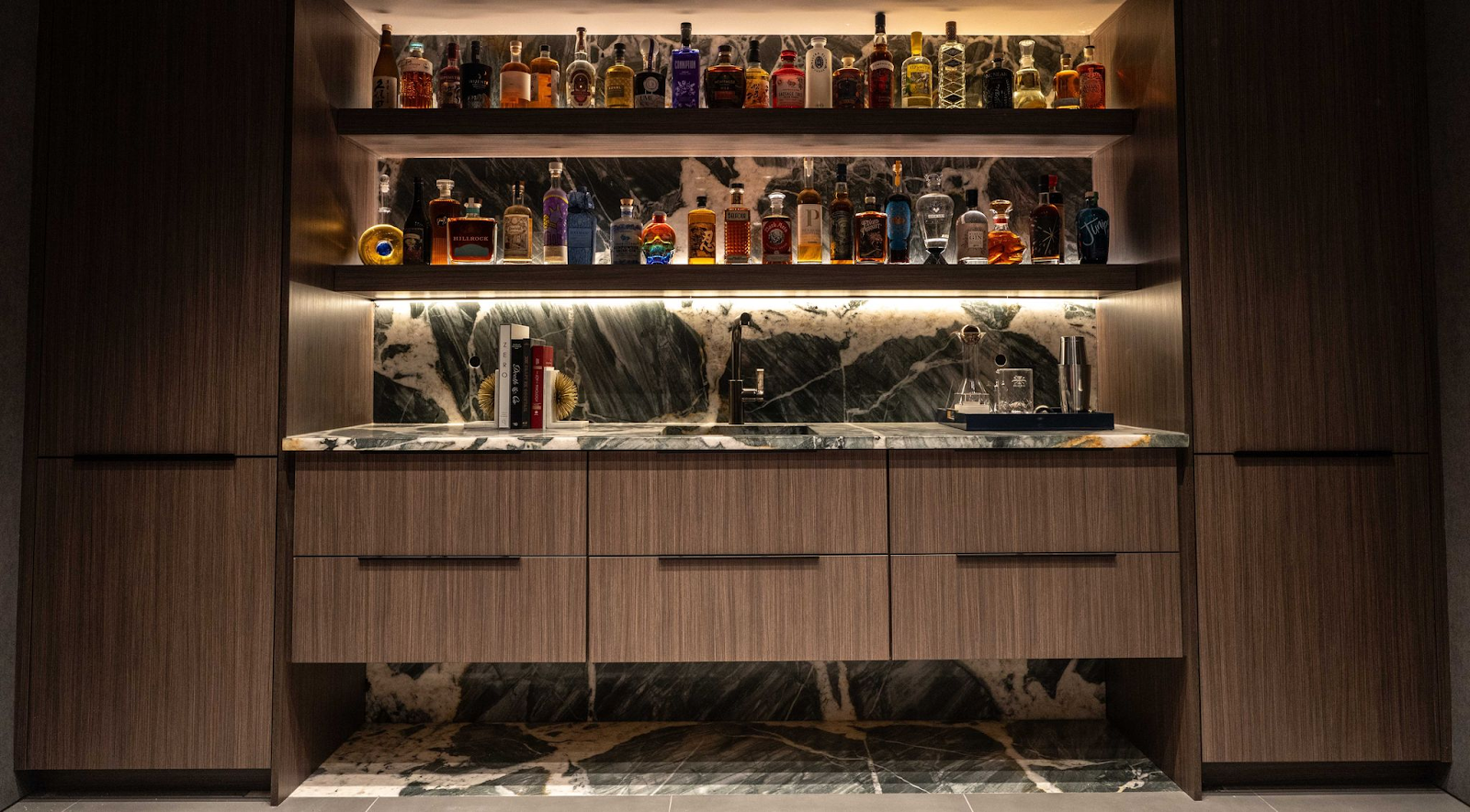
SD: That’s a hard one to answer, as most projects have an element of challenge. As a stone contractor, our challenge is to work within the parameters of a client’s needs, the designer’s vision and to maintain the practicality of the item’s use. While a kitchen or a vanity can be stunning, it also needs to be functional. There will be sauces spilled, hot pans that need to be placed and dried toothpaste front and center. But going back to the original question, I will say one of the most challenging projects was the renovation of the iconic Chicago Tribune Tower from a newspaper/office building into 165 luxury condominiums. The design was expectedly upscale, but we had a building and spaces that were difficult to access due to their historic landmark designation. And of course, there was the budget. Everything that could be thrown at us was, and we needed to look at each element. I am extremely proud of the outcomes – they speak for themselves.
AJ: Can you tell us about a design trend you are excited about?
SD: What I am really excited about are the questions that are beginning to be asked about sustainability and supply chain ethics – these questions lead to a more conscientious approach, and this “magically” leads to changing the energy in a space. Our bodies and minds react to this in ways that are difficult to articulate. The trends in design have become cleaner, and while patterns can have a lot of drama, the lines themselves have been more disciplined.
AJ: What design trends do you think will be popular in the coming years?
SD: In the stone/surface industry, technology has helped propel not only an array of choices but also the ability to manipulate material in ways we could not do previously. Today’s machinery allows us to change surface textures, get more precise in our edge treatments, and these come with price tags that are more attainable. For example, edging and carving machines now allow us to craft elaborate fireplaces that would have once required special artisans. Another example is Dekton, an innovative manmade stone that can mimic natural stone, concrete or metal and is available in ultra-thin profiles, allowing it to be used in more creative ways, such as cladding cabinetry, which opens a world of beautiful new design possibilities. It’s also far more sustainable, extremely durable and low maintenance, requiring no sealing.
Like what you see? Get it first with a subscription to aspire design and home magazine.