


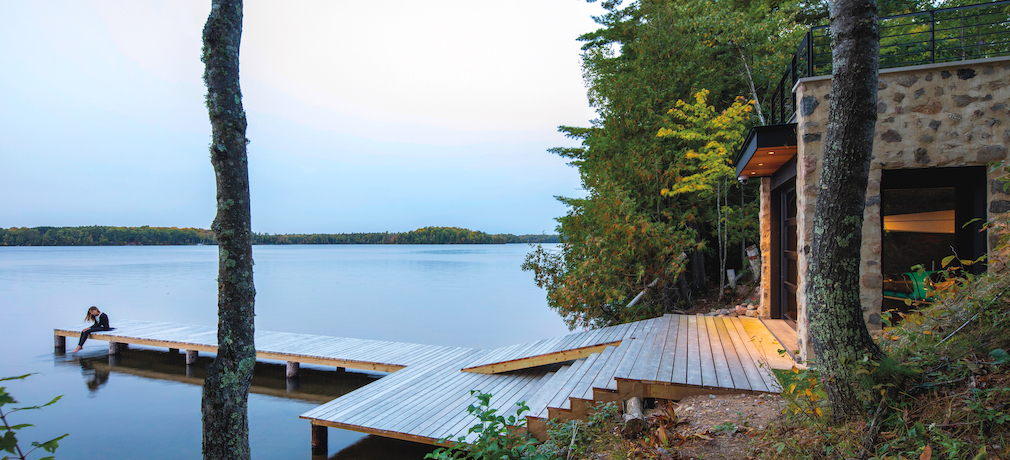
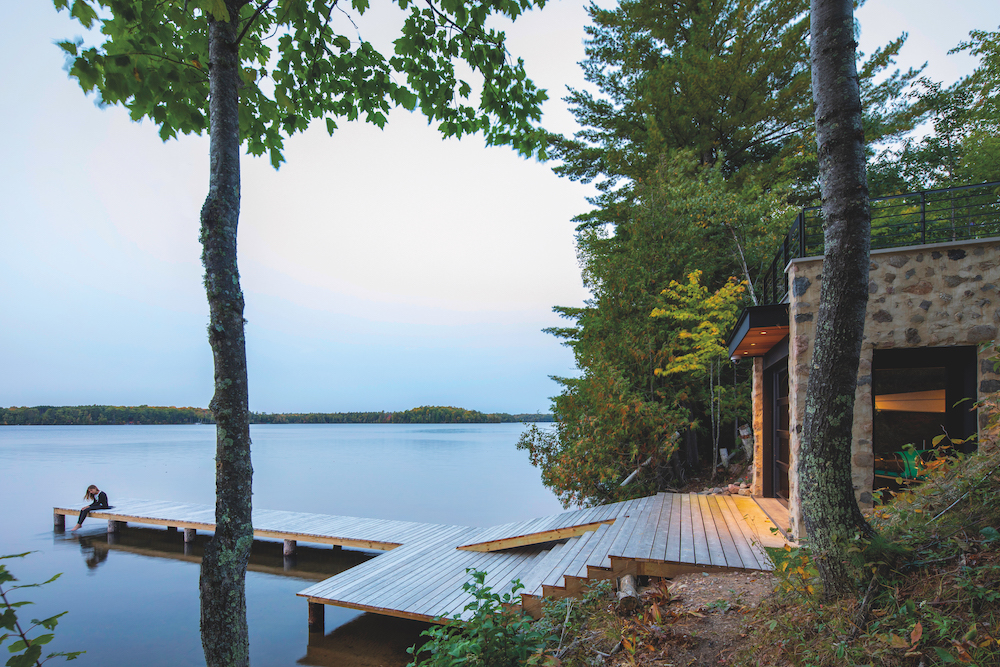

Play, relaxation and lots of laughs characterize life at Camp Spirit Lake, a family compound that includes two homes, a pair of boathouses and a detached art studio on a bosky bluff overlooking a picturesque lake in northern Wisconsin. “The owners are stewards of the area,” says architect, John Vetter, who designed several of the structures, most recently a modernist home he compares to a VFW hall at a Northwoods camp. “It’s a true legacy property that will pass from generation to generation.”
In addition to offering access to outdoor recreational activities like boating, swimming and bocce, his most recent creation includes a lower-level lounge with a luxe bar, a bowling alley, an 80s-style video arcade and a sauna. “(The new house) is a gathering place for our collective family,” the wife shares, noting there are often 10 or 20 people there at a time.
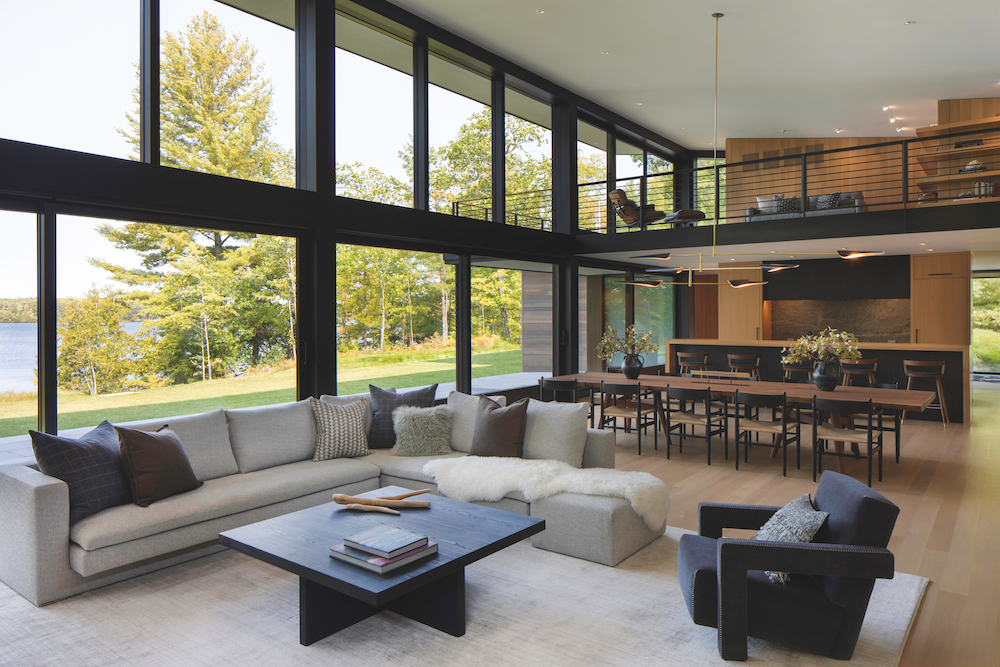
Inspired by the iconic stone silos and barn foundations throughout Wisconsin, Vetter and project architect, Erik Walsh, designed the sprawling structure with rough-cut fieldstone walls accented by metal roofing, cedar siding and floor-to-ceiling mahogany windows stained in a dark graphite color that perfectly frame the expansive lake views – the first thing visitors see from the glass pivot door. “This house is highly experiential,” Vetter explains.
Involved from the project’s inception, Amy Carman and team collaborated closely with the architects, cladding the floors and many walls with rift-sawn white oak punctuated by an entire wall of graphite-stained paneling that mirror the lake-facing windows. “(The wife) wanted it to be warm and true to its location,” Carman says. “It’s a modern interpretation of a lake house with knotty pine paneling.”


At one end of the lofty great room, a massive two-story fieldstone fireplace makes a stunning focal point for a contemporary sectional and a pair of modern club chairs. Steps away, a sleek chandelier illuminates a 12-ft.-long solid walnut dining table by Chicago-based craftsman, Michael Dreeben.
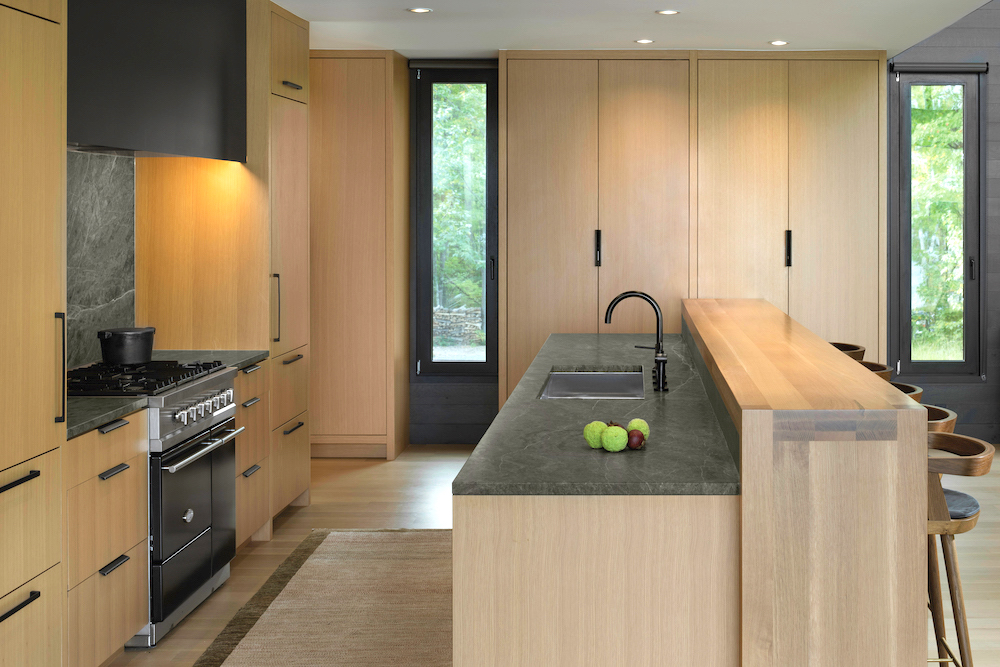
There’s additional seating at the steel-clad island with a white oak waterfall-style countertop. A blackened steel hood likewise plays off the veiny soapstone-like quartzite countertops and backsplash.

The bedrooms are equally well-considered. Connected to the main living area by a 150-foot-long corridor with rift-sawn white oak walls and a floor-to-ceiling, wall-to-wall window on either end, the virtually identical spaces each have custom furniture and cabinetry detailed with hand-stitched leather-clad drawer pulls, spa-like white marble bathrooms and private outdoor patios overlooking the water. “There are a lot of down-to-earth finishes,” Carman says. “Everything feels relaxing.”
And surprising: The white oak shelving in an open lounge overlooking the great room conceals an office space, its walls covered with a navigator’s map. And in the level, a large-screen TV livestreams video from a camera at the boathouse, allowing the guests to watch the boaters from the comfort of the chocolate leather stools at the zinc bar counter.


Darker and moodier than the main level, the subterranean lounge’s heated concrete flooring plays off an 80-ft. wall clad in dark-stained tongue-in-groove paneling – a stunning backdrop for a fully functioning two-lane bowling alley, where the family enjoy friendly tournaments. “The upstairs is sparse, spare and minimalist,” the wife explains. “And then you kind of go downstairs, and it’s a little over the top.”
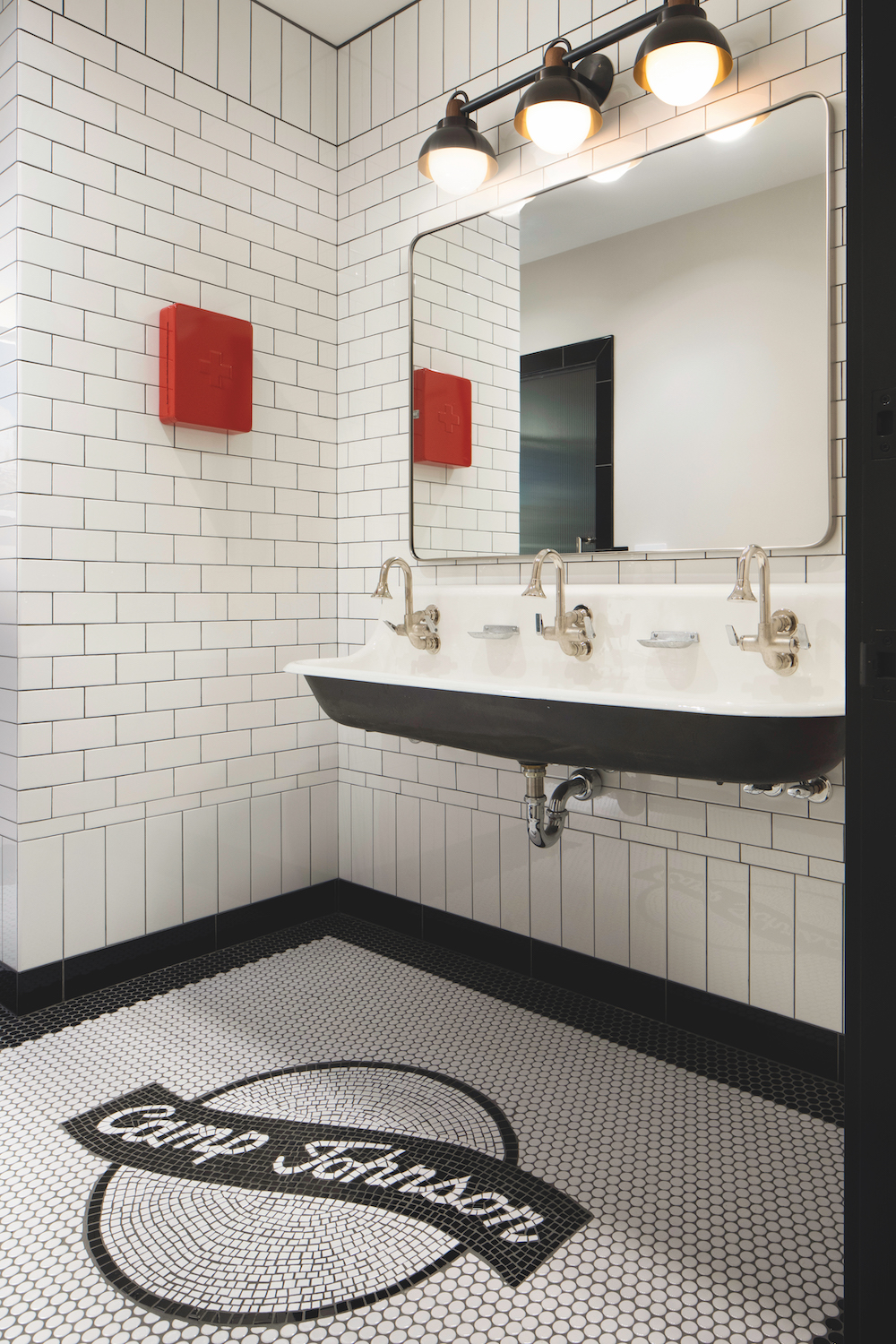
Not to be overlooked, design coordinator, Brittany Vogt, designed a family logo that can be found in the tile of the lower-level bathroom and on posters, ceiling fans, letter labels and custom hatchets. “There was a simplicity to the design that we all really love,” Carman says. “Once we had that, we were off to the races.”
Enhanced by the new gathering spot, the home proved to be a godsend for the owners during the early days of the pandemic, when they spent most of their time there, often providing a refuge for family and friends. “When you open the front door, you literally feel your body relax, and I attribute that to the space itself and the importance of architecture and what that does to you on a cellular level,” the wife says. “I feel very lucky to be in that box.”
Photography by Ryan Hainey and Elisabeth Witt.
Like what you see? Get it first with a subscription to aspire design and home magazine.