


In the mountain village of Fiss in East Tyrol, Austria, the family-owned hotel Schlosshotel Fiss is a beloved ski destination in the winter and hiking spot in the summer. Together with the architecture and interior design studio NOA, the property has begun a long-term renovation and repositioning process, developing a strategic vision for the future. The collaboration initially focused on the hotel’s existing children’s areas, with a new Kids Club opening last December, as NOA’s first interior design intervention at the hotel and the first phase of a more extensive transformation. In April 2026, construction began on a more complex project: a new experiential area for junior and teen guests, for which NOA curated both architecture and interior design.

The new volume is set within the hotel garden, facing southeast, and follows a mimetic architectural language. In the background, the dramatic panorama of the Samnaun Group dominates the view, and — as is often the case in the studio’s approach — the goal was to avoid an imposing volume that could interfere with the Alpine environment.
“The first design step was a careful study of the volumes and their relationship with the landscape,” explains architect Giulia Prevedello. “The aim was to engage in dialogue with the surrounding natural terrain and the ski slopes in winter, while reducing the impact of a new addition to an already substantial hotel complex. For this reason, we chose to develop much of the program in a semi-subterranean space, organized around two main access fronts, strongly integrated into the context.”


The design concept further develops through a direct reference to Alpine landscapes and, in particular, to the hidden environments of the mountain subsoil: caves, fissures, and rocky cavities become the main conceptual reference for both architecture and interior design. The volume, distributed across four main levels plus two additional levels forming the slide tower, is structured around a clear opposition between two architectural archetypes: the cave and the ice crystal.
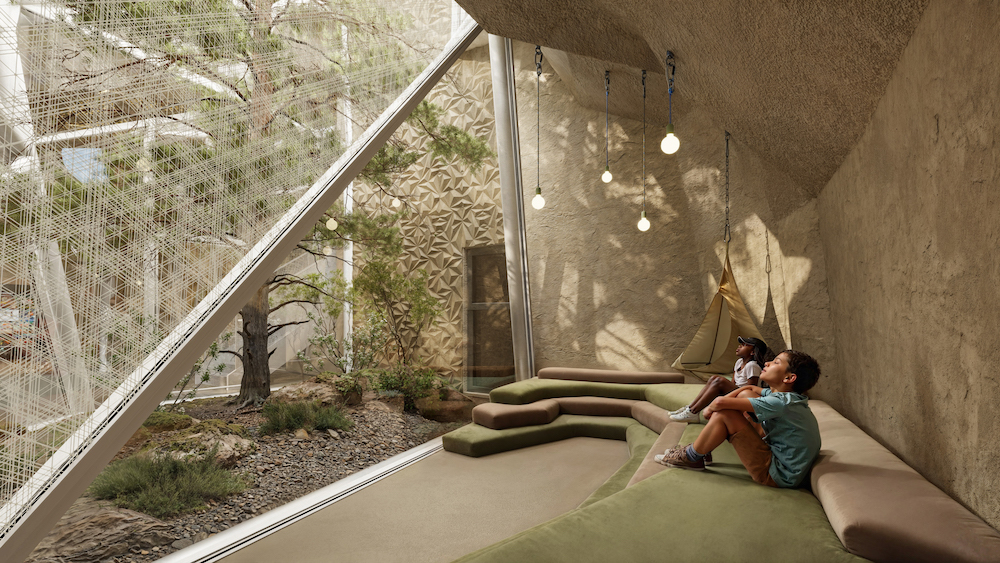
On one side, excavated subterranean spaces define a dense, material condition; on the other, two light-filled patios inspired by ice crystals are embedded into the ground, drawing natural light deep into the building. Conceptually, these crystalline volumes appear to pierce the soil layers, generating fissures and cracks, reinterpreted architecturally through glass roofs. Light is therefore one of the project’s central elements: by day, it enters the space through deep cuts and grazing rays, while the patios and the openings in the ground take on an even more dramatic presence at night.

The interiors are conceived as a subterranean landscape, visible from the outside only through two emerging towers and glazed openings cutting into the ground. Inside, walls and ceilings share the same color tones and material textures, reinforcing the idea of being in an underground environment shaped by nature. Triangular modules are integrated into the ceiling, partly made of acoustically active plaster and partly of 3D-printed concrete panels. These elements introduce a geometric fracture into the space and, beyond their aesthetic role, integrate acoustic functions and modulate light. Of the two patios, one is open while the other is covered by a glass structure. The functional program includes various entertainment spaces, both digital and analog, a Ninja Parkour and a Climbing Area, as well as a Kids Academy focused on creativity. On level -1 there is a shop and a ski depot, directly connected to the ski-in/ski-out system, ensuring immediate access to the slopes. The central experiential space on the ground level, developed as a double-height volume with suspended bridges and climbing walls, forms the playful heart and focal point of the project.
“The interior concept revolves around the vertical transition between different environments: as guests move through the building’s levels, they experience a shift from an underground world to the exterior,” shares interior designer Alin Messner. “Level -1 is essential and material, like a cave carved into stone, while the ground-level patios anticipate the relationship with the outside. On the upper levels, the experience becomes almost suspended, in sharp contrast to the solidity and density of the lower level.”

The materiality also evolves progressively along the building’s vertical journey. In the deepest levels, stone, metal, glass, and blue textiles dominate, while moving upward toward exterior-facing spaces, wood, green tones, and warmer textile materials appear. In the Kids Academy, the palette shifts to forest greens and terracotta ceramic inserts, while the parquet floor—arranged like a wooden chessboard with raised rings—defines a distinctive graphic motif.
The theme of ascent constantly accompanies the interior experience. Double and triple-height spaces, stepped seating rising along the walls, and lightweight structures naturally guide guests to move fluidly between levels. The architecture appears to originate from a deep, primordial cavity, later shaped by the interior design team through subtle and light interventions, never compromising the sense of openness and spatial depth.
The ambitious project is scheduled for completion in winter 2027.
Renderings by Aleksey Mokhov, NOA.
Like what you see? Get it first with a subscription to aspire design and home magazine.