


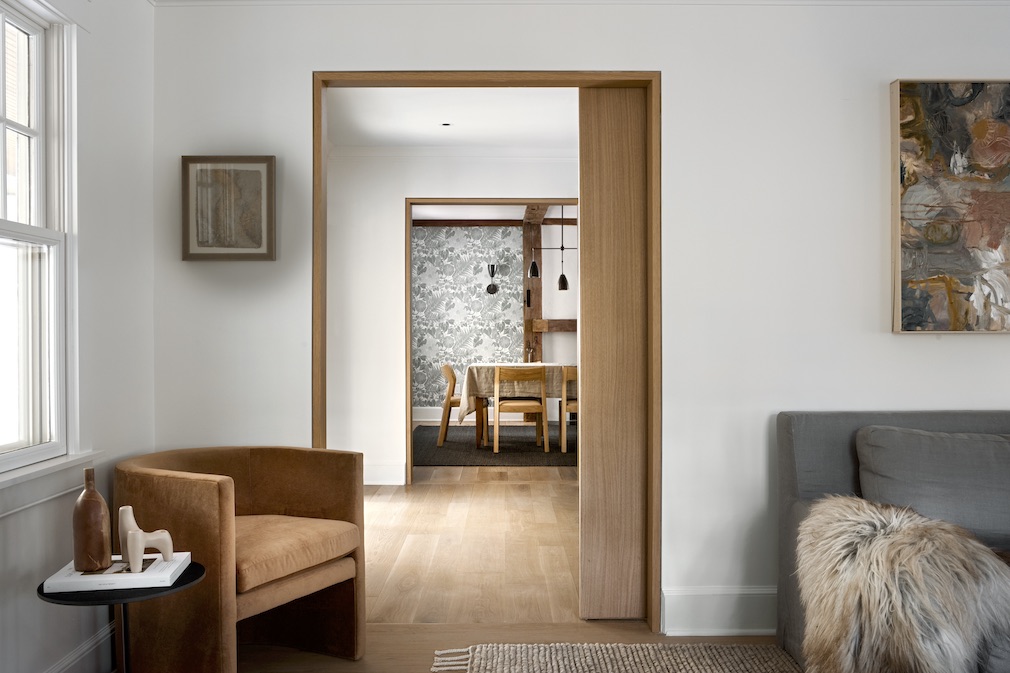

With its over-the-top, highly personal mishmash of clashing aesthetics, this European-style farmhouse in charming Weston, Connecticut, was far from move-in ready. But that did not deter the former New Yorkers who ultimately made an offer on the property.
Perhaps the spouses were still delirious after contending with the New York City housing market for so long. Or maybe they just couldn’t pass up the home’s verdant views, sprawling floor plan and location on a leafy street in a charming, tight-knit community. Whatever the reason, they soon held the keys to their and the home’s intertwined future.
Eager to create a space that better reflected them, the couple soon hired James Veal and Christine Stucker, a husband-and-wife team known for their streamlined designs, to make sense of what they increasingly viewed as undecipherable. “Our work leans contemporary and minimalist, but this home didn’t call for that, which gave us the opportunity to spread our wings and go in a different new direction,” Veal explains. “It’s minimalism with a traditional overlay.”
Embarking on a speedy, six-month renovation, they stripped away the visually painful raw lumber wall paneling, tore out the shabby-chic blue kitchen cabinets, vanquished the dated finishes and refinished the oak floors in a lighter stain that seems far more apropos for a European farmhouse.
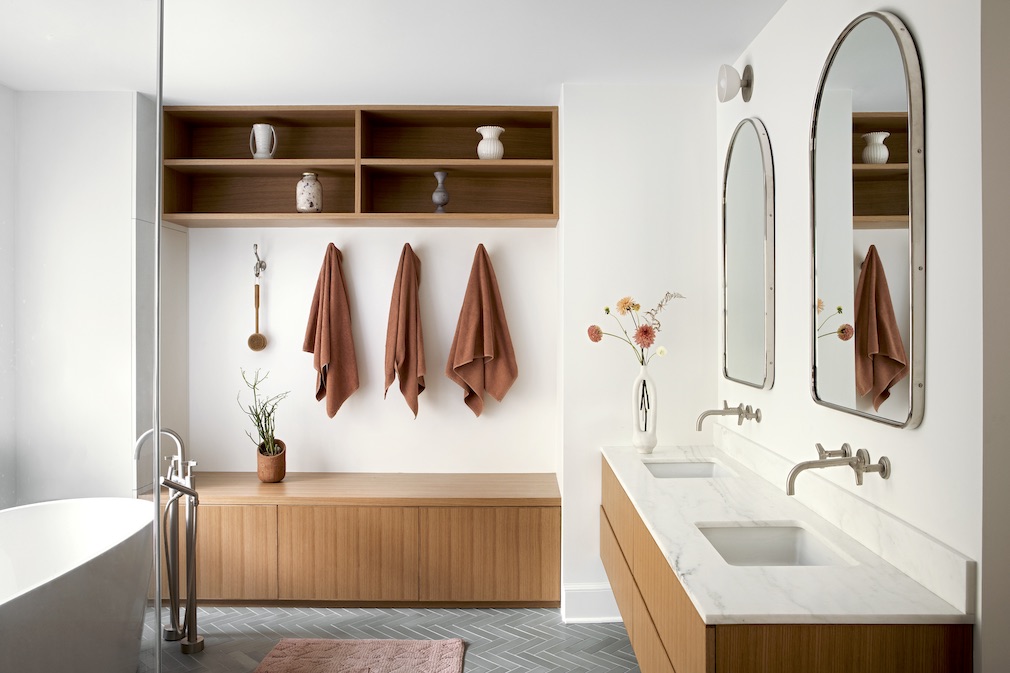
They also made strategic changes to enhance the functionality and improve the flow. Noting that the front entrance was barely used, the designers eliminated one of the home’s two staircases and repurposed the far larger remaining footprint as an office. By reclaiming the upper-floor void left by the stairs, they were able to enlarge the primary bedroom and spa-like en suite bathroom. “They’re using it more efficiently now, and the space flows a lot better,” Stucker notes.
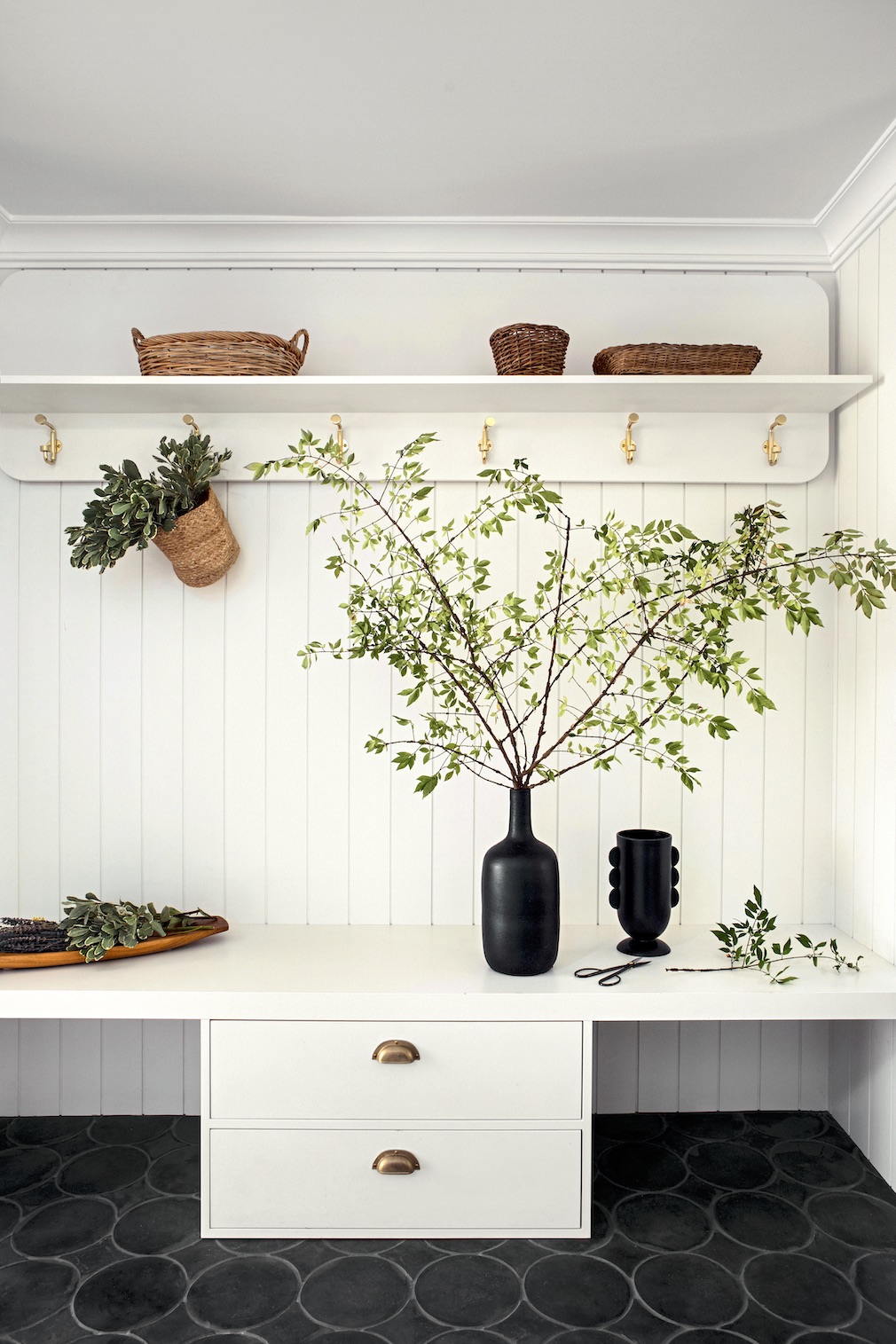
The improvements take shape in the new front foyer, which sports handmade, slightly imperfect Belgian concrete floor tile accented by white shiplap. When installed vertically, it takes on a far more modern look that suits the youthful, streamlined interior.

“Our work leans contemporary and minimalist, but this home didn’t call for that, which gave us the opportunity to spread our wings and go in a different new direction… It’s minimalism with a traditional overlay.”

Vertically applied shiplap painted in a washed-out, blue-green hue likewise distinguishes the updated country kitchen, which is outfitted with English fixtures, a showstopping French stove, a mix of light Danby marble and, atop the spacious island, butcher-block countertops. “We took traditional finishes and put our own spin on them,” Veal describes.
The updated living room fireplace creates a striking focal point for minimalist furnishings covered in sumptuous natural materials such as velvet, linen, wool, leather and fur. “In a tonal space, texture plays a huge role in that balancing act between soft and hard elements,” Stucker notes, pointing to the thick Icelandic hide over the sofa arm. “The mix adds a layer of coziness and richness.”
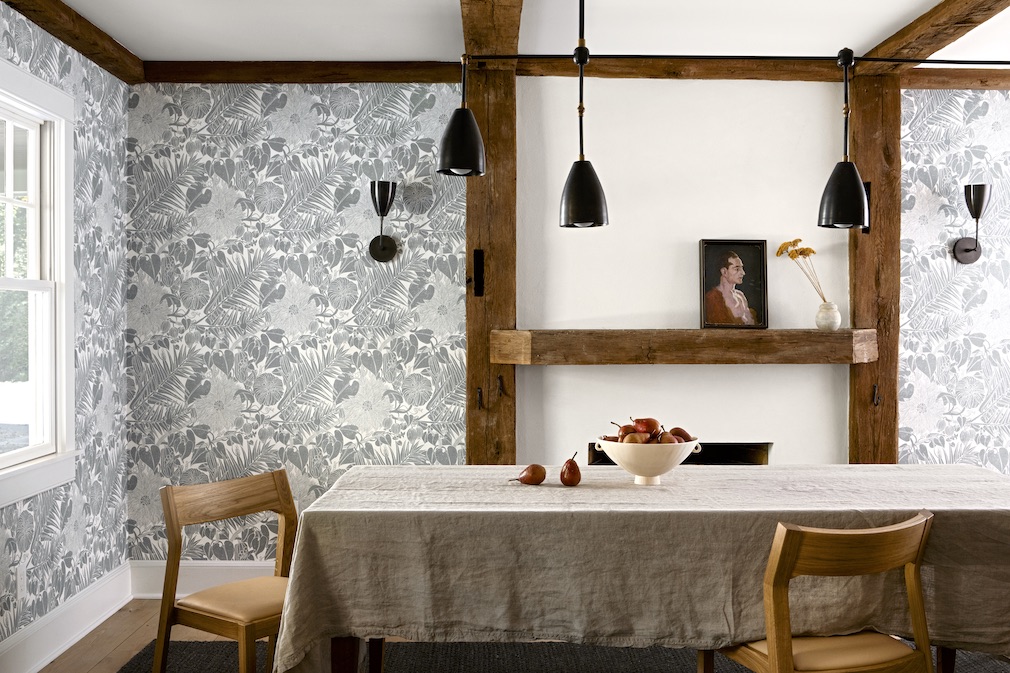
A lively counterpoint to the white walls throughout most of the interior, a muted, monochromatic wallcovering with a botanical motif defines the formal dining room, where a trio of sleek black pendants float over a linen-covered table with sculptural wooden chairs. Complementary sconces likewise illuminate the fireplace, skinned with concrete and flanked by rustic ceiling beams that flow onto the ceiling. “Carrying the same materials and color palette throughout the entire house makes it feel more elevated,” Veal adds.
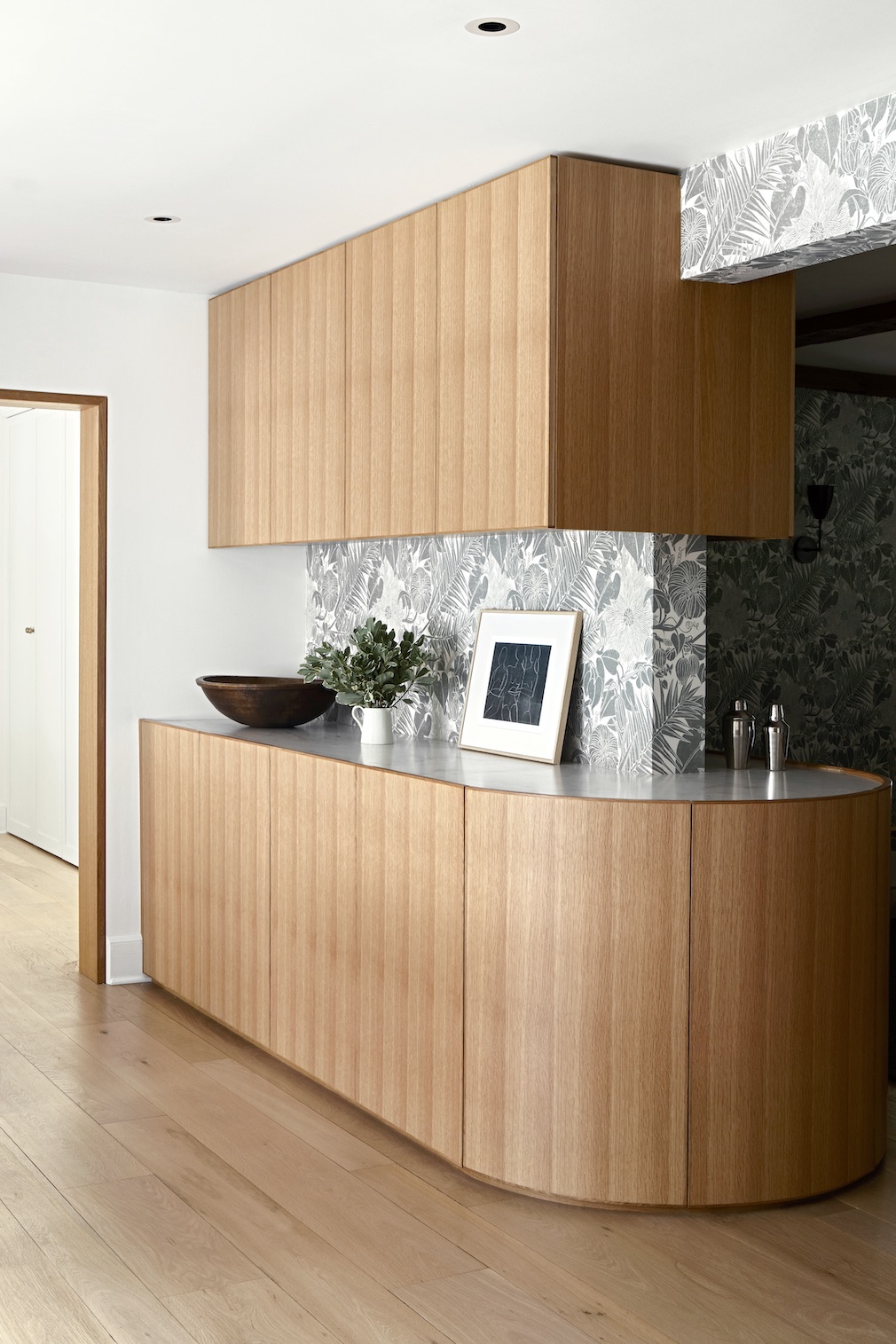
Indeed, the wallcovering flows into the adjacent bar, which is outfitted with custom oak base cabinetry with a sexy curve that softens the architecture. It’s one of many bespoke furnishings, including a built-in bench in the breakfast nook and a minimalist floating vanity with Danby marble counters, in the spa-like primary bathroom. “It’s chic, elegant, understated and so tranquil,” Stucker describes. Now home to both a sculptural tub and a standalone shower, it’s also far more luxurious.
The blend of tradition and modernity thrills the owners, who have already raised the idea of future collaborations with their designers, regularly sending them real estate listings that would benefit from a follow-up collaboration. “Knowing the clients are super happy and grateful is an overwhelmingly good feeling,” Veal shares. “It was an A+ job.”
Photography by Sarah Elliott.
Design by Stewart-Schafer.
Like what you see? Get it first with a subscription to aspire design and home magazine.