


Writing to a friend after beholding a particularly colorful spring day, the poet Rainer Maria Rilke observed, “If it were voices instead of colors, there would be an unbelievable shrieking into the heart of the night.” Entering this residence in Lake Como, the casa padronale of a 17th-century farm that was converted in the 19th century into a silk factory, he might have been tempted to quote himself.


The floor in the entry is bubble-gum pink. To the left, a drawing room sports a floor and wall painted with a checkered pattern of turquoise and violet rectangles. The furniture in this space is mostly candy-apple red. The wall behind a mammoth, original fireplace in a sitting room is deep emerald, while another sitting room features shamrock-hued walls and wide windowsills awash in more turquoise. A guest room is profoundly tangerine. And so on …
In fact, Rilke might have appreciated that the riot of color actually represents a kind of key to the moods of the residents, Italian designer Dalila Formentini and the painter Sean Shanahan. It is also an expression of Shanahan’s deep respect for the power of color in his art. “The house has changed color many times,” admits Formentini. “It is like a palette for changing moods. One time soft and romantic, another, more combative. There is no single ambition to make the house a vehicle for one emotion.”
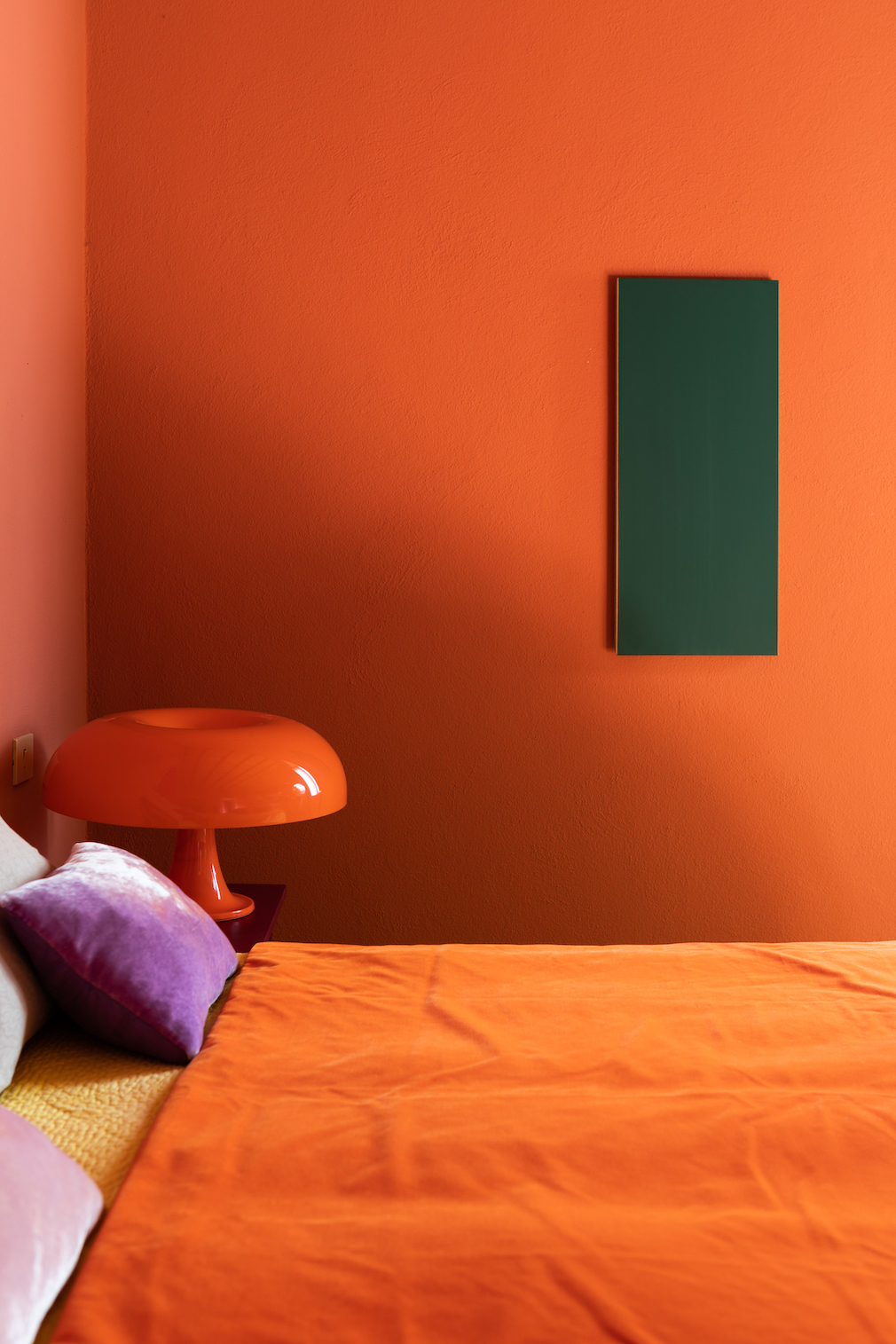
In many ways, Shanahan’s work is a kind of spiritual exploration of color. His monochromatic paintings on MDF emerge over many hours of wet-on-wet layering of oil paint. “At first it’s sort of skating on the surface,” he explains. “Then it’s swimming in the surface,” a transition he describes as “when color becomes substance.” The paintings are manifestations of pure hue coming into being, which accounts for their extraordinary existential volume and the sense of depth they convey.
That is also why, he explains, “there are lots of velvet surfaces in the house. If I had my way, everything would be boiled velvet. The color is not on the surface; it’s in the surface.” Ergo the red velvet chairs in the drawing room by their friend, architect Luigi Caccia Dominioni, the lilac velvet pillows in the orange guest room, the green slipper chair in the shamrock-colored room, or the persimmon velvet sofa in the living room.
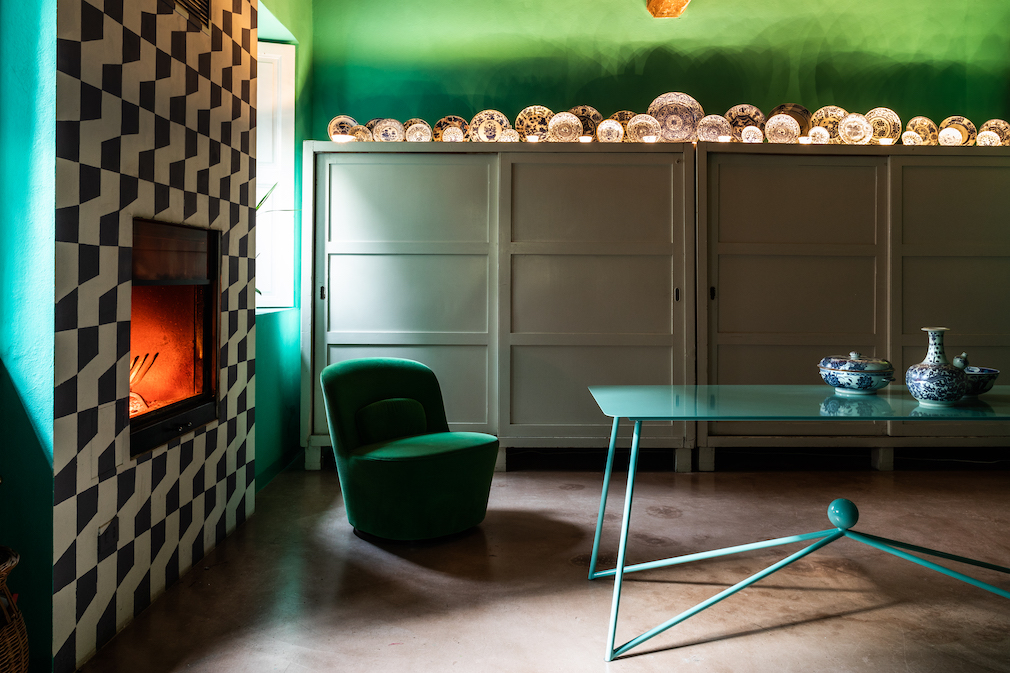

Color is, quite simply, the raison d’être of this home and its primary vehicle of decoration. There are objects too, of course. “My tables and beds are used in our house and are mixed with 16th- and 17th-century furniture,” describes Formentini. “Everything is together. I find that if it’s beautiful, most things sit happily with each other.”
The couple completely renovated the house a decade ago, using a light hand. “We didn’t turn it into a house by Hugo Boss,” jokes Shanahan. “Whatever could be kept, we kept. We fixed what we could and made whatever couldn’t be fixed.”

Furnishing the place was easy, he adds, because “when we got married, we were like the unification of Berlin – two opera houses, two theaters, two train stations. If I had one of everything, Dalila had three.” The furniture is eclectic: a Le Bambole Bibambola sofa from B&B Italia, Bellini Cab chairs, African wood and woven seating, Italian lighting and the Dominioni pieces. Except for some Hans J. Wegner chairs in the uncharacteristically all-white summer dining room, notes Shanahan, “Northern European modernism doesn’t work in our house at all.”
They also acquired art from friends who, like Shanahan, are part of the famous minimalist Panza Collection in Varese. These include Vincenzo Agnetti, Anne Appleby, Mario Schifano and Ettore Spalletti. Shanahan’s own works, much to his chagrin, also grace various walls in the home. “To live with my own art is almost a punishment. I’ve never lived with it until Dalila insisted on hanging it on the walls.”
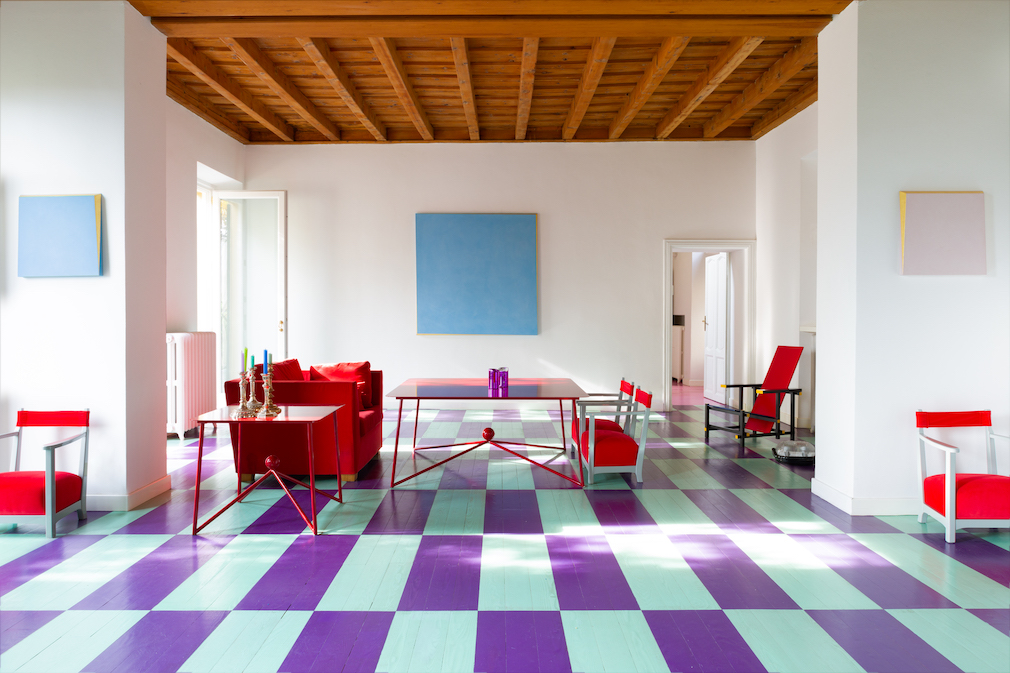
All this pure, saturated color somehow finds its reason and logic. “Color is the non-Cartesian element in our rationale,” believes Formentini, presumably referring to the dualist theories of French philosopher-scientist René Descartes. “It confounds, adds mystery, provides emotion.” Not, perhaps, what everyone craves. But exactly what nourishes the muses of the home’s owners.
Photography by Monica Spezia.
Like what you see? Get it first with a subscription to aspire design and home magazine.