

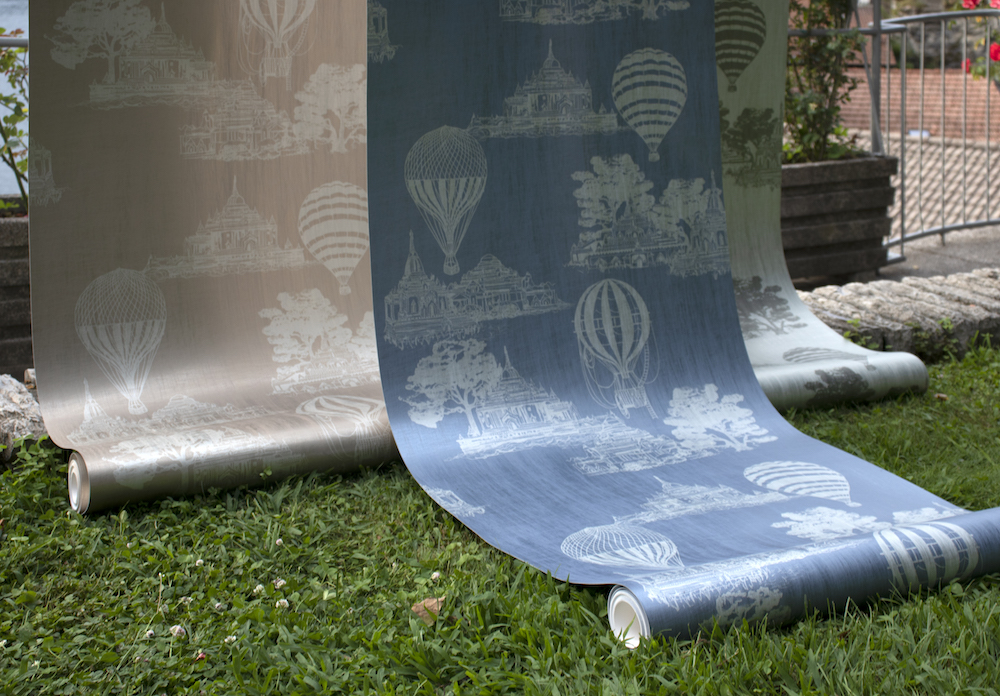
Melinda Marquardt, Founder + Designer of The Vale London, joins us this week to discuss the design process behind Bagan. Inspired by a trip to Myanmar and the Thatbyinnyu Temple, the wallcovering is an artful account of hot-air balloons floating over the ancient city. Originally hand-painted in shellac inks, Bagan is a Vale signature illustration printed on multidimensional paper: a non-woven backing paper with a pearlescent finish that’s printed in Italy, a mid-layer of tiny threads for texture, and a vinyl finish for washability.

Raymond Paul Schneider: When did you first start to develop this new pattern?
Melinda Marquardt: Drawing and sketching is my passion, and lots of times, I sit at my desk and play with illustrating things and places that inspire me, never knowing at first if, when, or what the drawings will become. I took the original photographs on a trip to Myanmar back in 2013. I found the pictures when looking through family photos towards the end of 2020 and thought I’d illustrate some of the balloons for fun.
RPS: What was the overall timeline from conception to achieving the final design?
MM: This design took about a year from start to finish once I decided to pursue it as a viable pattern. This design was an on-and-off project that I kept on revisiting because I wasn’t sure it would ever become something that I loved enough to finalize and transform into a complete pattern with a repeat in proper scale and multiple colorways. But as my 2022 Sloane collection began to take shape, the balloon illustrations done in shellac inks (my favorite) made so much sense in the story I was starting to create. Interwoven throughout SLOANE are the ethereal, the whimsical, and flights of fancy. What could be more magical than hot air balloons floating above ancient temples?


RPS: What was your initial inspiration, and where did the idea(s) come from?
MM: Several years ago, I went to Myanmar with my family, when tourists were allowed to travel there. On one of my favorite days, we traveled to the temples of Bagan, where we were able to climb to the top and watch the sunset. It was an incredible experience. The sky was filled with hot air balloons, and it was pure magic. The balloons and temples were backlit as the sun set, creating this ethereal monochromatic outline. I captured the moment on camera and later wanted to recreate the moment on paper.
RPS: Please describe your overall creative and design process.
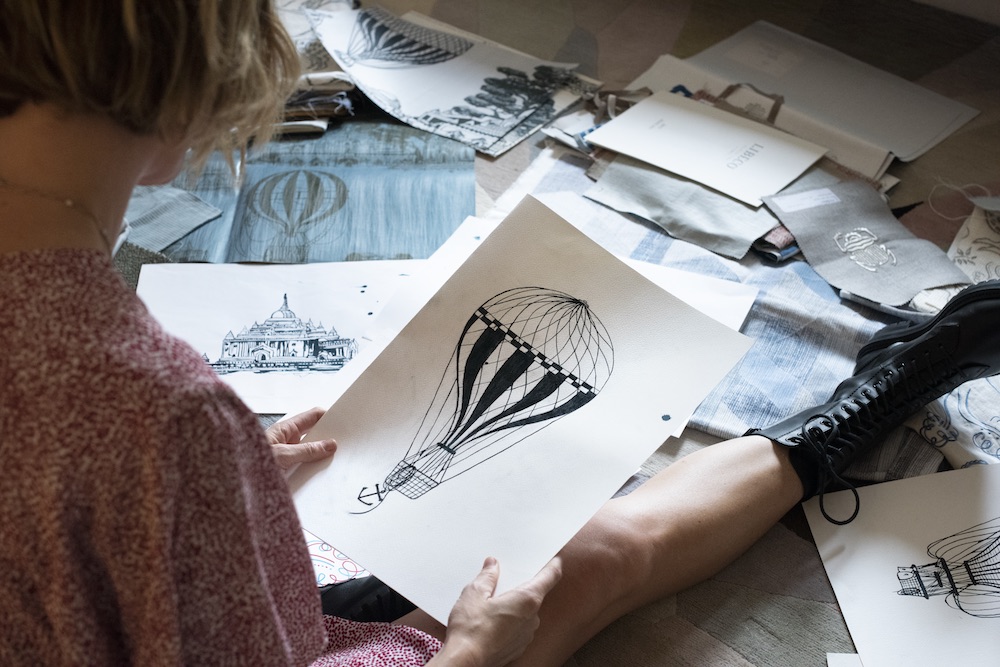
MM: This design was created using a dip pen and ink. I snapped the pen’s nib off so the ink would be more free-flowing and create a less precise line to recreate how the silhouette I saw felt muted and pixelated in the day’s setting light.
RPS: Did you have a specific audience or theme in mind?
MM: I probably should have, but I didn’t. My goal is always to create artwork for the home that I hope people will appreciate and enjoy for years to come. A few customers immediately recognize the scene as Myanmar from their travels. Every time they walk into the room, they feel Nostalgia and warmth and remember the beauty they experienced on their travels. This is the exact reaction I want to instill in a potential client. Its wallpaper with a soul and spirit.
RPS: Please describe the methods, tools, and materials you used to develop and prototype this design?
MM: The first step was to find the photographs from the trip and pull together a mood board. I often pull imagery other people took in the same location to visualize the mood of the time and place better. I then illustrated individual balloons, temples, and trees and uploaded them to my computer to play around with the repeat. I wanted this to be a relaxing/tone-on-tone piece, so I selected muted natural tones. It started to read more as a toile, and I liked how it zig-zagged down the paper with lots of resting space for the eye.

RPS: Did you utilize a new technique or technology to conceptualize this product?
MM: The printer is constantly working on new and innovative grounds to print digitally. I love working with makers that push the boundaries of what’s possible with digital printing. The printer I worked with on this design has a beautiful array of brand-new luxury Vinyl papers with incredible texture and depth. I figured most clients would use Bagan in children’s rooms, powder rooms, and dining rooms. Customers tend to like more durable papers for these areas, so I decided to go this route for cleanability.
RPS: Please describe any challenges that affected the design and perhaps steered you to an entirely new final design?
MM: In retrospect, Bagan was actually one of my more straightforward designs. The entire process went extraordinarily smoothly. Usually, it takes a few trial and error prints with the mill, but they nailed it on the first try! That never happens, so I was thrilled when they understood my vision immediately.
Click here to see more of our “Anatomy of a Design” series.
Like what you see? Get it first with a subscription to aspire design and home magazine.