


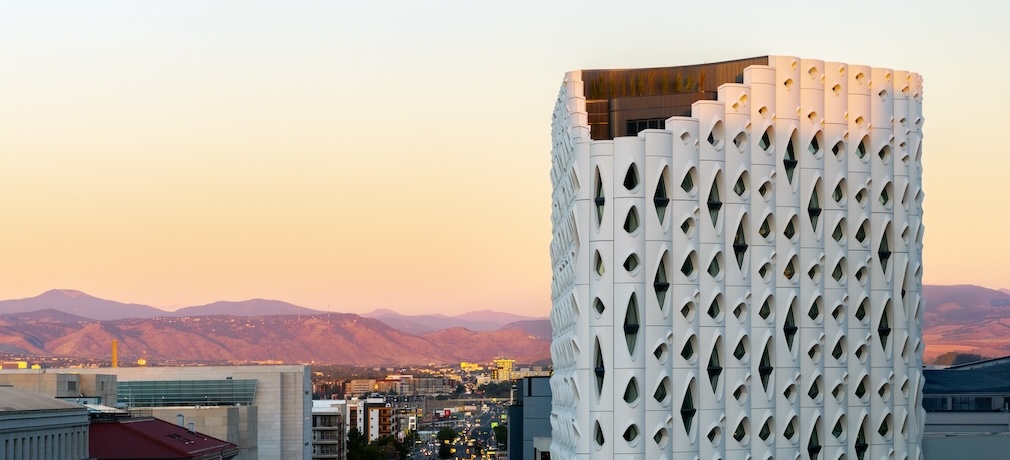

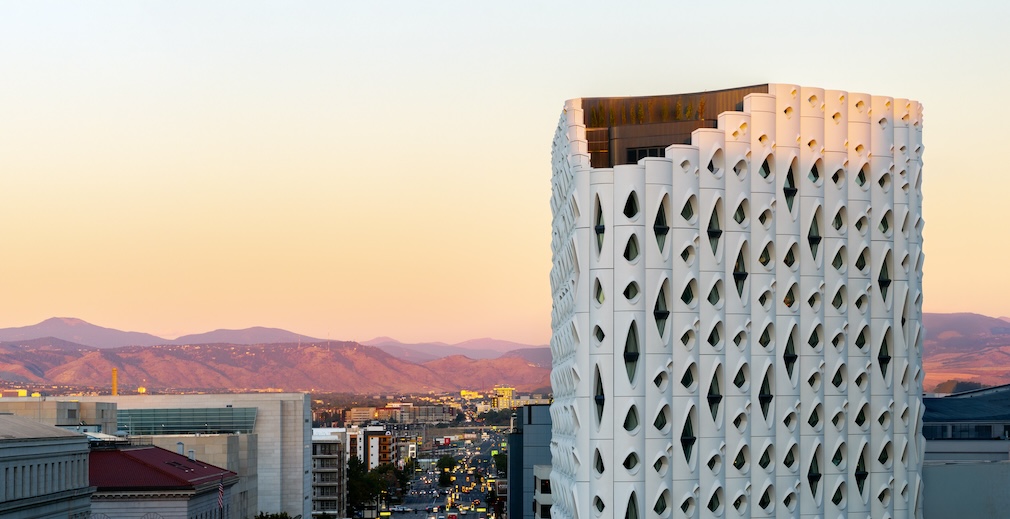
Populus Denver rises from a triangular downtown lot, a constraint that inspired the building’s striking, sculptural silhouette. Photo by Jason O’Rear
It’s rare for a new hotel to transform a city skyline, but the Populus Hotel in Denver does exactly that. With its triangular shape and white exterior that looks wrapped in lace, punctuated by organically shaped windows, the building became an instant landmark when it debuted in late 2024.
The hotel was designed by Jeanne Gang of the Chicago-based AD100 Studio Gang. It was created to be the nation’s first carbon-positive hotel, meaning it removes more carbon than it emits. (Studio Gang also designed the Aqua Tower in Chicago and the Richard Gilder Center for Science, Education, and Innovation at the American Museum of Natural History in New York.)
Every aspect of the building’s design was inspired by Colorado’s native Aspen trees. The central elevator bank acts as the trunk, with guest rooms spreading out along its branches. Eye-shaped windows reflect the patterns found on the bark, and become smaller as the building rises. The windows are as functional as they are beautiful, with a “lid” to shade the interior and channel water off the facade.

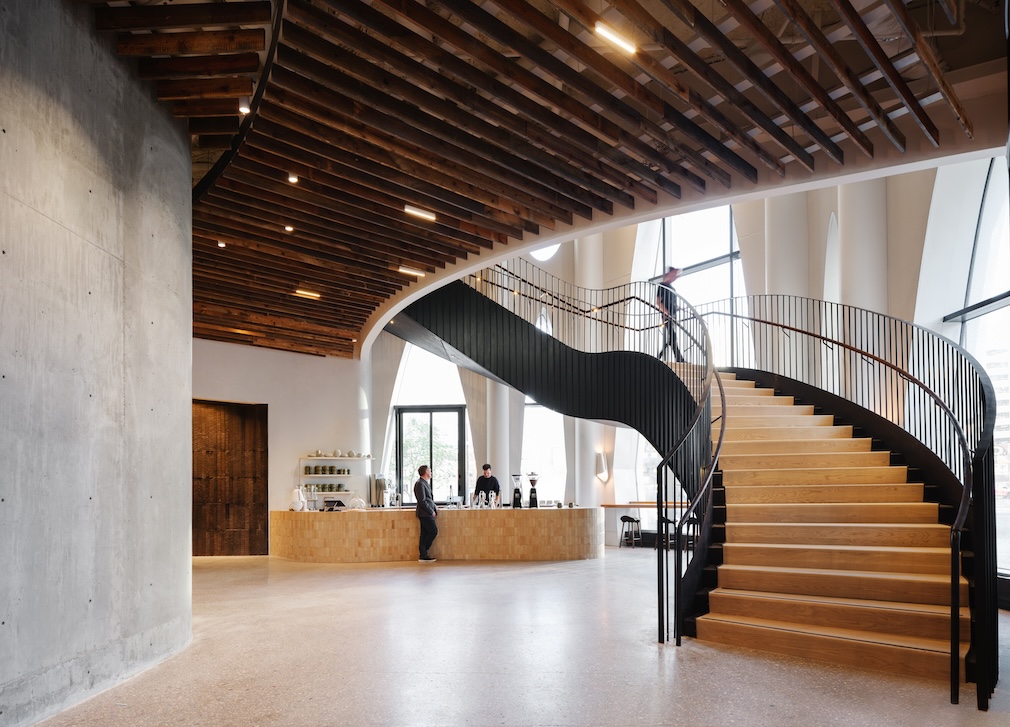
Designed to evoke a forest floor, the light-filled lobby is anchored by a dramatic, sculptural staircase. Photo by Steve Hall
Inside, Wildman Chalmers Design, in partnership with Fowler Architecture and Design, created interiors that align with the hotel’s biophilic architecture and are just as bold as the exterior. The bright lobby level is meant to evoke the forest floor, and is framed by a dramatic installation hanging over the bar. At first glance, it resembles leather, but it’s actually 500 sheets of Reishi, a material created from the roots of mushrooms. Above it, a series of wood slats made from reclaimed snow fencing from Wyoming reinforces the focus on sustainability.
Sustainability and repurposing are woven into all aspects of the hotel, starting with the exposed concrete, engineered without lime, to emit less carbon dioxide. The reception desk is crafted from a felled cottonwood tree, and a biodigester turns food waste from the hotel’s restaurants into a nutrient-dense liquid that is mixed with compost.

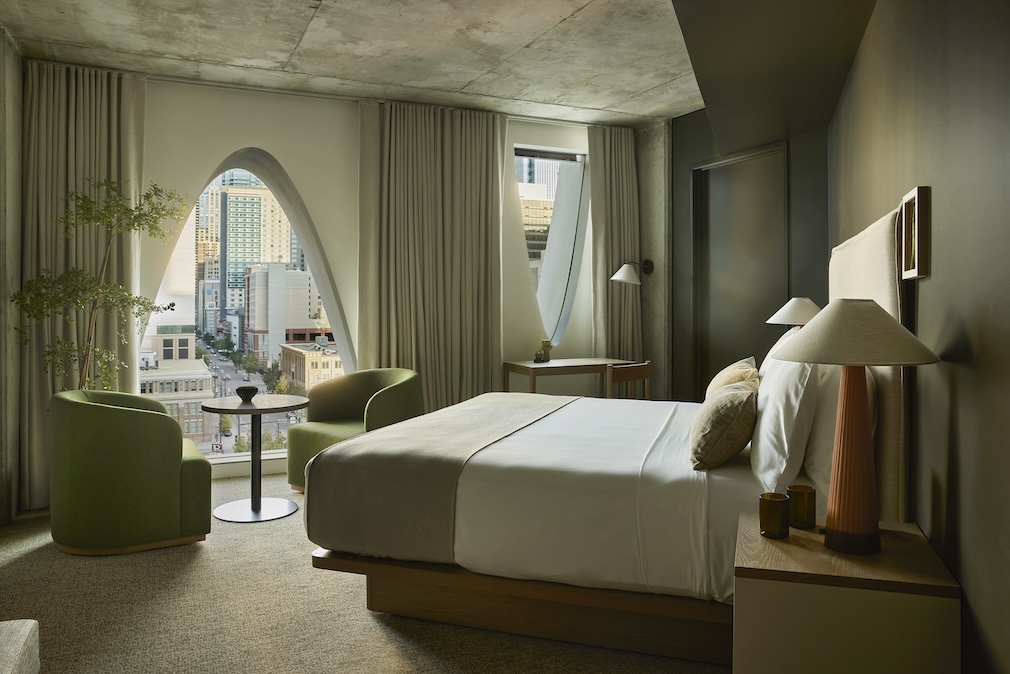
Exposed concrete, a nature-inspired palette, and windows shaped like Aspen trees create a calming retreat with a seamless connection to the outdoors. Photo by Yoshihiro Makino
While the lobby is sun-drenched, the hallways are dark and reminiscent of a thick canopy of leaves, and are reachable by elevators playing recorded birdsong. The 265 guest rooms are minimalist, with raw concrete walls and an earth-toned color palette of sage green, terracotta, and black. Natural touches include headboards created from fallen beetle-kill pine and art made from pressed flowers. The focal point of every room is the Aspen-eye window; in some rooms, the windows form curved benches to truly connect with the outdoors.
The design team wanted the interiors to encourage a personal and individual connection with nature. “The guest’s experience may be quiet for some and more involved for others,” says Heather Wildman, principal at Wildman Chambers Design. “Some guests may pause upon entry to the hotel to take in the Reishi tapestry hanging at the bar, a reflection within nature, smell the subtle scent of the Reishi, or feel the warmth of the texture of the seating. Others may experience these details more holistically. We tried to connect with as many senses as possible, but not overwhel,m as we want to retain the feeling of peacefulness in nature.”
Even the lighting is meant to be organic. “Much of the lighting was designed to create shadows, rather than continuous linear lighting, as one would experience in nature,” says Waldman.
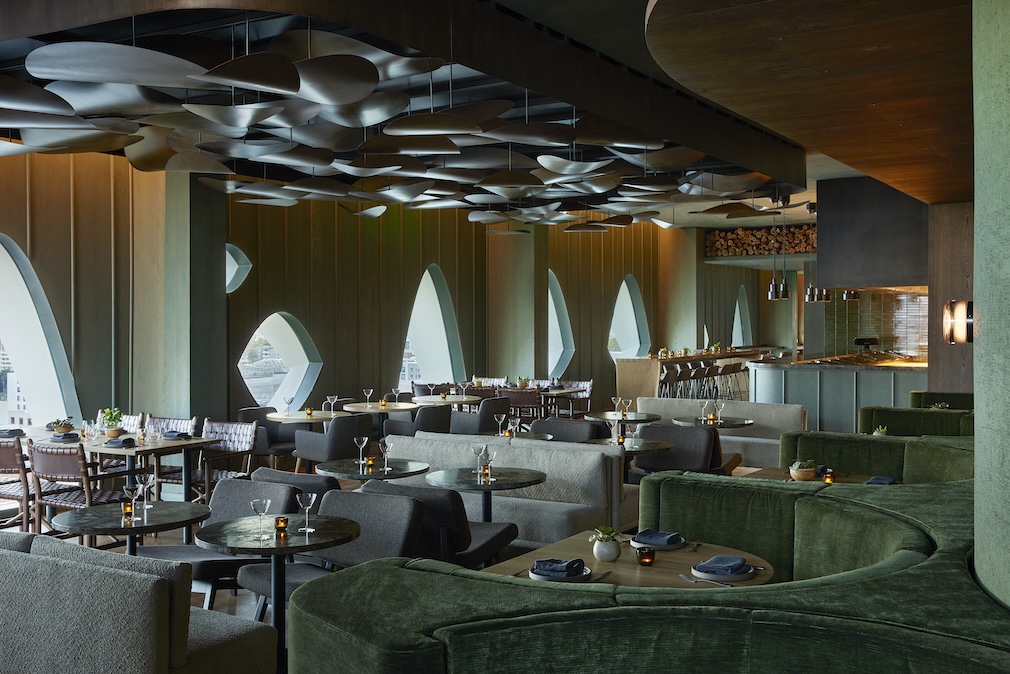
Perched on the top floor, Stellar Jay pairs wood-fired cuisine with bold design and sweeping city views. Photo by Yoshihiro Makino
While the Populus is driven by design, it’s equally shaped by its restaurants. The lobby level is home to Little Owl, a stylish spot for coffee and pastries, as well as Pasque, an all-day dining destination. The rooftop Stellar Jay is meant to feel like dining in the treetops. The airy restaurant spotlights wood-fired cuisine, and while the interiors offer dramatic lighting and views of the Denver skyline, the outdoor patio with views of downtown Denver is also a showstopper.
Whether you come for the food, the design, or both, the Populus is both a new landmark on the Denver skyline and a thoughtful reimagining of what a sustainable hotel can be.
Like what you see? Get it first with a subscription to aspire design and home magazine.