

How do you triumph over renovation surprises? Start with a surprising renovation. “I didn’t plan on a renovation to begin with,” explains designer Kathryn Scott. She’s describing her efforts to restore a beautiful Brooklyn Heights brownstone. The 1800s-era building was part of her life over the course of 30 years before unforeseen circumstances called for a dramatic overhaul. Thus began an four-year journey that ultimately required the talents of Mike Daddio—and a great deal of patience.
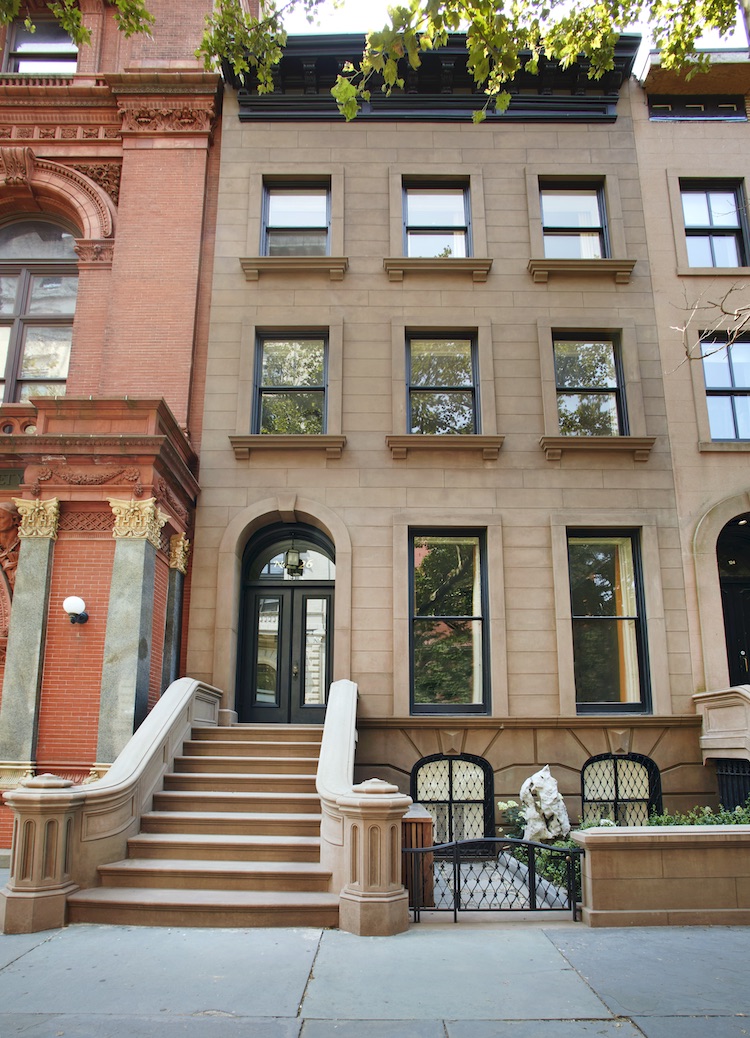
Designer Kathryn Scott moved into this brownstone in 1986, not anticipating the renovation drama that would unfold there nearly 30 years later.
Before the Renovation Surprises
“It’s a complex story,” admits Scott, who works with a diverse array of clients on projects ranging from renovation to new construction. But this time, she was the client. “I actually lived in that building since 1986,” she explains. At first, her immediate family occupied the middle two floors. When Scott’s mother came to live with them in 2001, they added the two floors below. “Then the people that lived on the top floor decided they were ready to live somewhere else,” Scott remembers. “And they sold us their apartment.”
Though they had consolidated ownership of the building, its tenancy continued to evolve. A friend of Scott’s lived on the top floor for a time. After Scott’s mother passed, they rented the garden level to a businessman who used it as a pied-à-terre. Meanwhile, Scott’s daughter was growing up, while Scott and her husband were growing apart. “Everything in my life was going through change,” says Scott.
But the house was about to go through its own great change. “My neighbor, a school that had bought two townhouses next to me, decided that they were going to upgrade and unify everything,” says Scott. “In doing that, they had to upgrade to commercial code requirements, which involved taking out the historical staircases and putting in an industrial staircase and an elevator. And in doing so, they created cracks all over my building.”
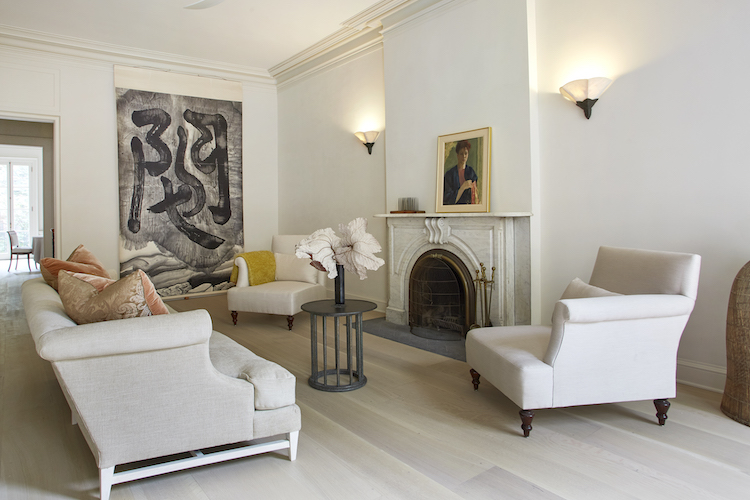
Though she moved out of the building during renovations, Scott says she wanted to make each unit to a quality “so I could move back into any of those apartments and feel like it was what I would want.”
The Renovation Surprises Begin
“So I decided to repair the building—thinking that I only had to do plastering, painting and maybe the front facade,” remembers Scott. She put her furniture in storage. At the time, she thought it would be back soon. “And then the air conditioning broke down. I replaced that. Some leaks show up. So I tried to fix those,” Scott remembers.
“And then I thought, ‘Okay, well while I’m at it, I’m going to just do everything that it needs—thinking that would still be really limited,” Scott says. She hoped she’d be done with renovating the building for her lifetime. But more surprises were waiting.
“It turned out that my gas pipes were not up to today’s code. And this was after almost all the painting was done. So that meant I had to open up all the walls of every floor and ceilings and sometimes cut into cabinetry, and it was extremely invasive,” Scott says. Even after repairs, such damage can still be evident. “They’re just not the same,” says Scott.
And the hits kept coming. “They accidentally cut the wires to the intercom,” Scott remembers. “And they cut other things that created other problems.” Scott was already worn out—from the relentless banging of the construction next door and repairs on her building. When she learned that she had to turn off her gas to continue repairs, she retreated upstate. Next came what may be the mother of all renovation surprises: “COVID happened.”
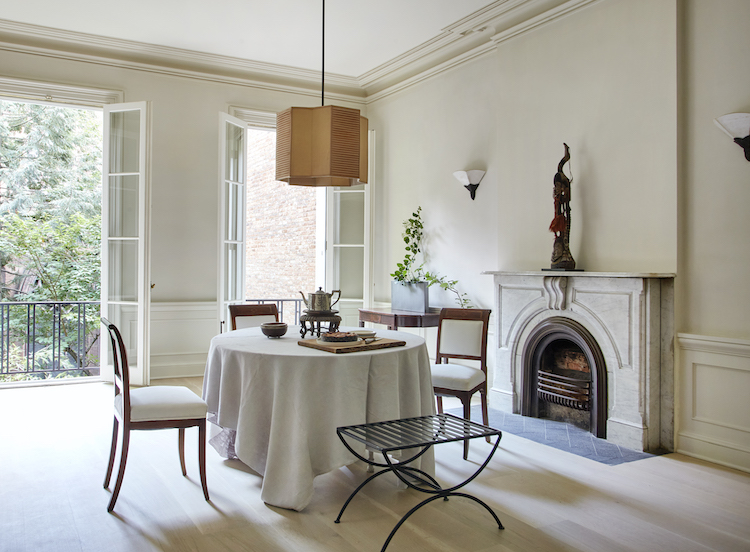
Another challenge was navigating the building’s eight fireplaces—some wood burning, others designed for coal, many nonfunctional but kept for the character.
Getting the Renovation Back on Track
By the time Mike Daddio arrived on the scene, Scott had worked with a series of project managers and contractors. Of one, she recalls, “After COVID, he just told me, ‘I can’t promise you when I can come back.'” Scott was stranded. “That’s when I hired Mike Daddio,” she says.
“Calling it a punch list really doesn’t do it justice,” says Daddio of the tasks awaiting his team from M. Daddio Builders. “But essentially, it was a ginormous, complicated punch list of items that we had to come in and address.” These included both installations and repairs, including gas, plumbing and electrical work behind walls badly in need of patching. “A previous contractor had abandoned her, and, unfortunately, vendors she’d had great relationships with were just no longer reliable.”
“It’s not uncommon for us to be asked to tackle challenging situations,” Daddio explains. Nevertheless, achieving results that would satisfy a designer’s discerning eye took flexibility. “We had a huge amount of trust from Kathryn,” explains Daddo. “We had open book time and material engagements,” he says, “because we didn’t know what the full scope was going to be. When we tackled what sometimes looked like, on the surface, it might be a simple thing—that can become very complex,”
Further, Scott did not want the ultimate design compromised by the chaos that had come before. “I didn’t want this to be lost to contemporary renovation,” she says. “I wanted to respect the history.” Scott’s vision incorporated inspirations true to the time of the building—like the Breakers in Newport, Rhode Island—in addition to referencing her own personal history. There were light, airy, Scandinavian-feeling nods to her Swedish-Russian descent. She also channeled the minimalism she’d admired while working with Lella and Massimo Vignelli early in her career. But after all the renovation surprises, could she and Daddio achieve this vision?
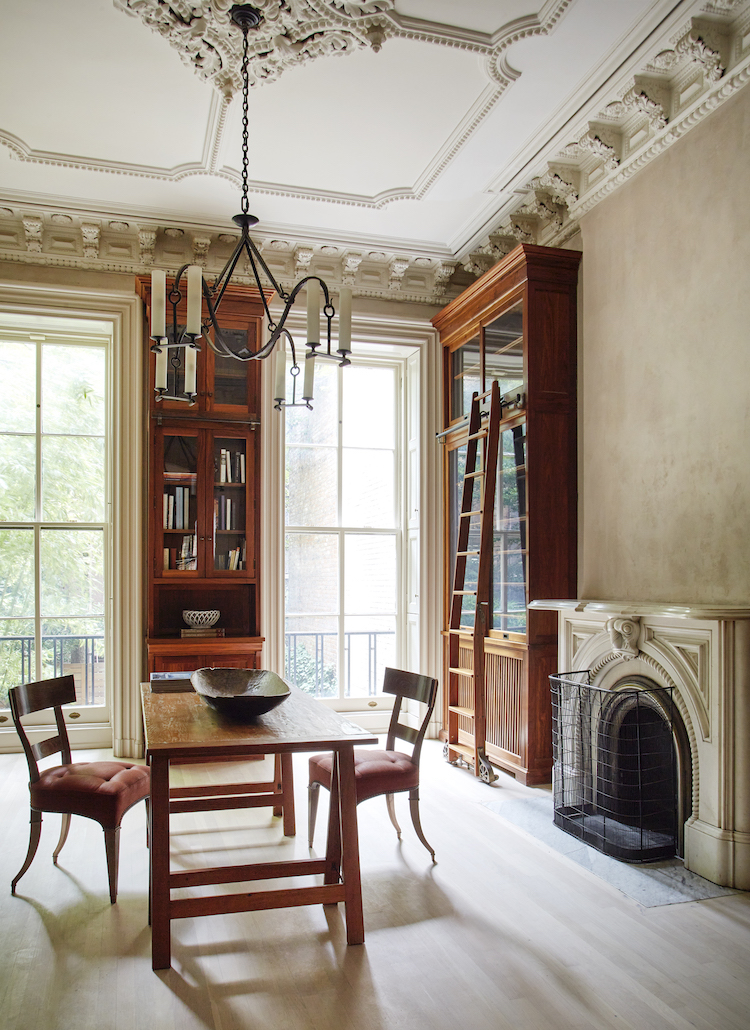
Scott sought ways to add brighter, more effective lighting that wouldn’t interrupt the home’s classic details.
Lighting the Lights
One way that Scott tried to improve functionality without imposing modernity were high-tech lighting additions. “There are lighting fixtures by apure called the minus one and minus two.” These tiny, recessed fixtures cast swathes of useful light from apertures that are just millimeters large. This allows the eye to focus on aspects other than anachronistic circles of downlighting. “They are especially useful in a historic atmosphere,” Scott notes.
Daddio is also also a fan of the apure lighting. “It produces enough light that you don’t even need more,” he says. “So you have a couple of these little three-quarter inch dots in your ceiling. When they’re ten feet off the ground, they really disappear.”
When it came to actually turning the lights on and off, Scott had sourced a variety of historical switches over the years. For the additional ones in need of replacing, she turned to Forbes & Lomax. “They still have brass engraving, and they still are a toggle,” Scott says. “So I’ve got a mixture of old and new.”
Daddio notes that this mix of old and new fixtures and switches called for his team’s electrical expertise. “There are always challenges with compatibility between switching and lighting, especially as everything becomes fancier,” he says. “We had to dive into the troubleshooting and the transformers.” And then they needed to make sure their wiring was safely stowed behind beautiful walls.
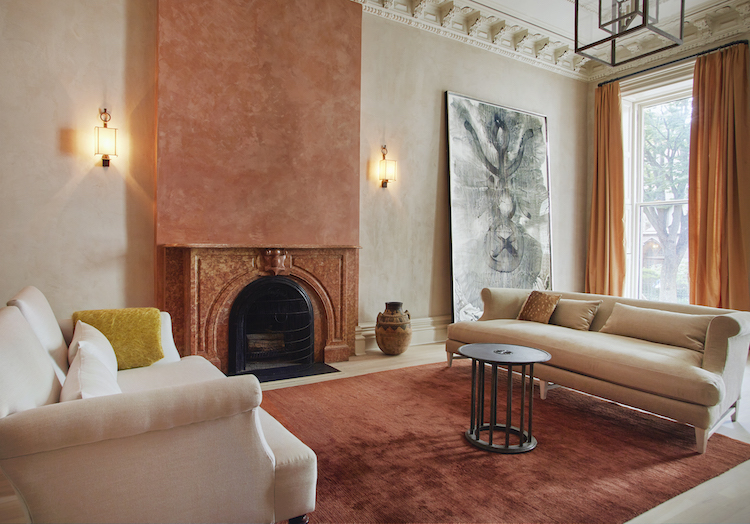
Scott called for the plasterwork above this fireplace to be slightly busier than the other walls, adding texture along with color.
Patching the Walls after Renovation Surprises
“The previous vendor had left the walls in bad shape,” remembers Daddio. But in addition to addressing cracks and other touch-ups, Daddio’s faced the issue of matching the existing plasters and finishes. “It’s a sample process,” explains Daddio. His team called in specialty vendors. “It’s so nice to be able to have those trusted resources that we’ve collaborated with before,” he explains. “You can bring them to site, and they can start to mix all special finishes together: consider tone, texture, sheen, feel, movement,” he says. “It’s uber custom.”
However, the process can lead to frustration. “So many times I almost said, ‘Let’s just redo all of it, Kathryn,'” he remembers. “But there is a real stick-to-itiveness of a good contractor to continue making subtle adjustments: add five percent more white, two percent more white, and continue until you get it just right.”
Scott’s goal was an Italianate finish that felt earthy and more matte than Venetian plaster. Daddio also notes that the larger surface areas made it even harder to achieve an even finish that showed no signs of patching.
Yet these large, spare walls seem central to Kathryn’s vision. “I like the empty walls, the feeling of space,” she explains. She also sees them add drama to the presentation of art. “This is why you see those Chinese paintings. Those are my ex-husband’s work,” she says. “Even though he’s my ex, I think he’s the best Chinese contemporary artist living.” One of his large ink paintings, she says, can be enough for a whole room. “You don’t need anything else.”
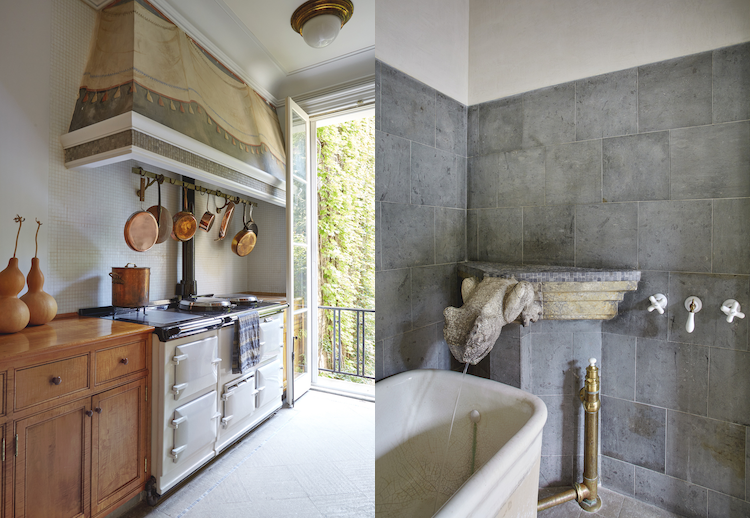
Scott added one-of-a-kind details, including this hand-painted hood and transformed gargoyle tub filler.
After the Renovation Is Over
An exhaustive list of all the revisions overseen by Scott and Daddio could continue on. Daddio painstakingly matched pieces of mosaic tile and installed a sprinkler system. Scott added many extraordinary details herself. This included hand-painting a range hood in one of the kitchens. She also found the delightful gargoyle that now fills a bathroom tub. One of the original owners of Urban Archaeology helped her turn it from statue to spout.
For Scott, Daddio’s role in the project continues to be heroic. “He completed everything for me. And he still is there if things go wrong or need repair,” she says. “He actually rescued me from people who—their mindset was really not so much to do the right job, but just to get through it.”
Daddio says that he and his team couldn’t have been happier with what they have achieved. “It’s very cathartic to go through. Every project has an emotional spectrum,” he says. “At the end of the project, it’s like playing a major chord after playing a minor chord—that feeling of relief.”
Scott notes that the process also lent her perspective about her own clients since the advent of COVID. “People are busy. Materials are not always available. It’s a lot more of a struggle,” she says. “This, to me, is the silver lining of this whole incident: now I can understand them better.”
What’s Scott’s relationship to this Brooklyn Heights Brownstone today? “I’ve become the custodian of this building,” she says. “It’s a commitment that I feel.” That is why, even when she was not sure if she would return to it, she refused to take shortcuts. “This is my home, and it’s not my home,” she says. She appreciates having tenants to help cover the cost of these renovation surprises for now. However, she says, “I have kept the building—in case one day I want to move back.”
Photography by Mark Roskams.
Still have renovation on the brain? Check out this sensitive update of a Midcentury home.
Like what you see? Get it first with a subscription to aspire design and home magazine.