


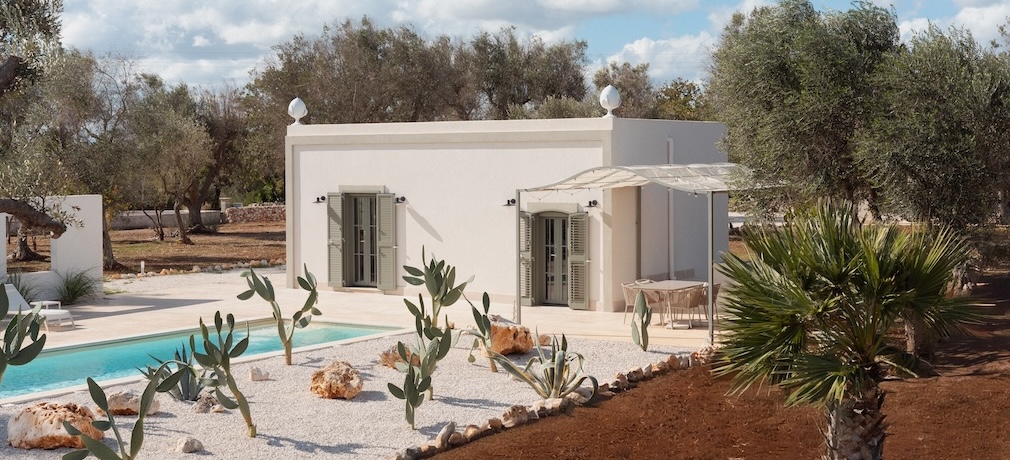
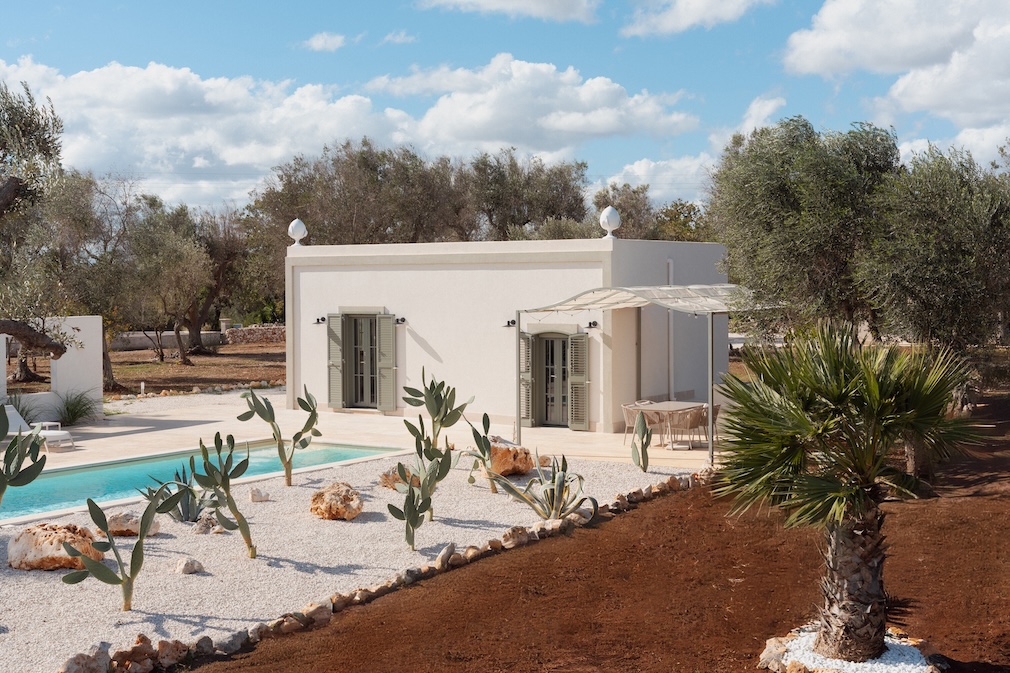

In the coastal Puglia region of Italy, Villa Normanni was conceived by architecture and design studio Urban Interior as both a personal project and a carefully calibrated investment: a contemporary holiday rental embedded within an olive-grove landscape and shaped by the spatial traditions of Southern Italy. The complex combines a newly built villa with the conversion of a former agricultural structure, drawing from local typologies and materials to establish a relationship with the surrounding Mediterranean environment. Large openings extend domestic life outward through pergolas, terraces, shaded transitional spaces, and a pool. Rather than relying on spectacle, the project explores a quieter form of Mediterranean living shaped by climate, materiality, and continuity with place.

From the Designer — Markéta Killi | The Villa Normanni project originated as a private initiative with a clearly defined investment vision. Our goal was to identify an attractive yet relatively undiscovered coastal area in Southern Europe that would allow the creation of a holiday villa of high standard within a moderate, pre-set budget. The purchase of land, construction, and associated costs were financed through the sale of two properties in Prague.
Although conceived primarily as an investment, the project soon acquired a strong personal dimension. My role as the design’s author was closely intertwined with the active involvement of my husband as a creative professional. Italy emerged as the natural choice, renowned for its cultural, architectural, and design heritage. Within it, the Apulia region offered the perfect setting: a rapidly developing tourist destination, framed by the Adriatic Sea to the northeast and the Ionian to the south, providing both natural beauty and affordable investment opportunities.
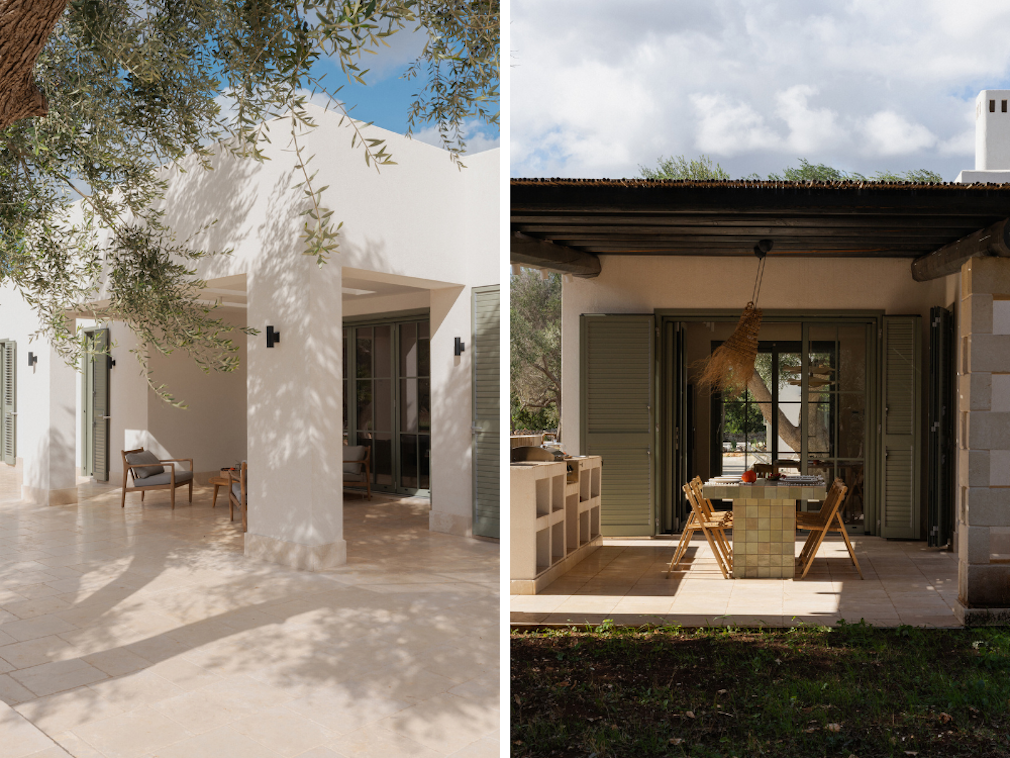

The complex comprises a newly built main villa and a smaller counterpart, adapted from an existing agricultural structure. Reflecting its recreational purpose and Mediterranean climate, the living spaces extend outdoors through a series of complementary features — pergolas, verandas, an outdoor kitchen, a fireplace terrace, a sun deck with pool, and covered parking.
The architectural language draws from the local context. The single-story building, with a white-plastered facade, integrates characteristic regional elements: an external staircase leading to a walkable roof, softened edges, a chimney, and pillars in traditional forms, walls of local tufo stone, reed-covered shading, and floors of pietra Leccese. These details evoke the genius loci, embedding the architecture naturally into its olive-grove surroundings. The palette reinforces this relationship, with green-grey window frames set against the luminous white forms.
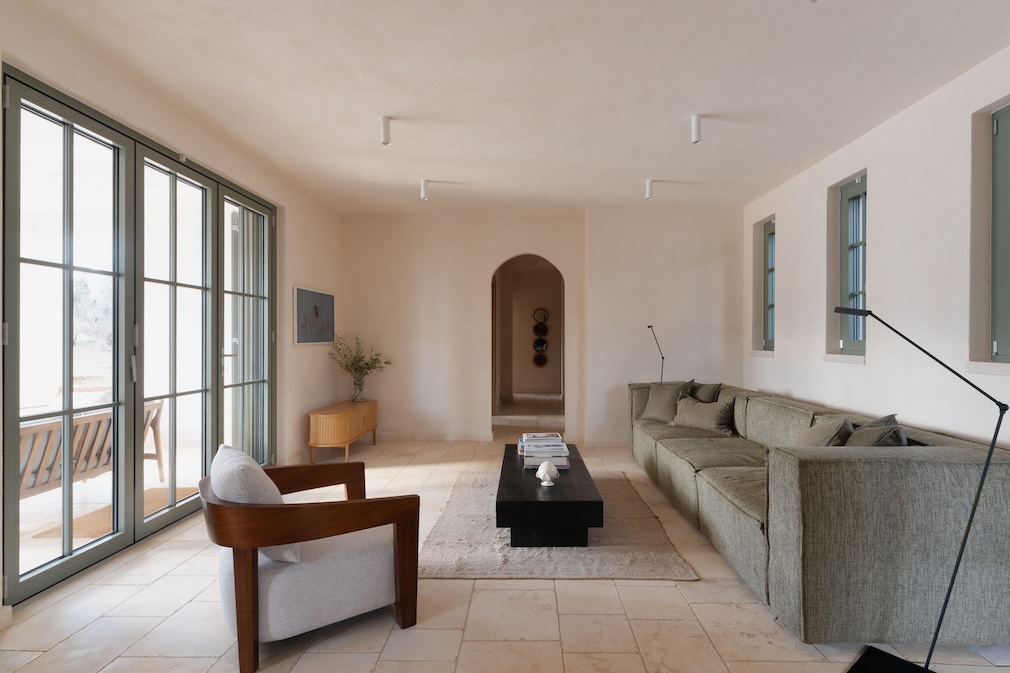
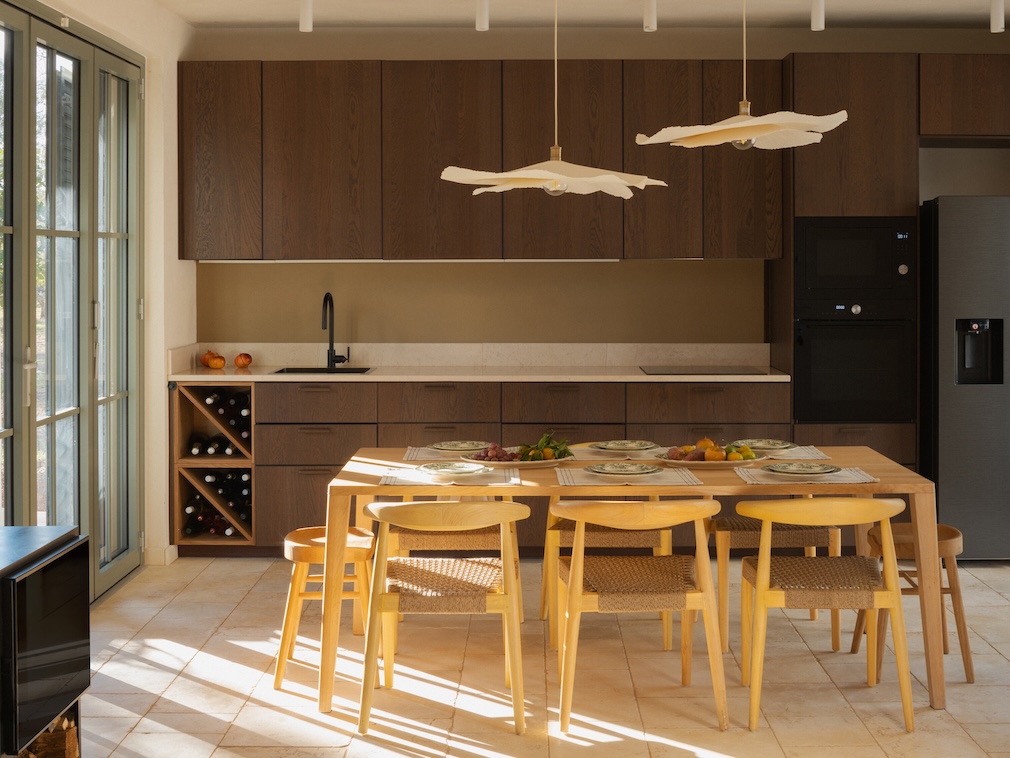
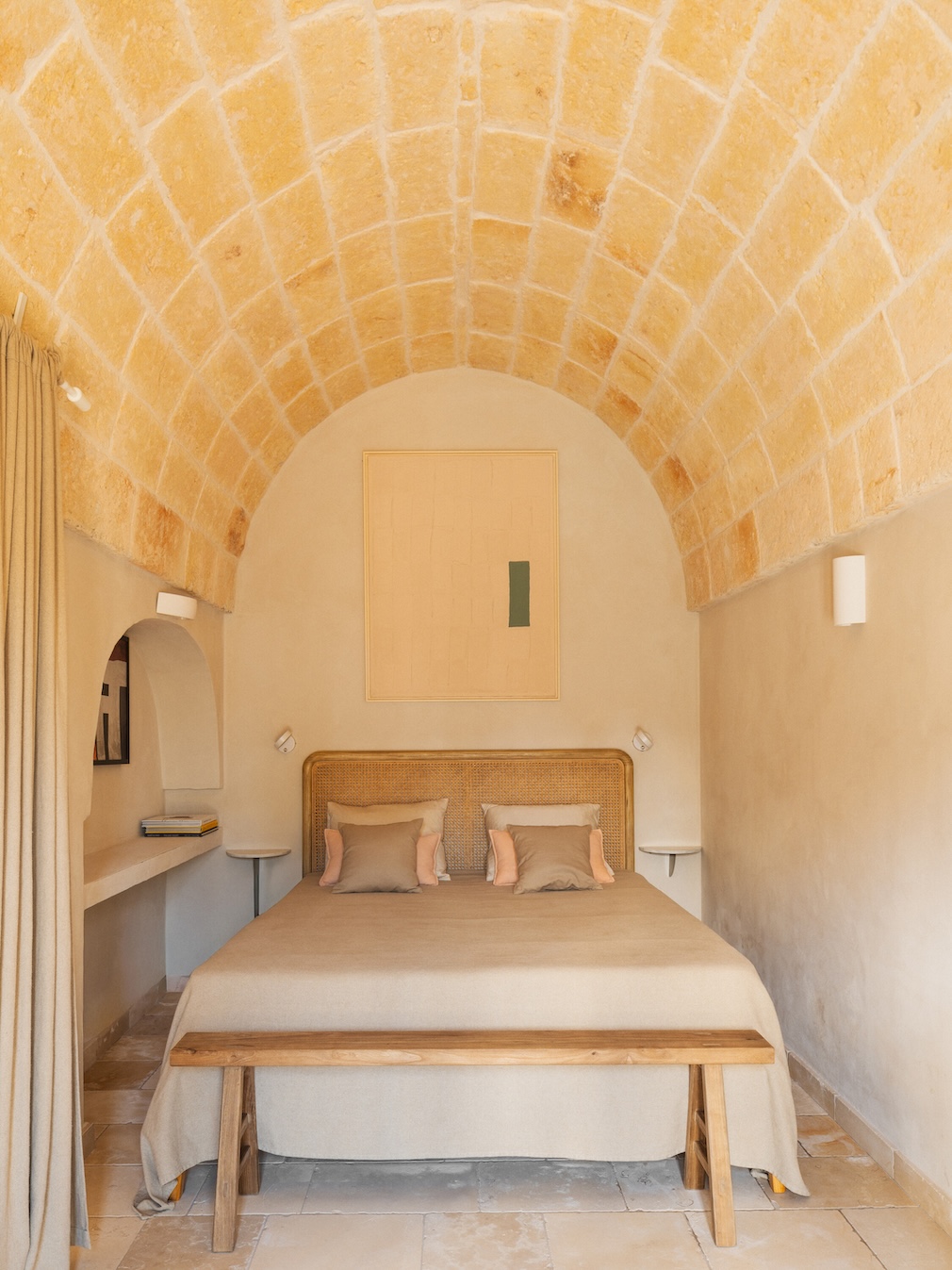
Inside, the restrained design continues. Natural materials — wood, linen, rattan, and stone — define spaces that are at once minimalist and welcoming. Their diverse textures merge into a harmonious composition, creating interiors that are understated but warm and comfortable.
The main villa was planned with privacy and guest comfort in mind, offering three ensuite bedrooms and a central living space with dining and kitchen. Supporting facilities such as laundry and storage are discreetly set apart. The smaller villa functions as a private apartment with a living room, kitchen, bedroom, and bathroom. Its architectural treatment deliberately evokes the impression of an older structure; its façade and interiors are therefore conceived in a distinct character. Two ceramic Pina figures crown the roof, traditionally believed to bring good fortune.
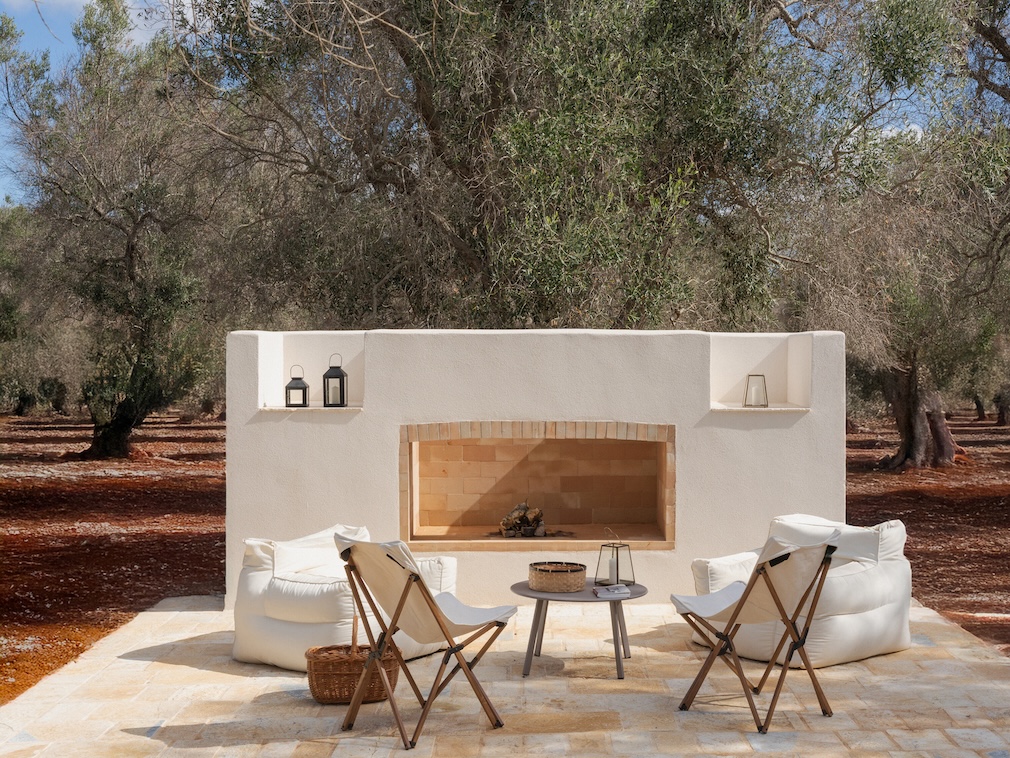
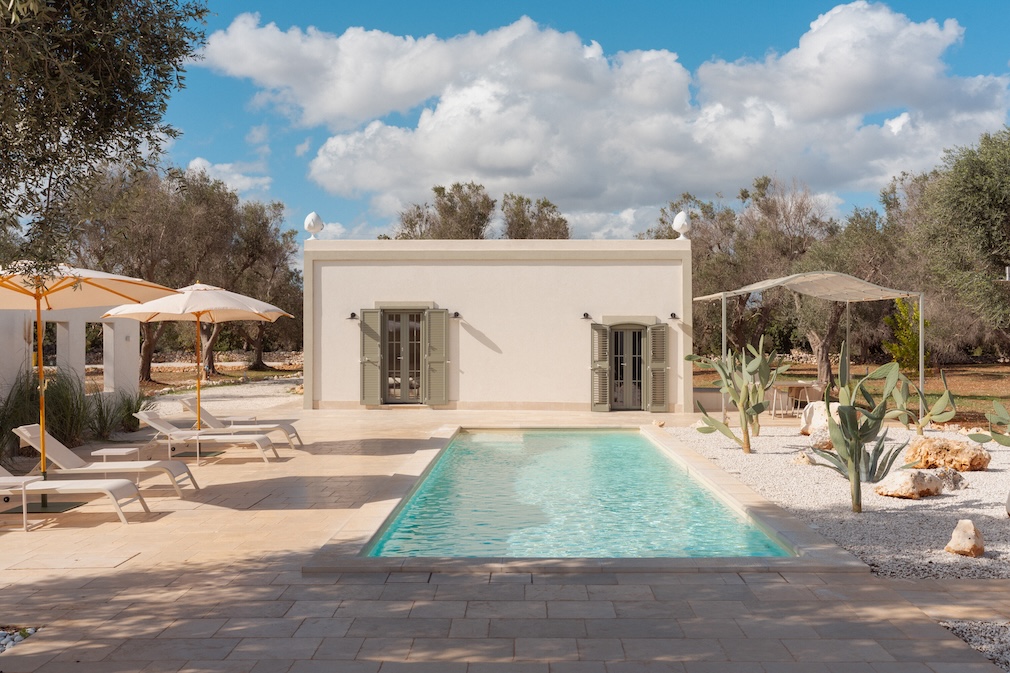
Large folding windows orient both villas toward the pool and olive grove, dissolving the threshold between inside and out. Most of the furnishings were brought from the Czech Republic, complemented by custom-made pieces.
Technically, the villas are designed for year-round use, fully air-conditioned and heated. Solar panels, as required by local regulations, ensure renewable energy production. Water is supplied from a well — completed successfully on the second drilling attempt — while rainwater is harvested in a cistern for reuse. Given the energy demands of air conditioning and water management, particular emphasis was placed on self-sufficiency, with systems designed to meet the highest standards.
Photography by Cosimo Calabrese and Duotono Fotografia
Like what you see? Get it first with a subscription to aspire design and home magazine.