
The history of Asian residents in Seattle runs deep. Chinese immigrants started settling here in about 1850, followed shortly by waves of Japanese and – in the 1960s – Koreans. The apartment building that accommodates this penthouse stands near Pioneer Square, which anchored one end of Nihonmachi, a thriving Japanese neighborhood for 50 years beginning in the 1880s. The wife of the couple who owns the penthouse is also Korean.
Reasons enough, believed designer Rocky Rochon, that an Asian approach to the apartment’s design seemed fitting. This did not mean Chinese armoires or shoji screens, however. Rochon envisioned something more subtle and contemporary, so he looked to the philosophy of wabi-sabi, the Japanese appreciation of the perfection that lies within imperfection. “The whole apartment alternates natural surfaces and materials that have imperfections with raw finishes that have flawless modern details,” he explains.
The apartment is actually one of two penthouses that comprise the entire top floor. The owners live in one, with the other 4,200-square-foot, three-bedroom apartment pressed into use when they have visiting guests or relatives. As such, Rochon says, “I wanted to do it as sparely as I could – absolutely minimal – so the architecture could be preeminent.” This set a backdrop for “crude, patinated, soulful pieces” to counterbalance the austerity of the envelope.
The material mix of rustic and refined begins as soon as you disembark the elevator and encounter walls of shou sugi ban – the Japanese charred-cedar technique – contrasted with a floor of smooth, large-format, Portuguese porcelain tiles. Turning into the main space, we are confronted with a volume clad in white gold leaf. “Gilding is a nod to wabi-sabi,” Rochon points out. “When something is imperfect, like a piece of cracked ceramic, you gild it.” It also had the practical effect of “making sense of many architectural intrusions into the space” (in this case, a boxed-in air shaft).
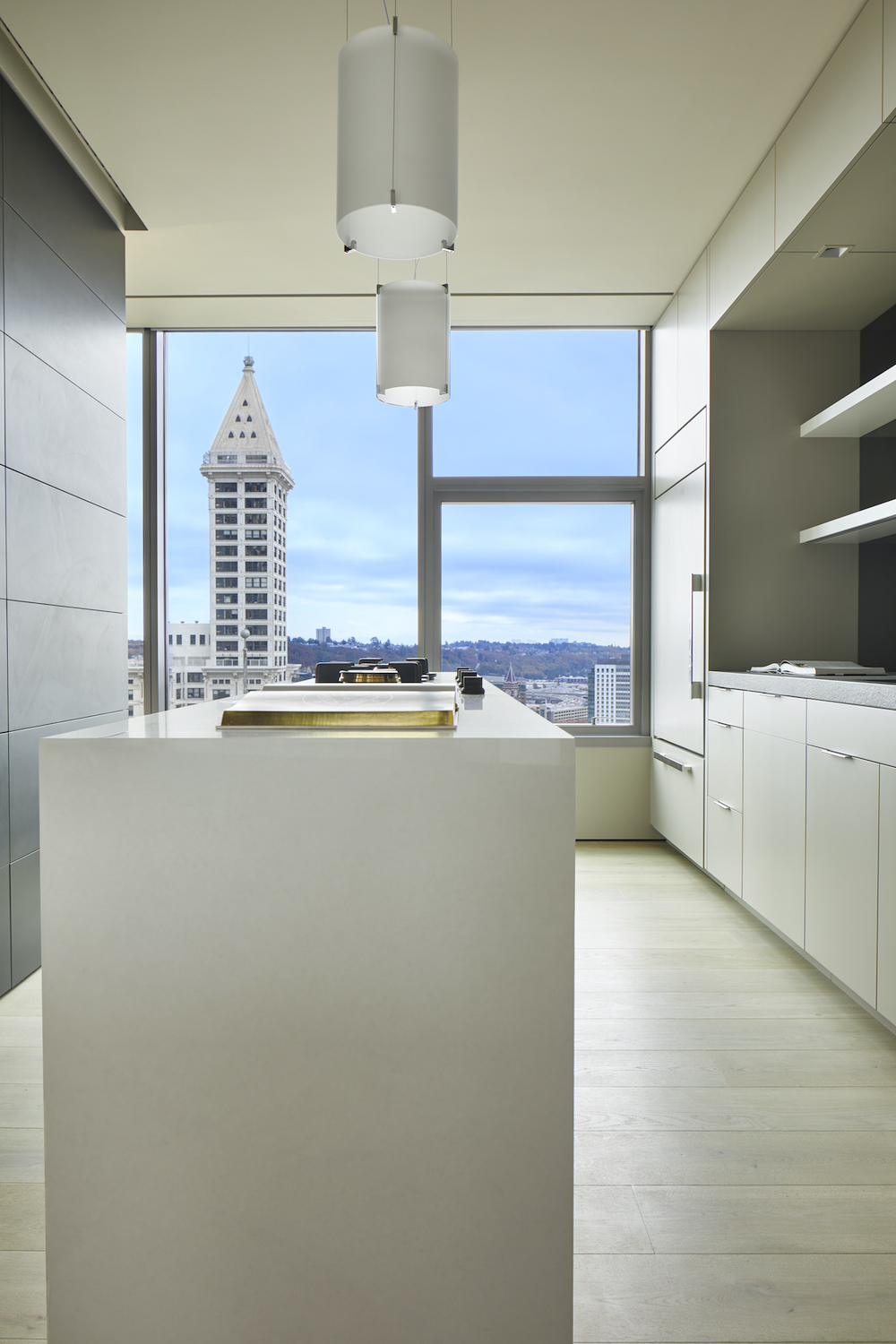
The metal leaf provides another striking juxtaposition for a structural concrete wall in the long corridor that forms the spine of the apartment, which Rochon roughed up by sandblasting it. “I wanted you to go into the apartment and be blown away by very long vistas and impressive termini,” asserts Rochon. The corridor then ends to the left at the porcelain soaking tub of the exquisitely restrained primary bath, which emanates the meditative stillness of a Zen altar. At the other extreme, our attention is drawn out toward the view through a huge kitchen window.
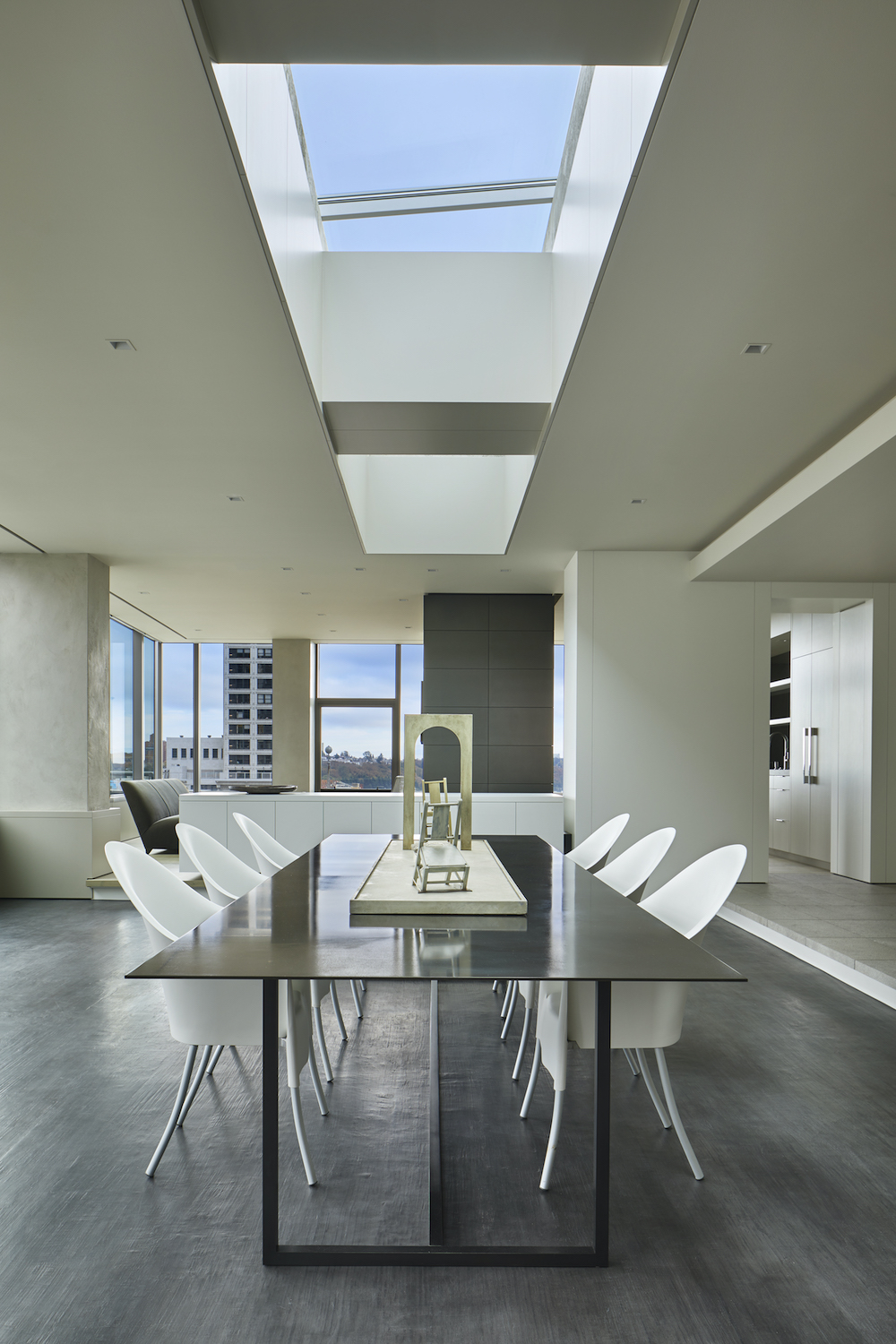
Walk around the white-gold wall, and the apartment’s wraparound fenestration opens to a spectacular panorama of Seattle and its environs. At this point we are in the dining area, where Philippe Starck chairs surround a table that supports a surreal de Chirico-like architectonic sculpture. “It functions as a centerpiece that gives the space some weight,” explains Rochon.
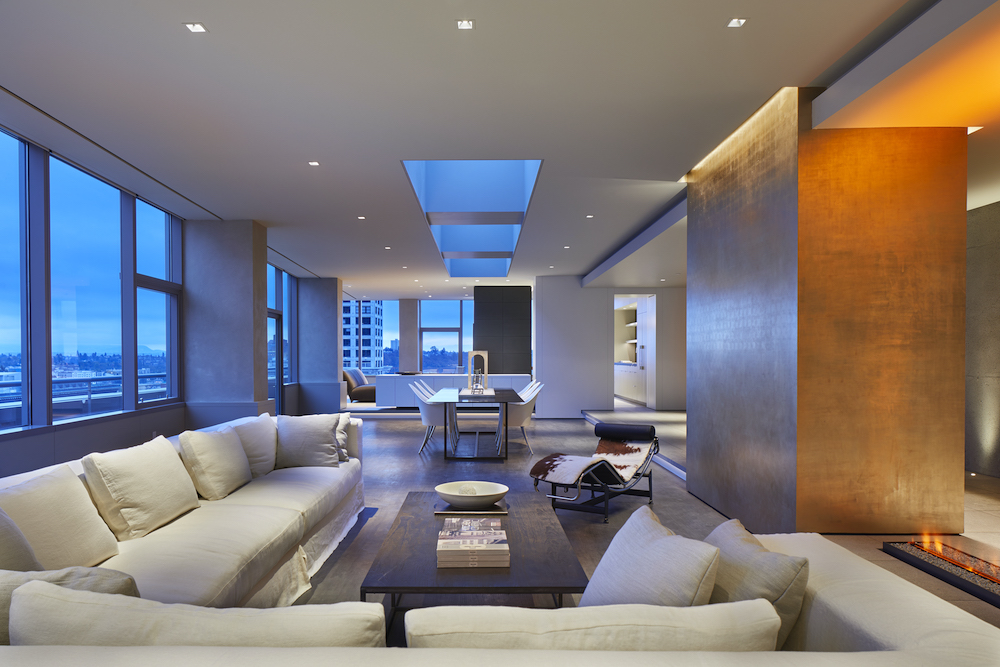
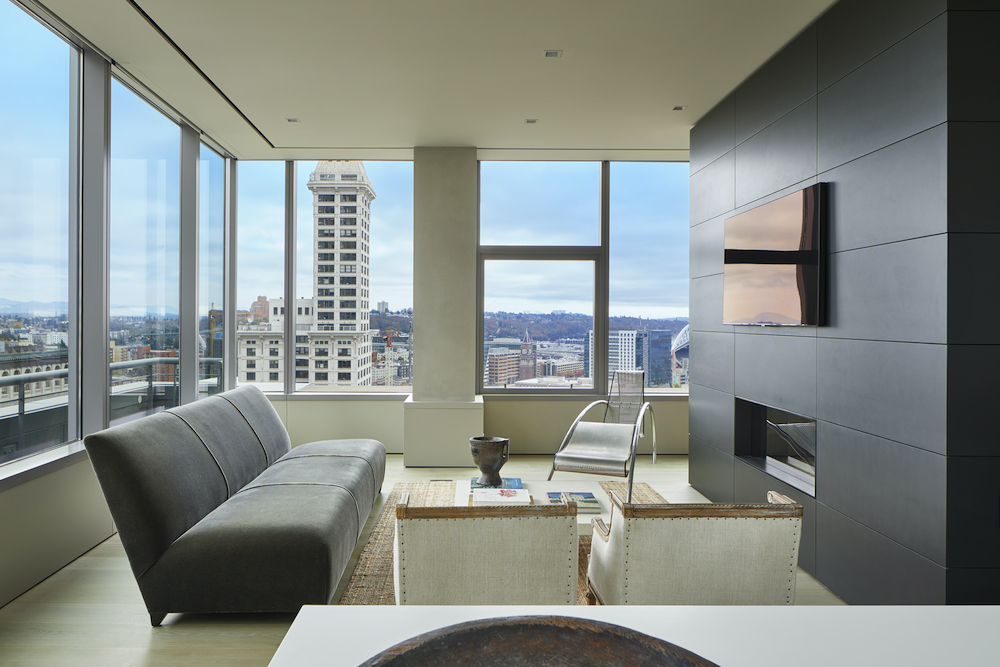
Flanking this section of the 18-by-40-foot room are a living room appointed with a simple linen-slipcovered sectional to the left and a family room to the right. Overhead, Rochon was able to negotiate with the developer to slice open the ceiling for a skylight, avoiding what he calls “tunneling,” particularly at night when the room might have felt relentlessly long and dark.
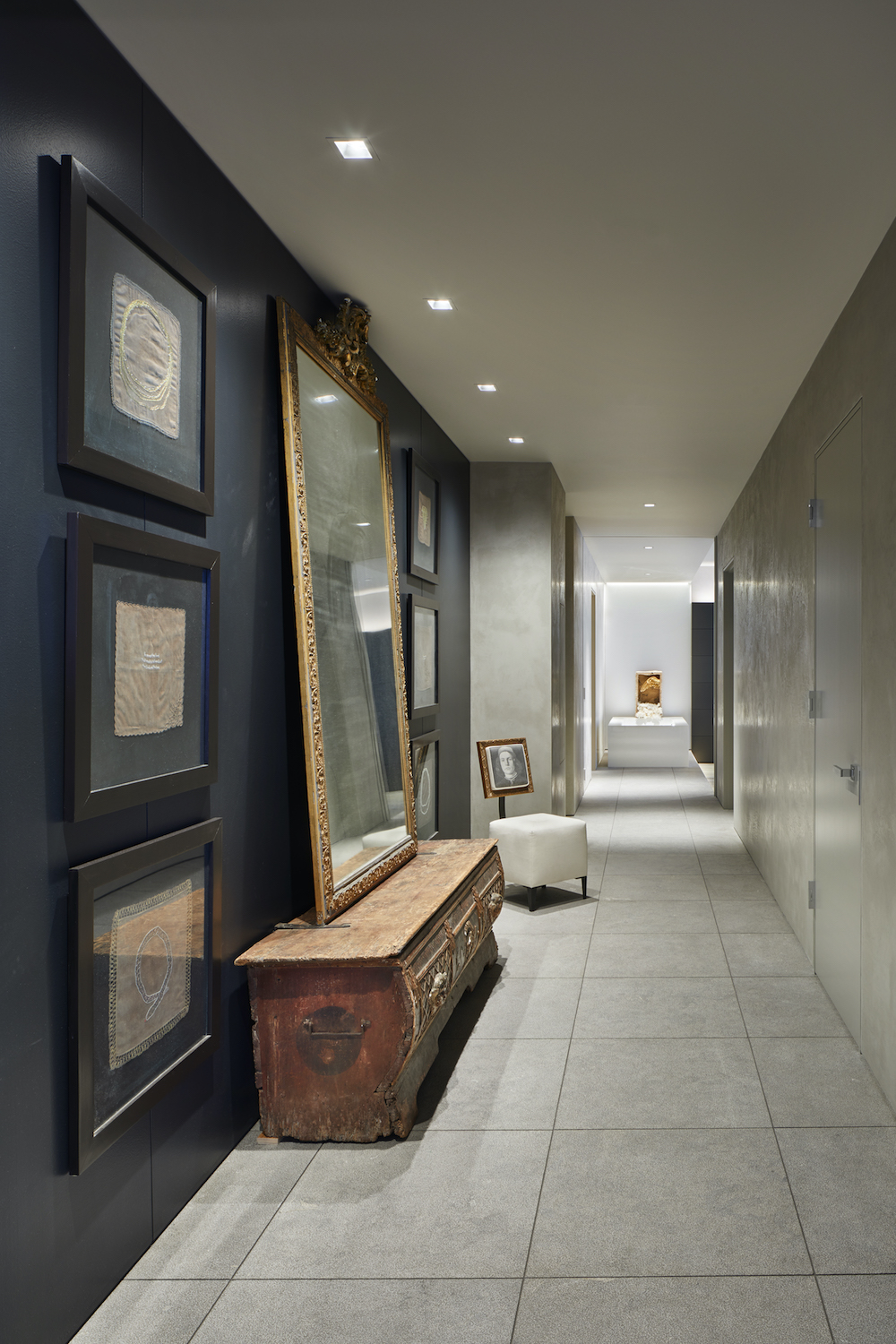
Rochon alleviates the potential austerity not only with the wabi-sabi interplay of coarse and refined textures but also with “soulful pieces” that add personal notes and a sense of warmth and human wear. These include a rustic Chinese elmwood bench in the primary dressing room; a painted Renaissance chest, an ornately carved, 18th-century gilt mirror and framed textiles in a hallway niche; and a French country table that doubles as a desk in the home office.
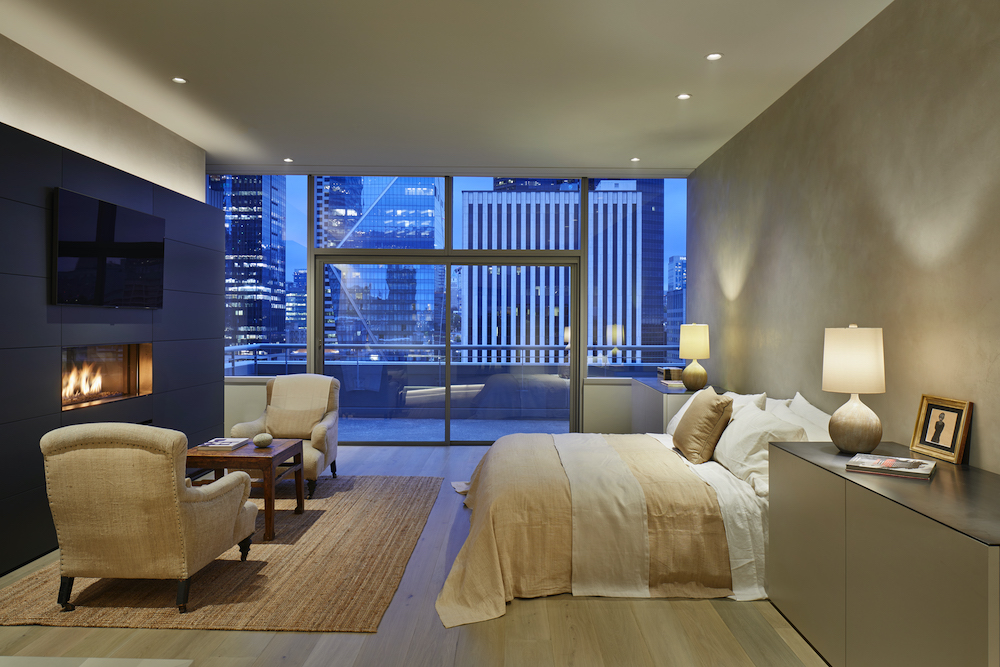
Appropriately, notes Rochon, “The primary bedroom is softer, less rigorous.” The architecture is just as spare, and he admits that “it would have been easy to put a big painting or drawing behind the bed,” something he chose not to do in order to maintain a sense of minimalist purity. But the bedding and the upholstery on the two armchairs are made from 18th-century French linens. Floors are bleached oak, and a highly textured sisal rug delineates a seating area by the fireplace. “Humble, natural materials,” he emphasizes.
The whole mix presents an interesting conundrum. We cannot pigeonhole the apartment as completely modern or even transitional. We cannot unequivocally describe its style as Eastern or Western. We cannot say its interior architecture is either sleek or warm. It is in the tension between these categorizations that something more palpable emerges: timelessness.
Photography by Benjamin Benschneider and Henry Rochon.
Like what you see? Get it first with a subscription to aspire design and home magazine.