
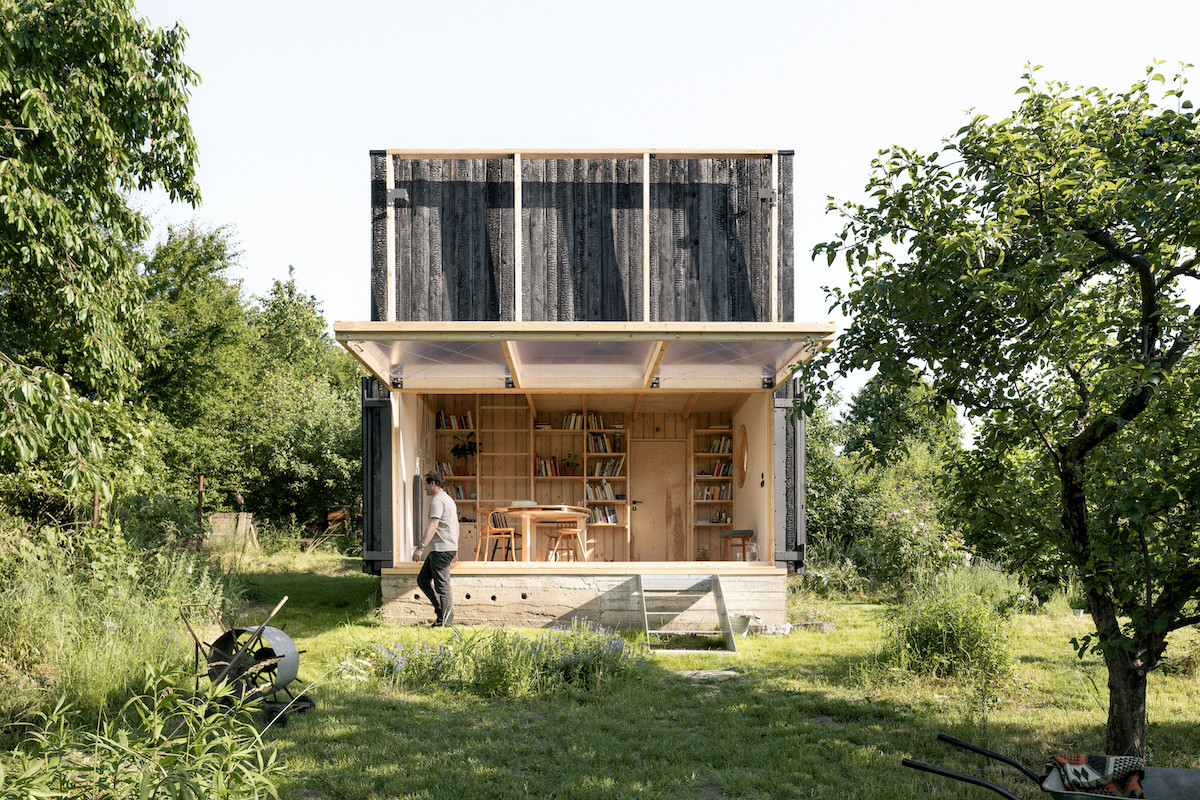
In the heart of Prague, clients Adam and Tereza Petrusek enjoy not only a centrally located apartment, but also a private garden on a lot just a ten-minute walk from home. The enviable setup allows them spacious green space, but required a clever solution to address a need for a sheltered space. BYRÓ architekti stepped in to design a garden pavilion to replace a dilapidated cottage, offering modest indoor space for adverse weather and occasional summer overnight stays, while also serving as a winter plant storage area.
A key feature is a folding panel that allows one side of the structure to open completely, seamlessly connecting the interior with the garden and creating an indoor-outdoor transition. Made of dark, burnt wood using the shou-sugi-ban technique, the pavilion harmonizes with the surrounding garden cottages, maintaining their romantically imperfect and irregular quality.
Read on to hear from architects Jan Holub and Tomáš Hanus on the project:

From the Architects | When the clients are in their garden, they try to spend as much time outdoors as possible and came to us with a specific and perhaps slightly paradoxical task. They wanted a new structure on the site of the original dilapidated cottage, but at the same time, they didn’t want to close off the garden. The building was supposed to offer only modest space, primarily in adverse weather, and allow for occasional overnight stays in the summer months.
We thought about how to connect the building as closely as possible to the surrounding garden, and we ultimately came up with the idea of a folding panel that allows one side of the house to completely open. This way, the interior seamlessly transitions to the outdoors, with the garden penetrating the building, creating a kind of paraphrase of a garden loggia, which was our fundamental architectural inspiration. When open, the polycarbonate wall also functions as an outdoor roof, expanding the covered space where one can stay during rainy weather. The panel folding mechanism consists of steel cables, pulleys, and counterweights, making it easy for one person to open the entire facade.
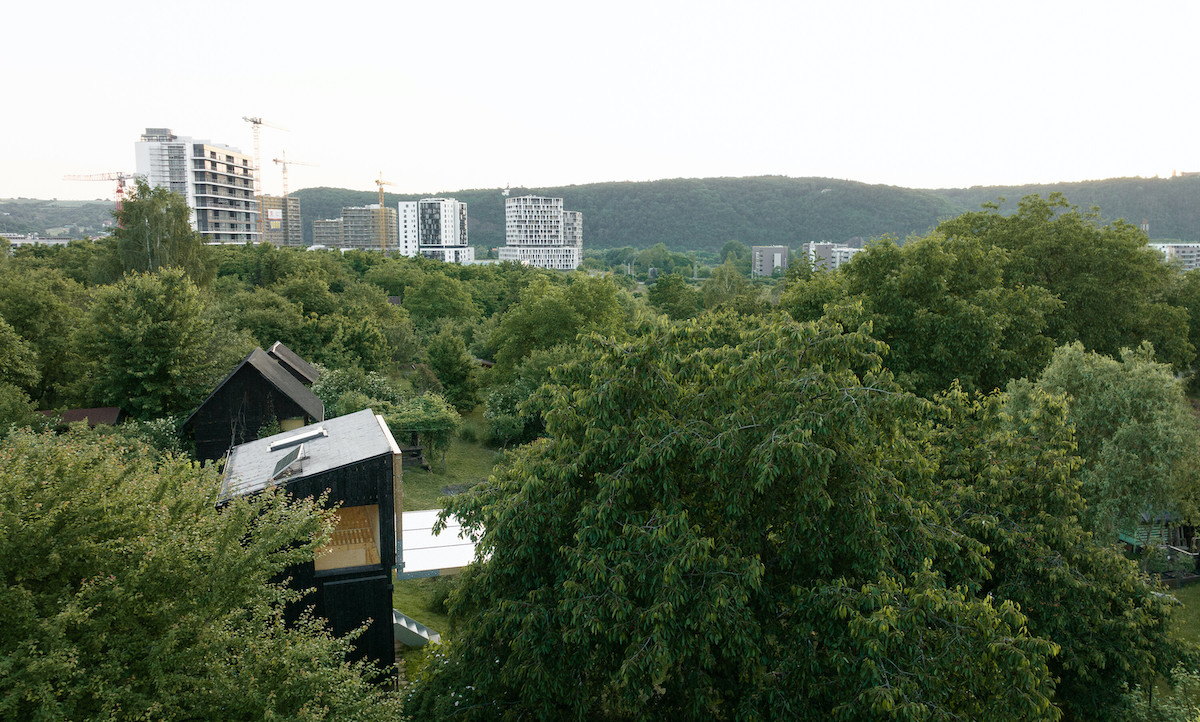
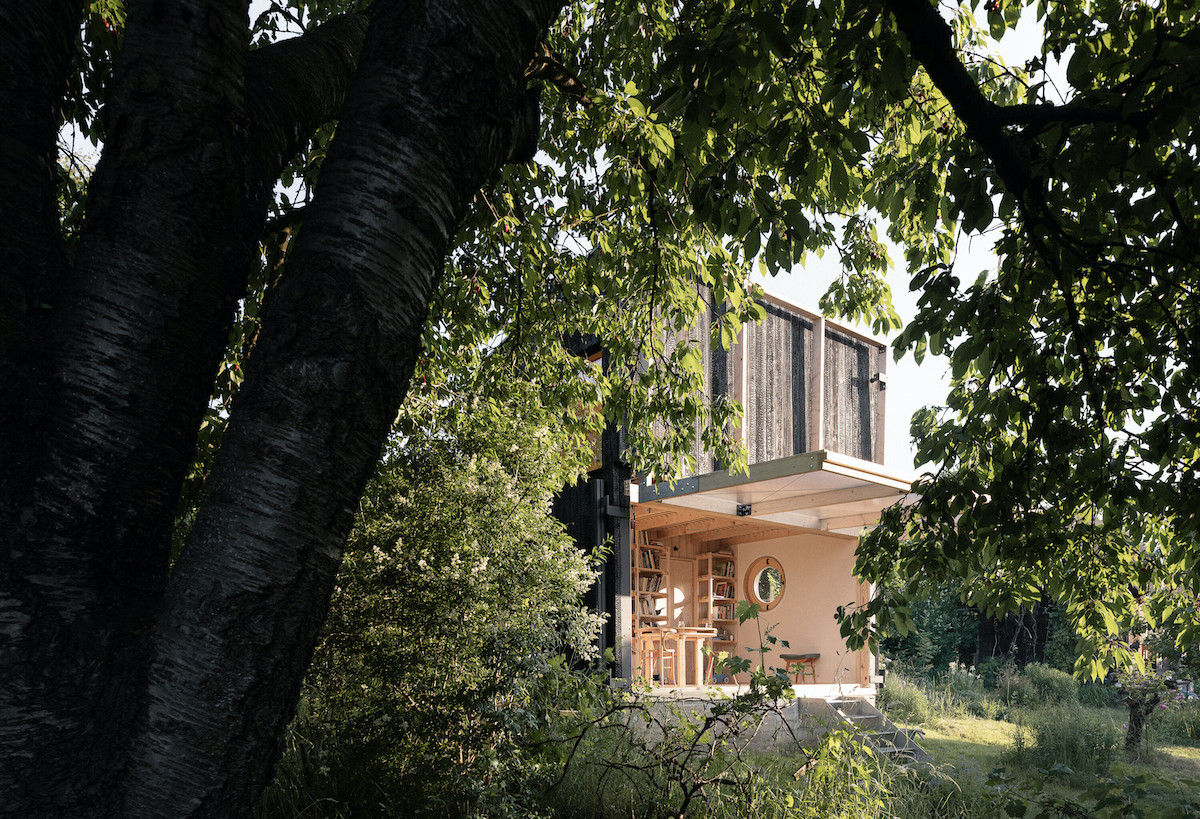
The garden pavilion is situated on the foundations of the original wooden cottage in a garden colony near the Vltava River. It is located in an environment where, in addition to the mature garden, there are greenhouses and arbors, along with several other small cottages that mostly serve as storage and facilities for individual gardens. These cottages are similar to each other, mostly dark, almost windowless, and possess a romantically imperfect and irregular quality. We tried to incorporate the character of the surroundings into the new building, which is made of dark, burnt wood (shou-sugi-ban technique) with a naturally irregular structure. With closed shutters, it corresponds to the quiet objects in the vicinity.
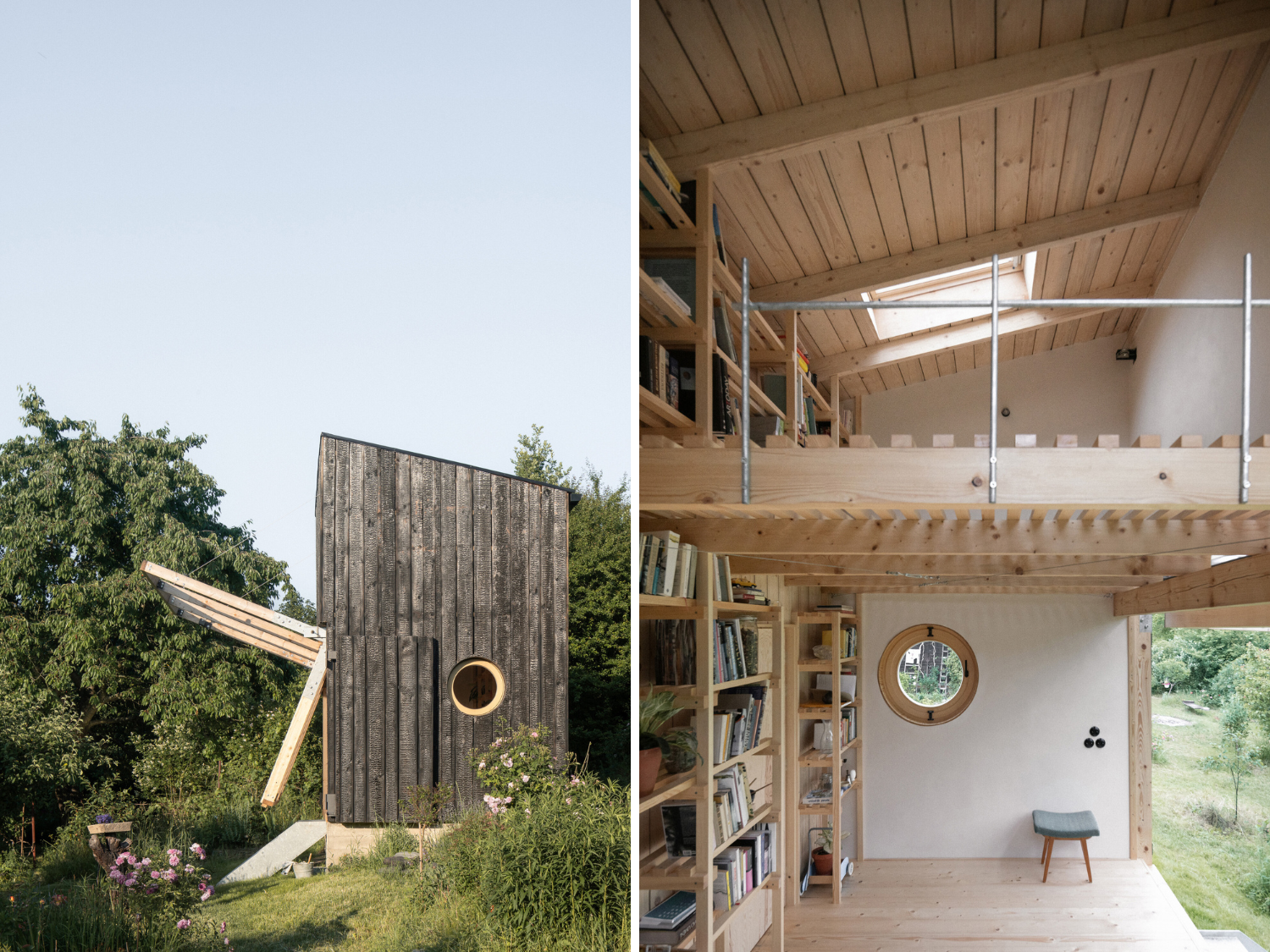
The building is designed as a wooden structure in a two-by-four construction system. The interior walls are plastered, and the rear wall with an integrated bookshelf and a ladder leading to the upper floor is lined with wood. The construction of the library and the upper floor are made of wooden slats to create a subtle interior that allows natural light to filter through. Thanks to windows oriented in three directions combined with the polycarbonate panel, the lighting mood inside the building changes during the day, and even when closed, the interior space does not feel cramped. The floor plan dimensions are minimal – 3 x 5 m, and the height of the building is just under 5 m. The building is not connected to any utility networks and has only its photovoltaic panel, which covers the basic electricity consumption in the building and provides lighting.
Photography by Alex Shoots Buildings.
Like what you see? Get it first with a subscription to aspire design and home magazine.