
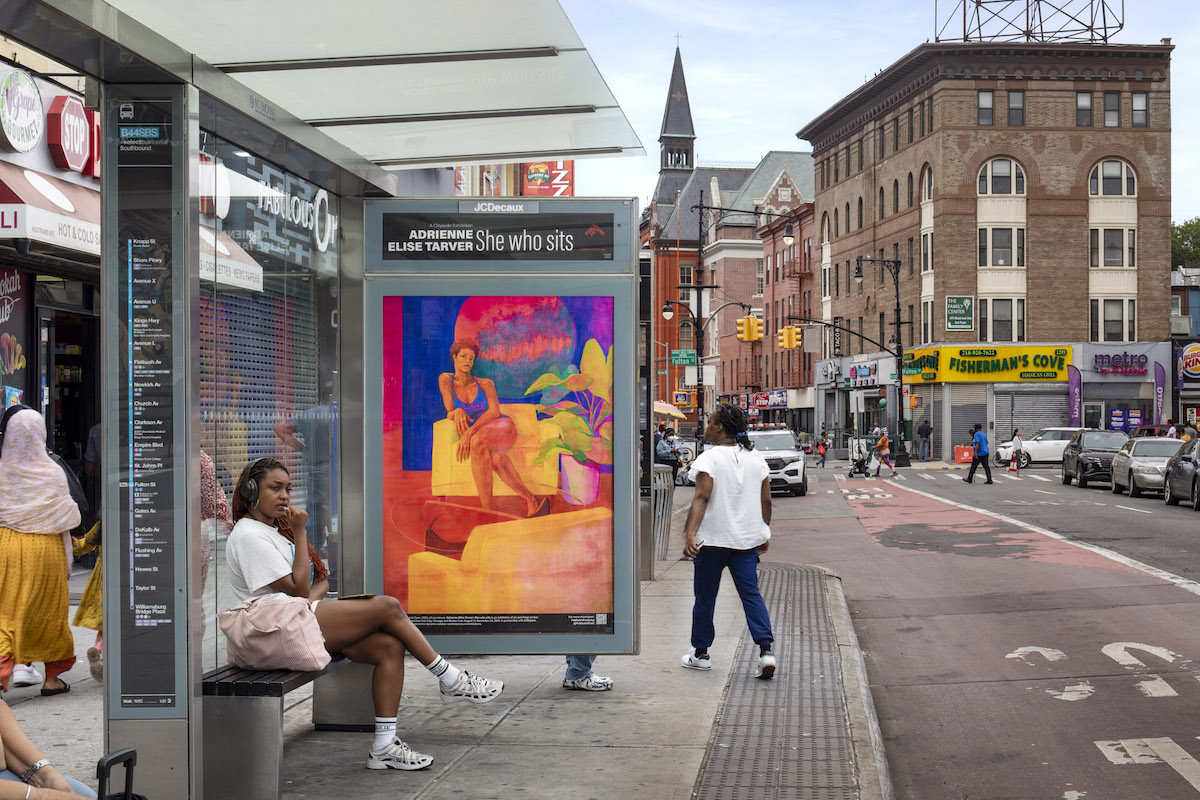
Adrienne Elise Tarver: She who sits; Between here and there, 2024; Photo: Nicholas Knight, Courtesy of Public Art Fund, NY.
Since its founding in 1977, Public Art Fund has made it its mission to make art accessible to anyone and everyone, mounting ambitious free exhibitions throughout New York City and beyond. Their latest exhibition, opening this week in partnership with JCDecaux, sees artist Adrienne Elise Tarver address the complexity and invisibility of Black female identity.
Adrienne Elise Tarver: She who sits, features six new images displayed on 300 bus shelters across New York City, Chicago, and Boston. Tarver’s newest body of work is an ongoing exploration of the centrality of the Black matriarchal figure, combined with new imagery where her subjects reject spectatorship, proclaim agency, and engage in self-affirming rest while seated in intimate environments.
“Adrienne Elise Tarver is incredibly skilled at building rich and complex worlds in which her subjects get to live, and her viewers get to witness,” said Public Art Fund Assistant Curator Jenée-Daria Strand. “Each painting possesses a vivid color story that offers a backdrop to an equally rich narrative—a narrative of radical rest that underscores the right of refusal and the reclamation of selfhood.”
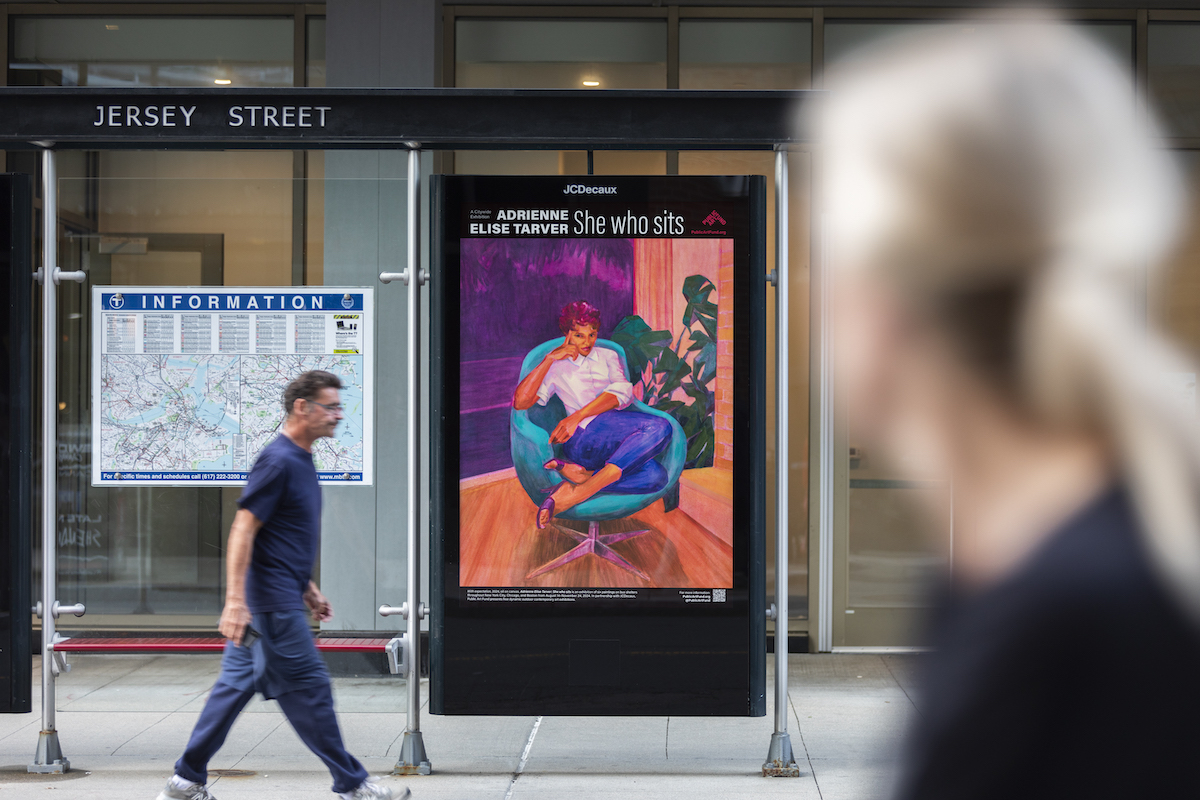
Adrienne Elise Tarver: She who sits; With expectation, 2024; Photo: Mel Taing, Courtesy of Public Art Fund, Boston.
Many of the works in the exhibition feature Vera Otis, a fictional subject whom Tarver has developed over the past 10 years. Originally inspired by an anonymous woman from a vintage photograph in a thrift store, each new portrayal of Vera Otis expands her story. Through Otis’s fabricated biographical narrative, Tarver investigates her own family history, complicates definitions of belonging, and contemplates how personal experiences are intertwined with historical accounts. In She who sits, Vera Otis is the muse through whom Tarver contextualizes rest and the posture of sitting as power. Though inspired by iconic Black actresses of the 1920s through 1960s such as Dorothy Dandridge, Eartha Kitt, Hattie McDaniels, and Lena Horne, Otis does not seek to entertain. She is composed and self-contained, yet at ease and relaxed, not rushing or waiting for anyone. Otis exists as both a meditative focal point for, and in direct contrast to, her commuter audiences.
“In the development of She who sits, as a continuation of my recent work focused on the fictional character, Vera Otis, I was thinking about archetypes, mythologies, and expectations placed on Black women,” said Adrienne Elise Tarver. “These works are an exploration of the power of sitting historically and in daily life, subverting the idea of it being a mundane or insignificant act.”
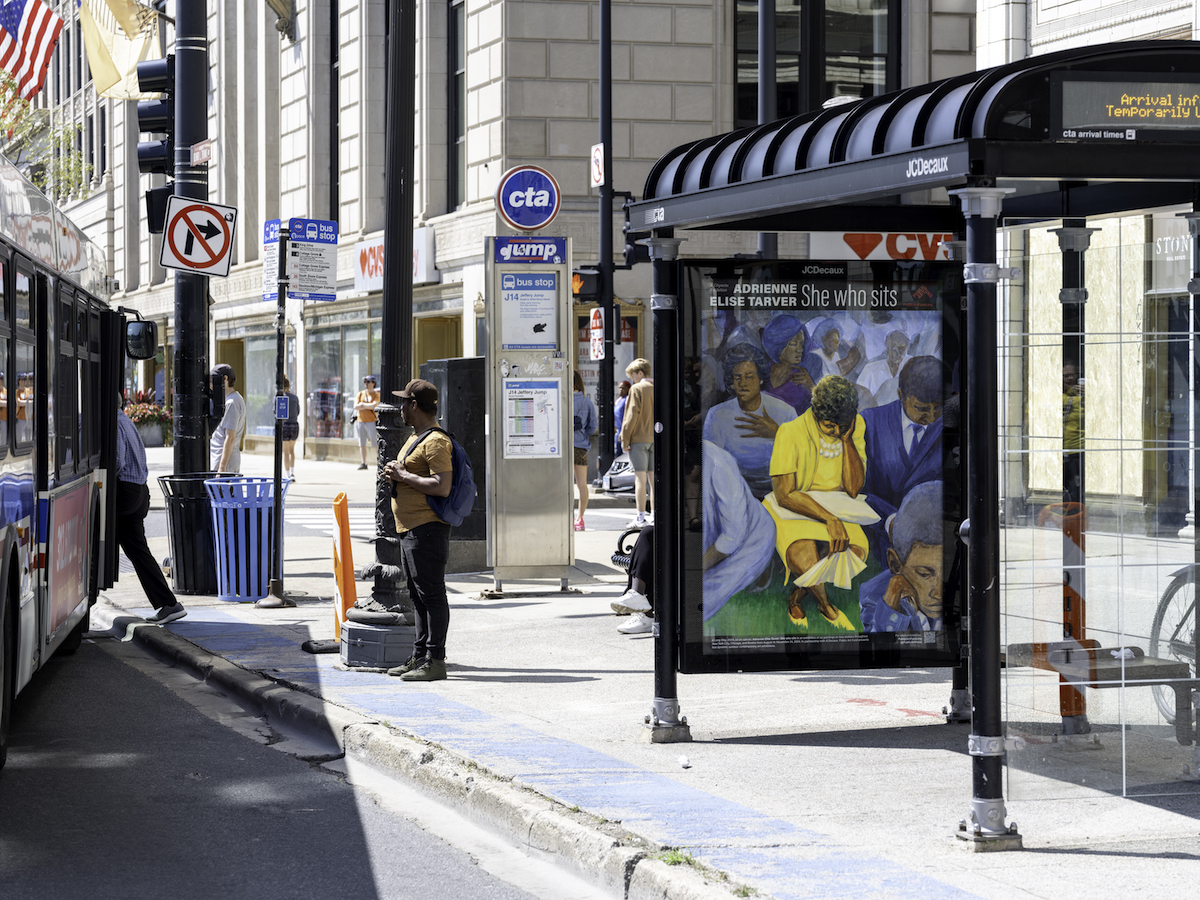
Adrienne Elise Tarver: She who sits; A Long Way, 2024; Photo: David Sampson, Courtesy of Public Art Fund, Chicago.
The exhibition’s title nods to Black actresses’ mandate to perform gleefully on and off stage, the prevalence of Black women’s labor in domestic spaces, and the significance of sitting in public space to enact social change. Dually, it refers to the exhibition’s presentation on bus shelters, where passengers sit as they await their next destination. In New York, Chicago, and Boston, Tarver’s subjects will mirror the posture of nearby commuters, offering physical respite and spaces of quiet confrontation.
Tarver undertakes extensive research to create new series, deriving images from a wealth of source material. Family photographs, found imagery, and media archives––especially that of Ebony Magazine and Jet––reside in each of the paintings, some more recognizable and others less so. By combining imagery that spans time and place, Tarver connects the past to the present.
For example, in the painting Dark Star, Tarver presents a reinterpreted image of model and actress Vera Francis — originally published on a 1951 Ebony Magazine cover — omitting all markers of her identity and leaving only Francis’s silhouette. Visible at the heart of her obscured figure is a dark blue celestial starburst that Tarver offers in a nod to Afrofuturism, and as a depiction of a Black woman’s prayer to the heavens for refuge and release. The concealed subject raises questions about the figure’s potential expressions of her mental and emotional state, especially when compared to the figure’s vibrant surroundings. Consistent throughout the exhibition is Tarver’s commitment to duality, blurring history and the present, invisibility and visibility, private and public.
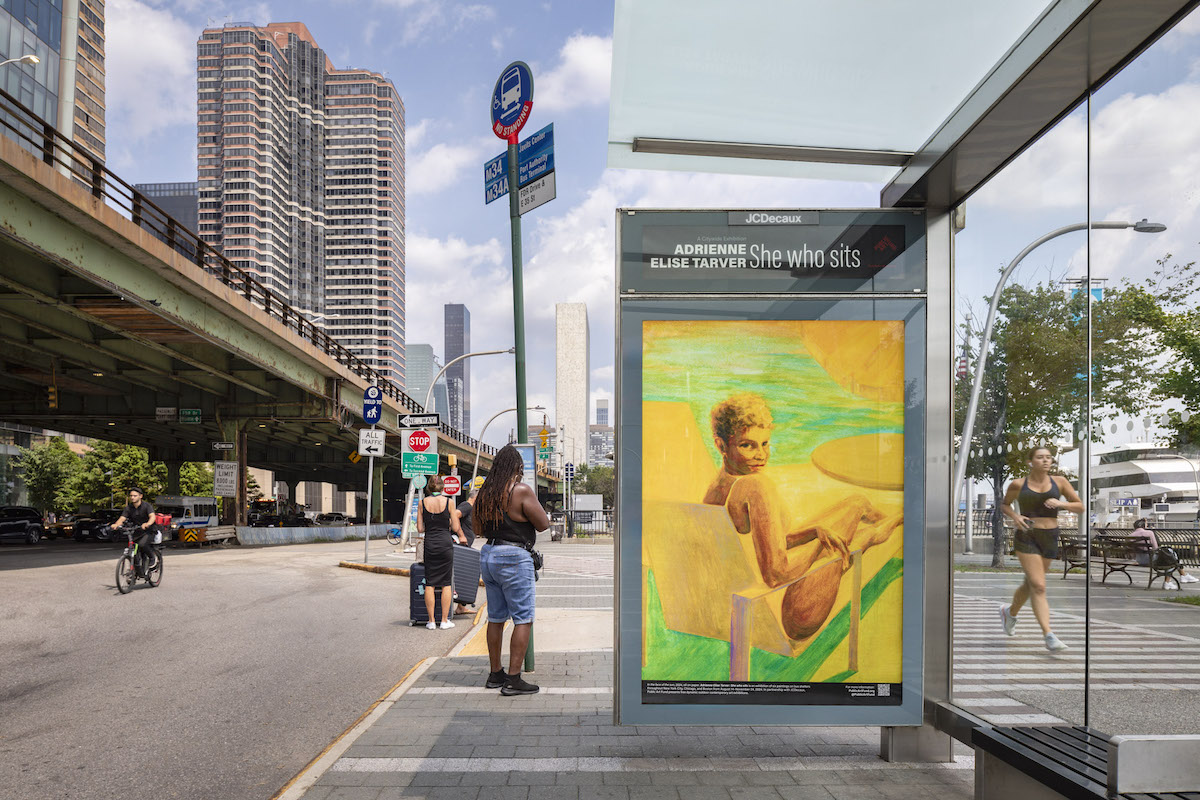
Adrienne Elise Tarver: She who sits; In the face of the sun, 2024; Photo: Nicholas Knight, Courtesy of Public Art Fund, NY.
The three exhibition cities each hold unique significance for the artist. Boston is where Tarver lived during her undergraduate years; Chicago is where she spent her teen years and returned to obtain her MFA; New York City is where she currently lives and works.
Adrienne Elise Tarver: She who sits is curated by Public Art Fund Assistant Curator Jenée-Daria Strand.
Like what you see? Get it first with a subscription to aspire design and home magazine.