
Alexander Lamont is a product of his upbringing, his worldview shaped from early on as a young habitué of global proportion, living in and visiting places like Bangalore, England, Kenya and elsewhere in Africa and Asia. His father was an entrepreneur importing folk art and antiques primarily from the world’s eastern hemisphere and as a result, Lamont has a voracious “thirst for experiences, travel and in design, for the importance of texture.”
Known across the globe, Lamont creates luxuriously detailed, timeless and scrupulously crafted collections of residential furnishings and lighting. In each piece, he seeks to employ ancient, classical or traditional techniques and materials while keeping the designs contemporary and original. “I had to learn so many techniques and build my own workshops, now we make almost every piece from start to finish,” says Lamont.
While he studied Anthropology and Asian languages at university, his design education came from direct observation and close interaction with the production of traditional products; not conceptual training, rather a sensual training. In this, he formed his strong predilection for authentic natural materials and techniques that employ the hands. “Humans have lived with natural, hand-made things since the beginning – for tens of thousands of years,” says Lamont. “The appreciation of ‘real’ things is in our deep layers.”
It is a wonder to hear Lamont discuss in depth his design process. He sketches in perpetuity, sometimes with eyes wide shut to explore “lines that are outside the limits that practice imposes,” or sometimes even scribbling with his left hand. These sketches transition to further sculpting through technical drawings, of which ten to twenty iterations may be completed. Each piece subsequently spends time in the modeling studio, where Lamont encourages happy accidents as they can be the best source of genuinely new materials. Prototyping continues under the Production Manager, Steven Lanham and team with Lamont watching throughout “to both observe and understand better the product.”
From where Lamont seeks inspiration knows no bounds: museums, art galleries, the cinema, current products in developmental stages, blurred photos he snaps himself, travels, memories and more. He holds in reverence the unnamed makers of our world’s past; “the artists, potters, carvers, lacquer workers, carpenters — whose work I grew up with or whose creations you see in museums — countless skilled artists/artisans from Guatemala, Nigeria, Laos, China, Mexico, Egypt, Japan and Sumeria,” Lamont laments.
It goes without saying that Lamont keeps busy and ASPIRE DESIGN AND HOME shows as evidence his four latest collections: Atlantica, a dramatic, modernist-inspired collection of furniture and lighting in collaboration with Antonio da Motta Leal; Intarsia, a gorgeous and very personal collection of case goods, seating and lighting drawn from Lamont’s passions; Le Mur, a group of elevated, luxurious and natural wall panels; and Peninsula, a beautifully poetic and supremely textural collection of small goods and accessories.
Lamont on the Atlantica Collection:
“Atlantica is a collection designed by Antonio da Motta Leal – a renowned Brazilian designer – for Alexander Lamont. I gave Antonio some categories but did not try to limit his ideas. He came up with a collection he had always dreamed of making: furniture and lighting that paid homage to the great modernist masters of Brazilian architecture. The eight pieces launched in Milan in 2017 pushed our materials in strong ways technically and conceptually, and it was a beautiful collaboration.”
Inspired by the Palacio da Alvorada in Brasilia, the Oscar Desk has a hand-polished black lacquer desktop with horn panel supported by six columns of cast brass legs.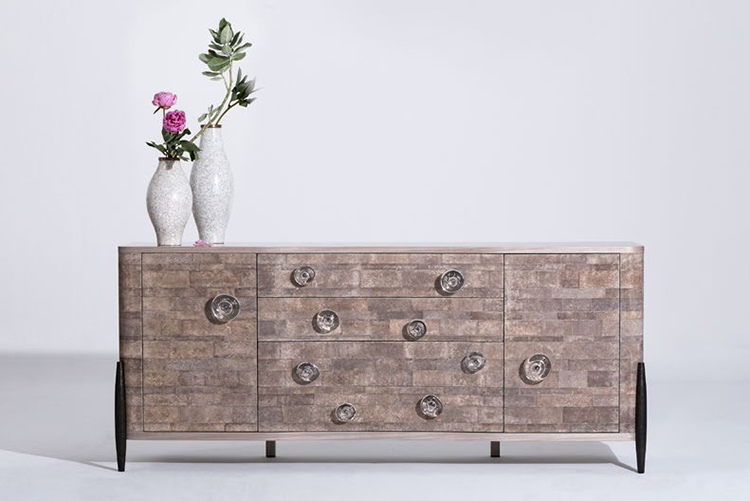
The Flamengo Screen is composed of silvered straw marquetry and koto veneer.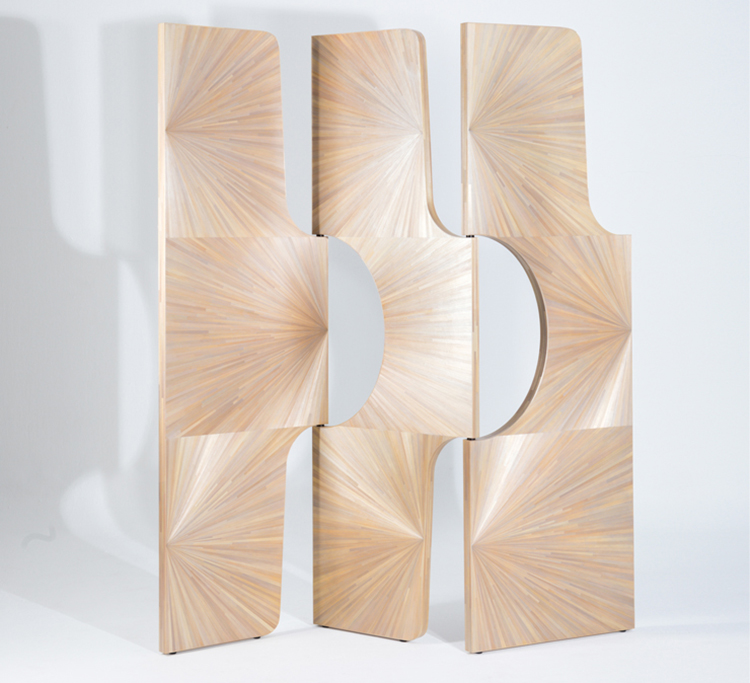
With lost-wax cast legs, the Lucio Floor Lamp includes a twelve-faced hand-polished Peking glass in either Amber or White Jade.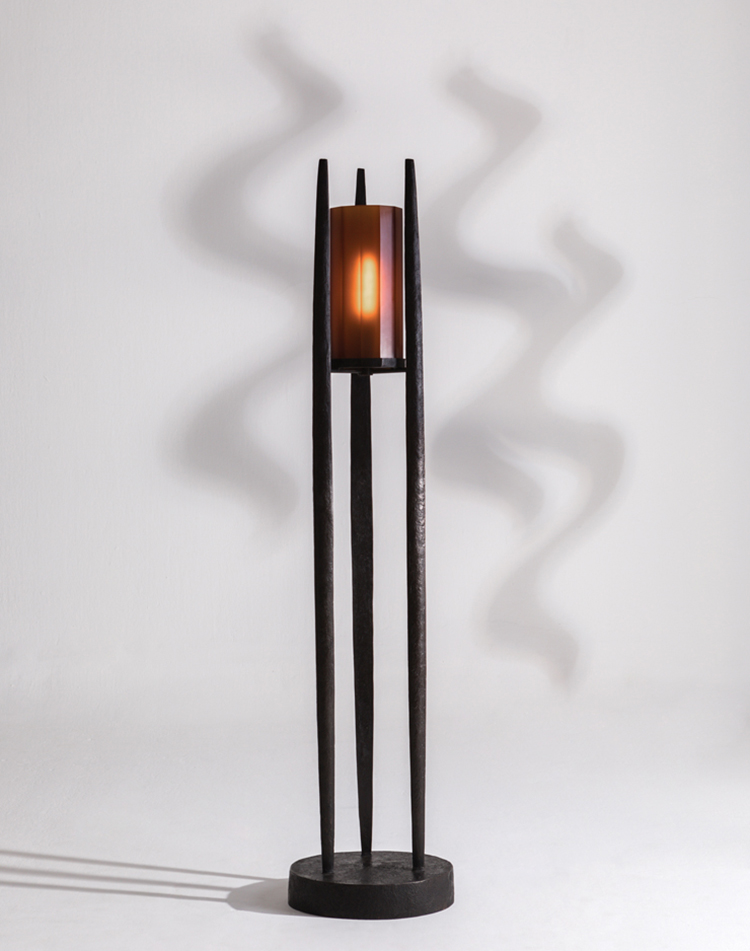
Inspirations: Brazilian Mid-Century Modernism, Modernist Masters Oscar Niemeyer, Lucio Costa and Roberto Burle Marx
Materials: Natural Lacquer, Horn, Straw Marquetry, Peking glass, Hand-blown Crystal, Shagreen, Gold Mica, Stainless Steel, Gold Leaf
Pieces: Desks, Lighting, Screens and Side Tables
Lamont on the Intarsia Collection:
“Intarsia exudes inspirations from antiquity and nature. The story of the acrolith in Greek sculpture and the structure of Lepidoptera (an order of insect including moths and butterflies who have ’scaly’ wings) led to the development of new finishes combining straw with abalone and copper to find aspects of iridescence; Shibori techniques and also a lighting group that juxtaposed pale skins and crystals with dark bronze to give the potency of early ‘acrolith’ sculpture but in a totally modern context. I [created] the collection over a three-month period of drawing and material development.”
With mother-of-pearl, patinated copper, indigo and taupe straw marquetry inlaid over the front and sides, the Prism Sideboard is intricate and detailed. The top is made of smoked eucalyptus and the interior of figured maple.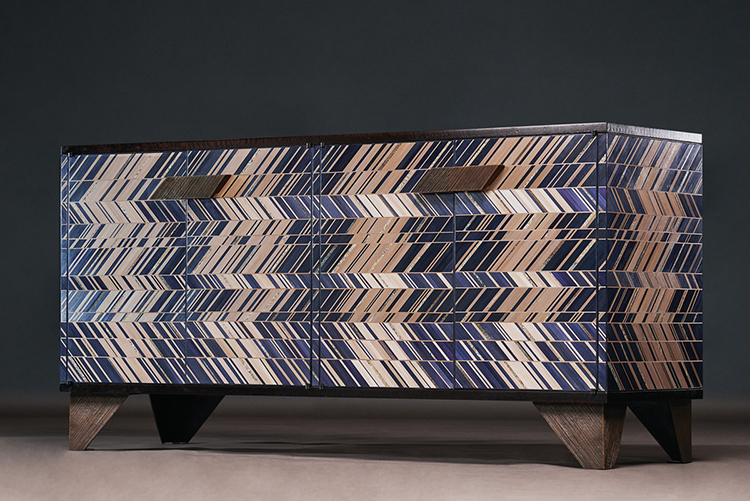
The Turtle Coffee Table includes raw, natural parchment panels that create a carapace section, supported by black bronze patinated fins.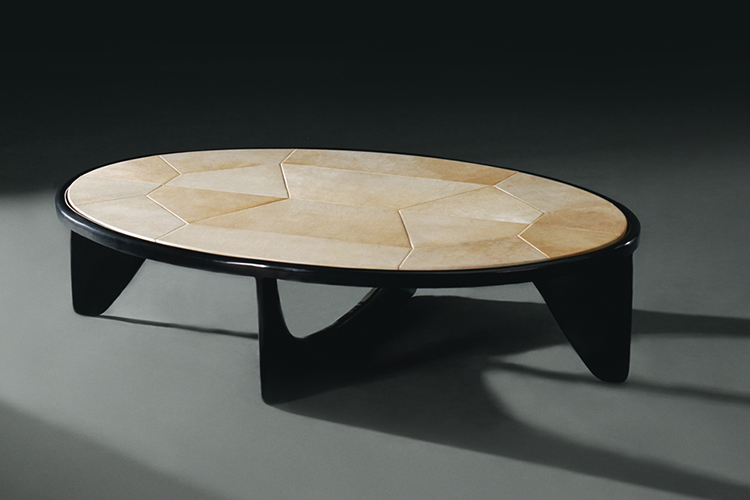
The Ovum Spot Table combines two polished black bronze-patina forms with an egg form suspended between; available in onyx marble, calcite crystal or finely applied eggshell.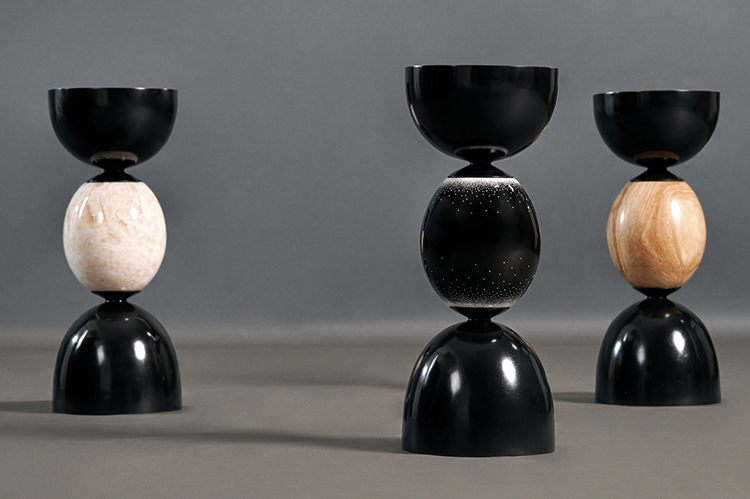
Inspired by ancient Greek acrolith statuary, the Acrolith Floor Lamp is made of a lost-wax bronze patina and natural calcite crystal with linen shade.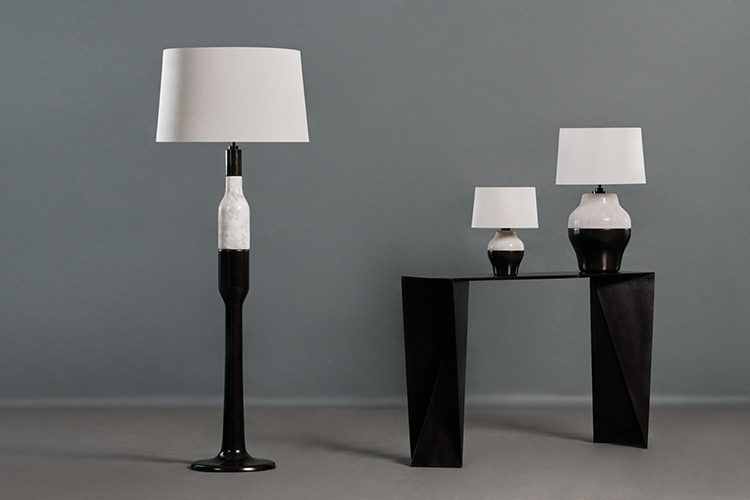
Inspirations: Lamont’s Passions for Antiquity and Nature, an Homage to Texture and Balance in Design, the World of Lepidoptera and Acrolith Statues of Ancient Greece
Materials: Straw Marquetry, Inlaid Mother-of- pearl, Copper, Burnt Bronze, Natural Parchment, Crystal, Onyx, Shagreen, Lacquered Eggshell, Mica, Nappa Leather, Abalone
Pieces: Cabinets, Coffee Tables, Seating and Lighting
Lamont on the Le Mur Collection:
“Le Mur is our sub-brand of wall-coverings. We have collections of classic patterns and more avant-garde designs that make stunning, reflective wall treatments. The panels have been used in Louis-Vuitton flagships and various important hotels. The Mandarin Oriental Doha, designed by David Collins, will open later this year [and] has an entire lobby of our panels, [as do] many private homes where the use of inventive wall coverings can transform spaces. At the core is our skill in straw marquetry. We have about 50 people in the straw studio – preparing, dyeing, inlay[ing]. Within Le Mur are also shagreen wall tiles that create exceptional accents.”

The Labirinto II Wall Panels use straw marquetry in beechwood or ebony with hand-applied Mercury Gold or silver leaf. As one moves throughout the room, different patterns are made visible based on the materials’ reflectivity.
Inspirations: Sonia Delaunay, Tribal Textiles, Landscapes, Locales
Materials: Straw Marquetry, Mercury Gold Leaf, Silver Leaf, Stingray Skins
Pieces: Wall Coverings and Panels
Like what you see? Get it first with a subscription to ASPIRE DESIGN AND HOME magazine.