
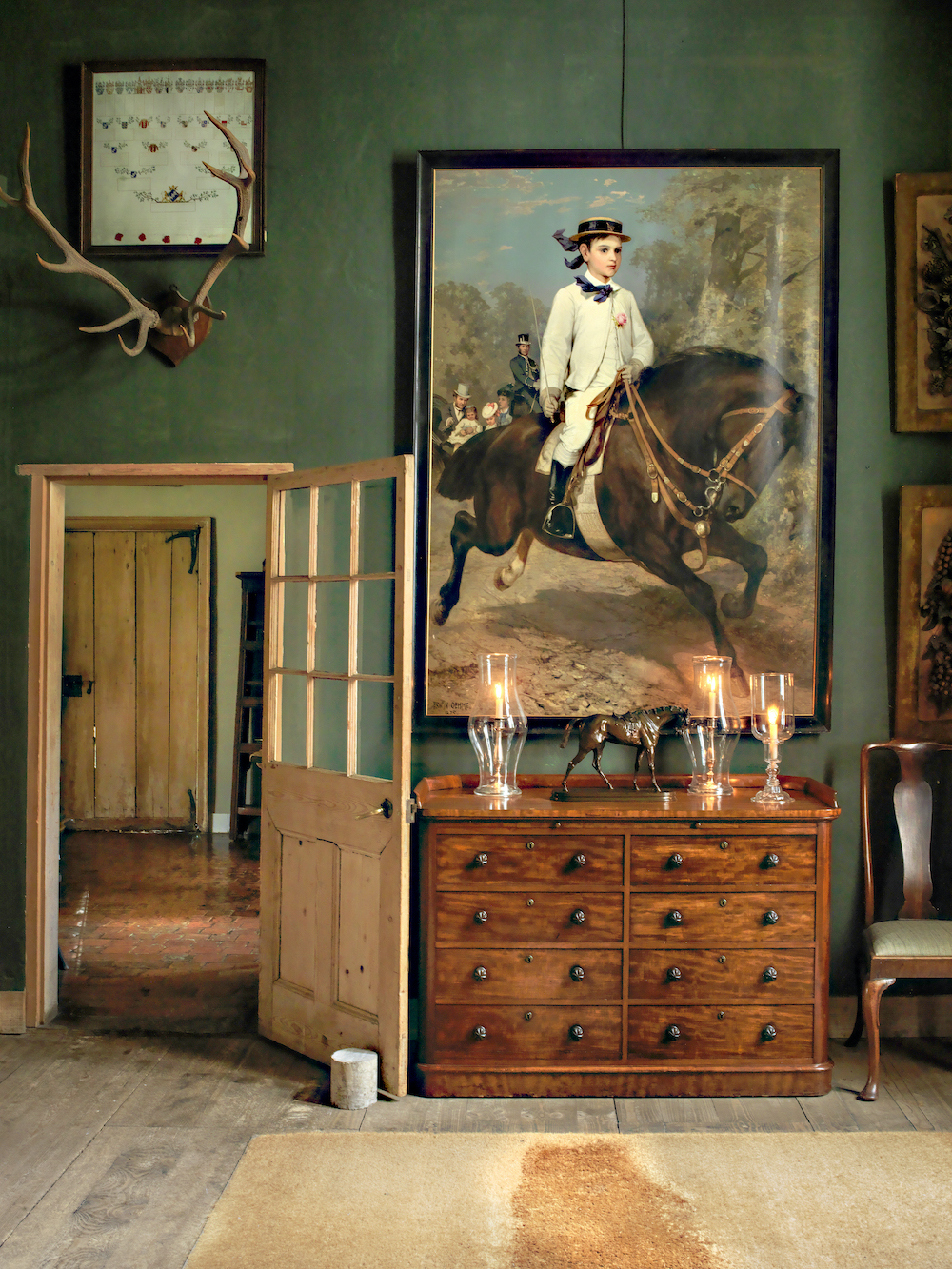
There’s something about an Axel Vervoordt interior that feels alive and yet utterly still, modern yet embracing all time, down-to-earth yet otherworldly. His rooms often feel as if they simultaneously emanate the sacred, contemplative air of a monk’s cell as well as the ripeness (maybe even decadence) of human experience.
This mood is everywhere at Kasteel van ’s-Gravenwezel, the famed antiquarian/curator/designer’s castle on the outskirts of Antwerp. The presence of history, of course, is innate here. The original structure traces back to 1102, when it was a fortress. Two six-story towers went up in the early 16th century, but the castle mostly took its present form in about 1745, with other buildings and an English-style garden following a bit later.
What accounts for the multidimensional spirit of Vervoordt’s interiors? We can glean one hint from the catalog essay he wrote for an exhibition he curated in 2007 at Venice’s Palazzo Fortuny: “I appreciate old walls, furniture that has not been restored, everything that, in its original state, has been transformed by time – ‘that mighty sculptor,’ as Marguerite Yourcenar puts it. I appreciate an old wall as much as an abstract painting. To me, everyday objects handled with love are works of art.”

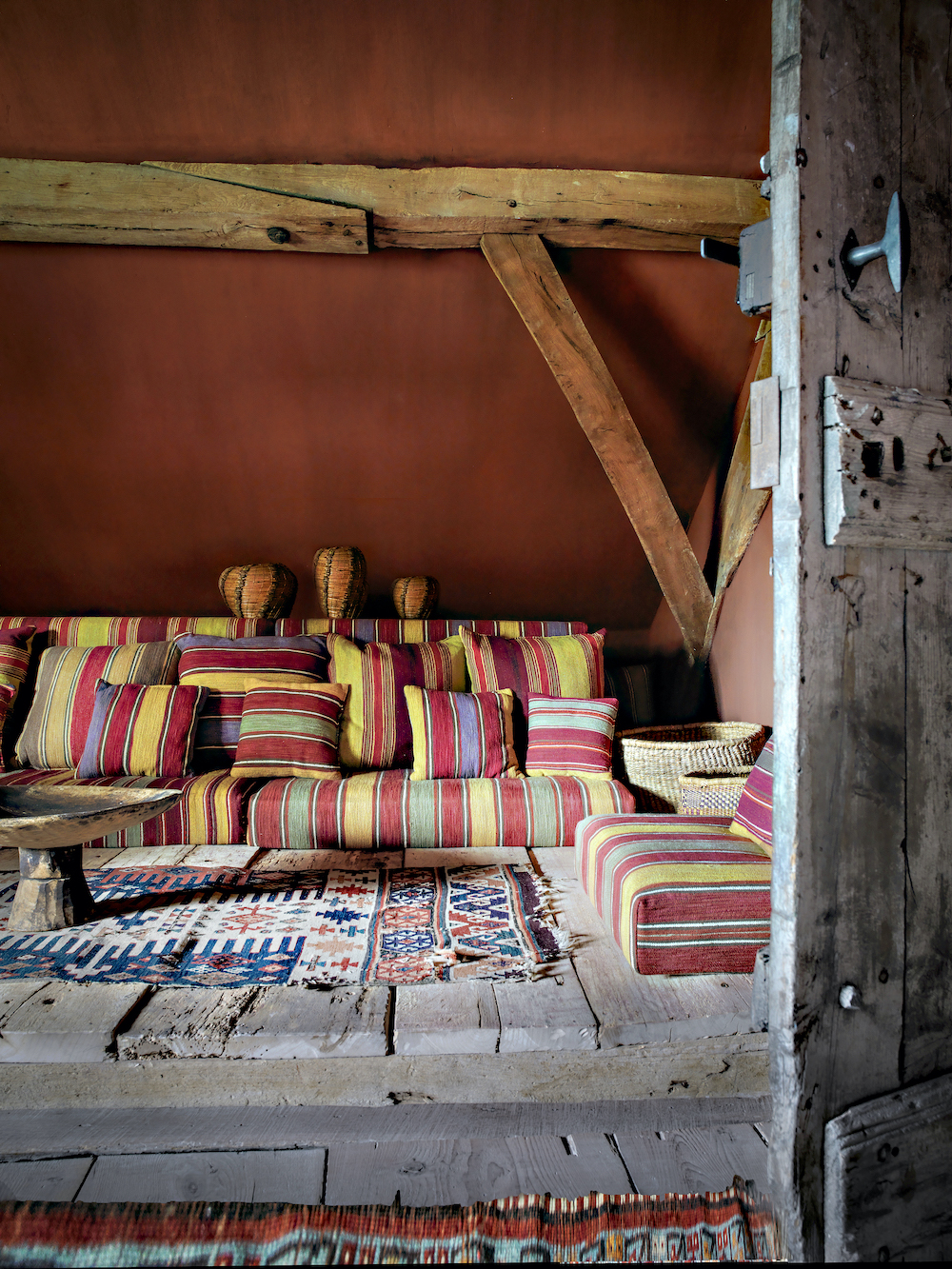
That goes a long way toward explaining why no one else on Earth could probably deploy a worn plank of wood as if it were a priceless Richard Serra or Mark Rothko. One such plank – bowed, chipped and scored with hash lines – leans nonchalantly against a rough-hewn, heavily weathered wall in a space Vervoordt calls “the loft room.” As it happens, the board shares space with a work by Japanese Gutai school artist Shozo Shimamoto that is a perforated, pockmarked sheet of galvanized steel. Nearby is a Zen monk’s ball.
What unites the architectural envelope, objects, art and furnishings of this room? Principally, Vervoordt’s veneration of patina. “It symbolizes an osmosis with the universe,” he explains, “a kind of abstract art created by time.”
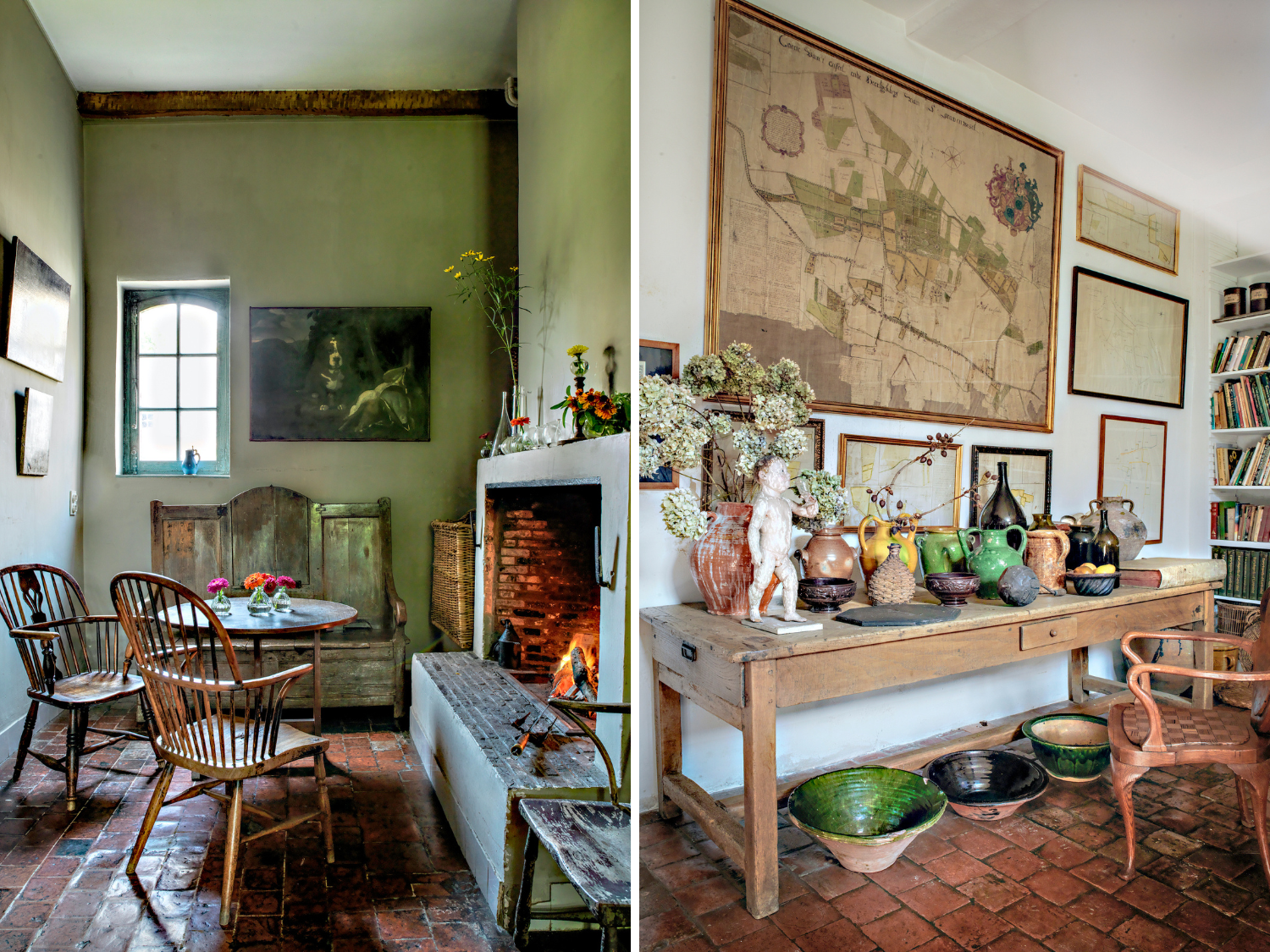
“To me, everyday objects handled with love are works of art.”
But time is also relative, and in many ancient mystical traditions with which Vervoordt shares an affinity, time does not even exist except as a way humankind orders our reality. Fundamentally, it has no substance. Which opens the door for Vervoordt to draw from the entire trajectory of human creativity in the creation of environments at the Kasteel and beyond. He has decorated the home of Robert DeNiro and inspired admiration from a wide swath of royalty and celebrities around the world: the Rothschilds, French presidents and the Aga Khan among them.
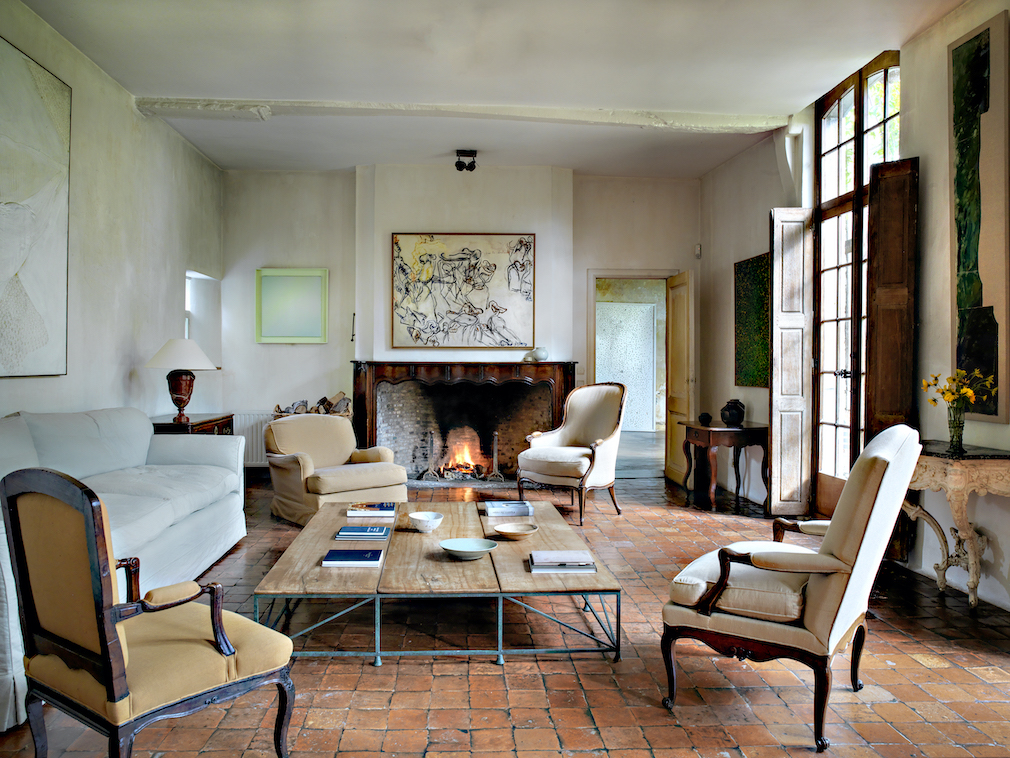
A typical expression of this visual survey of epochs and aesthetics is a Moroccan-style sitting room in the hayloft of one of the estate’s outbuildings. Or there is a “Manoir” room conjured from 18th-century French furniture, a sofa and coffee table from his eponymous furniture collection, a 1964 painting by Venetian artist Ida Barbarigo, a 1968 work – an ornately carved Baroque demilune table – by Belgian artist Jef Verheyen (a member of the Zero artists, a philosophically kindred European group to the Gutai) and a 1985 painting by Japanese artist Chiyu Uemae.
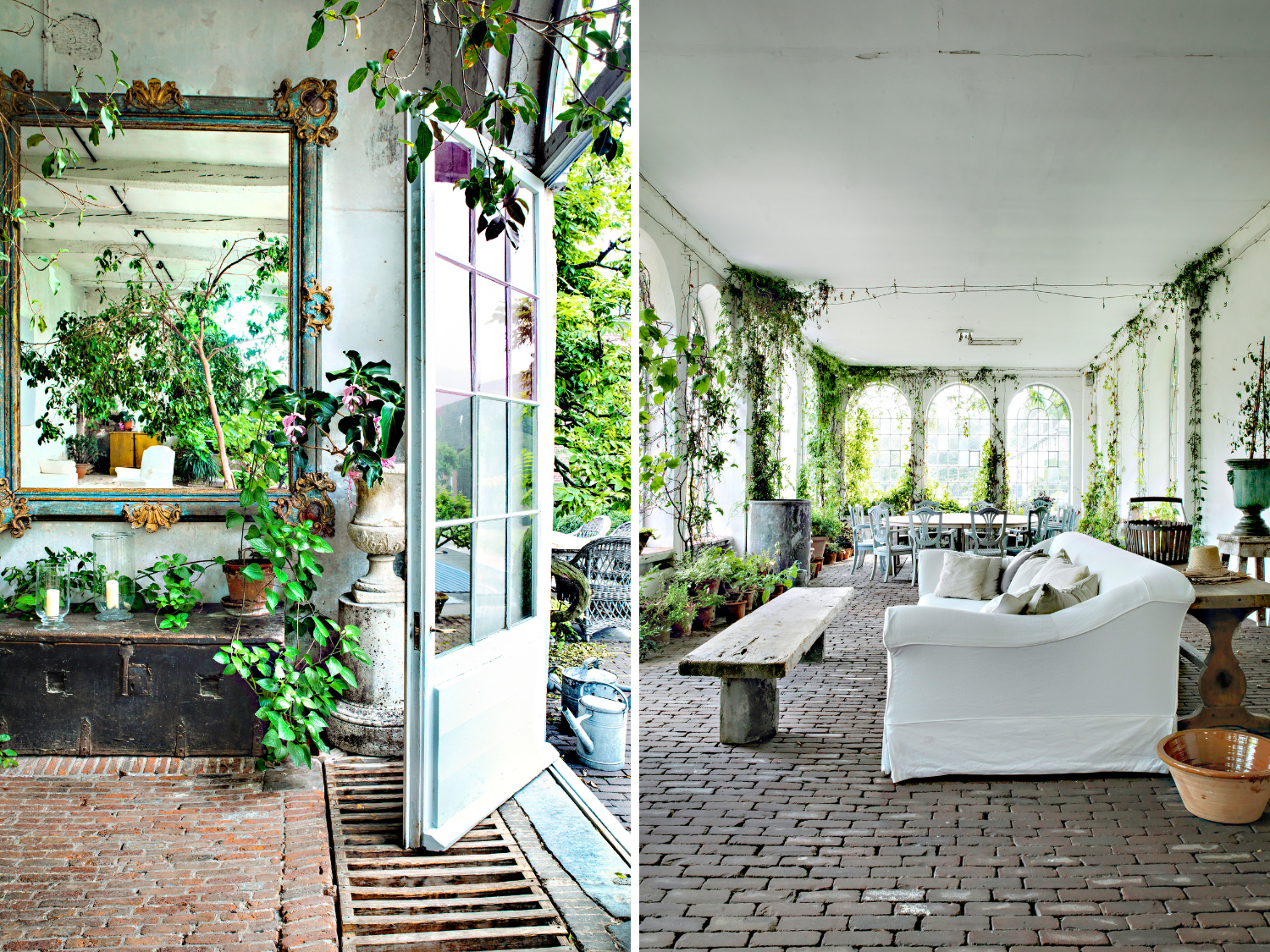
It is not, however, just eclecticism and patina that distinguish Vervoordt’s spaces. “There are other concepts that I find equally important,” he notes. “The use of proportions and the knowledge of sacred geometry. The concept of proportion is essential in the search for balance and harmony; it’s a key to happiness. Architecturally, the use of proportion is a way to create silence and space, where the space itself is more important than the walls surrounding.”
This is very evident in the loft room, where it feels clear that moving a single object or furnishing would upset some ineffable equilibrium. But it is also apparent in a pair of orangeries – one dating to the 18th century, the other added to the complex of buildings in 1986. Both are, as orangeries were, constructed primarily for the wintering over of plants. However, Vervoordt explains, “My wife and I found the old orangery too beautiful to fill it entirely with plants during the winter, so we’ve built a ‘new orangery’ on the other side of the property that we use in the summertime as an extra living space and in the winter to stock our delicate plants and keep them from the cold.”
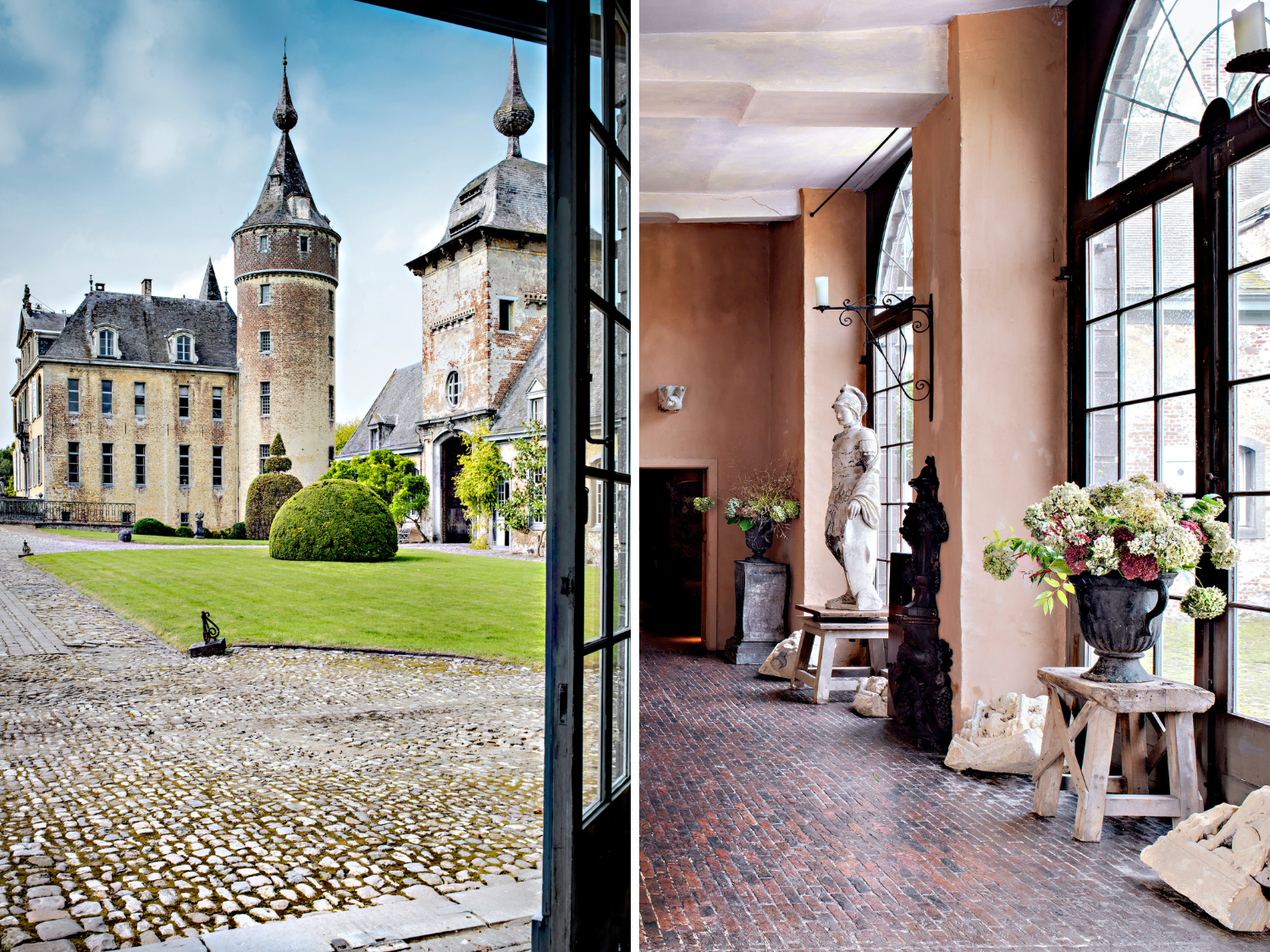
To wit, in both indoor-outdoor spaces, sofas from Vervoordt’s furniture collection mirror the low, longitudinal proportions of the rectangular rooms. Artifacts culled from the family’s 15,000-plus stock of objects and antiques are judiciously scattered around the rooms, contributing to the sense of timelessness and patina, but also exuding a palpable silent presence. The actual selection of these objects can be attributed to intuition, which Vervoordt talks about as a kind of mysterious process. “For artists, scientists and collectors,” he states, “I think every great discovery emerges out of intuition. Intuition is a feeling that comes out of total freedom, out of being one with cosmic energy. It’s knowledge before knowledge.”
Mystery, of course, cannot be replicated. Which is why, though Vervoordt has had many admirers who have aspired to mimic his style, he remains an inimitable icon of our age.
Photography by Michael Paul.
Like what you see? Get it first with a subscription to aspire design and home magazine.