
Jennifer Farrell is a frequent flier. Following her first professional encounter with the widely honored European practice of an August work shutdown, the designer headed from her work site in the South of France back home to Los Angeles to speak at Design Edge in mid-September, then hopped back over the pond to reconnect with the Interconnected Changeable Environments House — her budding conceptual living project in the Bordeaux region — before readying to bounce back to the States again for the debut of her furnishings and décor collection with Global Views at High Point Market in October. “I’m definitely in France more than anywhere these days,” the designer shared, “but I love every chance I get to head back to the States and back home to L.A.”
aspire Deputy Editor Jennifer Quail caught up with the globe-trotting designer in between flights to learn more about Center House, the largest of the three structures in her Interconnected Changeable Environments House enclave.
JQ: This August was your first professional experience with the European holiday closure. What was it like at the house during this time?
JF: We were on almost total shutdown, and it was very quiet here. August is an interesting time in France because people are on vacation for the better part of the month, and that definitely means that construction slows down. But our project manager was here in August and had meetings with our different teams, and we did have painting and other installations happening on the exterior during the month. We probably got more work done than anywhere in France. So, I will commend my lovely project manager for that.
It was a quiet time, which was really sort of nice. I was able to spend time on design boards, renderings and marketing plans. It also gave me a moment to take a step back and really talk with our project partners, not just about what my overall vision is for this Interconnected Changeable Environments House universe, but about what it is they need in their universe. I was able to spend more one-on-one time with the brands themselves and do a deep dive on how our collaboration can support and expand and change the way we have our design conversations. It has been very interesting to go further into the getting-to-know-you experience with our partner brands. The construction hiatus allowed me to really focus on relationship-building with them.
These showhomes I create, they’re not just for me. They’re for supporting the brands and showcasing them in their best light. I treat the showhomes and concept homes I develop as an opportunity for looking at design in a new way, through my very specific lens, and so, ultimately, you’re seeing the products and materials in ways you’ve never seen them before.
JQ: Center House has its own unique story. Tell us about its history and future.
JF: Center House is the main house. It’s the largest of the three environments — about 3,200 square feet — and it has two levels. The original structure was actually a cattle barn. It was converted into a residence about 25 years ago.
As we came to it, there were three bedrooms and four bathrooms, but I’m changing that a bit. We’re taking two of the upstairs bedrooms and the two upstairs bathrooms and turning all that space into the primary suite, which will be very large. There’s also a loft area upstairs that will become a billiards lounge, which will be a transitional space between the public seating areas downstairs and the private primary suite. It’s a spot that’s a little more intimate and will be a great place to wind down at the end of the day with a glass of wine and a game of pool.
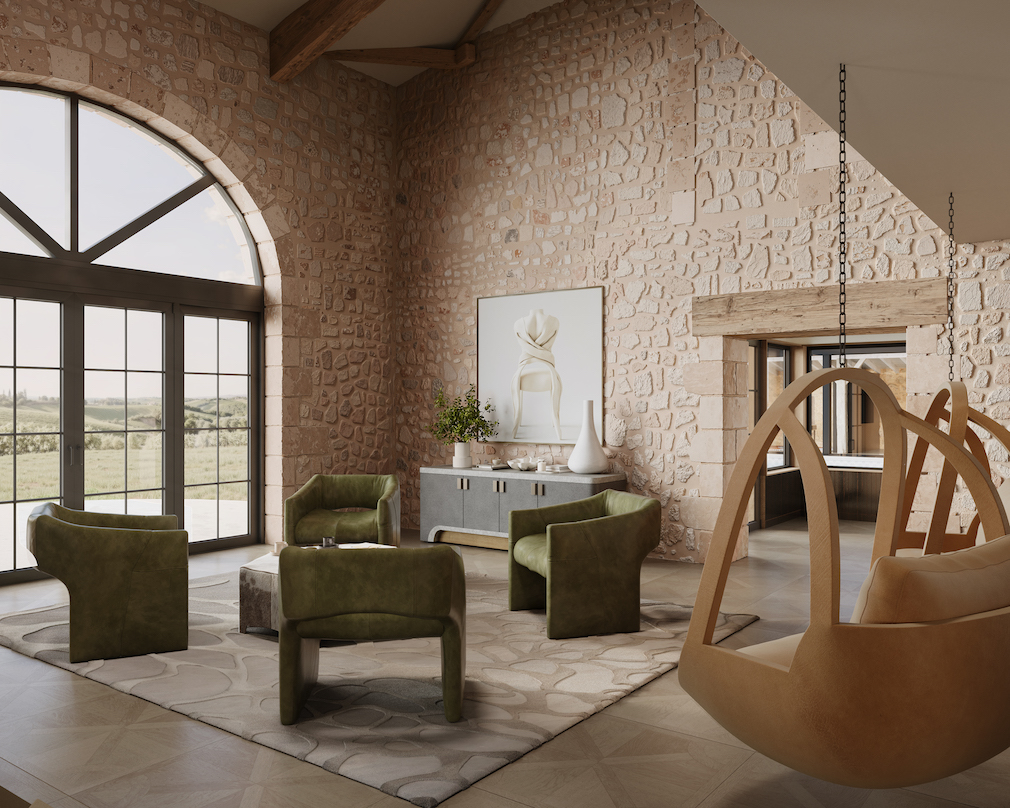
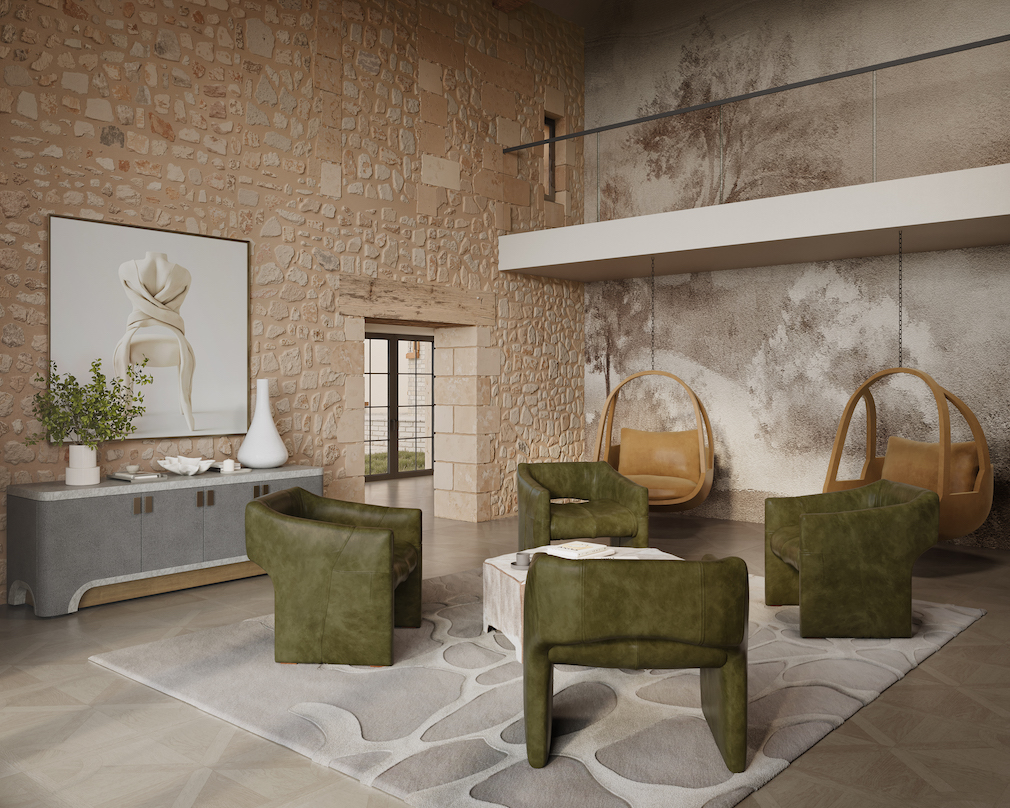
What’s interesting about Center House is, because it was a barn, it still has some of these interesting old elements that are very rustic, and so they really have that ancient feel. Perfect for our ancient-meets-modern aesthetic. We’re keeping those pieces, though some of them will be rethought a bit. One example is the main room of Center House is a very tall, two-story room — over 25 feet at its apex — and there is a massive tree that was chopped into a huge post that’s about 12-inches-by-12-inches. It goes all the way up in the middle of the house and holds the whole thing up. It’s phenomenal, and we’ll be keeping it. You’ve never seen a post like this in your life. And it’s literally in the center of Center House. We’re keeping a few other posts as well, and together they’ll form the outline of our glass wine cellar. So, you’ll have these beautiful ancient pieces that will become part of a very modern glass wine cellar. It’s positioned so that you see it as soon as you enter the house, and it really becomes this beautiful lit sculptural work.
I love to have a big impact when you walk into a space for the first time, and Center House will have quite the impact because, as you enter, you are walking into this huge two-story space. You see the wine cellar and this new steel and glass, and a wood staircase, a new two-story fireplace that’s where the old fireplace once stood, and an extraordinary lighting fixture that we’re custom designing with Kalco that will be like a floating, lighted work of art. We’re paying tribute to so much of the original materials that are here, and then bringing in that modern element as well.
JQ: Tell us about the products and materials we’ll find.
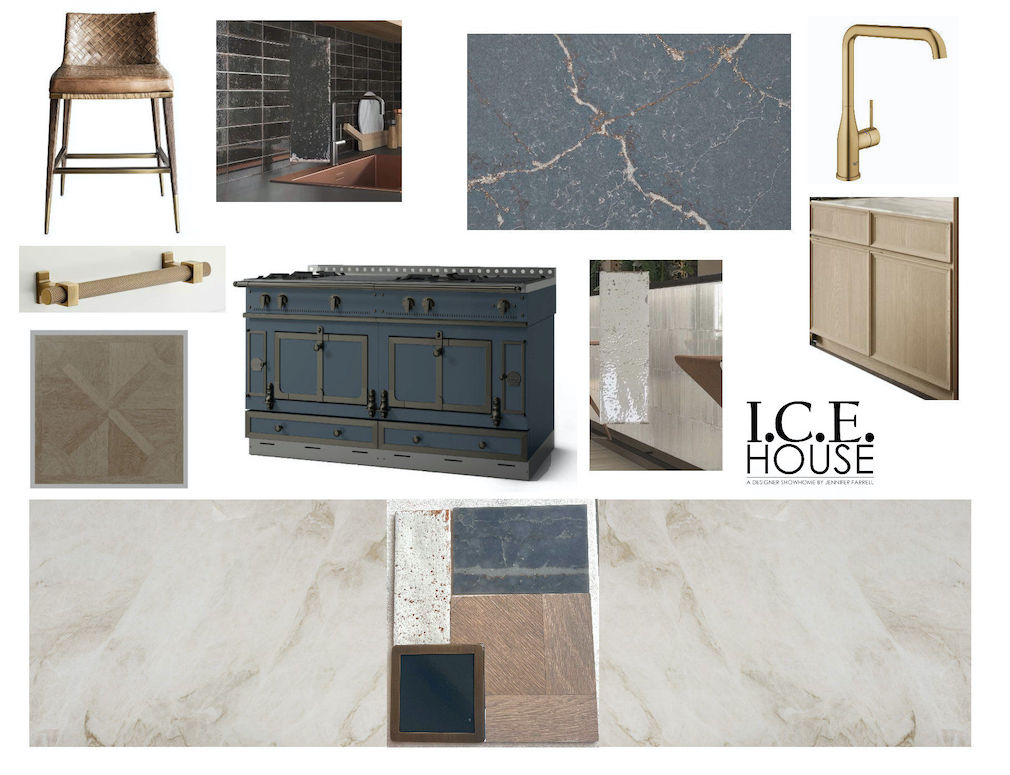
JF: I’m getting to showcase some of my own pieces, which is very exciting. My furniture, lighting, décor and rugs with Global Views; my tile from Emser tile — all of these will be part of the Center House story.
One of the pieces I’m very excited about is the chandelier I designed for Global Views that will hang in the dining room. It’s this massive branch chandelier I had dreamed about for two years, and the craftsmen who have fabricated this for me literally took branches from nature and cast them. The creation was so extraordinary, and I’ve named the piece Sauveterre, which is the name of our village here: Sauveterre-de-Guyenne. Sauveterre actually means “safe land” in French, so it’s a very special word, and to be able to have this beautiful piece, whose branches were literally drawn from the earth to be cast, is incredibly special. It’s exciting for me to be able to showcase not only my own pieces, but pieces that have great meaning to me and great stories to tell.
JQ: You’ve shared a lot about the surrounding landscape and how the views are constantly shifting and surprising you. Tell us about the view as seen from Center House.
JF: The land itself is so special. We are surrounded by vineyards as far as the eye can see and in all directions. We’re in the Bordeaux region and the wine is their economy, their culture and their heritage. Wine is the soul of this community, and this particular property is sited up on a hill a bit with the entire vineyard world below. It has the most incredible views, the most miraculous, really extraordinary. So much of what we’re doing here at Center House is to take advantage of those vistas that you really can’t duplicate.
We’re creating a beautiful strolling path that will meander through the field so you’re looking out at the vineyards all around you, and then you enter through these massive glass doors with a huge glass archway above you and you open the French doors to reveal this 25-foot-tall room that has walls of ancient stone and the beautiful posts that will anchor our glass wine cellar. And I’m doing a two-story mural that is nature-inspired, which will wander all the way along the two walls. It’s really about embracing nature to make it part of the Center House story.
JQ: Since you’re revealing this at the 40-year mark in the 60-year Interconnected Changeable Environments House journey, how will it be presented? How are the homeowners living in it at that moment in time?
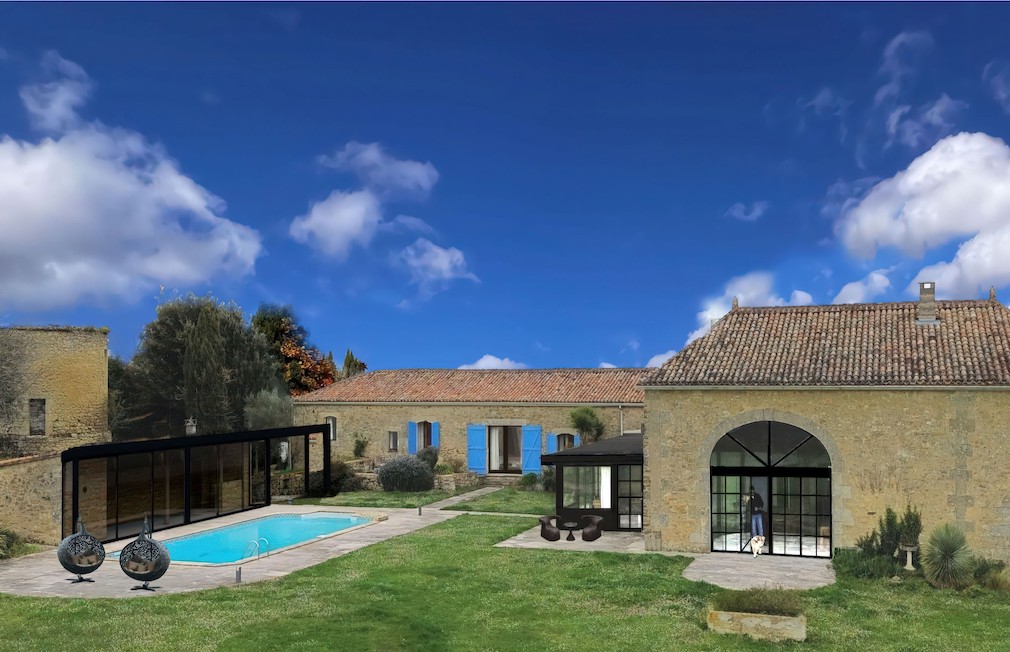
JF: The primary suite is being occupied by our main homeowners, and the breezeway that connects Center House to Extension House has been enclosed in glass and converted into the entertainer’s kitchen, complete with a wine lounge area. The breezeway has beautiful, folding glass doors that are outlined by black steel mullions and open up accordion-style.
JQ: What is the project of the moment for you in Center House?
JF: Right now, I’m working with La Cornue, crafting this gorgeous Chateau 150 series for the kitchen of Center House. It will be featured in our entertainer’s kitchen, the second kitchen in the house. La Cornue ranges are pieces of art and culinary masterpieces that take many months to handcraft. I’ve been to the factory outside Paris and have watched the artisans handcrafting every single piece of metal. It’s incredible to see how much love and care and thought goes into it. This is a very old company that’s been in operation for a very long time, and many of the artisans there are generational. Getting to experience how they craft something that ends up in a kitchen is really extraordinary. For the one we’re doing for Center House, I’m selecting very specific colors and materials—a gorgeous muted teal color and brushed bronze—and we’re going all-electric. I believe, in this particular combination, this may be the only one in existence.
To craft the hood, I’m working with this Parisian blue Silestone from Cosentino that has a beautiful metallic veining of copper in it. This is part of why I love going to the factories and doing a deep dive on what’s available. These blues, from two different companies, are tonal matches of each other. I had to really see them to make this happen.
And then there’s my Livable Luxury Metamor tile from Emser that also has a copper patina on the edging and a brushed bronze with an undertone of copper over it. You’ll see all of these materials—from three different partners, created in three different universes—but brought together in a way that elevates all of the brands and all of the materials. And you’ll see them and how they harmonize together from my own specific perspective, in a way that’s translatable.
JQ: You’re working deliberately to be sure there is a cohesive throughline among the three structures, yet each also claims its own signature style. How are you maintaining both connection and independence?
JF: When you have three homes on one property, there are a few ways you could go on the aesthetics. Each of the homes has its own spirit, its own personality, and yet they are interconnected. You’ll see some of my Emser tile that is in Center House also in Extension House and Indy House, but I’m telling the tile story in a different way in each home — the color palettes change even though we’ll use some of the same materials. There’ll be changes in pattern, changes in palette. I would say that Center House is the most romantic of the three; Indy House is the most contemporary, and Extension House is the most playful. Each has a different energy, and yet you can see how they tie together.
In Center House, you’re seeing more blues and greens, but the blues are inspired by the French blue shutters that are on the exterior of Extension House. So, you’ll see the shutters, and you’ll look into the kitchen and see the richer, more muted nod to that French blue.
JQ: There is a difference in play here compared to most showhomes, where you will actually be a part-time resident when this project is complete. Interconnected Changeable Environments House, quite literally, isn’t just for show. How is this aspect affecting your thought process?
JF: It’s a very personal project for me. I have always wanted to create a life in France, to do a project in France. I’ve loved the French culture since my first experience. I went to Northwestern University, and I graduated early, so while everyone else was finishing up their last quarter of school, I hopped on a plane and flew to Paris. I had $200 in my pocket, which, back in the day, you could actually do something with. My father was a pilot for United and arranged for me to fly standby, and I took my $200 and stayed in hostels and ate baguettes and bought a cheap bottle of wine and went to the museums and walked through the Tuileries Gardens and went to Versailles and spoke my mediocre French.
I was in love, and it’s been an ongoing love affair ever since. So, there is definitely a personal connection for me to this property, to this land. Especially having just finished Calibu Vineyard in Los Angeles and getting to grow grapes there from scratch, getting to really understand the beauty of the vine and how there is a true life that happens in the vineyard and with the vines. Learning that life and making it part of my own, and then to be here in a world where their entire universe is built on vineyards and wine… It really has been a personal journey for me here that goes beyond just creating a beautiful showhome.
Like what you see? Get it first with a subscription to aspire design and home magazine.