
Lorri Hicks Cazenave is the Founder and CEO of Hicks Cazenave Interior Design, known for creating soulful, timeless interiors that balance sophistication with ease. With over 25 years of experience in design, Lorri’s work has shaped interiors for some of the world’s most discerning clients, spanning the Bay Area and beyond, and bringing together refined craftsmanship, collected elements, and a distinctly personal approach to design. Early in her career, Lorri trained under celebrated talents Richard Keith Langham in New York, Glenn Gissler, and Waldo Fernandez in Los Angeles — designing projects that ranged from President Barack Obama’s Martha’s Vineyard retreat to residences in the Hamptons, the Upper East Side, and Louisiana. After leading projects at Jeff Schlarb Design Studio in San Francisco, Lorri founded Hicks Cazenave Interior Design in 2016. Learn more about Lorri’s interior design work in today’s Designer Friday.
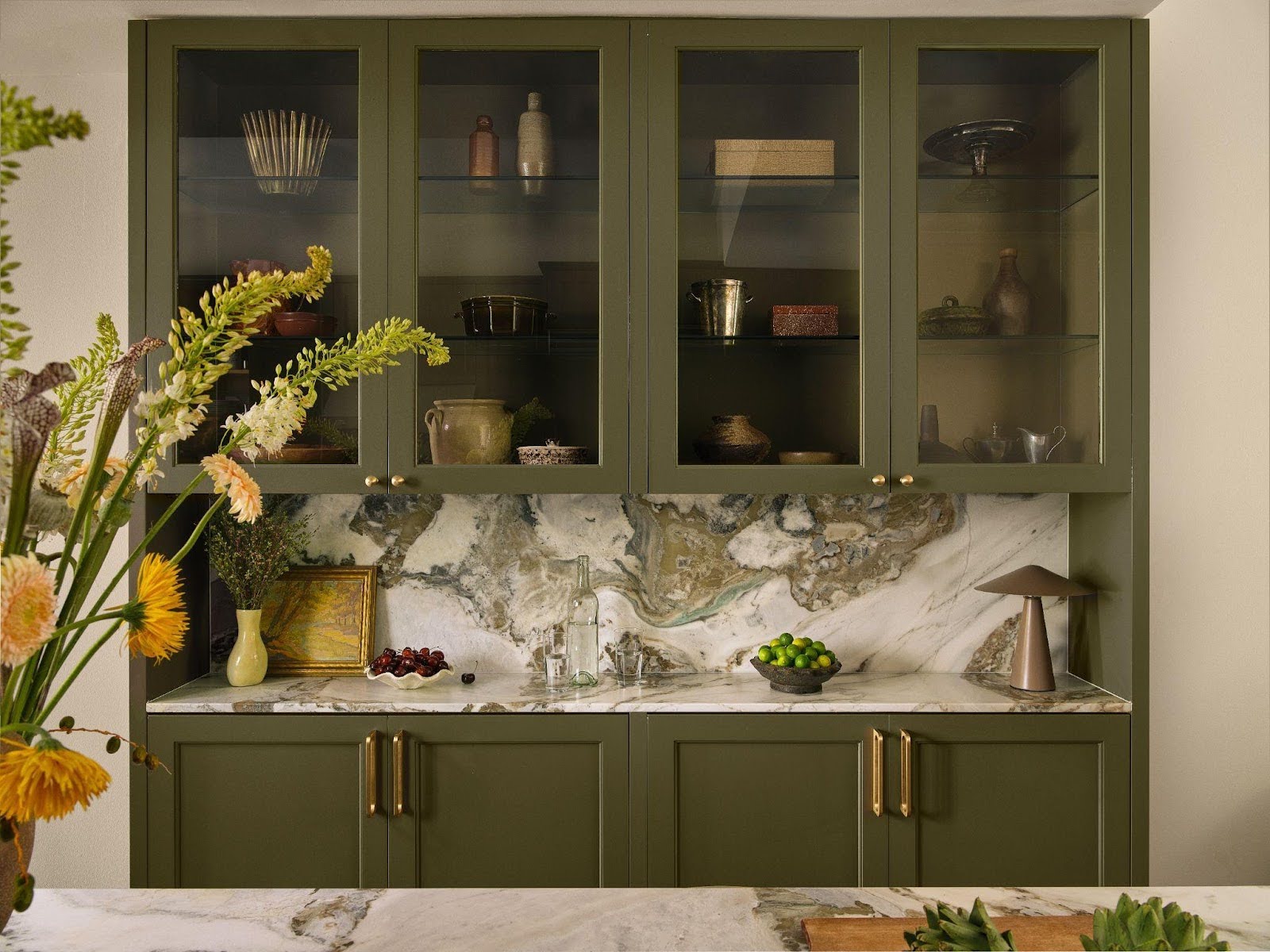
Olive cabinetry anchors the palette as a sweeping, stone-veined backsplash brings natural materials to this calming kitchen bar.
Andrew Joseph: What inspired you to become a designer?
Lorri Hicks Cazenave: I grew up with a love for history and my grandparents’ stories about life in Denmark, where you dressed in layers to meet the day. That idea of layering has always stayed with me. Fashion taught me how to play with proportion and texture, and design became the natural extension of that curiosity. Working under incredible designers in New York and Los Angeles showed me that interiors can hold memory, culture, and personality all at once. When I launched HCID, I knew I wanted to create spaces that were layered and soulful — lived in, not staged.
AJ: How do you approach a new design project?
LHC: I start by listening to the client’s story and to the architecture itself — what the space wants to be. From there, I layer in history, materiality, and moments of tension that bring a room to life. A silk shade against raw plaster, a vintage rug beneath a sculptural modern table — those contrasts create depth and make a home feel personal.
AJ: Can you describe your design philosophy in three words?
LHC: Layered. Soulful. Unpredictable. (I love that last one because the best rooms always have a little surprise, something you didn’t see coming.)
AJ: What is the most important element in a successful interior design?
LHC: Balance. A room only works when beauty and practicality meet. A sofa should make you want to curl up with a book, but also stand the test of kids, pets, and daily life. That’s the sweet spot.
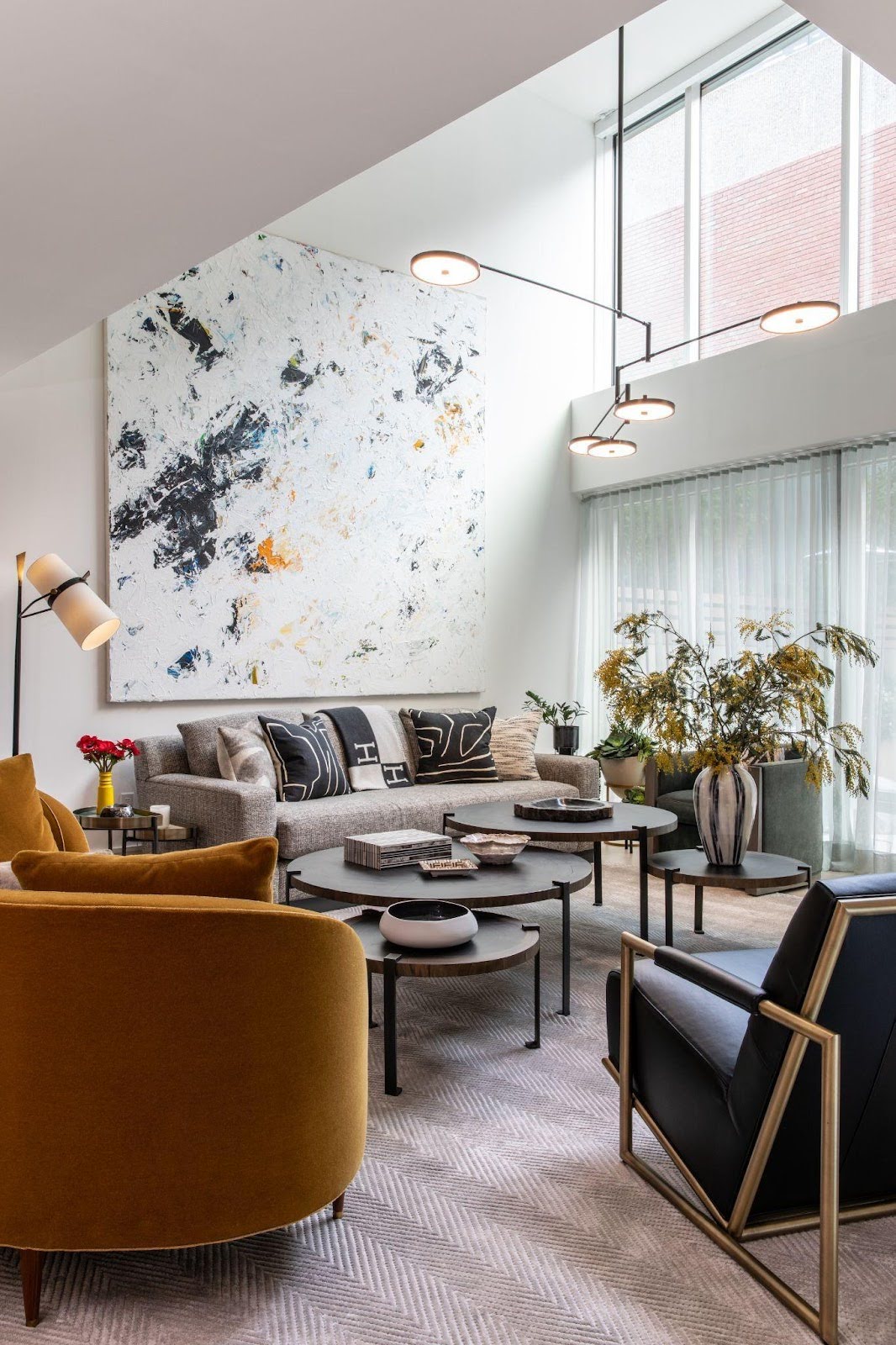
Bathed in natural light, the gestural abstract painting becomes the room’s anchor, its motion mirrored in the layered tables and curated seating.
AJ: Can you describe a project that you’re particularly proud of?
LHC: A historic home in San Francisco where we layered in contemporary pieces without erasing its character. We leaned into tension — juxtaposing original moldings with bold modern lighting, pairing timeworn rugs with sculptural furniture. The result feels deeply personal: not a preservation project, not a reinvention, but a dialogue between past and present.
AJ: What’s the best piece of advice you’ve received as a designer?
LHC: When I worked for Richard Keith Langham in New York, he would often direct us to “go find the je ne sais quoi” — a chair, a fabric, a piece with that elusive spark. It was never about perfection or matching, but about finding the element that gives a room its soul. That lesson stuck with me: design lives in the tension between the expected and the surprising, and I’m always searching for that special something.
AJ: What is your favorite place to find inspiration?
LHC: International magazines and antique shops. I love disappearing into lofted antique spaces, never knowing what I’ll stumble upon. Recently, it was a set of 18th-century English Regency dining chairs with a subtle Egyptian twist — pieces that carry history yet still feel surprising. Pairing finds like that with interesting fabrics, unexpected weaves, or bold patterns is what makes a room feel alive. Those discoveries — the soulful objects you give a second life — are what keep me endlessly inspired.
AJ: What is your favorite aspect of your job?
LHC: The relationships with artisans. I love collaborating with people who bring their craft and passion to the table — whether it’s a woodworker who understands the grain like a language, or a textile maker whose fabrics carry the soul of their process. Those connections infuse projects with humanity and story. For me, design isn’t just about creating beautiful rooms; it’s about the hands, histories, and collaborations that make them possible.
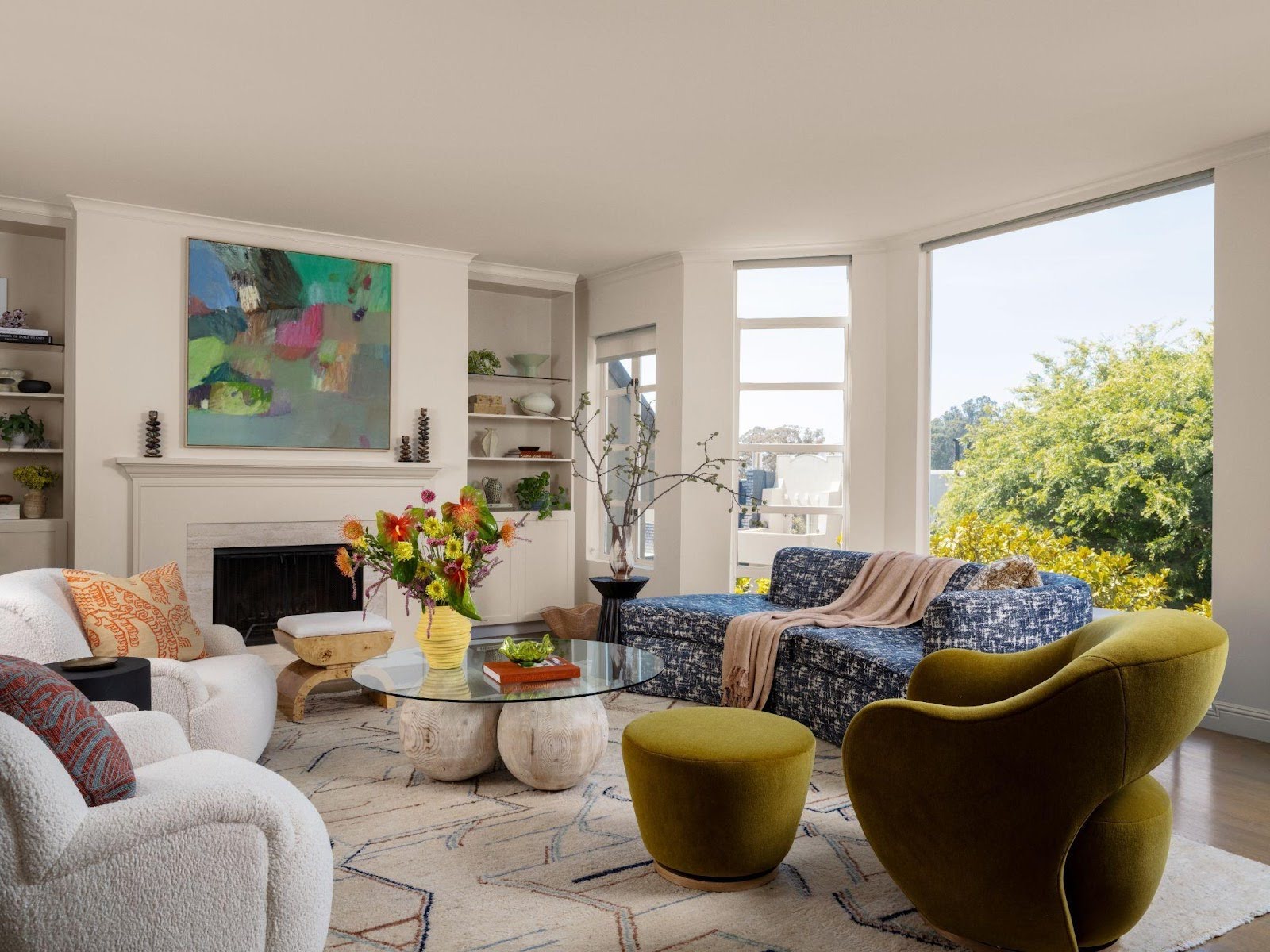
A mix of boucle, velvet, and patterned upholstery sets a lively dialogue against the glass-topped table balanced elegantly on sculptural spheres.
AJ: How do you keep up with the latest design trends?
LHC: I read a lot of international design magazines, but I also look to fashion. Fashion always sets the stage — it’s often where you first see the shifts in color, silhouette, and texture that eventually filter into interiors. I love tracing those parallels and then translating them into spaces in a way that feels timeless rather than trendy.
AJ: How do you incorporate art into your designs?
LHC: Art is never an afterthought — it’s part of the soul of the room. With a BA in art history, I can’t help but think about context: how a French portrait carries one story, while a bold contemporary canvas tells another. I love playing with those contrasts — pairing something with history alongside something fresh, or letting a client’s collection take center stage. It brings humor and edge, keeps the space from feeling too self-serious, and makes the room feel alive.
AJ: Style (or design) icon and why?
LHC: Sophie Ashby and Beata Heuman. Sophie has this incredible cultural sensibility — her rooms layer art, history, and travel in a way that feels soulful and grounded. Beata, on the other hand, brings humor and edge. She’s fearless with color and playful details, and her work reminds me that design should have joy and wit as much as depth. Together, they represent the balance I’m always chasing: cultured, layered, and never without personality.
Like what you see? Get it first with a subscription to aspire design and home magazine.