
Jennifer Farrell is no stranger to design on a grand scale. Included on her creative resume are individual clients, TV appearances and the full scope of showhouse development — from initial concept through opening day and beyond. Her latest endeavor takes her across the Atlantic to the south of France, where she is developing Interconnected Changeable Environments House, a showhouse that blends three historic stone structures into one modern, changeable compound that adapts over time for living well through all stages of life. It’s a concept Farrell is creating as a global design destination experience, not just for the American A&D community, but for the design community around the world.
aspire’s Deputy Editor Jennifer Quail is following along with the designer as the work on the Interconnected Changeable Environments House unfolds. They sat down recently to discuss the master plan.
Jennifer Quail: You’ve worked on other showhouses, including one you came to live in yourself, but this is a very different creation. Tell us how the idea for the Interconnected Changeable Environments House began. Why was this the right next project for you?
Jennifer Farrell: I’ve been creating showhouses for many years and have learned new things from each of them. The more I evolve, the more the projects evolve. For decades, I’ve been toying with this idea about multi-structure, adaptable living and I honestly think it goes back to watching reruns of The Golden Girls. I thought it was so clever that these lovely women, who all had their own lives, ended up living together in this compound. I’ve even said to my own girlfriends over the years that someday I’m going to build this multi-structure universe with a central gathering hub.
As the idea grew, the vision became for a sustainable, adaptable, changeable, multi-structure space that would evolve over time so that you never had to change your home; your home would instead change with you. I came to envision the spaces as interconnected but changeable, so they could disconnect and reconnect as needed. They would be separate environments that could come together in different configurations and for different phases of life.
JQ: Tell us about the individual identities of each of the three structures.
JF: I wanted this to be a truly communal experience — these three houses that together created a bit of a compound around a central courtyard-type space. I started thinking of the Interconnected Changeable Environments name and it hit me that the smaller house would be Indy House — this is the independent one; then we have Center House — the main house on the property and the primary hub for living; and finally, Extension House — the one that adapts and changes over time, from a guest house or Airbnb unit, to your teenager’s wing when the time comes, and then your yoga/meditation studio after they move out.
 JQ: This is your first showhouse overseas. Why was France the right location for this project?
JF: I’ve had a love affair with France for decades. I studied French in high school and remember my French teacher going to the Loire River Valley for her summer break and taking photos of all these castles and chateaus and farmhouses. It was so magical to see it all. So, I took my own trips to France and have been quietly threatening to do a showhouse here ever since. As I was formulating the idea for the Interconnected Changeable Environments House, I began shopping in the Malibu Hills, in California, which is where I designed the Calibu Vineyard and Wolf Peak showhouses. I kept looking for just the right place where I could create these three stone farmhouses that would feel like the European countryside, and I kept striking out. And then it hit me one day: Why am I trying to fabricate ancient stone farmhouses? Why don’t I buy ancient stone farmhouses and make this an authentic story, and part of a big movement that’s happening right now in design, which is this movement towards the global culture of design — the global experience of design as a personal, connective experience. It’s the inter-connective tissue for all of us. In choosing France, I’m telling this as an authentic story. These are authentic, old stone buildings rich in heritage, where I’m creating an ancient-meets-modern aesthetic. In doing this, I’m being true to the story.
JQ: How has working in France differed from working in the States?
JF: Working in France is lovely. There’s a different valuation of time and what’s important. I’m accustomed to 60-hour weeks, eating lunch while driving and talking on the phone, and responding when clients text me at 10 p.m. on a Sunday. In France, they take two-hour lunch breaks, and they don’t work on weekends. The clock shuts off when business hours are over. So, I did have to adjust to that. The reality, though, is the French may be outsmarting us in terms of quality of life. Those measures are in place to enhance their lives and preserve their own mental and physical health. I’m learning the value of that. And I’m learning to manage my time really, really well so the working time is productive, and I can adopt the French clock a bit better.
JQ: Tell us about the land itself and the structures as they were purchased. How did you know these were the right bones for the Interconnected Changeable Environments House?
JF: It was quite a journey. Once I realized I needed to do this in the south of France, I got online and looked at 500 properties. I looked at chateaus and country hamlets and narrowed it down to nine properties to visit with my husband in the summer of 2024. I localized the region between Toulouse and Bordeaux — it’s extraordinarily beautiful and picturesque, with great weather and great wine.
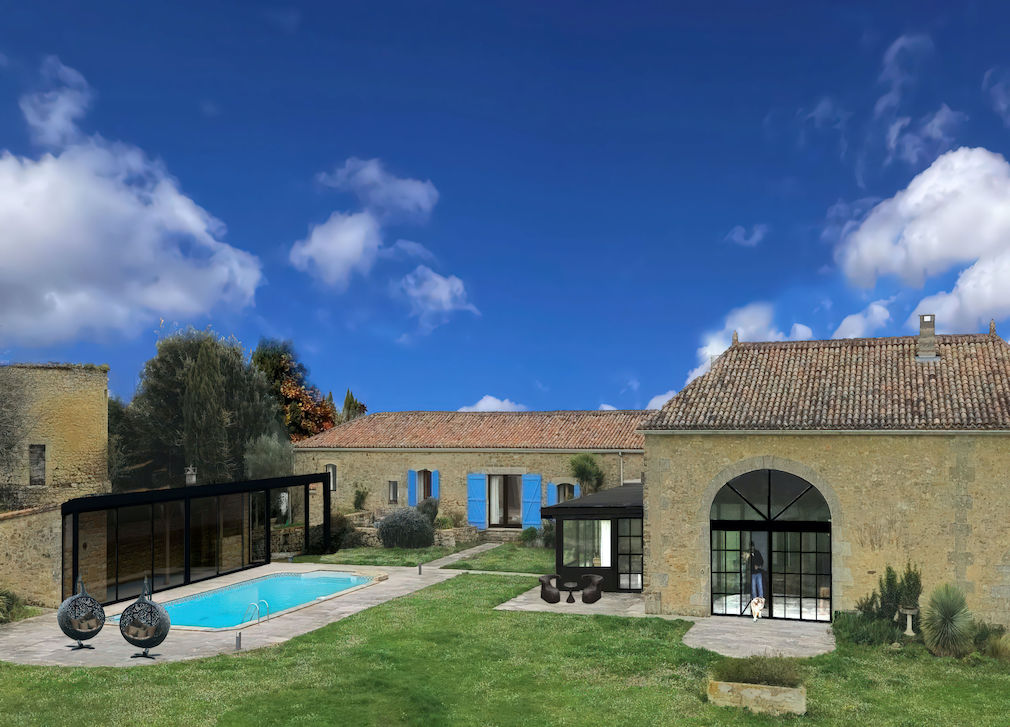
I was looking for a cluster of limestone buildings, patinaed by time. I wanted to connect them with very modern steel and glass so we would have that ancient-meets-modern result. We were very excited when we drove up to see our first chateau, but it took seven increasingly stressful viewings before we pulled up to property number eight and it was the Interconnected Changeable Environments House. It looked like what I had already created in my renderings for the project — the only thing missing was the modern steel and glass. There were three beautiful stone farmhouses surrounding a courtyard with a pool in the middle, acres of open fields, and vineyards surrounding the property as far as the eye can see.
JQ: The property is being developed to respect its surroundings and live with nature. Tell us about the planned functionality.
JF: This project has three tenets: sustainability, adaptability and livability. Those are at the core. The property is already geared up for so many of those elements, and then we’re adding the others. That means we have two septic systems. We have two wells. We have a water recapture system with an underground storage tank. We will have solar power and wind power. We have a huge food garden. This property is designed to be completely unplugged and off the grid — it will be able to be completely self-sustaining. This area is gifted with great wind, great sunshine and great precipitation. No one waters their gardens or their vineyards here. It’s done by Mother Nature. And the sunsets here are magical.
JQ: Tell us about the marriage of style and time here. How will we see these ancient structures transition to modern living environments?
JF: It’s a perfect example of what this global culture of design movement is about. There is a reach back happening right now to heritage pieces, to artisan craftsmanship, and to the feeling of the human hand in creation. At the same time as we are creating these smart homes, we’re also trying to get back to the feeling of human connection. And that’s translating in materials and aesthetics.
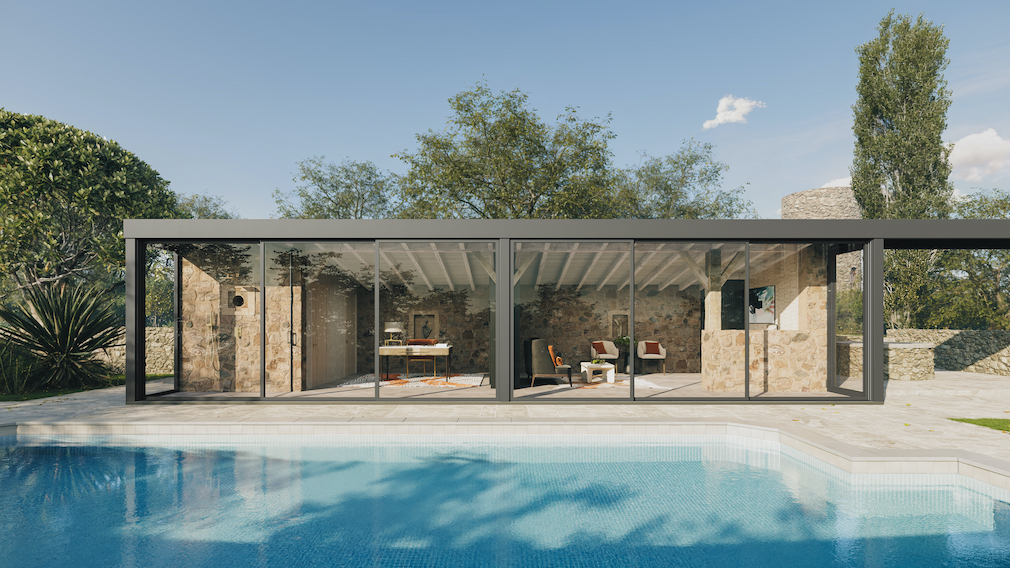
A good example is how we’re structuring the three buildings and their aesthetic forms. Originally, Center House was a cattle barn, Extension House was a winery, and Indy House was a summer kitchen — called a cuisine d’été. There’s also an ancient windmill on the property. I’m trying to keep as much of that ancient aesthetic as possible. So, we’ll still see these gorgeous, weathered stone walls but Indy House is being enclosed by a modern, slidable glass wall system, and will connect to Extension House by a steel-cased open-air breezeway. All the systems move and change so the home can adapt as needed.
JQ: Tell us about the envisioned resident. Who is this home and this program for adaptable living designed for? Who will live here?
JF: What’s great about the concept of the Interconnected Changeable Environments House is that I see all humans living in some version of this space. Very few of us live isolated on an island. We have friends, we have children, we have parents, we have siblings. We have financial needs. We change and grow over time. I can envision anyone living here who wants to be in a place of quiet and space. We’re on the outskirts of a tiny village in Bordeaux that was built in the 1280s. This is a place of tranquility, calm and quiet. It’s a perfect place for a young family who wants to have a yoga studio and a play space for their kids. And then, 20 years from now, when their kids move on, they can have a guest retreat for their friends or an Airbnb they can rent out. Then, when they’re retired, they can have their best friends living in Extension House, and they can even have their caregiver living in Indy House. I can really envision any family here.
I can also see the concept of this multi-structure space in urban areas — a small urban lot that includes three individual units that can be connected with each other, can be individual rentals, or can be multi-generational family, in the heart of a city. There are many cultures around the world where it’s common practice for your children and your grandchildren and your mother and your grandparents to all live in one compound — but not necessarily under the same roof. So, I do think the concept really applies to all of us.
aspire design and home is a media partner for the Interconnected Changeable Environments House.
Portrait of Jennifer Farrell for Emser Tile by Monica Orozco.
Like what you see? Get it first with a subscription to aspire design and home magazine.