
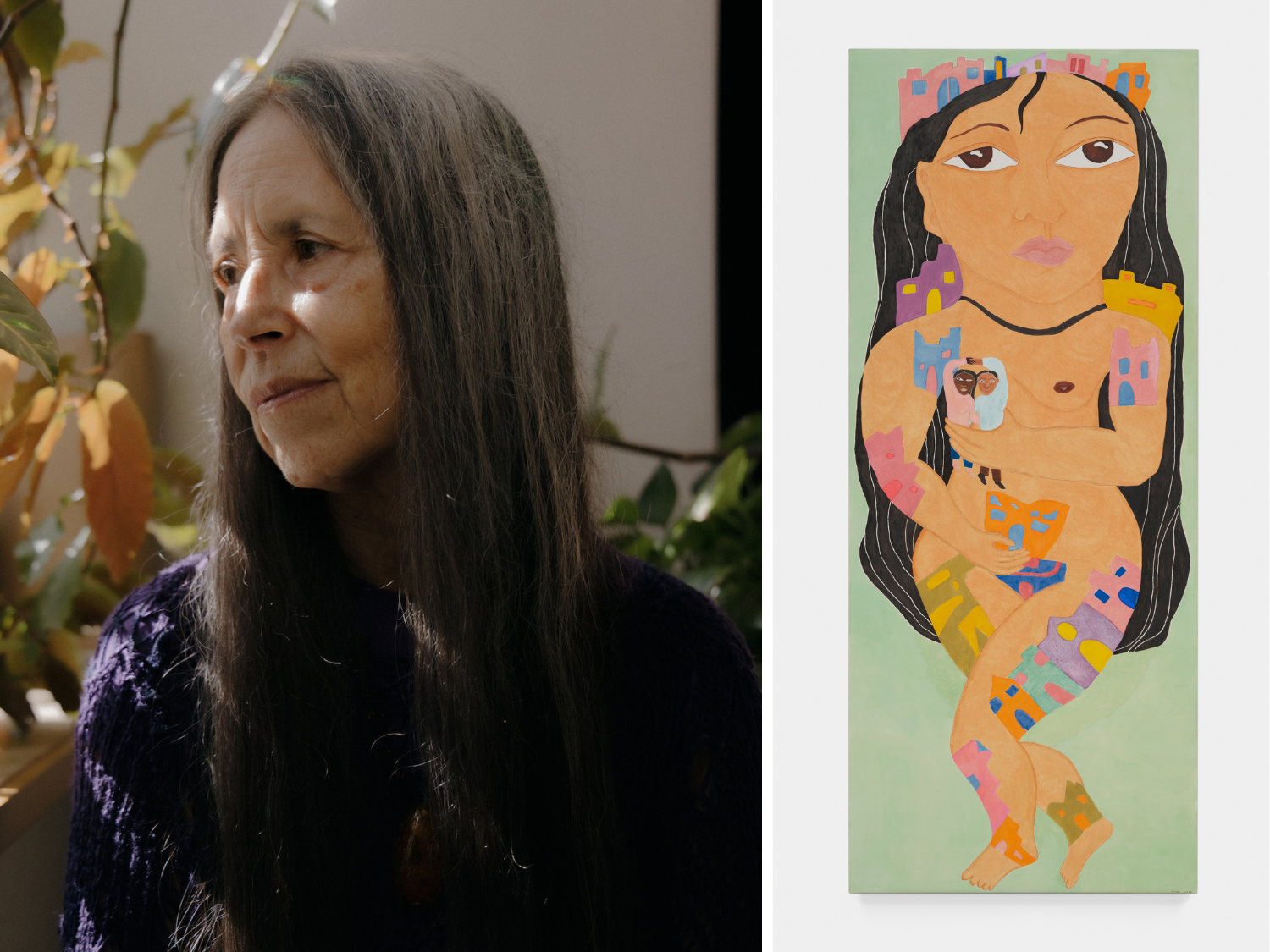
Cecilia Vicuña. (R) “Santa Bárbara” 2024, oil on canvas, 28″ w x 69″ h
This past fall, the Museum of Contemporary Art in Los Angeles awarded Chilean-born artist, poet, filmmaker and activist Cecilia Vicuña the inaugural Eric and Wendy Schmidt Environmental and Art Prize, established to provide, according to the museum, “support to develop a commissioned project addressing the critical intersections of art, climate change and environmental justice.” (Artist Julian Charrière also won.)
Wasting no time, Vicuña, now 77, flew to Chile to continue her work of over six decades: organizing with communities around the world – especially those of Indigenous cultures – to envisage art that raises awareness about the environment, specifically in this case, the right to clean water. It has been a busy few years for Vicuña, with solo exhibitions at the Guggenheim in New York, Tate Modern in London and Museo de Bellas Artes in Santiago, as well as a second solo show at her New York gallery, Lehmann Maupin.
In June, there will be a solo exhibition at Xavier Hufkens in Brussels and, come November, one at the Irish Museum of Modern Art in Dublin. Maupin’s La Migranta Blue Nipple show synthesized much of what Vicuña has been thinking about her whole life and is now codifying in book form with her partner, Jim O’Hern. (They are currently seeking a publisher.)

“La Migranta Blue Nipple” November 21, 2024 – January 11, 2025 Lehmann Maupin New York
One work in La Migranta was a combined quipu-precario installation in which Vicuña regenerated the ancient Andean systems of knotted threads (quipu) that recorded statistics and held knowledge, while precariously suspending fragile found objects amid the knots as a way to challenge Western notions of permanence. Another area showcased oil paintings of Orishas, Yoruban deity forces, that recreate drawings she made in the mid-1970s while submersing herself in the religious practices of Amazon peoples.
All dovetail with the book concept, which explores the moment when the Minoan civilization perished and, in its wake, the mutual respect between female and male energies somehow split. This cataclysm separated our humanness from its cosmic nature, essentially a mother consciousness harmonious with creation and fertility inextricably bound to the wisdom of plants, seas, mountains and other “blood knowledge” of the universe. “From an Indigenous art perspective,” Vicuña explains, “artmaking is another form of inscription in the energy field, a parallel history or record we access in the encounter or through art arising from ritual.”
What eventually arises out of the MOCA prize will be another “inscription in the energy field,” part and parcel of Vicuña’s epic ambition to pivot the world’s consciousness back to its cosmic nature. “If we are to survive the current violence and dehumanization in the world and create peace for all, we need to migrate to a new state of mind and soul,” she adds.
Like what you see? Get it first with a subscription to aspire design and home magazine.