
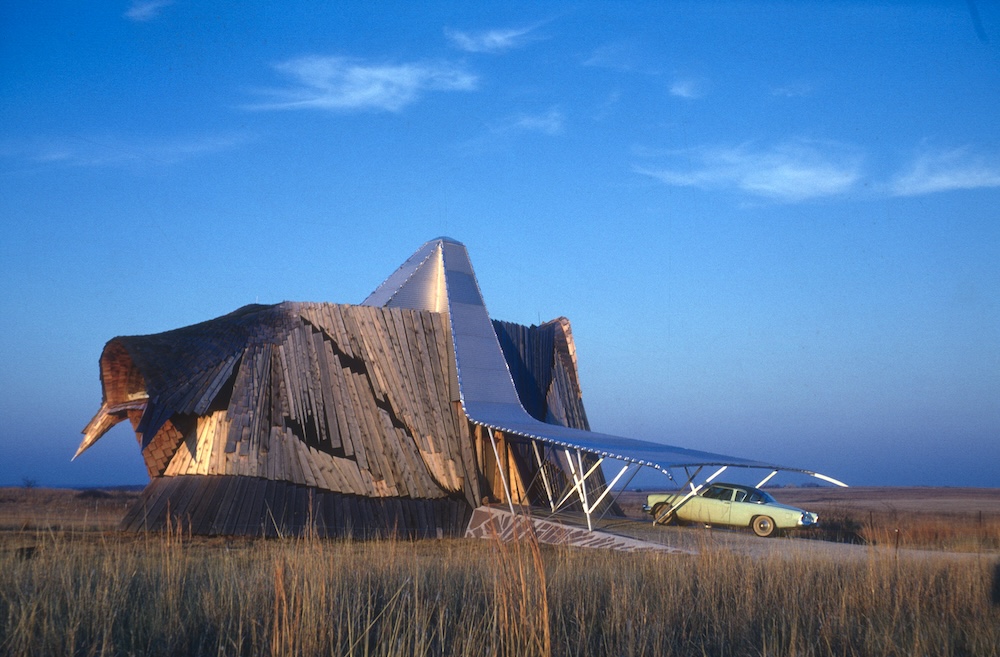
Prairie House, Norman, OK, designed by Herb Greene, c. 1960.
In the 1950s and 1960s, a group of iconoclastic architects who would go on to develop groundbreaking design practices and leave their stamp on California architecture were being educated and mentored in Oklahoma. The so-called American School of Architecture approach to design yielded hundreds of iconic projects, including the eastern span of the San Francisco-Oakland Bay Bridge and the fantastical Pavilion for Japanese Art on the Miracle Mile in Los Angeles. That legendary work is the focus of Outré West: The American School of Architecture from Oklahoma to California, a recently opened exhibition at the Oklahoma Contemporary Arts Center in Oklahoma City.
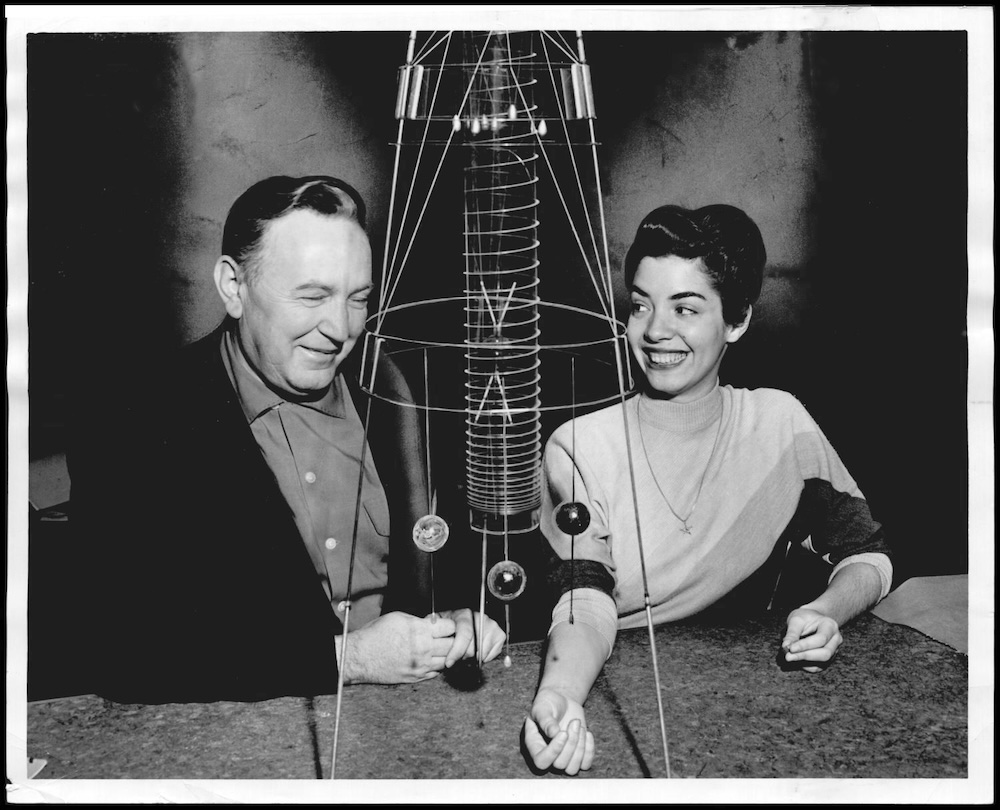
Julia Urrutia studies an abstract design model with Bruce Goff at the University of Oklahoma, 1955. Courtesy of the Oklahoma Publishing Company Photography Collection, Oklahoma Historical Society.
Developed at the University of Oklahoma (OU) during the postwar period, the American School of Architecture became known for emphasizing individual creativity and experimentation. Under the guidance of professors, including outsider architect Bruce Goff (1904-82) and Herb Greene (b. 1929), students were inspired by everyday objects, the natural landscape and the designs of cultures around the world – a methodology that was decidedly ahead of its time.
Goff encouraged students to create their own designs for architecture rather than emulating his famous works or those of anyone else. The American School challenged students to look beyond European styles for inspiration, such as Native American designs, Asian architecture, South American architecture, nature and found objects.
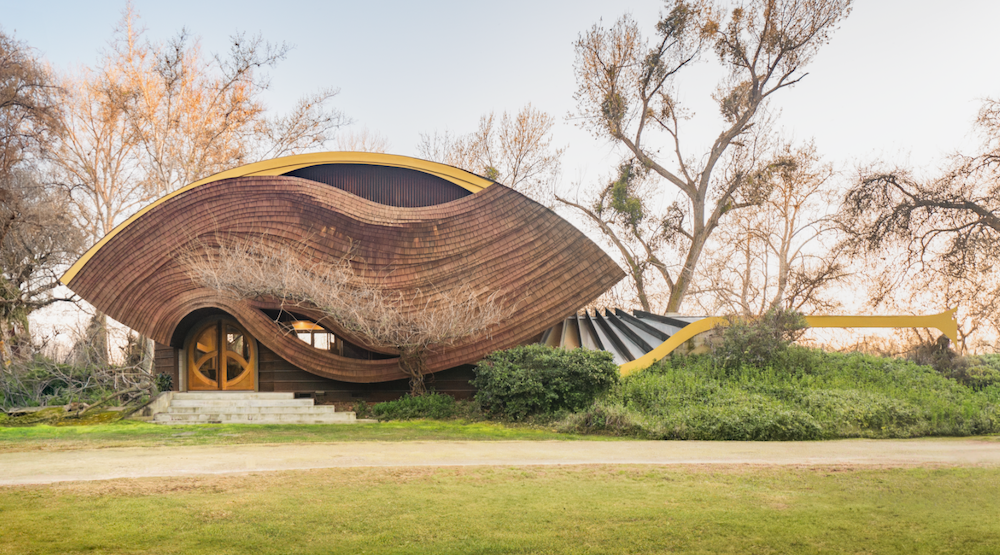
Lencioni Residence designed by Arthur Dyson, Sanger, CA, 1985. Courtesy of Christopher Loofs.
“These renegades, as we’ve come to call them, promoted a radical approach to teaching centered on contextualism, resourcefulness and experimentation,” explains chief exhibition curator Angela M. Person, PhD, associate professor of architecture at the University of Oklahoma.
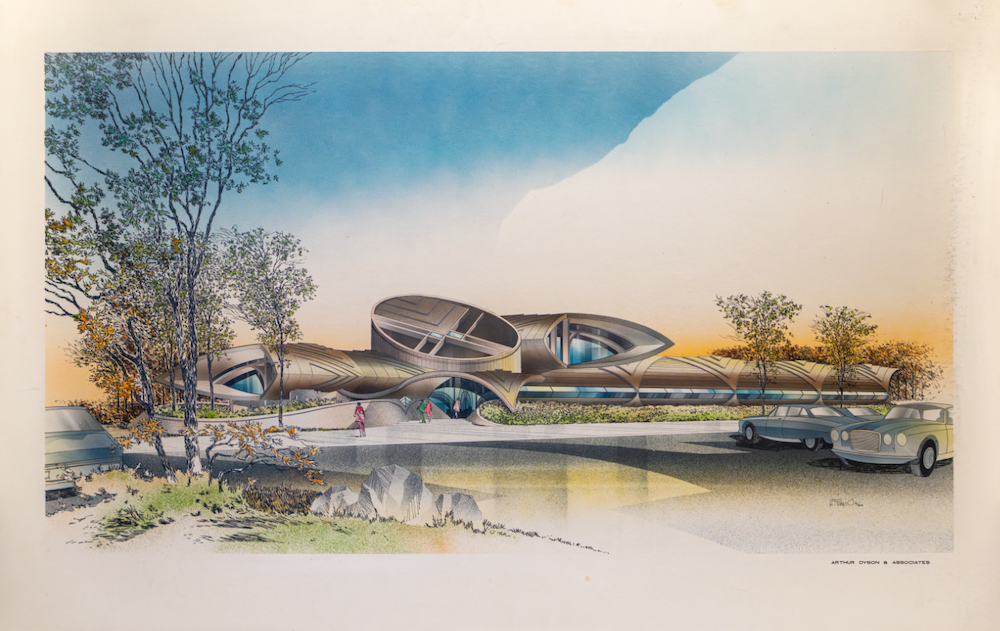
Arthur Dyson (1940, Inglewood, CA ), Perspective rendering of the Glynn’s Restaurant, an unbuilt project in Fresno, CA, delineated by Harvey Ferrero, 1984. Courtesy of Arthur Dyson.
The exhibition includes more than 200 items, ranging from archival drawings and sketches to original and new architectural models – some at full scale – to historical press clippings, large-scale photographs and more. Outré West explores how these architects translated their American School education into practices that continue to enrich California’s built environment to this day.
Like what you see? Get it first with a subscription to aspire design and home magazine.