
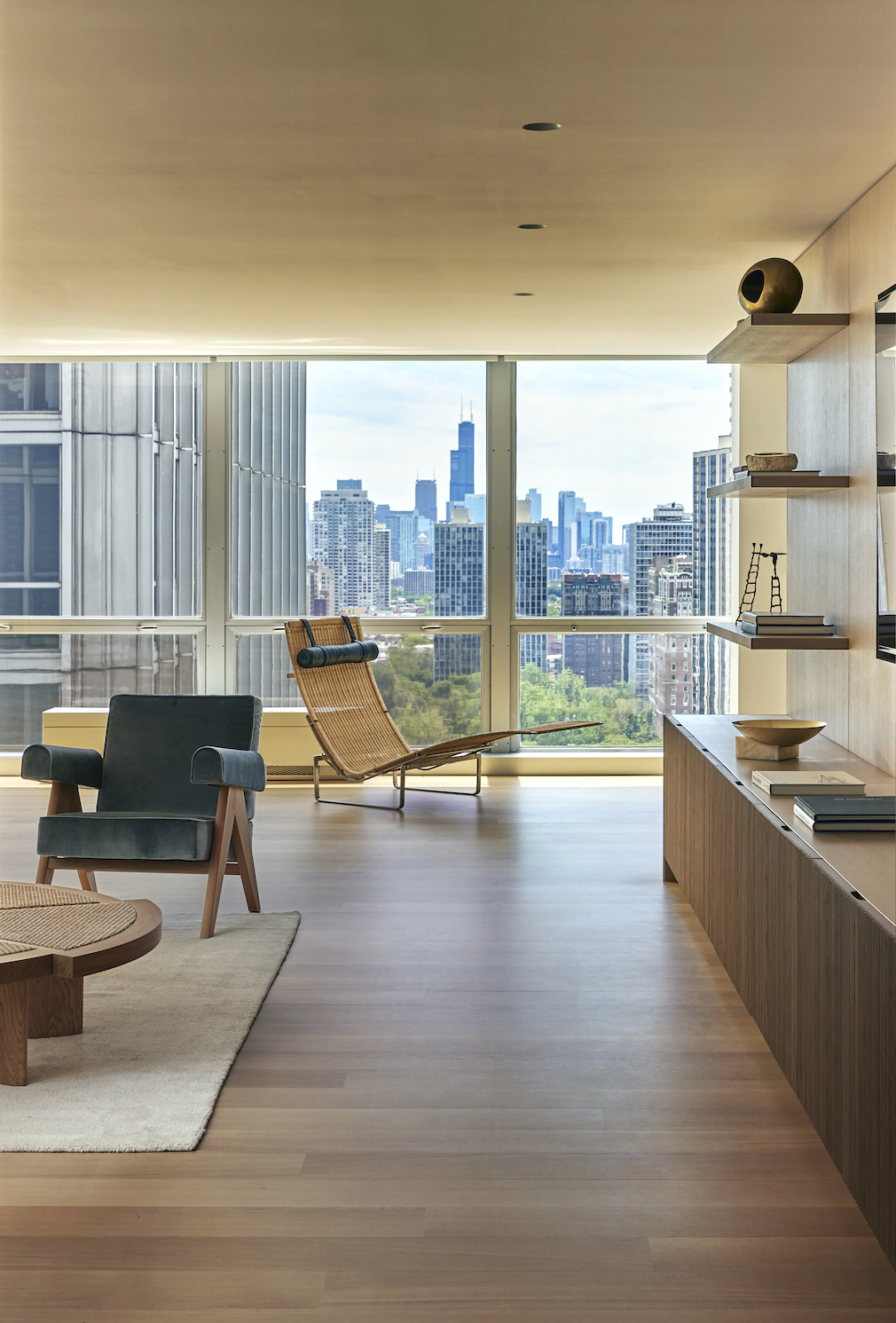
As simple as they are – or perhaps because they are so apparently simple – the apartments Mies van der Rohe designed in Chicago are often badly abused when updated, with utterly out-of-place Tuscan-style kitchens or millwork more suitable to a pre-war building on Park Avenue. Of course, the master’s “less is more” aesthetic isn’t for everyone, so it’s natural that folks take a crack at making these spaces their own. One of the more successful examples is this penthouse unit in the circa 1957 Commonwealth Plaza Tower, a project of architect Eric Rothfeder.
While respectful, Rothfeder wasn’t slavish in his mediation of the space – which actually comprises several units combined into a considerable 5000 square feet. “Working within a Mies van der Rohe tower carries a built-in tension: how to respect an iconic legacy without merely repeating it,” observes the architect. “My approach was to let the apartment establish its own order and integrity, one that converses with Mies’ rigor but responds to the homeowner’s everyday needs.”
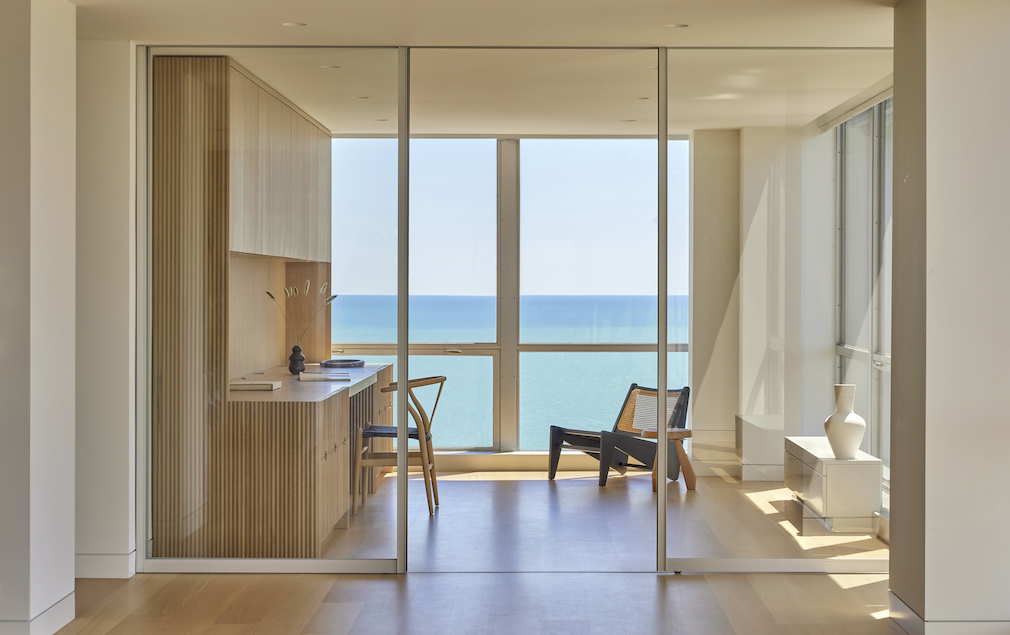
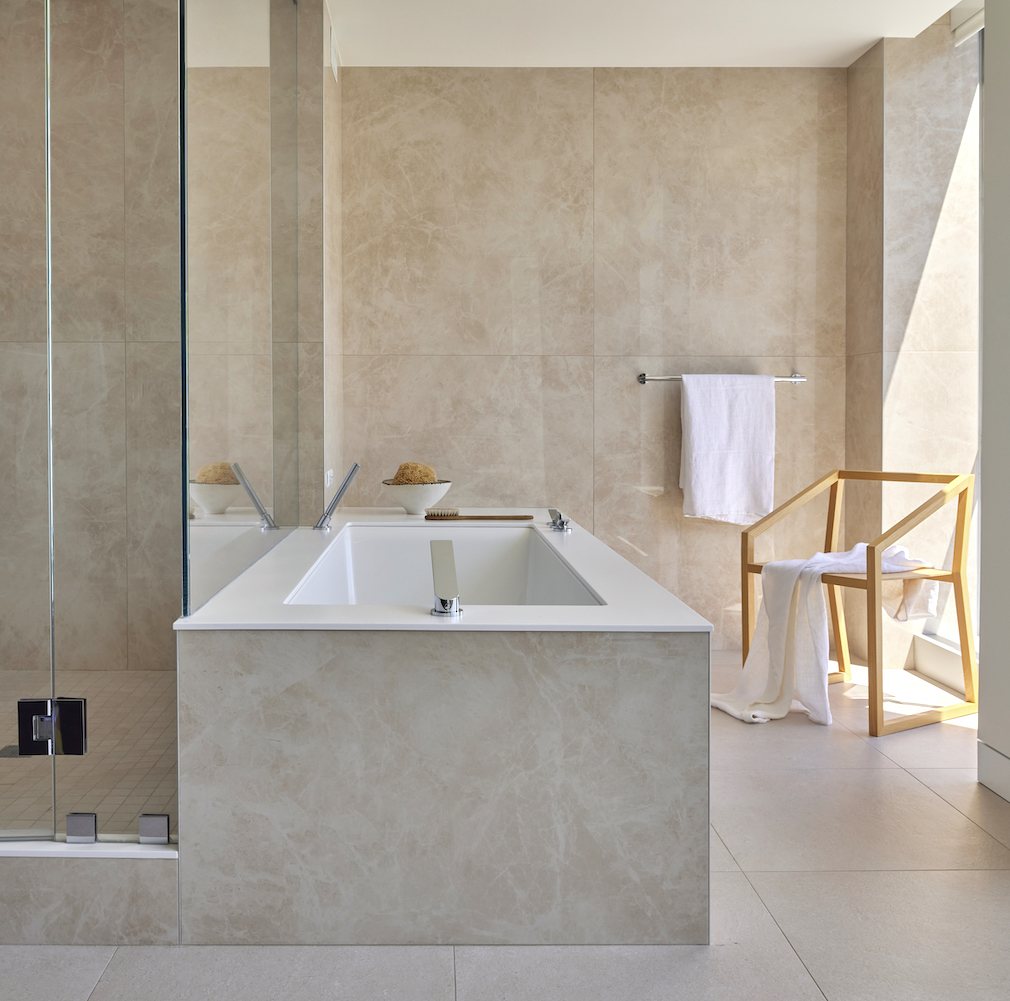
Employing a restrained geometry appropriate to the pronounced linearity that defined Mies’ style, Rothfeder created space-defining built-ins and celebrated the curtain wall, organizing rooms along the perimeter so even the primary bathrooms and closets enjoy daylight, while the living spaces unfold along a 150-foot continuous length of windows, offering panoramic views to the south, east and west.
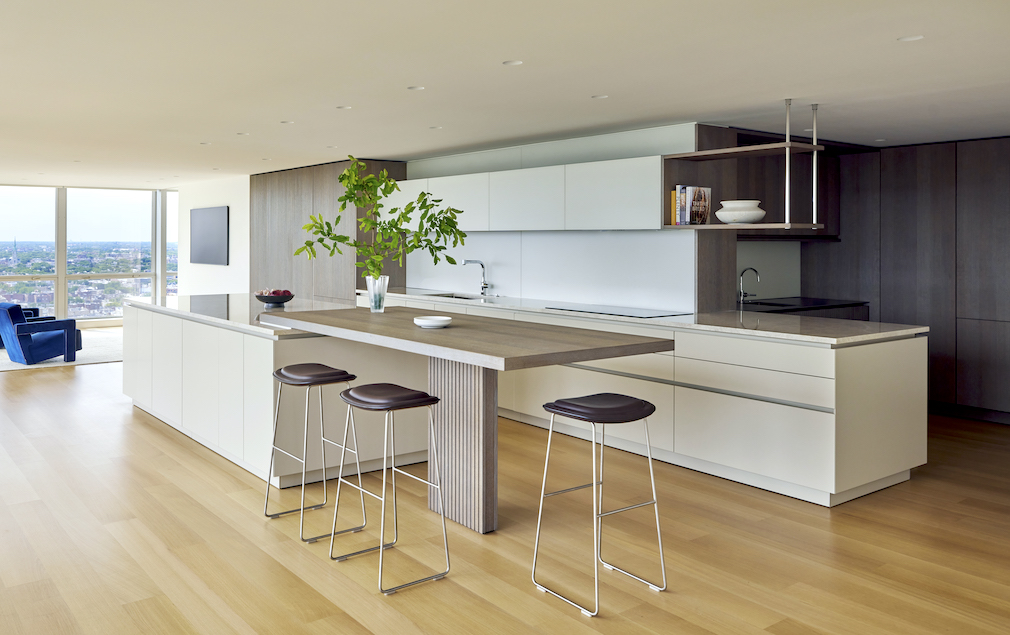
Kitchens, of course, were never terribly thrilling in these apartments and have not always been easy to rework, but Rothfeder managed to do so very sympathetically, with a sensitively scaled composition of planes and volumes. “The most transformative move was relocating the kitchen – once buried deep within the plan – to the southwest corner, where the apartment captures the best light and views,” he explains. “This shift brings the apartment’s layout into alignment with how the owners spend most of their time. Crisp detailing and muted finishes support the architecture, rather than compete with it. It’s less a showpiece than a vantage point, a place to watch the daylight shift and the seasons turn.”
The new kitchen, with cabinetry by eggersmann, the oldest family-owned cabinetry manufacturer in Germany, is central to the free-flowing plan of the apartment. The kitchen island combines a dedicated work area with a constraining component for dining, set with Jasper Morrison’s Hi Pad Barstool from Cappellini.
Although the home had undergone some earlier renovations, Rothfeder’s work required a deep dive into the guts of the unit. “Demolition exposed a dense web of original plumbing, electrical risers and HVAC ducts woven through the original layout in seemingly arbitrary places,” he relates. “Designing around these services was a precise, almost surgical exercise, but was necessary so that the redesigned apartment would read as a single, uninterrupted volume.” While low ceilings and flat-slab concrete floors made it difficult to execute some mechanical interventions, the smaller scale of today’s components allowed Rothfeder to bring the spaces up to speed. “High-quality LED fixtures, AV components and window-shading systems now fit into spaces that once seemed impossible,” he notes. “We integrated directional, recessed lighting, discreet speakers, motorized shades and all the necessary electrical and control wiring. In many ways, we’re able to do more with less – more function, less visual noise – while maintaining the clarity and minimalism we associate with Mies’ architecture.”
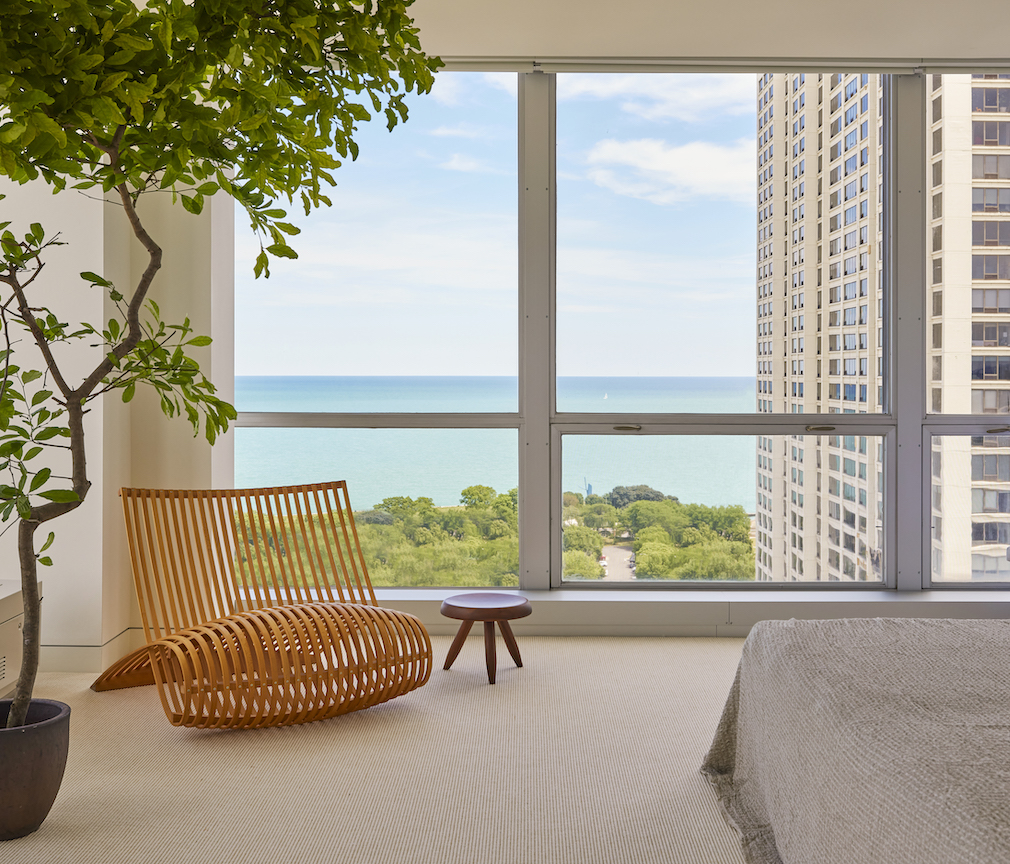
Between the floor-to-ceiling windows, white walls and neutral finishes, and with the clean lines of the architectural volumes that define the function of the various spaces, the apartment possesses both a stunning luminosity and the sort of singular grounded quality peculiar to the modernist aesthetic. Think, an envelope holding a wonderful letter that is deeply personal and poetic.
Photography by Mike Schwartz.
Interior design by Harold Skulte.
Like what you see? Get it first with a subscription to aspire design and home magazine.